
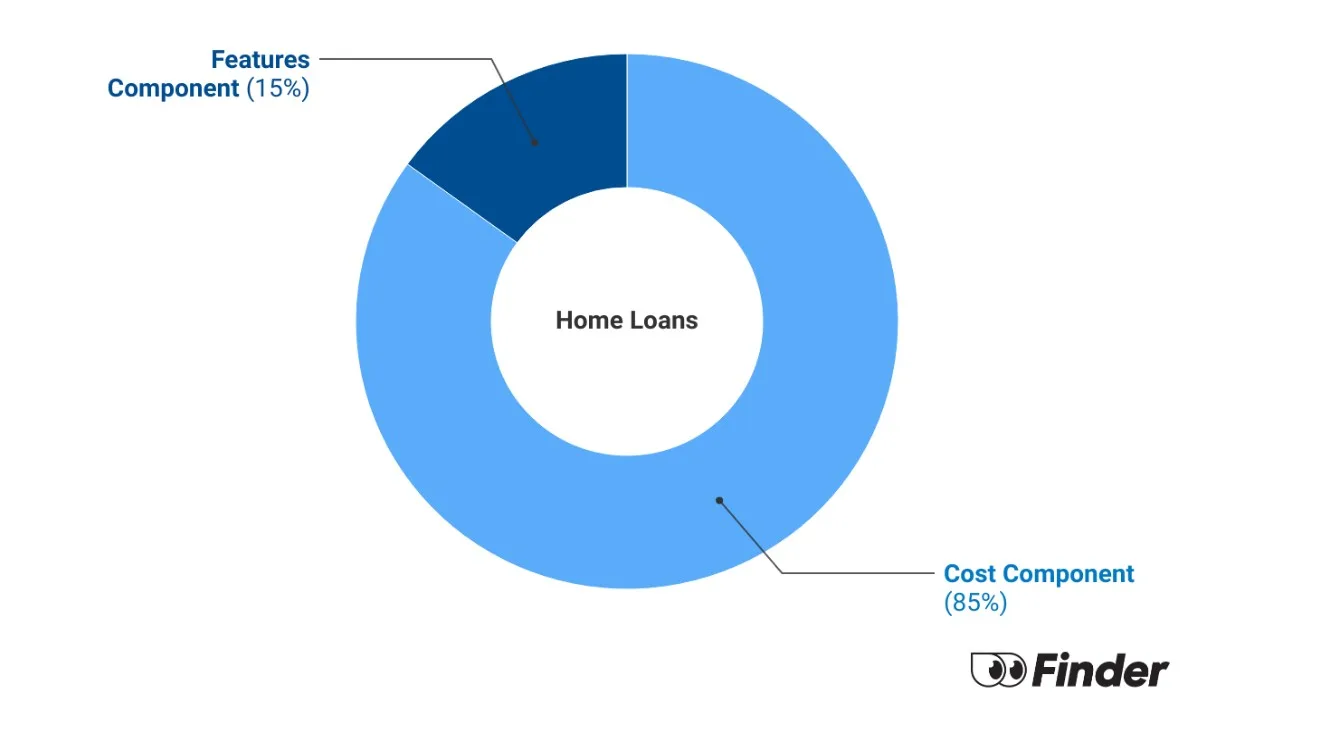



These low deposit home loans offer low costs, coupled with a host of features, giving the best overall value.
7+
Great
These home loans may have slightly higher interest rates or fewer features but overall, a competitive offering.
5+
Standard
Usually the home loans would offer above average rates. They may still include some competitive features.
0+
Basic
Higher costs and/or fewer features.
How low deposit home loans work
A 20% deposit is the standard when buying property in Australia. But that's a tall order, especially when house prices are so high.
Low deposit home loans are those that only require 10% deposits or even 5% deposits. This means saving less, borrowing more, and buying a home sooner.
But there is a catch. When your deposit falls below 20%, lenders charge you something called a lenders mortgage insurance (LMI) premium. This can add thousands of dollars to your property buying costs.
Is a low deposit home loan the right option for you?
Given how hard it is to save a 20% deposit, many buyers still go for low deposit loans even with the LMI cost added on.
You can enter the market faster when you buy with a low deposit
The lower your deposit, the quicker you can save it. If you're buying a property for $500,000, a 20% deposit is $100,000. A 10% deposit is $50,000 and a 5% deposit is only $25,000.
It's far more realistic and achievable to save up $25,000 than $100,000, so low deposit loans enable you to get on the property ladder sooner.
You can build equity faster and not worry about runaway prices
When property prices are rising fast, the amount required for a deposit grows in tandem. Jumping in early with a small deposit means you don't have to worry. Once you've got your foot on the property ladder, rising prices are good: You now own the asset.
And instead of building up a deposit you're now paying off a debt and building equity.
But low deposit home loans come with more costs
A low deposit home loan means you may have to pay an LMI premium. This cost can range from several thousand dollars into the tens of thousands, depending on your deposit size and the cost of the property.
You may also pay more interest with a low deposit loan, simply because you're borrowing more money.
Here's a simple example of 2 home loans with identical interest rates based on a $800,000 property and a 30-year loan term. The only difference is the deposit size. You can see how this changes both the loan amount (and therefore the repayments) and the LMI premium.
Details
Low deposit
Full deposit
Property value
$800,000
$800,000
Deposit size
$40,000 (5%)
$160,000 (20%)
Loan amount
$760,000
$640,000
LMI costs
$34,982.80
$0
Interest rate (30-year loan)
6.00%
6.00%
Monthly repayments
$4,557
$3,838
Difference in monthly repayments
$719 more
$719 less
In this hypothetical example, the low deposit borrower pays $34,982.80 in LMI premiums upfront, and an extra $719 a month in repayments. This is because they have to borrow more money.
Over the life of the loan this adds up to $139,006 in extra interest. Adding the LMI in, the low deposit home loan works out to be $173,988.80 more expensive.
But that doesn't mean the low deposit option is a bad idea
Choosing a low deposit home loan can still be worth it. You just need to have a clear idea of the costs involved. Plus, you can always minimise the interest charges over time by repaying more of the loan, or saving money in an offset account.
You also need to consider how long it would take you to save a 20% deposit. It could take you years.

No deposit home loans
Most borrowers cannot borrow 100% of their property's value now. Lenders at most will lend you 95% and expect you to save at least a 5% deposit. But there is an exception: a home loan guarantor.
If your parents (or another family member potentially) own a property, they could guarantee a portion of your deposit for you. This means the guarantor is offering their property as security over your home loan. If you can't repay the debt, the lender can sell your home to recover the debt. And they could come after your guarantor's property too.
It's a slightly complicated and risky approach for the borrower (and their parents). But it's a lower risk prospect for the lender and the only true no deposit home loan option left in Australia.
Get creative with your deposit
Another way to get a home loan with a very low deposit is to get creative with how you pull your deposit together.
Parental gift. If your parents are even more generous and financially comfortable, they could gift you the deposit or part of it.
Use a first home owners grant. Many first home buyers can qualify for a grant of $10,000 (check our first home owners grant guide to see if you're eligible). This grant can form part of your deposit.
Boost your savings. This is a hard one (obviously!). But basic saving and budgeting tips are always helpful. You could cut back on your spending, find extra sources of income or try to get more from your existing cash with a high interest savings account or term deposit to earn more interest.
It can be harder to get approved for a home loan with a lower deposit. As a low deposit borrower, you need to ensure that your application paperwork is in order and your everyday spending under control.
Here are some tips to help you get approved:
Check your credit score. Strengthen your chances of success by making sure there are no issues with your credit history.
Check where and what you're buying. Some lenders impose higher lending requirements on apartment purchases in certain postcodes. They might require a 20% deposit or even 30% depending on what you're looking for, and where you want to buy.
Examine your debts and spending. Strengthen your application by paying down debts such as credit cards – and as you repay them, lower the limits to avoid over-spending again. Try to limit your spending as much as you feasibly can before applying.
Talk to a mortgage broker. Mortgage brokers don't just connect you to a lender, they help you find one that is likely to accept your application based on their eligibility requirements. Professional help might be just the thing you need.
Advice from an expert
3 tips for low deposit borrowers from Marissa Schulze, mortgage broker, property developer and director of Rise High Financial Solutions.
Tighten up your spending
The most important thing for applicants of low deposit home loans is to review their living expenses and if they can, to tighten up their spending. Applicants should rein in their spending for the 6 months prior to applying for the loan.
Genuine savings and rental history
Some lenders like to see "genuine savings". That means the applicant has been consistently saving each month or fortnight to build up their savings bucket. If that's not the case and they've been given the deposit as a gift from parents then lenders often want to see that sum of money sitting in the applicant's account for 3 to 6 months before applying.
If the applicant is renting they can actually prove they have good rental history and use that to boost their application in place of genuine savings.
Don't make any big changes between pre-approval and settlement
A common mistake is that buyers get pre-approval and then quit their job or apply for a car loan or increase their credit card limit. People don't realise how that impacts their application. You need to keep your financial and employment situations stable from the time you apply until you settle the loan and move in. Then you can do what you like.
Government support makes low deposit borrowing cheaper
There are now several federal government schemes that allow eligible borrowers to buy homes with 5% deposits. These schemes let you borrow 95% and avoid paying LMI. This means you can avoid quite a big cost associated with a low deposit mortgage.
These are the schemes:
First Home Guarantee. If you're a first home buyer you can use this scheme to buy or build a home with a 5% deposit and avoid LMI.
Family Home Guarantee. Under the Family Home Guarantee, eligible single parents can buy homes with 2% deposits and avoid LMI costs while borrowing the remaining 98%.
Regional First Home Buyer Guarantee. The Regional First Home Buyer Guarantee lets you buy or build a new home in regional Australia with a 5% deposit while avoiding LMI costs.
What's the First Home Guarantee?
The First Home Guarantee is where the federal government acts as a guarantor on your home loan. It secures up to 15% of the property price, meaning you only have to pay a 5% deposit. You won't need to pay lender's mortgage insurance (LMI) either. There are no income limits for borrowers and no limit on the number of borrowers who can take part. However there are other eligibility criteria and property price caps for each state/territory. Check the full guide for all the info.
Find a low deposit home loan in your state or territory
Here's some more information about finding lenders, brokers and government support options for low deposit borrowers in your state or territory.
New South Wales
There are many lenders in New South Wales offering loans with low deposit options, including lenders based in other states.
There are specific regional-based lenders too, such as:
Residents of Victoria's capital can get in touch with a Melbourne mortgage broker who can help you find a low deposit loan.
Queensland
If you're looking to buy in Queensland then you can look at loans from most of the major lenders on the market but also Queensland-based lenders such as:
Another low deposit borrowing option in Queensland is a Queensland Housing Finance Loan. This is a state government scheme for eligible first home buyers and allows you to buy a property with just a 2% deposit.
To qualify, you need to be a Queensland resident with a household income under $141,000 a year with no serious debts and good savings history and credit history.
If you are buying or building a new house or unit valued at under $750,000 you may also qualify for the Queensland First Home Owners' Grant, worth $15,000. While the grant could be used as a deposit the Queensland government advises that "it's best not to count on using the grant as a deposit" because the timing of the payment depends on factors such as your application and the type of property you are building.
South Australia
Here are some lenders based in South Australia who may be able to help you:
Borrowers in Western Australia have access to a unique low deposit home loan called Keystart. This is a low deposit home loan that eligible borrowers can get with just a 2% deposit while avoiding lenders mortgage insurance.
Tasmania
Here are some Tasmanian lenders who have low deposit home loans:
The Northern Territory government and People's Choice Credit Union offer a scheme called HomeBuild Access. This is a low deposit home loan for new homes and the construction of new homes.
To qualify for this loan your income needs to be under a certain limit and there are limits on the value of the property you are buying or building.
The Northern Territory also offers a $10,000 first home owner grant for eligible buyers or builders of new homes.
More questions about borrowing with a small deposit
For the ordinary borrower, 5% is the lowest your home loan deposit can be. And if you have a guarantor you could buy a house with no deposit.
But there is another rare case where you could buy a home with a 2% deposit. If you're a single parent borrower who qualifies for the Family Home Guarantee scheme, you could buy a home with a 2% deposit and support from the federal government.
Not directly. However, first home buyers can use extra super contributions to minimise tax and put it towards a deposit under the first home super saver scheme.
Yes. While not every lender offers home loans for borrowers with 5% deposits, many do. Just look for a home loan with a maximum insured LVR of 95%.
This is a mortgage term that means you can get it with a 5% deposit. But you'll need to pay LMI.
Yes. If you're eligible for a first home owners grant, you can use that to form part of your deposit. Just make sure you are in fact eligible for a grant in your state or territory.
What is Finder Score?
The Finder Score crunches 7,000 home loans across 120+ lenders. It takes into account the product's interest rate, fees and features, as well as the type of loan eg investor, variable, fixed rate - this gives you a simple score out of 10.
To provide a Score, we compare like-for-like loans. So if you're comparing the best home loans for cashback, you can see how each home loan stacks up against other home loans with the same borrower type, rate type and repayment type. We also take into consideration the amount of cashback offered when calculating the Score so you can tell if it's really worth it.
Richard Whitten is Finder’s Senior Money Editor, with over eight years of experience in home loans, property, credit cards and personal finance. His insights appear in top media outlets like Yahoo Finance, Money Magazine, and the Herald Sun, and he frequently offers expert commentary on television and radio, helping Australians navigate mortgages and property ownership. Richard started his career in education and textbook publishing in South Korea. He holds multiple industry certifications, including a Certificate IV in Mortgage Broking (RG 206) and Tier 1 and Tier 2 certifications (RG 146), as well as a Bachelor of Education from the University of Sydney and a Graduate Certificate in Communications from Deakin University.
See full bio
Richard's expertise
Richard
has written
687
Finder guides across topics including:
I want to buy a home at Douglas point as owner-occupier, I am able to come up with the 5% deposit and the money to cover the fees and stamp duty through the different avenues in which I have money tied up, eg: shares, cars, savings. But need to find a lender who will do the best mortgage deal, for the area as a couple banks in my area say the postcode is in a high risk area and need 20%.
Finder
JoshuaJanuary 15, 2019Finder
Hi Anthony,
Thanks for getting in touch with finder. I’m sorry to hear that a few banks have rejected your application.
I would advise that you continue comparing your options using our table above. The lenders on our table provide mortgages with low downpayment options. You can then click on the “Go to site” green button to discuss with them your situation and confirm if they can provide you with your needed loan.
Please make sure that you’ve read the relevant T&Cs or PDS of the loan products before making a decision. Moreover, check the eligibility requirements as well and consider whether the product is right for you.
I hope this helps. Should you have further questions, please don’t hesitate to reach us out again.
Have a wonderful day!
Cheers,
Joshua
donnaAugust 22, 2018
Hi my husband & I have purchased a block about 7 months ago and we want to build a house on it but we are not entitled to the first home owners grant and have very little as a deposit what is the best way to go about it thanks
Finder
JoshuaAugust 30, 2018Finder
Hi Donna,
Thanks for getting in touch with Finder. I hope all is well with you. :)
It is worth noting that most home construction loan lenders will want at least 20% of the total cost put down as a deposit. This is because your lot is not of great value yet without a building on it.
As this might be the case, it would still be worth checking out our list of home construction loans. But it is not just the cost you need to consider before choosing to build. On that page, you will see a table that allows you to conveniently compare your options. The table includes interest rates, ongoing fees, and monthly payments, to name a few. Once you find the right one for you, click on the “Enquire now” green button to learn more.
The page that I just shared with you also includes guides and tips on finding the right construction loan for you. So, it is really worth reviewing.
I hope this helps. Should you have further questions, please don’t hesitate to reach us out again.
Have a wonderful day!
Cheers,
Joshua
GavinJune 13, 2018
Hello
I have $14000 saved. Would this some how be enough to get a mortgage on an existing home
If so what sort of amount of loan value could be attained with annual income of 150k. Just roughly
Thanks
G
Finder
JeniJune 16, 2018Finder
Hi Gavin,
Thank you for getting in touch with Finder.
Lenders use different important criteria such as your income, outstanding debt level, and credit history to determine your eligibility for a home loan. I suggest that you answer all the information asked from our home loan eligibility calculator to see the estimated amount you can borrow. It is also a good idea to seek professional help from mortgage brokers regarding your home loan enquiry.
I hope this helps. Please feel free to reach out to us if you have any other inquiries.
Thank you and have a wonderful day!
Cheers,
Jeni
ChrisMay 13, 2018
Is Defence bank offering a good deal on their home loans?
Finder
JeniMay 14, 2018Finder
Hi Chris,
Thank you for getting in touch with Finder.
Defence Bank offers several different home loan options for its customers that include competitive interest rates and flexible payment options. Several loans are available just for Australian Defence Force members, which allows them to use the Defence Home Ownership Assistance Scheme (DHOAS) subsidies.
Some of the home loans offered by Defence Bank are:
DHOAS saver home loan
DHOAS advantage home loan
DHOAS construction home loan
Flexi saver home loan
Flexi choice home loan
Smart mover home loan
Interest-only construction home loan
Basic variable home loan
You can use our home loans comparison tool to compare your option. To help you, please enter the amount you’d like to borrow, and your preferred term then press “Calculate”. You may then compare each lender based on their interest rate p.a., comp rate p.a, fees, maximum LVR, and your projected monthly repayment. If you like to see the side-by-side comparison between brands, just click the “compare box” below the brand’s logo.
When you are ready, head to Defence Bank’s official website to proceed with your application.
Before applying, please ensure that you meet all the eligibility criteria and read through the details of the needed requirements as well as the relevant Product Disclosure Statements/Terms and Conditions when comparing your options before making a decision on whether it is right for you. You can also contact the provider if you have specific questions.
I hope this helps.
Have a great day!
Cheers,
Jeni
LouiseApril 4, 2018
I would like to know which of the lenders listed loan to someone looking at buying a home to reside in the postcode 6714 and the percentage deposit
that is required.
Thank you
NikkiApril 4, 2018
Hi Louise!
Thanks for your message and for visiting finder – the leading comparison website & general information service built to give you advice on your buying decision needs. How are you doing today?
All lenders listed on the page you’re in will be able to help you find to a loan that suits you best. It would be best to contact the lender to ask about the percentage deposit and you may also mention to him/her that you’re purchasing a property in the postcode 6714.
Also, please be reminded that the standard deposit size for most lenders is 20% of the property’s value. In other words, borrowers need a loan-to-value ratio (LVR) of 80%. Low deposit loans come with an LVR of 90 or 95%. This means you can potentially get a mortgage with just a 5% deposit.
If you’re buying an $800,000 property, a 20% deposit is $160,000. A 5% deposit is just $40,000. That’s a huge difference.
You may review the lenders on the table above. Just filter your options and once you’ve decided on the lender, click ENQUIRE NOW.
Hope this helps!
Feel free to message us again should you have further questions.
Cheers,
Nikki
LouiseApril 4, 2018
Hi Nikki,
At this stage most lenders I have contacted won’t lend past 70% due to the risk of lending to people in the 6714 postcode due to properties dropping $300,000 – $700,000 in price and the rate of mortgagee repossessed homes. CBA is the only one I can find that lends 90% with LMI.
Finder
MayApril 5, 2018Finder
Hi Louise,
Thanks for getting back.
I would suggest that you contact a mortgage broker instead. They can take your circumstance into account and can offer you a range of lending options based on your situation.
You can click the link above to find the right broker for you. Please ensure to press the “Load More” button to expand the link. Once done, sort the table based on upfront consultation fee, variable rates from, comparison rates from as well as the number of lenders on their panel. You can also click the name of the broker or the “More info” link to be redirected to our review page and learn more about them. When you are ready, you may then click on the “Enquire Now” button to send in your details.
Once they’ve found a lender who is willing to help, you may proceed with the regular application process. Before applying, please ensure that you meet the eligibility criteria and requirements of the loan option or lender and make sure to read the details, as well as the relevant Product Disclosure Statements / Terms & Conditions of the loan option before making a decision and consider whether the product or option is right for you.
Think you need a 20% deposit to buy a home? Think again. We break down no deposit home loans: how they work, who offers them, and what to watch out for.
Home loan cashback deals can help you refinance to a cheaper interest rate and get a lump sum cash payment. Compare the latest deals and check your eligibility today.
Learn how to compare rates to find the best home loan and start saving money on your mortgage today.
Important information about this website
Finder makes money from featured partners, but editorial opinions are our own.
Finder is one of Australia's leading comparison websites. We are committed to our readers and stand by our editorial principles.
We try to take an open and transparent approach and provide a broad-based comparison service. However, you should be aware that while we are an independently owned service, our comparison service does not include all providers or all products available in the market.
Some product issuers may provide products or offer services through multiple brands, associated companies or different labeling arrangements. This can make it difficult for consumers to compare alternatives or identify the companies behind the products. However, we aim to provide information to enable consumers to understand these issues.
We make money by featuring products on our site. Compensation received from the providers featured on our site can influence which products we write about as well as where and how products appear on our page, but the order or placement of these products does not influence our assessment or opinions of them, nor is it an endorsement or recommendation for them.
Products marked as 'Top Pick', 'Promoted' or 'Advertisement' are prominently displayed either as a result of a commercial advertising arrangement or to highlight a particular product, provider or feature. Finder may receive remuneration from the Provider if you click on the related link, purchase or enquire about the product. Finder's decision to show a 'promoted' product is neither a recommendation that the product is appropriate for you nor an indication that the product is the best in its category. We encourage you to use the tools and information we provide to compare your options.
Where our site links to particular products or displays 'Go to site' buttons, we may receive a commission, referral fee or payment when you click on those buttons or apply for a product.
When products are grouped in a table or list, the order in which they are initially sorted may be influenced by a range of factors including price, fees and discounts; commercial partnerships; product features; and brand popularity. We provide tools so you can sort and filter these lists to highlight features that matter to you.
Please read our website terms of use and privacy policy for more information about our services and our approach to privacy.
We update our data regularly, but information can change between updates. Confirm details with the provider you're interested in before making a decision.
How likely would you be to recommend Finder to a friend or colleague?
0
1
2
3
4
5
6
7
8
9
10
Very UnlikelyExtremely Likely
Required
Thank you for your feedback.
Our goal is to create the best possible product, and your thoughts, ideas and suggestions play a major role in helping us identify opportunities to improve.
The information provided by Frankie is general in nature and has been prepared without considering your objectives, financial situation or needs. Frankie may make mistakes so it's important that you review the information before deciding. By messaging Frankie, you agree to our Terms and have read our Privacy Policy.
I want to buy a home at Douglas point as owner-occupier, I am able to come up with the 5% deposit and the money to cover the fees and stamp duty through the different avenues in which I have money tied up, eg: shares, cars, savings. But need to find a lender who will do the best mortgage deal, for the area as a couple banks in my area say the postcode is in a high risk area and need 20%.
Hi Anthony,
Thanks for getting in touch with finder. I’m sorry to hear that a few banks have rejected your application.
I would advise that you continue comparing your options using our table above. The lenders on our table provide mortgages with low downpayment options. You can then click on the “Go to site” green button to discuss with them your situation and confirm if they can provide you with your needed loan.
Please make sure that you’ve read the relevant T&Cs or PDS of the loan products before making a decision. Moreover, check the eligibility requirements as well and consider whether the product is right for you.
I hope this helps. Should you have further questions, please don’t hesitate to reach us out again.
Have a wonderful day!
Cheers,
Joshua
Hi my husband & I have purchased a block about 7 months ago and we want to build a house on it but we are not entitled to the first home owners grant and have very little as a deposit what is the best way to go about it thanks
Hi Donna,
Thanks for getting in touch with Finder. I hope all is well with you. :)
It is worth noting that most home construction loan lenders will want at least 20% of the total cost put down as a deposit. This is because your lot is not of great value yet without a building on it.
As this might be the case, it would still be worth checking out our list of home construction loans. But it is not just the cost you need to consider before choosing to build. On that page, you will see a table that allows you to conveniently compare your options. The table includes interest rates, ongoing fees, and monthly payments, to name a few. Once you find the right one for you, click on the “Enquire now” green button to learn more.
The page that I just shared with you also includes guides and tips on finding the right construction loan for you. So, it is really worth reviewing.
I hope this helps. Should you have further questions, please don’t hesitate to reach us out again.
Have a wonderful day!
Cheers,
Joshua
Hello
I have $14000 saved. Would this some how be enough to get a mortgage on an existing home
If so what sort of amount of loan value could be attained with annual income of 150k. Just roughly
Thanks
G
Hi Gavin,
Thank you for getting in touch with Finder.
Lenders use different important criteria such as your income, outstanding debt level, and credit history to determine your eligibility for a home loan. I suggest that you answer all the information asked from our home loan eligibility calculator to see the estimated amount you can borrow. It is also a good idea to seek professional help from mortgage brokers regarding your home loan enquiry.
I hope this helps. Please feel free to reach out to us if you have any other inquiries.
Thank you and have a wonderful day!
Cheers,
Jeni
Is Defence bank offering a good deal on their home loans?
Hi Chris,
Thank you for getting in touch with Finder.
Defence Bank offers several different home loan options for its customers that include competitive interest rates and flexible payment options. Several loans are available just for Australian Defence Force members, which allows them to use the Defence Home Ownership Assistance Scheme (DHOAS) subsidies.
Some of the home loans offered by Defence Bank are:
You can use our home loans comparison tool to compare your option. To help you, please enter the amount you’d like to borrow, and your preferred term then press “Calculate”. You may then compare each lender based on their interest rate p.a., comp rate p.a, fees, maximum LVR, and your projected monthly repayment. If you like to see the side-by-side comparison between brands, just click the “compare box” below the brand’s logo.
When you are ready, head to Defence Bank’s official website to proceed with your application.
Before applying, please ensure that you meet all the eligibility criteria and read through the details of the needed requirements as well as the relevant Product Disclosure Statements/Terms and Conditions when comparing your options before making a decision on whether it is right for you. You can also contact the provider if you have specific questions.
I hope this helps.
Have a great day!
Cheers,
Jeni
I would like to know which of the lenders listed loan to someone looking at buying a home to reside in the postcode 6714 and the percentage deposit
that is required.
Thank you
Hi Louise!
Thanks for your message and for visiting finder – the leading comparison website & general information service built to give you advice on your buying decision needs. How are you doing today?
All lenders listed on the page you’re in will be able to help you find to a loan that suits you best. It would be best to contact the lender to ask about the percentage deposit and you may also mention to him/her that you’re purchasing a property in the postcode 6714.
Also, please be reminded that the standard deposit size for most lenders is 20% of the property’s value. In other words, borrowers need a loan-to-value ratio (LVR) of 80%. Low deposit loans come with an LVR of 90 or 95%. This means you can potentially get a mortgage with just a 5% deposit.
If you’re buying an $800,000 property, a 20% deposit is $160,000. A 5% deposit is just $40,000. That’s a huge difference.
You may review the lenders on the table above. Just filter your options and once you’ve decided on the lender, click ENQUIRE NOW.
Hope this helps!
Feel free to message us again should you have further questions.
Cheers,
Nikki
Hi Nikki,
At this stage most lenders I have contacted won’t lend past 70% due to the risk of lending to people in the 6714 postcode due to properties dropping $300,000 – $700,000 in price and the rate of mortgagee repossessed homes. CBA is the only one I can find that lends 90% with LMI.
Hi Louise,
Thanks for getting back.
I would suggest that you contact a mortgage broker instead. They can take your circumstance into account and can offer you a range of lending options based on your situation.
You can click the link above to find the right broker for you. Please ensure to press the “Load More” button to expand the link. Once done, sort the table based on upfront consultation fee, variable rates from, comparison rates from as well as the number of lenders on their panel. You can also click the name of the broker or the “More info” link to be redirected to our review page and learn more about them. When you are ready, you may then click on the “Enquire Now” button to send in your details.
Once they’ve found a lender who is willing to help, you may proceed with the regular application process. Before applying, please ensure that you meet the eligibility criteria and requirements of the loan option or lender and make sure to read the details, as well as the relevant Product Disclosure Statements / Terms & Conditions of the loan option before making a decision and consider whether the product or option is right for you.
Cheers,
May