Australian homeowners aged 60+ can use a reverse mortgage to borrow money using their home as security. But when you sell the property the lender gets a portion of the sale.
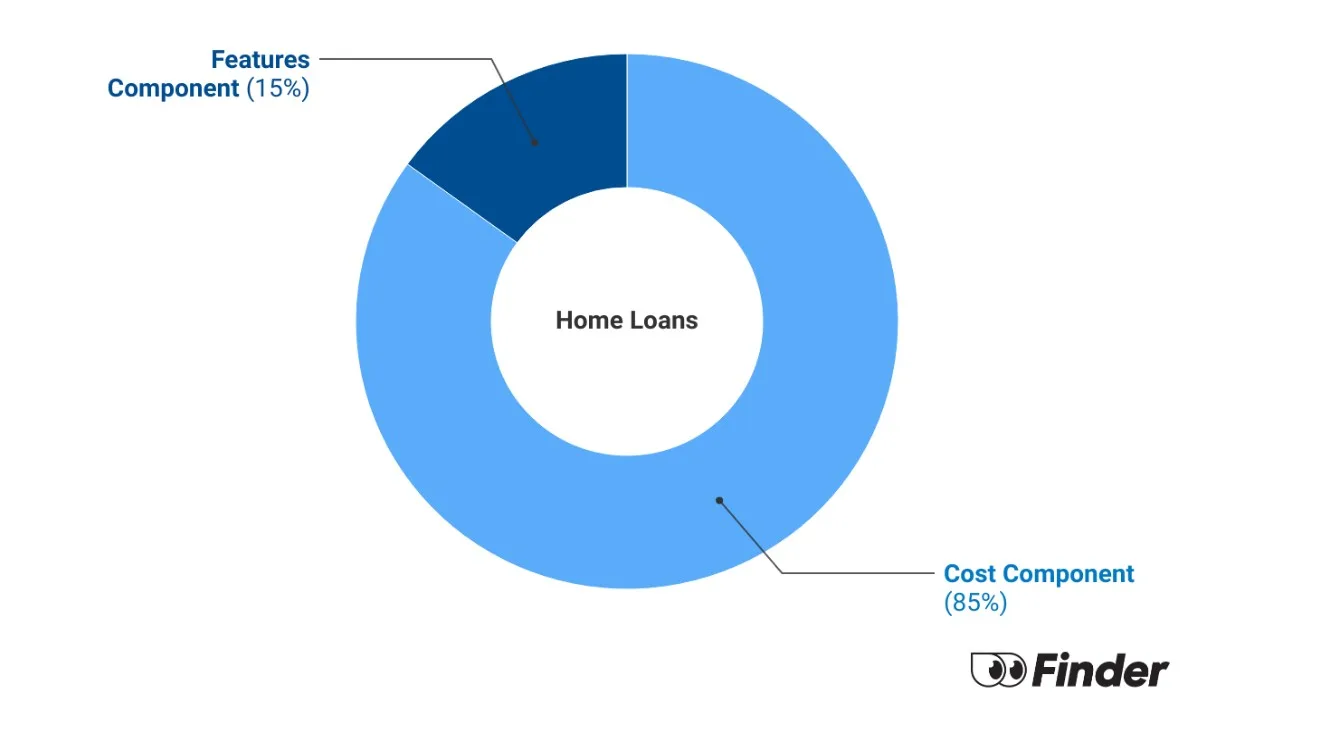
These home loans offer low costs, coupled with a host of features, giving the best overall value.
7+
Great
These home loans may have slightly higher interest rates or fewer features but overall, a competitive offering.
5+
Standard
Usually the home loans would offer above average rates. They may still include some competitive features.
0+
Basic
Higher costs and/or fewer features.
How do reverse mortgages work?
Reverses mortgages are for Australian home owners aged 60 and over who need to access some of the money in their property without selling it (this money is called equity).
A reverse mortgage lender charges fees and interest on the money you borrow. But instead of making monthly repayments, you can pay the loan back later when you sell, move into a retirement home or die.
The amount of equity in your home you can borrow is limited and is determined by your age and the value of your property. Lenders won't let you borrow more than 50% of your property's value.
⚠️ Seek independent financial advice before applying for a reverse mortgage
Taking out a reverse mortgage can affect your ability to pay for future living expenses and reduces the value of your home. A reverse mortgage could also affect your eligibility for the Aged Pension.
Seek independent financial advice before applying for a reverse mortgage.
Reverse mortgages: Key facts and terms
What is equity?
Equity is the current value of your home, minus any debts. It's how much of the home you own, in a dollar value.
If your home is worth $700,000 and you have $100,000 left on your home loan you have $600,000 equity. If you've paid off your home loan your equity is $700,000.
A reverse mortgage lets you borrow money using the equity in your home.
How do I pay off a reverse mortgage?
You don't have to repay a reverse mortgage debt over time like a normal home loan.
You can pay it off when you sell your home, move into an aged care facility or die.
Some lenders may let you pay off part or all of the debt in instalments.
How can I access the money I borrow?
You can borrow the money in one go (lump sum), a regular monthly payment or a line of credit (an approved amount you can spend flexibly).
How much can you borrow on a reverse mortgage?
Most reverse mortgage lenders let you borrow between 15% and 45% of a property's value. The percentage also depends on your age. Here's an example.
Age of borrower
Percentage of property value available
60
15%
65
20%
70
25%
75
30%
80
35.5%
85+
45%
Reverse mortgage example
You're 65 years old and you have a home valued at $900,000. You own the home outright, so your equity is 100%, or $900,000.
Your lender will let you borrow up to 20% of your equity, which is $180,000.
You decide to borrow $60,000 with an interest rate of 9% and a $500 application fee. In 10 years you sell the property, which has risen in value 3% a year to be worth over $1,200,000.
After 10 years your $60,000 loan plus interest is now a debt of $148,307. After paying the debt your equity is 88% of the home's value, which is over $1 million.*
*This is a simple reverse mortgage calculation that assumes a fixed 9% interest rate and a 3% annual increase in your property's value. It does not take other factors into account and is purely an illustrative example.
Which banks offer reverse mortgages?
Several smaller banks and specialist retirement finance providers offer reverse mortgages in Australia today. The Big Four banks and their subsidiaries no longer offer reverse mortgages.
Australian lenders who offer reverse mortgages
Household Capital
Heartland
Seniors First
Gateway Bank
P&N Bank
G&C Mutual Bank
Please note that this list is not exhaustive.
Reverse mortgage calculator
Use our reverse mortgage calculator to estimate how much you can borrow and what it will cost you.
To use the calculator, enter the following details:
Your age. The older you are, the more equity you can borrow.
Your property's value. You can borrow a percentage of your property's value. You can estimate your home's current worth if you're not sure.
An estimate of your property's future value. The lender factors in the future growth of your property's value. You can choose high, medium or low. You can also insert your own figure. Lenders usually go with 3%.
The interest rate. Add the interest for the reverse mortgage product you are interested in.
Payment options. You can get paid in a lump sum or a regular monthly payment.
How to find the best reverse mortgage for you
Look for a lower interest rate. A lower rate means you pay less interest on the money you borrow.
Calculate the fees. Reverse mortgages often have high set-up fees.
Decide on your payment type. Find a reverse mortgage that offers the type of payment you need (lump sum, monthly payment or line of credit).
Customer service. Find a lender that offers good customer service and takes the time to explain everything to you clearly.
Are there any risks or downsides with a reverse mortgage?
Reverse mortgages aren't risky necessarily. But they have significant costs that borrowers need to be aware of.
High repayment costs. Reverse mortgages help you turn your non-liquid home equity into real cash. But they're expensive. In the example above, a $60,000 loan ends up costing the borrower more than double this, at $148,000.
You lose home equity. If you borrow a portion of your home's equity and plan to pay it back when you sell, you effectively lose a portion of your home's current (and future) value. It's something to be aware of.
Higher interest. Interest charges on reverse mortgages are higher than on home loans. As the interest compounds, the loan amount can increase rapidly.
Fees. Setup costs for a reverse mortgage may vary between lenders. Application fees range from $500 – $1,000.
Pension eligibility. A reverse mortgage may affect your ability to qualify for the pension. Contact the Department of Human Services to find out how it could impact your eligibility.
Break fees. If you fix the interest rate on your reverse mortgage, the charges to break the agreement can be costly.
Alternatives to a reverse mortgage
Sell your home
If you want to access the equity in your property, but don't want to take out a reverse mortgage, the primary alternative is to sell or downsize your home. However, this will incur other costs such as stamp duty, agent fees and conveyancing fees.
Home Equity Access Scheme
The Home Equity Access Scheme is a federal government scheme for older Australians. Similar to a reverse mortgage, the scheme allows eligible older Australians to get "a voluntary non-taxable loan" using a property as security.
The scheme offers a lower interest rate than reverse mortgages. To qualify you need to be of pension age, receiving an eligible pension, own a property and meet other criteria.
Home loan top-up
If you still have a home loan your lender might let you borrow a little more via a home loan top-up. This is just a way of extending your loan to borrow a little more. The interest rate will be lower than a reverse mortgage. But unlike a reverse mortgage you'll have to make regular repayments.
Line of credit
Another way to access equity in your home is via a line of credit loan secured by your property. You can get approved for a set amount and then you only pay interest on the money you spend.
Like a home loan top-up, you'll need to repay this loan over time, unlike a reverse mortgage.
Access your super
You can access your super from age 60. Depending on what you need to cover, and how much super you have, withdrawing a lump sum from your super could be an option. After age 60 withdrawals are tax-free too.
Frequently asked questions about reverse mortgages
Yes. Your name is still on the title and you retain ownership of your home.
Yes. It's completely up to you when you choose to sell your home or move into a care facility.
A reverse mortgage is a big financial decision and there's no right answer to this question. While it allows you to access the equity in your home, there are also some risks to taking out a reverse mortgage and it can impact the rest of your family if you're planning on leaving the property to children.
In September 2012 the government introduced a no negative equity protection for reverse mortgages. This means you can't end up owing the lender more than your house is worth.
You or your estate also won't be asked to cover any shortfall that may arise in the event that your home is sold for less than the amount owed on your reverse mortgage.
It is possible to choose a "protected equity option" with some lenders. This lets you preserve a predetermined amount of equity that can't be accessed for future use as an inheritance for your beneficiaries. For example, if you want to protect 20% of your equity for inheritance purposes, your lender will calculate the amount you can borrow to protect this amount.
For example, if your home is worth $500,000, 20% of this amount is $100,000. So the lender will calculate how much you can borrow based on only having $400,000 in equity available.
Sources
Was this content helpful to you?
Thank you for your feedback!
To make sure you get accurate and helpful information, this guide has been edited by
Rebecca Pike
as part of our
fact-checking process.
Richard Whitten is Finder’s Senior Money Editor, with over eight years of experience in home loans, property, credit cards and personal finance. His insights appear in top media outlets like Yahoo Finance, Money Magazine, and the Herald Sun, and he frequently offers expert commentary on television and radio, helping Australians navigate mortgages and property ownership. Richard started his career in education and textbook publishing in South Korea. He holds multiple industry certifications, including a Certificate IV in Mortgage Broking (RG 206) and Tier 1 and Tier 2 certifications (RG 146), as well as a Bachelor of Education from the University of Sydney and a Graduate Certificate in Communications from Deakin University.
See full bio
Richard's expertise
Richard
has written
794
Finder guides across topics including:
If my wife and I take out the government reverse mortgage and use up the funds available would we be able to still get a reverse mortgage on the depreciated value of our property.
Finder
SarahMarch 9, 2026Finder
Hi Keith,
It is possible, but unlikely and generally not advisable, to get a commercial reverse mortgage after using up your government Home Equity Access Scheme (HEAS) funds. Commercial lenders typically require a significant amount of equity (often over 50%) and the government loan must usually be repaid first before they will consider another loan.
CONovember 19, 2025
My mother owns her house as tenants-in-common with her partner, 50% share each. They have each provided a life interest to the other, to allow the surviving partner to continue to live in the property, in the event of the death of either partner. Would either partner be eligible to take out a reverse mortgage in their own capacity, on their own 50% share of the property?
Finder
SarahNovember 19, 2025Finder
Hello,
It’s unlikely they would be approved for their own individual loans. Usually with a reverse mortgage, all owners of the asset being offered for security must be on the loan, which means every owner of the property must be included in the application and meet the lender’s eligibility requirements. Hope this helps
ppOctober 7, 2025
We have a unit worth $950,000 with no mortgage owing. This is currently on the market. We have purchased an off the plan unit ready in 2 months. The purchase price of the new unit is $609000. We were planning to sell our current unit to purchase the new unit. We have $450000 in our superfund. Are we still able to apply for a reverse mortgage on our current property to pay for the shortfall while we wait for the unit to sell? We are 71 and 65 years of age.
Finder
RebeccaOctober 7, 2025Finder
Hi there,
As a financial comparison site we can’t give specific advice on financial decisions like this. There’ll be a lot to consider about your financial circumstances to know whether you can apply for a reverse mortgage. It’s probably worth speaking to a professional like a mortgage broker or accountant. They’ll know more about what considerations lenders take into account (such as if you can take out a reverse mortgage while the property is on the market) as well as other eligibility criteria or solutions.
I’m sorry I can’t be of more help.
Rebecca
RodSeptember 26, 2025
Can you have Home Equity Access from Centrelink and a Line of Credit
And how does the Line of Credit be repaid
Finder
RebeccaOctober 7, 2025Finder
Hi Rod,
The Home Equity Access Scheme has some conditions around using your property as security for other loans. You’ll need to enquire directly with them or speak to a finance professional like a mortgage broker.
With a specific line of credit product, you’ll make monthly repayments on the amount of credit you’ve used, similar to a credit card. With a reverse mortgage, you won’t need to repay until you sell the property it’s secured against or you pass away.
Rebecca
RayDecember 27, 2024
Can you please tell me if I can reverse mortgage in Young NSW. Having trouble finding someone that will help.
Best
Ray
Finder
AngusDecember 30, 2024Finder
Hi Ray, A reverse mortgage should be possible, but a lot will depend on the specific condition of your property. A reverse mortgage is a major financial decision so it’s always sensible to get independent financial advice first.
If you’re having trouble securing a home loan through traditional means, there are some government programs that might help you achieve your property goals.
Pensioners can have a tough time getting a home loan because each lender treats pension payments differently. Here are some tips you can use to find out whether or not you could get a home loan.
If you haven't sold your house yet, but want to buy your next one before the sale is completed a bridging loan may be able to help. Read on to discover how bridging finance can help.
Low doc home loans allow you to get a mortgage if you're self-employed or don't have regular payslips. check your eligibility and compare competitive offers now.
Important information about this website
Finder is a comparison service. We do not compare every product or every provider in the market.
We make money through commercial arrangements with some of the providers on this site. Products marked 'Sponsored', 'Promoted', 'Featured' or 'Advertisement' appear as a result of a commercial arrangement.
Our editorial content, product reviews and any 'Top Pick' designations are prepared independently of these commercial arrangements.
The default order of products in our tables can be influenced by commercial arrangements. You can re-sort or filter using the controls above each table.
Some content on this site may be generated or supported by AI tools. You should verify details directly with the provider.
Finder is one of Australia's leading comparison websites. We are committed to our readers and stand by our editorial principles.
Our comparison service does not include every product or every provider in the market. Some product issuers offer their products under multiple brands or through associated companies. Where we can, we identify the underlying issuer so you can compare like with like, but you should always check with the provider directly to confirm which brand you are dealing with.
Finder is a comparison website and an intermediary. We are not a product issuer and we do not provide personal financial or credit advice. When you click a link to a product, or apply for a product through our site, you deal directly with the product issuer. We may receive a referral fee, commission or other payment from the issuer if you click through, apply or take out a product. We describe these arrangements in more detail under 'How we make money' below.
Product features, fees, terms and eligibility criteria are set by the product issuer and may change. We rely on information supplied by issuers when we present product details on our site. Before you apply for or take out any product, you should confirm the details directly with the issuer.
We earn revenue from Finder in four principal ways:
Referral fees and commissions. When you click a product link, complete an enquiry form or apply for a product through our site, we may receive a referral fee, commission or other payment from the product issuer. We may also receive payment based on the volume of leads or conversions we send to an issuer.
Sponsored placements. Products marked 'Sponsored', 'Promoted', 'Featured' or 'Advertisement' appear as a result of a commercial arrangement between Finder and the issuer. These labels always indicate a paid placement. We do not use them for editorial choices.
Display advertising. Banner advertising, newsletter advertising and similar display ads on our site are paid by advertisers.
Content sponsorship. Some articles, videos and social media posts are sponsored by an issuer and are clearly labelled as such.
Our editorial opinions, product reviews and any 'Top Pick' designations are prepared independently of these commercial arrangements. A 'Top Pick' is an editorial choice made by our writers and editors based on the criteria described on each comparison page. A 'Top Pick' is not a personal recommendation and does not mean the product is appropriate for your circumstances.
If you would like to know whether we have a commercial arrangement with a specific product issuer, please contact us.
When products are grouped in a table or list, the default order can be influenced by commercial arrangements we have with product issuers. In some categories, sponsored or featured products appear in the top positions of the table by default, and are always labelled as such.
Other factors that influence default order include price, fees and features, and (where relevant) our editorial view of the product.
You can re-sort every comparison table using the controls above the table. You can filter by product features that matter to you. The order you see after re-sorting or filtering is not influenced by commercial arrangements.
Some content on this site is generated or supported by artificial intelligence tools, including our AI-powered assistant FinderBot. AI-generated content may contain errors. Please verify important information directly with the product issuer before making a financial decision. For more information about FinderBot, see the FinderBot Terms of Use and FinderBot Privacy Collection Notice.
Please read our website terms of use and privacy policy for more information about our services and our approach to privacy.
We update our data regularly, but information can change between updates. Confirm details with the provider you're interested in before making a decision.
Our goal is to create the best possible product, and your thoughts, ideas and suggestions play a major role in helping us identify opportunities to improve.






If my wife and I take out the government reverse mortgage and use up the funds available would we be able to still get a reverse mortgage on the depreciated value of our property.
Hi Keith,
It is possible, but unlikely and generally not advisable, to get a commercial reverse mortgage after using up your government Home Equity Access Scheme (HEAS) funds. Commercial lenders typically require a significant amount of equity (often over 50%) and the government loan must usually be repaid first before they will consider another loan.
My mother owns her house as tenants-in-common with her partner, 50% share each. They have each provided a life interest to the other, to allow the surviving partner to continue to live in the property, in the event of the death of either partner. Would either partner be eligible to take out a reverse mortgage in their own capacity, on their own 50% share of the property?
Hello,
It’s unlikely they would be approved for their own individual loans. Usually with a reverse mortgage, all owners of the asset being offered for security must be on the loan, which means every owner of the property must be included in the application and meet the lender’s eligibility requirements. Hope this helps
We have a unit worth $950,000 with no mortgage owing. This is currently on the market. We have purchased an off the plan unit ready in 2 months. The purchase price of the new unit is $609000. We were planning to sell our current unit to purchase the new unit. We have $450000 in our superfund. Are we still able to apply for a reverse mortgage on our current property to pay for the shortfall while we wait for the unit to sell? We are 71 and 65 years of age.
Hi there,
As a financial comparison site we can’t give specific advice on financial decisions like this. There’ll be a lot to consider about your financial circumstances to know whether you can apply for a reverse mortgage. It’s probably worth speaking to a professional like a mortgage broker or accountant. They’ll know more about what considerations lenders take into account (such as if you can take out a reverse mortgage while the property is on the market) as well as other eligibility criteria or solutions.
I’m sorry I can’t be of more help.
Rebecca
Can you have Home Equity Access from Centrelink and a Line of Credit
And how does the Line of Credit be repaid
Hi Rod,
The Home Equity Access Scheme has some conditions around using your property as security for other loans. You’ll need to enquire directly with them or speak to a finance professional like a mortgage broker.
With a specific line of credit product, you’ll make monthly repayments on the amount of credit you’ve used, similar to a credit card. With a reverse mortgage, you won’t need to repay until you sell the property it’s secured against or you pass away.
Rebecca
Can you please tell me if I can reverse mortgage in Young NSW. Having trouble finding someone that will help.
Best
Ray
Hi Ray, A reverse mortgage should be possible, but a lot will depend on the specific condition of your property. A reverse mortgage is a major financial decision so it’s always sensible to get independent financial advice first.