
These products offer great value, with a good score across both features and price.
7+
Great
These are competitive products, though they didn't quite get top scores.
5+
Standard
These products might offer less value or command a higher premium than others in the market.
0+
Basic
These products might only offer a basic set of features or aren't very competitive on price.
Compare these life insurance brands & more
How much does life insurance cost?
The average cost of a life insurance policy is $1,258 annually, according to Finder research of 11 providers.
The cost of your life insurance premium will depend on the following:
Your age
Your health and any pre-existing conditions
Your lifestyle choices, for example, if you're a smoker or if you exercise regularly
The level of cover you choose
How many optional extras you do or don't add on
The cost of life insurance is highly dependent on personal factors so your own annual premium is likely to be different to our average cost. This information should be used as a guide only.
How much are Australians spending on life insurance?
Every month, we ask a bunch of Aussies what they're paying for their life insurance. Here's what their bill looked like in November 2025.
$150
Price based on 140+ responses about their monthly premium in November 2025.
TPD covers you if you get severely injured or sick. For example, if you become blind or paralysed after a car accident and become permanently disabled. Typical cover range:$50,000 to $5 million.
Trauma cover, sometimes called critical illness cover, is a policy add-on that pays a lump sum if you're diagnosed with a major medical condition, such as cancer or a heart attack. Typical cover range:$500,000 to $2 million.
Income protection insurance pays a monthly benefit if you're unable to work due to illness or injury. Usually, it will only pay up to 70% or 75% of your typical wage for a period of 2 or 5 years.

"I've never really thought about my life insurance, but after having a baby and buying a house in the same year I felt now was the time I needed to take out cover. Having a policy that would cover my mortgage payments is one less thing I now need to worry about."
When you sit down to compare life insurance it helps to start with a few key questions:
If you passed away, could your family maintain their current lifestyle?
Would they still be able to reach future goals you've planned for them?
If you were permanently disabled, how would the bills get paid - and if you live alone, how would you afford care?
How long could you cover expenses without your regular income?
Could you afford major costs like home modifications or long-term rehab after a serious injury?
Are the ongoing premiums sustainable for your budget?
Asking these questions gives you a clear picture of the type and level of cover you may need. From there, you can compare life insurance policies side by side to weigh up the costs, features and benefits that best match your circumstances.
Compare life insurance premiums
When you compare life insurance, premiums are one of the biggest factors to look at. The cost you pay isn't just about today's price - it's also about how the structure of those premiums will affect your budget over time.
Because a life insurance policy can last for decades, understanding whether costs rise each year or stay fixed can make a big difference to affordability in the long run.
Premiums vary based on age, gender, occupation and smoking status.
Policies can run for decades, so check how costs may change over time.
Stepped premiums: cheaper upfront but increase as you age.
Level premiums: higher at first but stay consistent across the policy.
Compare life insurance features
Premiums matter, but the real value of life insurance lies in its features. The inclusions, exclusions and benefit limits all determine how useful the cover will be when your family needs it most. By taking the time to compare life insurance features alongside costs, you'll be able to find a policy that balances affordability with meaningful protection.
Ensure the cover amount is enough to support your family if you pass away.
Review inclusions, exclusions and benefit limits carefully.
Some policies include extras like financial planning or accommodation benefits.
Comparing features alongside premiums helps you find the best value protection.
The best life insurance for you will depend on your personal profile and budget, however, we've done some research to help get you started. In 2024, TAL life insurance was the winner of our best life insurance award. This is because TAL offers competitive pricing and extensive benefit limits. In short; it's well priced for such a good product. Keep in mind, you should always get your own quote and read through the product disclosure statement to know if this product offers the kind of coverage you're looking for.
To be straight with you, only you can answer this one. Life insurance is one of those products you hope you never have to use because for it to ever be used, something terrible has to happen first. However, you may deem it 'worth it' for the peace of mind it brings you and your family. Life insurance can cover the cost of major debts like your mortgage in the event you're unable to do so yourself. For many, knowing your family would be financially stable in the event of your passing makes life insurance worth it. If you're not sure whether or not life insurance is necessary for you, this article can help you assess your needs and what your family would need in the event of your passing.
A life insurance payout goes to the beneficiary; this is the person you choose at the time of taking out your policy. In the event of your death, the beneficiary - which can be 1 person or a selection of people - would get the payout.
If you cancel your life insurance, you will no longer be covered as of the date you cancel. If you've paid your premium in advance then you may be refunded for the unused portion of it, minus any cancellation fees you may owe.
It's an individual assessment depending on your cashflow, retirement funding and tax situation. While it's often cheaper and easier to hold life insurance within super, it reduces the amount in your retirement fund. Additionally, the payout is usually small and the policies typically expire when you turn 65. With a traditional life insurance policy, the expiry age is usually around 99 or there is no expiry age at all, as long as you keep paying your premiums.
Yes, it is possible. If you have a pre-existing medical condition, there are insurers who will still cover you. But they might ask you to pay slightly higher premiums or exclude that condition from your cover. It's really important to disclose any condition you have when you apply for life insurance. Not doing so could void your cover.
Child life insurance is a feature you can add to your life insurance policy for an added fee. It will pay out a financial benefit if your child dies or suffers a serious medical condition.
What is the Finder Score?
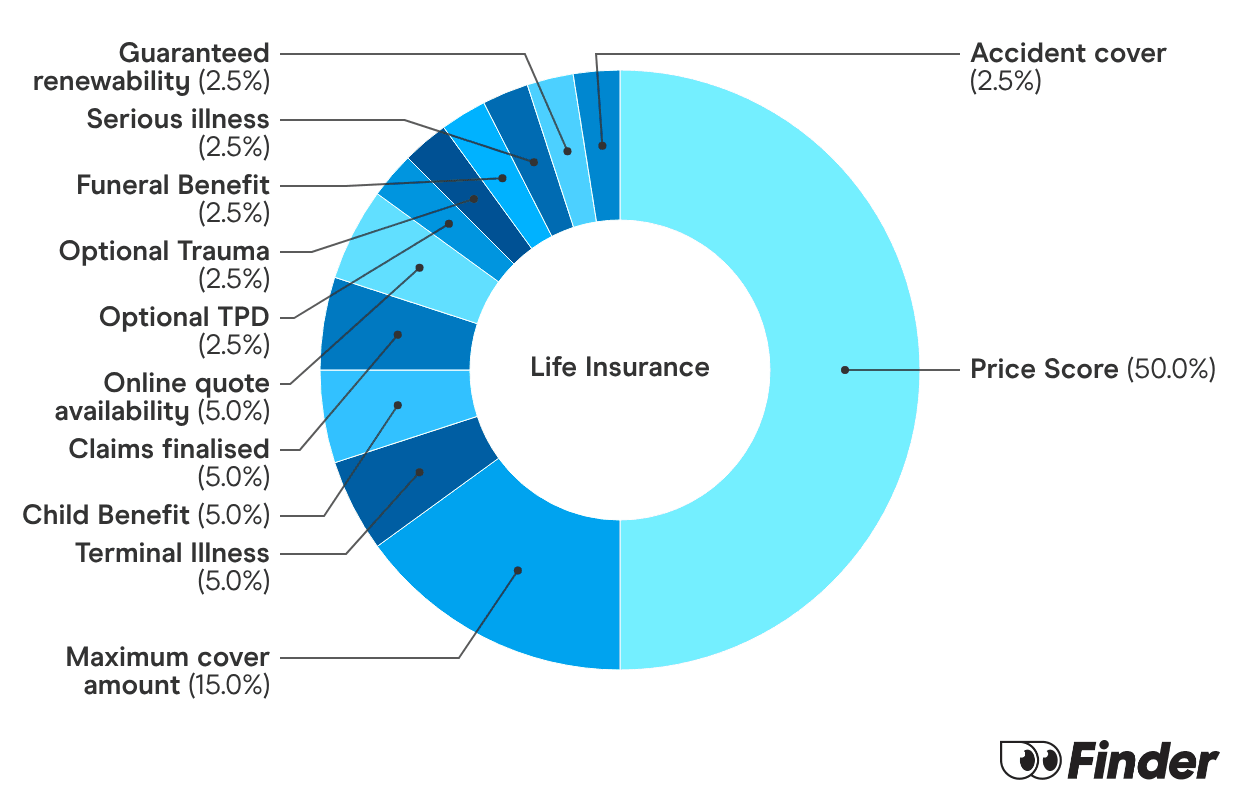
Life Insurance is a little complicated and a lot overwhelming. That's why we made the Finder Score, to make it easier to compare Life Insurance products against each other.
We have assessed over 30 products and assign each product a score out of 10 based on 13 features, including price.
Remember that Finder Score is just one factor to consider. Look at other aspects like fees, features, benefits and risks to make sure a product is suitable for you. Double-check details that matter to you before applying or buying.
To be eligible for a Finder Score, providers must provide us with quotes. We use the average price across 12 personas. The personas we collect quotes and use for the purpose of Finder Score are:
Age
Gender
Smoker/Non Smoker
25
Male
Non Smoker
35
Male
Non Smoker
45
Male
Non Smoker
25
Female
Non Smoker
35
Female
Non Smoker
45
Female
Non Smoker
25
Male
Smoker
35
Male
Smoker
45
Male
Smoker
25
Female
Smoker
35
Female
Smoker
45
Female
Smoker
Feature
Weights
Price
40.0%
Interim Accident Cover
5.0%
Optional TPD Cover
2.5%
Optional Trauma Cover
2.5%
Guaranteed Renewability
5.0%
Counselling
5.0%
Child Benefit
5.0%
Future Insurability
5.0%
Online Quotation
5.0%
Repayment Methods
2.5%
Serious Illness
2.5%
Terminal Illness
5.0%
Maximum Cover
10.0%
Funeral Benefits
2.5%
Claims finalised
5.0%
The Finder Score methodology is designed by our insights team and reviewed by our editorial team. We review the products objectively. Commercial partnerships do not affect the score.
Gary Ross Hunter has over 6 years of expertise writing about insurance, including life, health, home, and car insurance. Having reviewed hundreds of product disclosure statements and published over 800 articles, he loves simplifying complex insurance topics for everyday readers. Gary has contributed to major outlets like Yahoo Finance, The Sydney Morning Herald, and news.com.au, and holds a Bachelor of Arts (Honours) in English Literature from the University of Glasgow, along with a Tier 2 General Advice certification, ensuring his work adheres to ASIC’s RG146 standards.
See full bio
Gary Ross's expertise
Gary Ross
has written
589
Finder guides across topics including:
James Martin was the insurance editor at Finder. He has written on a range of insurance and finance topics for over 7 years. James often shares his insurance expertise as a media spokesperson and has appeared on Prime 7 News, Insurance News, 7NEWS and The Guardian. An experienced journalist, James' work has featured in publications including The Irish Times, Companies100 and In Business. He holds a Tier 1 General Insurance (General Advice) certification and a Tier 1 Generic Knowledge certification, both of which meet the requirements of ASIC Regulatory Guide 146 (RG146).
See full bio
James's expertise
James
has written
184
Finder guides across topics including:
Finder members can get up to $300 when they take out a NobleOak life insurance policy - but this limited-time offer ends 30 June or unless withdrawn earlier
Switching life insurance just got more rewarding. Finder members can score up to $300 in a digital Visa card with an eligible NobleOak policy - but only for a limited time.
Finder makes money from featured partners, but editorial opinions are our own.
Finder is one of Australia's leading comparison websites. We are committed to our readers and stand by our editorial principles.
We try to take an open and transparent approach and provide a broad-based comparison service. However, you should be aware that while we are an independently owned service, our comparison service does not include all providers or all products available in the market.
Some product issuers may provide products or offer services through multiple brands, associated companies or different labeling arrangements. This can make it difficult for consumers to compare alternatives or identify the companies behind the products. However, we aim to provide information to enable consumers to understand these issues.
We make money by featuring products on our site. Compensation received from the providers featured on our site can influence which products we write about as well as where and how products appear on our page, but the order or placement of these products does not influence our assessment or opinions of them, nor is it an endorsement or recommendation for them.
Products marked as 'Top Pick', 'Promoted' or 'Advertisement' are prominently displayed either as a result of a commercial advertising arrangement or to highlight a particular product, provider or feature. Finder may receive remuneration from the Provider if you click on the related link, purchase or enquire about the product. Finder's decision to show a 'promoted' product is neither a recommendation that the product is appropriate for you nor an indication that the product is the best in its category. We encourage you to use the tools and information we provide to compare your options.
Where our site links to particular products or displays 'Go to site' buttons, we may receive a commission, referral fee or payment when you click on those buttons or apply for a product.
When products are grouped in a table or list, the order in which they are initially sorted may be influenced by a range of factors including price, fees and discounts; commercial partnerships; product features; and brand popularity. We provide tools so you can sort and filter these lists to highlight features that matter to you.
Please read our website terms of use and privacy policy for more information about our services and our approach to privacy.
We update our data regularly, but information can change between updates. Confirm details with the provider you're interested in before making a decision.
How likely would you be to recommend Finder to a friend or colleague?
0
1
2
3
4
5
6
7
8
9
10
Very UnlikelyExtremely Likely
Required
Thank you for your feedback.
Our goal is to create the best possible product, and your thoughts, ideas and suggestions play a major role in helping us identify opportunities to improve.
The information provided by Frankie is general in nature and has been prepared without considering your objectives, financial situation or needs. Frankie may make mistakes so it's important that you review the information before deciding. By messaging Frankie, you agree to our Terms and have read our Privacy Policy.