With TAL life insurance, you can get a comparatively high funeral benefit of $25,000 and there's no maximum cover limit. TAL lets you add total & permanent disability, trauma or child cover to your policy if you wish - most of the 19 brands we reviewed don’t offer all 3 add-ons.
"As part of their life insurace plan TAL offer a benefit of up to $10,000 in the event one of your children are diagnosed with a critical illness. They are the only provider we have compared to offer this inclusion making it a great option for extra coverage for those with kids."
Adelaide Moore
Author
Why compare life insurance with Finder?
You pay the same price as buying directly from the life insurer.
We're not owned by an insurer (unlike other comparison sites).
We've done 100+ hours of policy research to help you understand what you're comparing.
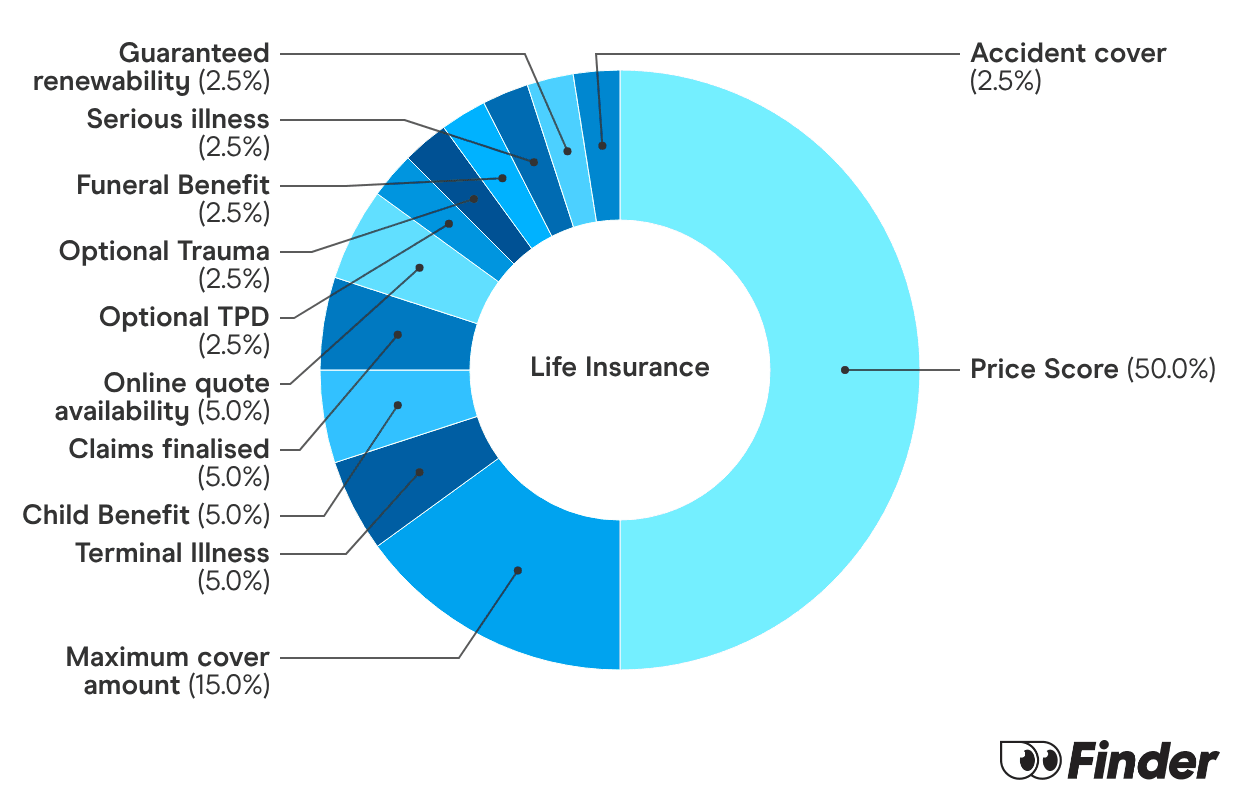
Finder Score - Life Insurance
Life Insurance is a little complicated and a lot overwhelming. That's why we made the Finder Score, to make it easier to compare Life Insurance products against each other. Our experts analysed over 30 products and gave each one a score out of 10.
But a higher score doesn't always mean a product is better for you. Your situation is unique, so your policy choice will be too. Don't think of Finder Score as the final word, but as a good place to start your life insurance comparison.
TAL offers 3 core types of life insurance products to its customers: life insurance, critical illness insurance and total and permanent disability insurance. Its policies fall under TAL Accelerated Protection and can be bought through an adviser or directly through TAL.
TAL also lets you tailor your policy to suit your needs by either choosing a standalone policy, choosing one or more policies and then adding benefits and linking to other plans, or choosing to structure your life insurance through a superannuation plan.
Accelerated Protection life insurance will pay out a lump sum in the event of the policyholder's death or the diagnosis of a terminal illness. The main purpose of this type of cover is to help provide for your family after your death and to take care of your family's finances so they can focus on dealing with their loss.
TAL Accelerated Protection life insurance includes the following features and benefits:
Death benefit: This is a lump-sum payment of the nominated benefit amount if the life insured dies.
Terminal illness benefit. The nominated benefit amount can be paid out early if the policyholder is terminally ill and not expected to live longer than 12 months.
Advanced payment benefit: 10% of the benefit amount (up to a maximum of $25,000) can be paid in advance to help your family deal with day-to-day finances.
Repatriation benefit: The advanced payment limit is increased to $35,000 if the policyholder dies overseas.
Inflation protection benefit: Your cover automatically increases every year in line with the Consumer Price Index.
Premium freeze benefit: Your premiums stay the same by reducing your cover each year. This is available on stepped premium policies only and only after the policyholder's 30th birthday.
Guaranteed future insurability benefit: This means you'll be able to increase your cover after significant life events (for example, getting married or having a baby) without having to provide additional health information.
Other benefits: These include a financial planning benefit, a grief counselling benefit and a child's critical illness benefit.
TAL also offers the following optional benefits:
Premium relief option: This option lets you waive your premiums if sickness or injury means you are unable to work for at least 3 months.
Business insurance option: This option lets you increase your insurance without providing additional health information after a valid business event, such as an increase in your share of business ownership or an increase in the level of a business loan for which you are a guarantor.
Critical illness insurance
TAL Accelerated Protection critical illness insurance pays out a lump sum if you are diagnosed with a specified medical condition like cancer or have a heart attack or stroke. The benefit will be paid even if you're still able to work. There are 2 types of plans available: Standard and Premier.
Some of the key benefits of the Premier plan include the following:
Advancement benefit: This benefit provides cover for immediate expenses if a certain event happens – for example, if you lose hearing in one ear or are diagnosed with partial Alzheimer's disease.
Female critical illness benefit: This benefit will be paid for conditions like pregnancy complications and congenital abnormalities.
Needlestick benefit: This benefit is available if you work in certain occupations and suffer occupationally-acquired hepatitis B or C.
Benefits featured in both the Standard and Premier critical illness insurance plans include the following:
Critical illness benefit: This benefit is a lump-sum payment of up to $2,000,000 for a range of conditions, such as heart attack, stroke, dementia, blindness, cancer and kidney failure.
Paralysis support benefit: The lump-sum payment is doubled to a maximum of $2,000,000 if the policyholder becomes paralysed.
Death buy-back benefit: You can repurchase your life insurance after the payment of 100% of the critical illness benefit, paralysis support benefit or TPD benefit (if applicable). This benefit only applies if critical illness insurance or TPD insurance (if applicable) is attached or linked to life insurance.
Optional benefits on critical illness insurance plans include the following:
Critical illness reinstatement benefit: This lets you repurchase your critical illness insurance after you've been paid a critical illness benefit, advancement benefit, needlestick benefit or female critical illness benefit.
Double critical illness option: When critical illness insurance is attached to life insurance, this benefit means that payment of the critical illness benefit will not reduce your life insurance and future premiums will be waived.
Premium relief option: This option lets you waive your premiums if sickness or injury means you are unable to work for at least 3 months.
Business insurance option: This option lets you increase your critical illness insurance without medical underwriting after a valid business event, such as an increase in your share of business ownership or an increase in the level of a business loan for which you are a guarantor.
TPD insurance
TAL Accelerated Protection TPD insurance pays a lump-sum benefit if you are totally and permanently disabled. The benefits of this type of insurance include the following:
TPD benefit: A lump-sum payment of up to $3,000,000 if you become totally and permanently disabled.
Accommodation benefit: TAL will reimburse the cost of accommodation for your immediate family member of up to $250 per day if the policyholder is confined to bed more than 100km away from home.
TAL's TPD insurance policies also feature the following optional benefits:
Death buy-back option: You can repurchase your life insurance after the payment of 100% of TPD insurance. This is only available when TPD insurance is linked to life insurance.
Double TPD option: Available when TPD insurance is attached to life insurance, this benefit means that payment of the TPD benefit will not reduce your life insurance and future premiums will be waived.
Premium relief option: This option lets you waive your premiums if sickness or injury means you are unable to work for at least 3 months.
Business insurance option: This option lets you increase your critical illness insurance without medical underwriting after a valid business event, such as an increase in your share of business ownership or an increase in the level of a business loan for which you are a guarantor.
Age eligibility
Accelerated Protection Plan
Entry age
Life cover
Between 19 and 74
Income protection cover
Between 19 and 60
TPD
Between 19 and 62
Critical illness insurance
Between 19 and 62
You must also be an Australian resident to apply.
Find better life insurance
Take our easy quiz to find a better deal for you.
See how TAL's claim acceptance rate stacks up against other life insurers
This will depend on the policy – below are some of the exclusions you will find. Note: this is not an exhaustive list and we'd recommend you read each policy's product disclosure statement (PDS) so that you know what you'll be insured for.
A number of general exclusions apply to each Accelerated Protection policy from TAL. Your Critical Protection life insurance claim will not be paid if the claim is caused by an intentional self-inflicted act by the life insured within the following time frames:
Within 13 months of the policy start date
Within 13 months of cover being increased (but only in respect to that increase)
Within 13 months of the policy being reinstated
No Accelerated Protection critical illness insurance claim will be paid in the following situations:
It is caused by an intentional self-inflicted act by the life insured
The condition was diagnosed or became apparent within 3 months of the policy starting or of cover being increased or reinstated (this exclusion does not apply to all critical illness events)
The life insured does not survive for at least 14 days following the critical illness event
Your claim under Accelerated Protection TPD insurance will not be paid in the following situations:
It is caused by an intentional self-inflicted act by the life insured
Other specific exclusions apply to income protection, so read the Accelerated Protection PDS for more information.
Frequently asked questions about TAL life insurance
If you select stepped premiums, your premium payment will generally increase each year. If you choose level premiums, the amount you pay is based on the life insured's age when the policy starts and premiums will remain the same until your policy reverts to stepped premiums at either 65 or 70 years of age.
A waiting period is the amount of time before your insurance benefits begin to accrue.
Any benefits you receive from your policy are usually assessable for tax purposes. Check with an accountant or the Australian Taxation Office to be sure.
TAL may ask you to get an independent medical examination to help assess your claim. Your case manager will give you plenty of notice of any examination, so you can make travel arrangements. TAL pays for this examination and will also reimburse you for all reasonable travel costs.
In cases where there is not enough evidence to support a claim being approved, the case is put before TAL's Decision and Review Committee for further consideration before a final decision is made. If you don't agree with TAL's final decision, you can write to its Complaints Resolution Department and ask that your case be independently reviewed.
TAL aims to make the claims process as easy and stress-free as possible. Before submitting your claim, remember that the process involved will differ depending on where you purchased your policy.
To submit a claim, follow these simple steps:
Inform TAL that you wish to make a claim by emailing or phoning them
TAL will then give you the forms you'll need to complete your claim
Make sure you fill out all the forms you receive as this will help them assess your claim as quickly as possible. Return your completed claim forms and any supporting documentation to TAL via email or post
Once TAL has received your completed forms, a case manager will be appointed and will start to assess your claim. If your claim is approved, you can nominate to have your benefit paid into your bank account or you can receive a cheque.
James Martin was the insurance editor at Finder. He has written on a range of insurance and finance topics for over 7 years. James often shares his insurance expertise as a media spokesperson and has appeared on Prime 7 News, Insurance News, 7NEWS and The Guardian. An experienced journalist, James' work has featured in publications including The Irish Times, Companies100 and In Business. He holds a Tier 1 General Insurance (General Advice) certification and a Tier 1 Generic Knowledge certification, both of which meet the requirements of ASIC Regulatory Guide 146 (RG146).
See full bio
James's expertise
James
has written
177
Finder guides across topics including:
If we took out life insurance to include kids on it…when the kids turn 18 can they can opt to continue with their own insurance…what happens if they have acquired some condition along the way before they turn 18…would it be covered or considered a pre existing when they choose to rollover to adult insurance?
Finder
AngusSeptember 23, 2024Finder
Hi Rebecca, Life insurance generally applies to a specified individual – your kids might be beneficiaries of the policy, but their own health isn’t relevant to it. Once they turn 18 they might choose to apply for life insurance of their own. At that point any pre-existing conditions would be relevant – we have a detailed guide to pre-existing conditions and life insurance where you can learn more. Hope this helps.
Review the Australian Seniors Life and compare options available.
Important information about this website
Finder is a comparison service. We do not compare every product or every provider in the market.
We make money through commercial arrangements with some of the providers on this site. Products marked 'Sponsored', 'Promoted', 'Featured' or 'Advertisement' appear as a result of a commercial arrangement.
Our editorial content, product reviews and any 'Top Pick' designations are prepared independently of these commercial arrangements.
The default order of products in our tables can be influenced by commercial arrangements. You can re-sort or filter using the controls above each table.
Some content on this site may be generated or supported by AI tools. You should verify details directly with the provider.
Finder is one of Australia's leading comparison websites. We are committed to our readers and stand by our editorial principles.
Our comparison service does not include every product or every provider in the market. Some product issuers offer their products under multiple brands or through associated companies. Where we can, we identify the underlying issuer so you can compare like with like, but you should always check with the provider directly to confirm which brand you are dealing with.
Finder is a comparison website and an intermediary. We are not a product issuer and we do not provide personal financial or credit advice. When you click a link to a product, or apply for a product through our site, you deal directly with the product issuer. We may receive a referral fee, commission or other payment from the issuer if you click through, apply or take out a product. We describe these arrangements in more detail under 'How we make money' below.
Product features, fees, terms and eligibility criteria are set by the product issuer and may change. We rely on information supplied by issuers when we present product details on our site. Before you apply for or take out any product, you should confirm the details directly with the issuer.
We earn revenue from Finder in four principal ways:
Referral fees and commissions. When you click a product link, complete an enquiry form or apply for a product through our site, we may receive a referral fee, commission or other payment from the product issuer. We may also receive payment based on the volume of leads or conversions we send to an issuer.
Sponsored placements. Products marked 'Sponsored', 'Promoted', 'Featured' or 'Advertisement' appear as a result of a commercial arrangement between Finder and the issuer. These labels always indicate a paid placement. We do not use them for editorial choices.
Display advertising. Banner advertising, newsletter advertising and similar display ads on our site are paid by advertisers.
Content sponsorship. Some articles, videos and social media posts are sponsored by an issuer and are clearly labelled as such.
Our editorial opinions, product reviews and any 'Top Pick' designations are prepared independently of these commercial arrangements. A 'Top Pick' is an editorial choice made by our writers and editors based on the criteria described on each comparison page. A 'Top Pick' is not a personal recommendation and does not mean the product is appropriate for your circumstances.
If you would like to know whether we have a commercial arrangement with a specific product issuer, please contact us.
When products are grouped in a table or list, the default order can be influenced by commercial arrangements we have with product issuers. In some categories, sponsored or featured products appear in the top positions of the table by default, and are always labelled as such.
Other factors that influence default order include price, fees and features, and (where relevant) our editorial view of the product.
You can re-sort every comparison table using the controls above the table. You can filter by product features that matter to you. The order you see after re-sorting or filtering is not influenced by commercial arrangements.
Some content on this site is generated or supported by artificial intelligence tools, including our AI-powered assistant FinderBot. AI-generated content may contain errors. Please verify important information directly with the product issuer before making a financial decision. For more information about FinderBot, see the FinderBot Terms of Use and FinderBot Privacy Collection Notice.
Please read our website terms of use and privacy policy for more information about our services and our approach to privacy.
We update our data regularly, but information can change between updates. Confirm details with the provider you're interested in before making a decision.
Our goal is to create the best possible product, and your thoughts, ideas and suggestions play a major role in helping us identify opportunities to improve.








If we took out life insurance to include kids on it…when the kids turn 18 can they can opt to continue with their own insurance…what happens if they have acquired some condition along the way before they turn 18…would it be covered or considered a pre existing when they choose to rollover to adult insurance?
Hi Rebecca, Life insurance generally applies to a specified individual – your kids might be beneficiaries of the policy, but their own health isn’t relevant to it. Once they turn 18 they might choose to apply for life insurance of their own. At that point any pre-existing conditions would be relevant – we have a detailed guide to pre-existing conditions and life insurance where you can learn more. Hope this helps.