Life insurance can cover mental illness, but you must fully disclose your health history when applying for a policy.
Insurers assess mental health and its management individually, so expect varying cover options or premium costs.
Be aware that insurers often consider past symptoms - like stress-related leave or counseling - as part of your history, even if you were never formally diagnosed with a mental health condition.
If you have a mental illness, you're not alone. Around 45% of Australians will be affected by mental illness at some stage in their life and a 2021 Finder survey found that more than 1 in 3 Australian workers (36%) took sick leave for their mental health in the previous year.
If you're considering a new life insurance policy and have a history of mental health issues, the good news is life insurance can still cover you.
Compare income protection policies covering mental health
These products offer great value, with a good score across both features and price.
7+
Great
These are competitive products, though they didn't quite get top scores.
5+
Standard
These products might offer less value or command a higher premium than others in the market.
0+
Basic
These products might only offer a basic set of features or aren't very competitive on price.
2 of 5 results
Compare other products
We currently don't have that product, but here are others to consider:
Looking for other options? Check out these similar products.
How we picked these
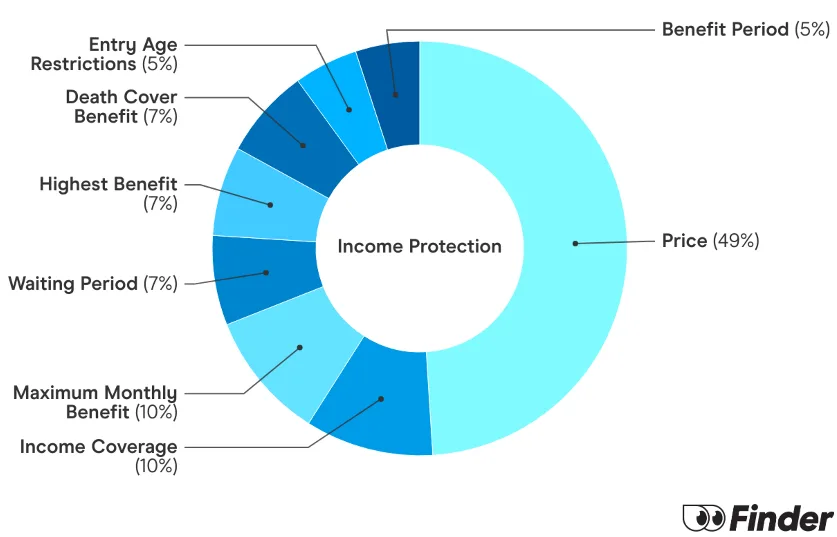
Finder Score - Income Protection
Income Protection is a little complicated and a lot overwhelming. That's why we made the Finder Score, to make it easier to compare Life Insurance products against each other. Our experts analysed over 12 products and gave each one a score rank out of 10.
But a higher score doesn't always mean a product is better for you. Your situation is unique, so your policy choice will be too. Don't think of Finder Score as the final word, but as a good place to start your life insurance comparison.
The short answer is, yes, you may be able to get coverage if you have a mental illness or suffer from one in the future. While there are still some misconceptions when it comes to mental illness and life insurance, industry analysis shows that mental disorders make up 11% of disability income claims.
What do I need to do to be covered? You should disclose your condition at the time of application and will need to satisfy health and lifestyle criteria.
Are there any waiting periods? Of the insurers we considered, all have a waiting period of 6 months for mental health claims, usually referred to as a qualifying period.
How long can I be covered? Insurers tend to limit the time you can be on income protection to 2 years over the life of your policy.
How does mental health affect your premiums?
Your premiums are affected by the perceived risk you pose to make a claim. High-risk factors such as an existing mental health issue, are viewed by insurers as more likely to make a claim and can be subjected to higher premiums.
Every insurer is different but you can expect your premiums to be affected in one of the following ways:
Cover at no extra cost: Your mental health might not be seen as an added risk and you'll be covered at no extra cost. You are more likely to get this if you can demonstrate that your condition is being managed and that you haven't had any recent issues.
Cover at extra cost: If your insurer feels that your condition represents an increased level of risk, but not an unreasonable one, they may offer cover but at an additional cost.
Cover with exclusions: Your insurer might offer you cover at no extra cost, but exclude cover for certain mental health conditions or offer lower benefit limits. This may be their course of action if you sought treatment or had a mental health episode several years ago but not recently.
Deny cover: Sometimes insurers can decline to cover people they feel are too risky. If they feel that your condition will almost certainly result in a claim or extra costs, they may be more likely to opt for this.
From a legal perspective, insurers must have reasonable and relevant information to back up their decision.
Will I need to disclose my mental illness?
You are required to disclose mental health illnesses the same as you would any other condition.
Disclosure can help your insurer tailor your cover. Remember, your insurer cannot provide effective cover if it doesn't know your needs, and it's generally advisable to provide as much information as possible.
What is my duty of disclosure? You are required to inform your insurer of anything that may impact the type of insurance policy or level of cover you receive.
What happens if I don't disclose everything? If a customer fails in their duty of disclosure, the insurer reserves the right to cancel their policy without refund or refuse to pay a claim.
Key steps to take if you're looking for cover
Go through the policy document. You need to understand what your policy offers and the best way to do this is to read through the policy disclosure statement (PDS). This document contains information about how your insurer defines mental illness and if there are any exemptions or exclusions.
If in doubt, speak with an expert. Because of the confusing nature of insurance products, it's always best to speak with someone in the know. If you're having trouble understanding where an insurer stands when it comes to mental illness, get in touch with a financial adviser or the insurer.
Get specific definitions. If you do contact an insurer, ask them specifically how mental illness is defined. Some insurers use mental illness as a blanket term that covers everything from bipolar to anxiety disorders.
Ask if it's covered as a pre-existing condition. While some insurers will cover you if you have an existing mental illness, others will only provide you with cover if the illness presents itself after you start the policy.
Double-check before you switch. If you have cover through your super and you change providers, make sure you check the conditions related to mental illness as they differ between funds.
Ask about waiting periods. Some policies may have waiting or non-claims periods for a specified amount of time. Make sure you know what these are before you apply for cover.
What if I experienced mental health issues in the past but no longer do?
If you have previously experienced or sought treatment for a mental health issue, then it is likely to qualify as a pre-existing condition and the insurer may impose additional loadings or exclusions. The insurer may also decide that the condition poses little risk and cover you as normal.
A mental health issue could be identified as a pre-existing condition if it meets 1 or more of the following criteria:
A doctor or relevant medical specialist diagnosed it at a prior date
You have experienced prior symptoms that would cause a reasonable person to seek treatment
It's identified as the symptom of a genetic condition present from birth
You are currently taking medication for the purposes of managing the condition
These criteria may be interpreted differently depending on the insurer and the policy. Check the exclusions and pre-existing conditions sections of your policy's product disclosure statement (PDS) for more details.
Example: How insurers work with pre-existing conditions
Jason was looking for life insurance but was finding it difficult to get cover because of an incident several years ago where he had experienced a period of severe anxiety and depression but never sought treatment. To find cover, he started looking at how different insurers defined pre-existing conditions.
The first insurer's PDS defined having a pre-existing condition as "previously experiencing symptoms that would have caused a reasonable person to seek treatment". Under this definition, Jason's former anxiety and depression would count as a pre-existing condition.
The second insurer's PDS defined pre-existing conditions as ones that were "previously diagnosed by a relevant medical specialist". Under this definition, Jason's anxiety and depression would not count as a pre-existing condition.
Realising that he might be able to get lower premiums with the second insurance company, Jason got a quote to compare alongside other options.
* This is a fictional, but realistic, example.
Speak to an insurance specialist to help you find personalised cover
What are my options if I'm rejected for cover?
If you're refused cover, you can contact the Australian Financial Complaints Authority (AFCA) as they handle complaints about insurers that refuse to provide general insurance. However, you can only contact FOS after you have gone through the insurer's dispute resolution process.
If you believe an insurer treated you in a discriminatory fashion because of your mental illness, there are options available to you including:
Contacting the insurers chief underwriters and explaining to them your issue
Contacting your insurers internal dispute resolution team
Getting in touch with the Mental Health Council of Australia (MHCA)
Income protection generally covers recognised mental health conditions that prevent you from working. This includes conditions such as depression, anxiety disorders, bipolar disorder, and post-traumatic stress disorder. However, the exact scope of cover depends on your specific policy and how the insurer defines mental illness in its Product Disclosure Statement.=.
Yes, taking medication for a mental health condition can impact your application, but not necessarily negatively. Insurers will assess your overall health, including your current treatment plan, medication, and prognosis. Disclosing your medication demonstrates you are actively managing your condition, which can sometimes be viewed favourably. Non-disclosure, however, could lead to a claim being denied later on.
To make a mental health claim, insurers typically require comprehensive medical evidence from qualified professionals. This usually includes reports from your general practitioner, psychiatrist, or psychologist outlining your diagnosis, symptoms, treatment plan, and how the condition prevents you from performing your work duties. You may also need to undergo an independent medical examination if requested by the insurer.
Yes, income protection can cover mental health issues arising from or exacerbated by your work environment if they render you unable to perform your occupation. The key factor is your inability to work due to the mental health condition, not necessarily the cause of the condition. However, it is important to be aware that workers compensation may also apply in such cases, and your income protection policy may have clauses about coordinating benefits.
To improve your chances of obtaining income protection with a mental health condition, it is vital to demonstrate stability and active management of your condition. Provide clear, honest, and detailed information about your diagnosis, treatment history, and current health during the application. Having a consistent treatment plan, a good prognosis, and a period of stability without recent episodes or hospitalisations can be beneficial.
Richard Laycock is Finder’s insights editor after spending the last five years writing and editing articles about insurance. His musings can be found across the web including on MoneyMag, Yahoo Finance and Travel Weekly. Richard studied Media at Macquarie University and The Missouri School of Journalism and has a Tier 1 Certification in General Advice for Life Insurance.
See full bio
Review the Australian Seniors Life and compare options available.
Important information about this website
Finder is a comparison service. We do not compare every product or every provider in the market.
We make money through commercial arrangements with some of the providers on this site. Products marked 'Sponsored', 'Promoted', 'Featured' or 'Advertisement' appear as a result of a commercial arrangement.
Our editorial content, product reviews and any 'Top Pick' designations are prepared independently of these commercial arrangements.
The default order of products in our tables can be influenced by commercial arrangements. You can re-sort or filter using the controls above each table.
Some content on this site may be generated or supported by AI tools. You should verify details directly with the provider.
Finder is one of Australia's leading comparison websites. We are committed to our readers and stand by our editorial principles.
Our comparison service does not include every product or every provider in the market. Some product issuers offer their products under multiple brands or through associated companies. Where we can, we identify the underlying issuer so you can compare like with like, but you should always check with the provider directly to confirm which brand you are dealing with.
Finder is a comparison website and an intermediary. We are not a product issuer and we do not provide personal financial or credit advice. When you click a link to a product, or apply for a product through our site, you deal directly with the product issuer. We may receive a referral fee, commission or other payment from the issuer if you click through, apply or take out a product. We describe these arrangements in more detail under 'How we make money' below.
Product features, fees, terms and eligibility criteria are set by the product issuer and may change. We rely on information supplied by issuers when we present product details on our site. Before you apply for or take out any product, you should confirm the details directly with the issuer.
We earn revenue from Finder in four principal ways:
Referral fees and commissions. When you click a product link, complete an enquiry form or apply for a product through our site, we may receive a referral fee, commission or other payment from the product issuer. We may also receive payment based on the volume of leads or conversions we send to an issuer.
Sponsored placements. Products marked 'Sponsored', 'Promoted', 'Featured' or 'Advertisement' appear as a result of a commercial arrangement between Finder and the issuer. These labels always indicate a paid placement. We do not use them for editorial choices.
Display advertising. Banner advertising, newsletter advertising and similar display ads on our site are paid by advertisers.
Content sponsorship. Some articles, videos and social media posts are sponsored by an issuer and are clearly labelled as such.
Our editorial opinions, product reviews and any 'Top Pick' designations are prepared independently of these commercial arrangements. A 'Top Pick' is an editorial choice made by our writers and editors based on the criteria described on each comparison page. A 'Top Pick' is not a personal recommendation and does not mean the product is appropriate for your circumstances.
If you would like to know whether we have a commercial arrangement with a specific product issuer, please contact us.
When products are grouped in a table or list, the default order can be influenced by commercial arrangements we have with product issuers. In some categories, sponsored or featured products appear in the top positions of the table by default, and are always labelled as such.
Other factors that influence default order include price, fees and features, and (where relevant) our editorial view of the product.
You can re-sort every comparison table using the controls above the table. You can filter by product features that matter to you. The order you see after re-sorting or filtering is not influenced by commercial arrangements.
Some content on this site is generated or supported by artificial intelligence tools, including our AI-powered assistant FinderBot. AI-generated content may contain errors. Please verify important information directly with the product issuer before making a financial decision. For more information about FinderBot, see the FinderBot Terms of Use and FinderBot Privacy Collection Notice.
Please read our website terms of use and privacy policy for more information about our services and our approach to privacy.
We update our data regularly, but information can change between updates. Confirm details with the provider you're interested in before making a decision.
Our goal is to create the best possible product, and your thoughts, ideas and suggestions play a major role in helping us identify opportunities to improve.