Looking for other options? Check out these similar products.
How we picked theseKey takeaways
- One third of Australians lack loved one financial safeguards; death cover provides a lump sum for family expenses.
- Assess your needs considering income, debts and family expenses to choose between term, life or funeral cover.
- Death cover helps with mortgage, education and daily living costs, or add TPD for injury protection.
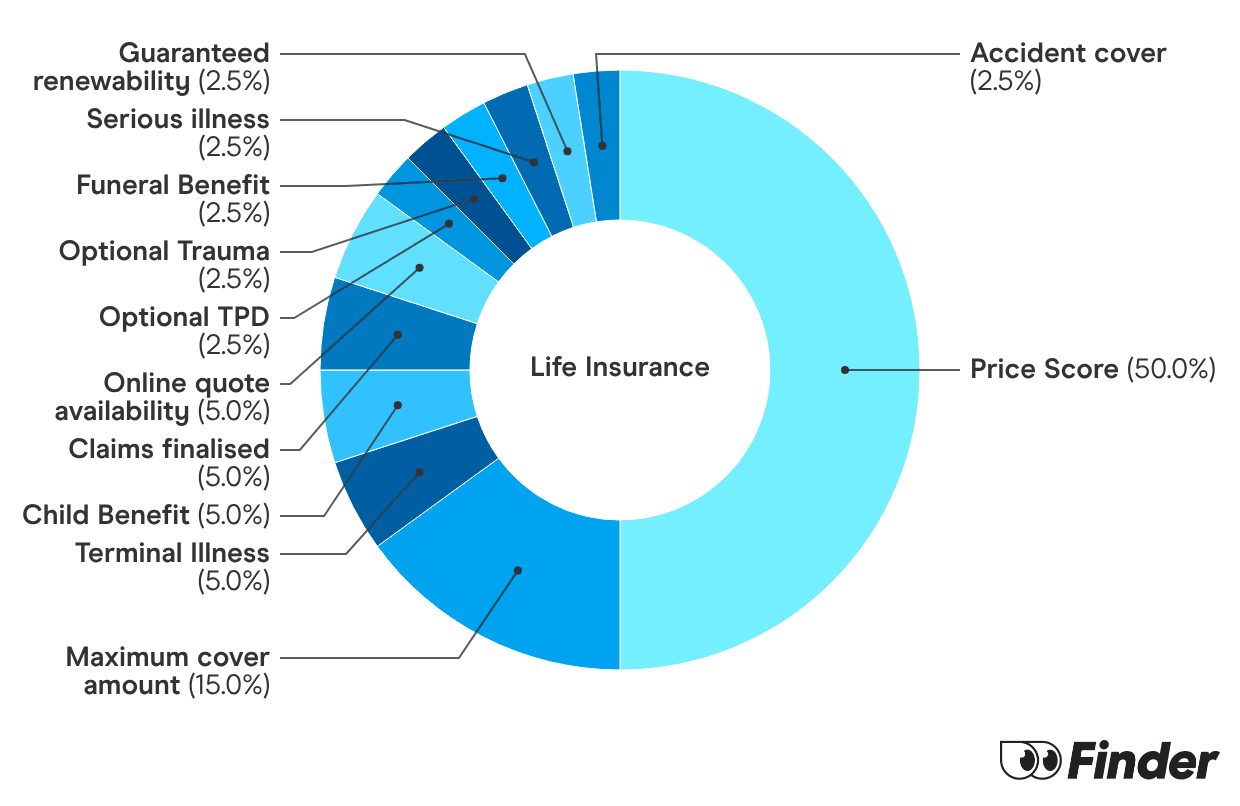
Finder Score - Life Insurance
Life Insurance is a little complicated and a lot overwhelming. That's why we made the Finder Score, to make it easier to compare Life Insurance products against each other. Our experts analysed over 30 products and gave each one a score out of 10.
But a higher score doesn't always mean a product is better for you. Your situation is unique, so your policy choice will be too. Don't think of Finder Score as the final word, but as a good place to start your life insurance comparison.
Why compare insurance with Finder?
-
You pay the same price as buying directly from the insurer.
-
We're not owned by an insurer (unlike other comparison sites).
-
We've done 100+ hours of policy research to help you understand what you're comparing.
What is death insurance cover?
Death insurance cover, sometimes called life insurance, pays a lump sum to your beneficiary (or beneficiaries) if you pass away.
Death cover can bring peace of mind for you and your family. It can help secure your family's future and ensure they don't need to face the burden of financial uncertainty while simultaneously coping with grief.

- Lump sum payments in the event of death or terminal illness
- Advance payments to help cover the immediate costs
- Financial planning and counselling benefits for your family
- Benefit payments available in the event of serious injury or illness

What type of expenses am I covered for?
- Rent or mortgage repayments
- Children’s education expenses
- Daily living expenses and needs, such as food and clothing
- Costs to hire housekeeper or nanny
- Home maintenance costs
- Funeral expenses
- Legal expenses
- Estate settlement costs
How do I determine my life insurance needs?
There isn't one death cover that is ideal for everyone, which is why it is important to assess and compare different policies to determine which plan would be most suitable for you and your family's needs. Here are a few things to consider when calculating the right amount you need:
- You current annual income. Replacing your lost income for the years required
- Short-term and long-term debts. This often includes mortgage, credit card debts, personal loan, and car loan
- Your immediate expenses. This includes food, clothing and shelter (rent payments, if you don't own your home)
- Your children's education expenses. Consider the number of children you have and their respective ages to determine the total amount of expenses
- Emergency funds. Work out how much of your expenses such as a funeral arrangement, medical treatments, legal fees and estate settlement costs can be covered by your savings.
You can use a life cover calculator to give you an indication on how much you may need for a death cover. If you want further guidance, an experienced death cover agent can help you in determining an ideal amount that will match your needs situation, as well as providing tailored advice on life policies that suit what you require.
Speak to an insurance specialist to help you find personalised cover
What forms of death cover are available?
The two main types of life insurance are term life insurance and funeral cover, both of which can pay out the full sum insured on death. If you are not eligible to obtain term life insurance (such as due to medical conditions or age), a funeral plan may be a good option.
| Type | Details |
|---|---|
| Term life insurance |
|
| Funeral plans |
|
Death cover for different life stages
-
You're relatively young and healthy and your premiums are reasonably low. You might be single, or you might have a family and dependents and can find a level of cover to suit.
As your responsibilities grow you will typically be adjusting your policy and increasing your level of cover later on. Here, additional disability cover with term life insurance can deliver an important extra layer of protection for you in the event of life-changing accident or illness.
-
You may be married with children and you might be bearing more financial obligations. Investments and debt can also make up a significant portion of your finances which should be considered when comparing life insurance policies or adjusting cover.
If you don't have children already, you may be planning for kids in the future, and their age will determine how far ahead you need to plan for their education expenses.
Disability can be just as significant a concern as death, putting you and your family in a difficult position. With more assets, costs and dependents, as well as your retirement to think about, a comprehensive and versatile life policy can be important in this life stage.
-
At this point, if you have children, they will likely have moved out and you would be looking towards retirement. Protecting your investments and assets through life insurance may be an important part of retirement planning, and paying off the mortgage and other debt before retirement is also a concern.
Don't underestimate the level of cover you might need in order to provide for a long retirement spanning several decades. Consider your children's circumstances when looking at policies, as well as the likelihood of your partner being able to return to the workforce if something happens.
-
After retirement, your financial obligations will generally have decreased, but naturally so has your income. You can get cover to help you keep up with your plans, such as travelling, in line with your financial capacity. The assets you've spent a lifetime building may need to be protected, and any financial obligations towards your partner or other dependents.
Estate planning and aged care costs can be worth considering, as are growing medical expenses or costs relating to other health needs. Financial planning might also be important to consider, specifically in the form of estate tax mitigation and budgeting for an extensive retirement with many years ahead.
Finding a policy to match your budget and help maintain your lifestyle while protecting important obligations depends largely on your circumstances, such as your age of retirement and current income from assets.
Can death cover pay for accidents and injuries?
In the event of a fatal accident or injury, death cover of both types, funeral plans and term life insurance, can pay out, while some benefits may also be available for survivable accidents or injuries, although these are generally only available with term life insurance policies.
-
With funeral plan insurance policies, you may be able to institute a premium pause in the event of financial hardship, while still retaining cover for accidental death. This can let you stop paying premiums for a limited time, such as 3 months, while still knowing that the policy will pay out in the event of an accidental death.
-
The accidental death benefit available with term life insurance policies can pay out an additional amount should your death be the result of an accident, in order to help compensate for the suddenness of the event and additional costs that may be associated. This may only be available with term life insurance policies.
For severe but survivable accidents you may also be able to link additional forms of cover to your policy including:
- Trauma, serious injury or serious illness cover: In the event of specified health events you can get paid lump sum benefits. The specific events covered will vary between policies, but can include cardiac arrest, cancer, loss of limbs, blindness, heart surgery and many others.
- Total and permanent disablement or income protection insurance: Should you suffer an accident, injury or illness that leaves you permanently disabled, this type of policy can pay benefits. Depending on the type of cover, disabled might be defined by an inability to work, an inability to perform specific tasks or a percentage measurement of disability based on your physical injuries and loss of function.
What is funeral cover?
Funeral cover is an insurance product that gives your family a lump sum when you die so they can pay for your funeral without worrying about the hefty costs.
If you are in the older age group and have little debt, you may want to consider a funeral plan that will take care of your funeral costs.
Frequently asked questions
-
Your death insurance premiums are calculated based on several factors. These typically include your age, gender, occupation, health and medical history, lifestyle choices such as smoking or dangerous hobbies and the amount of cover you choose. The type of premium structure you select also plays a role.
-
Stepped premiums increase annually as you get older, becoming more expensive over time. Level premiums remain relatively constant throughout the life of your policy, not increasing with age but usually adjusting for inflation. While level premiums might start higher, they can be more cost effective over a long period.
-
Yes, like most insurance policies, death insurance policies have exclusions. Common exclusions can include death as a result of self inflicted injury, engaging in illegal activities or war. Some policies may also have waiting periods or specific exclusions related to pre-existing medical conditions or dangerous occupations. Always read the Product Disclosure Statement PDS carefully.
-
Generally, if your death insurance is held outside of superannuation, the lump sum payout is tax free for your beneficiaries. If the policy is held within a superannuation fund, the tax treatment can be more complex and may depend on factors such as the age of the beneficiary and their relationship to you. It is advisable to seek financial advice.
-
Yes, many Australians hold death insurance through their superannuation fund. This can often be a cost effective way to get cover as premiums are paid from your super balance. However, policies held in super can have different terms, conditions and tax implications compared to policies held outside super.
-
You can usually nominate almost anyone as a beneficiary for your death insurance policy, including your spouse or partner, children, other family members or even a legal entity. It is important to make sure your nomination is valid and up to date, especially after significant life events like marriage divorce or the birth of a child.
-
Whether you need a medical exam depends on the insurer, your age, the amount of cover you are applying for and your medical history. For higher sums insured or if you have certain health conditions, an insurer may request a medical examination, blood tests or a report from your doctor. Some policies offer simplified underwriting with no medical exams.
-
It is often possible to get death insurance if you have a pre-existing medical condition, but the terms of the policy might be different. Insurers may apply an exclusion, impose a loading (increased premium) or offer cover with a waiting period related to that specific condition. In some cases, if the condition is severe, cover may be declined.
-
If you stop paying your death insurance premiums, your policy will typically lapse after a grace period. This means your cover will end and your beneficiaries will not receive a payout if you pass away. It is important to maintain regular premium payments to keep your policy active.
-
To make a death insurance claim, beneficiaries typically need to contact the insurer directly. They will usually be required to provide the policy number, a certified copy of the death certificate and proof of their identity. The insurer will guide them through the process, which may involve further documentation and assessment.
James Martin was the insurance editor at Finder. He has written on a range of insurance and finance topics for over 7 years. James often shares his insurance expertise as a media spokesperson and has appeared on Prime 7 News, Insurance News, 7NEWS and The Guardian. An experienced journalist, James' work has featured in publications including The Irish Times, Companies100 and In Business. He holds a Tier 1 General Insurance (General Advice) certification and a Tier 1 Generic Knowledge certification, both of which meet the requirements of ASIC Regulatory Guide 146 (RG146). See full bio
- Car, home, life, health, travel and pet insurance
- Managing the cost of living
- Money-saving tips
Richard Laycock is Finder’s insights editor after spending the last five years writing and editing articles about insurance. His musings can be found across the web including on MoneyMag, Yahoo Finance and Travel Weekly. Richard studied Media at Macquarie University and The Missouri School of Journalism and has a Tier 1 Certification in General Advice for Life Insurance. See full bio
Get rewarded $$ for switching with Finder Rewards
Find a better deal, save on your bills and get a free gift card. Sign up to be the first to hear about new Finder Rewards.
More guides on Finder
-
How do life insurance payouts work?
From the claims process to exclusions, we detail how life insurance gets paid out.
-
OnePath Life Insurance Review
Compare life insurance policies on offer from OnePath and find out how to a secure quote for cover. Find out what is covered under each of the OnePath policies.
-
RAC Life Insurance Review
Read our review of RAC life insurance. Find out if it’s right for you.
-
Medibank Life Insurance Review
Choose a flexible life insurance policy that meets your needs with Medibank life insurance.
-
Life insurance for diabetics
Does having diabetes affect your ability to take out a life insurance policy? Find out what Australian insurers say.
-
Insuranceline Life Insurance Review
Get protection against the unexpected with Insuranceline Life Insurance policies.
-
Australian Super Life Insurance
Read the finder.com.au review of Australian Super Life Insurance
-
CommBank Life Insurance Review
Read the finder.com.au CommBank life insurance review and find out what is covered under each policy. CommBank Total Care policies include trauma, TPD, income protection and child cover options.
-
NobleOak life insurance review
Looking for a direct insurance company that offers affordable, straightforward cover options? Discover the benefits of NobleOak life insurance.
-
Real Insurance Life Insurance Review
Compare Life Insurance and Income Protection policies from Real Insurance and get cover in place with no medical or blood tests.