We currently don't have that product, but here are others to consider:
Looking for other options? Check out these similar products.
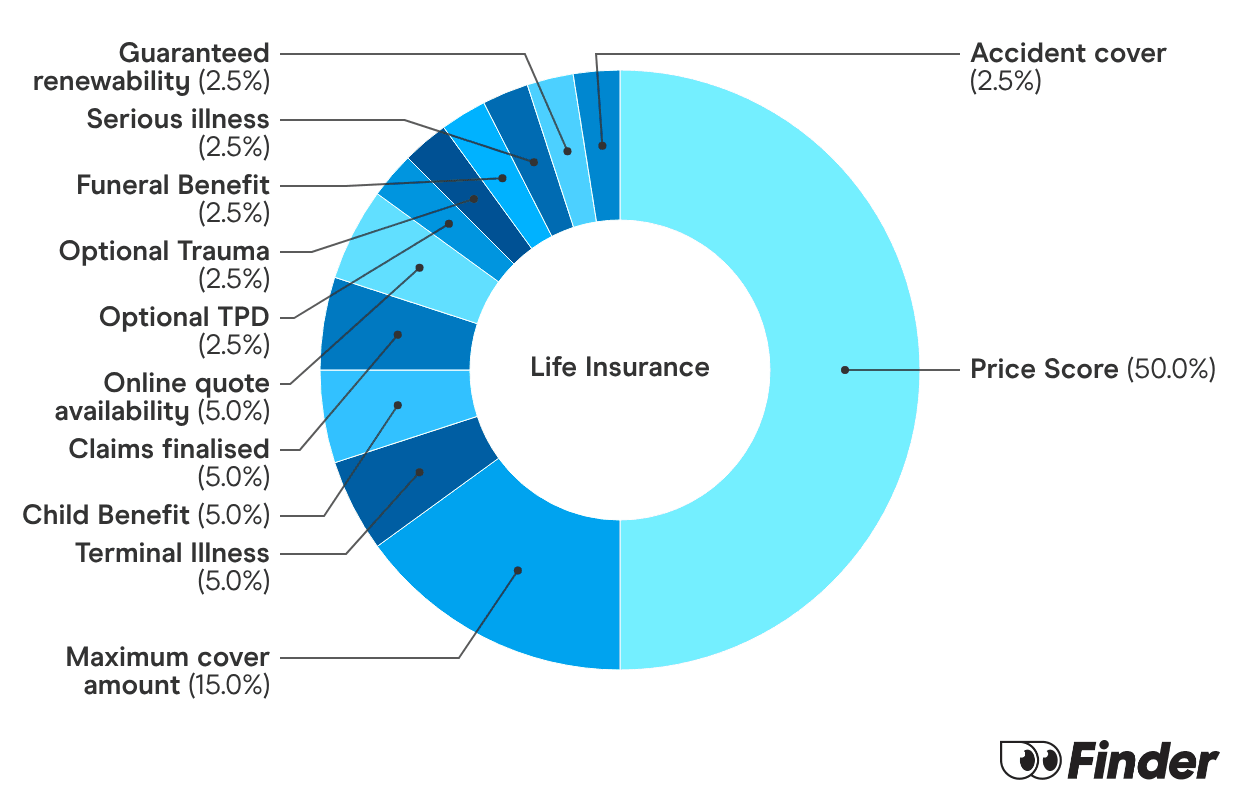
How we picked these
What is term life insurance?
Term life insurance is a type of life insurance that covers you for a set period of time, known as the "term". If you pass away or are diagnosed with a terminal illness during that term, it pays a lump sum to the people who depend on you. That money can go towards anything your family needs, from staying on top of the mortgage and debts to covering everyday living costs or your children's education.
Unlike some older-style policies, term life insurance has no investment or savings component and no cash-out value. You're paying purely for cover. If the term ends and you're still here, the policy simply stops and nothing is paid. That's exactly why term life is usually the most affordable way to get a large amount of cover, because you're only paying for protection.
In Australia, most life insurance sold today is effectively term-based, with cover that renews each year up to a maximum age (often 99). It's the simplest, most common form of life cover, and for most families it's the one that does the essential job: making sure the people who rely on you are looked after if the worst happens.
Pros and cons of term life insurance
Pros
It offers a lump sum payout. Your benefit's paid in one go, meaning your family has flexibilty with how they can use the money. It could be used to pay off debts such as the mortgage or credit cards. Or to maintain your family's lifestyle, such as your children's education costs.
You can be paid out if you get a terminal illness. If a medical practitioner expects you to die within 12 months, your policy can pay out the benefit as an advance payment. A terminal illness payment can help with medical bills, funeral costs or even as a cash gift.
Your policy can be renewed each year. Most policies can be renewed until you reach the age of 99, if necessary.
Policies can be straightforward. Exclusions are fairly limited with term life insurance. One common exclusion is a passing from suicide in the first 13 months of a policy. Otherwise, your family will usually be able to rely on a cash payout if you die during the policy term.
Cons
There's no benefit once the term ends. If you outlive your term insurance policy, it'll expire. Your beneficiaries won't receive any cash out or death benefit. (It's a key reason why term life insurance is competitively priced.)
Regular renewals and rising costs. Term life insurance is not a 'set and forget' insurance product. As a policy is only valid for the term you've chosen, when the policy expires at the end of that term you need to take out a new policy if you want to continue to be covered. At the end of the term, you're older than you were when you first applied, it could well make finding a new policy more expensive.
Your premium will directly reflect your lifestyle. Your premiums will be based on the level of risk you present to your insurer. If you smoke, engage in high-risk activities or work in a dangerous occupation, you can expect to pay more than others.
How much does term life insurance cost?
Below is a quick view of how much life insurance could cost you, per month.
*Prices are an estimate based on a 35 year old non-smoking male office worker. Quotes last checked in August 2026 and are subject to change.
The 4 types of life insurance compared
"Life insurance" is often used as an umbrella term, but it actually covers a few different types of protection. Many Australians hold more than one, either directly or through their super. While term life is the one this page focuses on, it helps to see how it compares to the others so you can work out which mix is right for you and your family. Here's how the 4 main types stack up:
A regular payment replacing part of your income while you can’t work.
Monthly, while you’re unable to work due to illness or injury.
When is a good time to take out cover?
This will really depend on your own situation and what you would need to cover in the event of your death.
Some key triggers that lead people to take out cover or review their existing cover include buying a house, getting married and having their first child.
Building Wealth
18-25
25-35
35-45
Starting career
Start accumulating wealth
No dependents
No mortgage
Few financial commitments
Active lifestyle
Increase in earnings
Career development
Long term debt with mortgage
Possible short-term debt
Marriage and children
Increase in earnings
Career development
Mortgage decreasing
Saving for retirement
Securing retirement
45-55
55-65
Maximising earnings
Preparing for retirement
Less concern around financial security
Less long-term debt
Fewer financial commitment as children start to move out
Focus on other investments
Protecting wealth accumulated
Income decreases
Focus on investments
Finance lifestyle with savings
The maximum entry age may also change based on the type of premium you choose and how much cover you apply for.
Is whole of life insurance still available in Australia?
Whole of life cover is no longer sold in Australia. It was a popular product decades ago, but new policies aren't offered today.
Whole of life was a permanent policy that covered you for your entire life and was guaranteed to pay out eventually, rather than only during a set term. It also included an investment or "cash value" component, part of every premium was invested by the insurer, and many Australians used it as a way to save for retirement, cashing it out when they stopped working.
When compulsory superannuation was introduced in 1992, Australians had a dedicated, tax-effective retirement savings system, and super funds also came with built-in death benefits and life cover. Whole of life's "insurance plus savings" model was largely doubled up by super, so demand fell away and insurers stopped selling it. Today it's only held by people who took out a policy before the early 1990s.
Are there any add-ons I should consider for term life insurance?
There are a number of extra features you can add to your term life insurance policy to tailor it to your needs, and so you may want to consider:
Accidental death benefit. Will pay an additional amount above your coverage amount if your death is the result of an accident.
Children's term life insurance. Can pay a death benefit for each of your children covered under your policy in the event of their death. You can usually add insurance for your child for around $10,000 and $20,000, based on their age and other eligibility requirements.
Total permanent disablement. Will make sure your premiums are paid for you if you become totally disabled. There are often age and coverage restrictions that apply.
Accelerated death benefit. Will make an advance payment of part of your benefit amount if you are diagnosed with a terminal illness.
Term life insurance pays a lump sum if you pass away or are diagnosed with a terminal illness. Total Permanent Disability TPD insurance provides a lump sum payment if you become permanently disabled and are unable to work again. While term life covers death and terminal illness TPD covers severe permanent disability.
Term life insurance provides a lump sum payment to your beneficiaries if you die or are diagnosed with a terminal illness. Income protection insurance on the other hand provides a regular income stream if you are temporarily or permanently unable to work due to illness or injury. Income protection replaces a portion of your income while you are alive and unable to work.
Term life insurance pays out for death or terminal illness. Trauma insurance also known as critical illness cover pays a lump sum if you are diagnosed with a specific serious medical condition such as a heart attack cancer or stroke. Trauma insurance provides funds for recovery while you are still alive whereas term life is for death or terminal illness.
Term life insurance offers a substantial lump sum payment to your beneficiaries that can cover a range of financial needs including debts living expenses and education costs. Funeral insurance provides a smaller benefit specifically designed to cover funeral and related end of life expenses.
The claims process typically involves your beneficiaries contacting the insurer to notify them of your passing or terminal illness diagnosis. They will need to complete a claim form provide identification documents and supply supporting medical and death certificates. The insurer will then assess the claim and if approved pay the benefit.
Your beneficiaries will generally need to provide a certified copy of the death certificate the original policy document proof of the beneficiaries identity and bank details and any medical reports or diagnostic tests related to the cause of death or terminal illness. The insurer may request additional documents as needed.
This can vary depending on the complexity of the case the completeness of the documentation and the insurer's processes. Simple claims with all required documents can sometimes be processed within a few weeks while more complex cases may take several months.
If you miss a premium payment your policy may enter a grace period usually 30 days, during which you can still make the payment without losing cover. If the payment is not made by the end of the grace period, your policy may lapse meaning your cover will cease. It is important to contact your insurer immediately if you anticipate missing a payment.
Yes, most term life insurance policies have specific exclusions. Common exclusions include death as a result of suicide within the first 13 months of the policy, or certain high risk activities that were not disclosed at application, or death due to a pre-existing condition that was not declared or accepted by the insurer. Review your Product Disclosure Statement PDS for full details.
You can generally cancel your term life insurance policy at any time by contacting your insurer directly. They will usually require written notification. Keep in mind that if you cancel outside of the initial cooling off period you will not receive a refund of premiums paid for the period you were covered.
Yes, it is possible to hold multiple term life insurance policies from different insurers. Some people choose to do this to achieve a higher total sum insured or to tailor different policies to specific needs. However you will need to apply for and pay premiums for each policy separately.
You can nominate almost anyone as a beneficiary on your term life insurance policy including your spouse children other family members a de facto partner or even a legal entity. It is important to ensure your nominated beneficiaries are clearly identified and kept up to date to avoid delays or disputes.
Ceyda Erem is Finder’s senior writer for insurance and has almost 10 years of experience writing about personal finance. Formerly a copywriter for several business and finance clients, Ceyda has written hundreds of articles, guides, blogs and more to ensure Australians stay in the loop about how to best manage their money. She has a Bachelor of Arts, Majoring in Writing from Macquarie University.
See full bio
Ceyda's expertise
Ceyda
has written
212
Finder guides across topics including:
Richard Laycock is Finder’s insights editor after spending the last five years writing and editing articles about insurance. His musings can be found across the web including on MoneyMag, Yahoo Finance and Travel Weekly. Richard studied Media at Macquarie University and The Missouri School of Journalism and has a Tier 1 Certification in General Advice for Life Insurance.
See full bio
Review the Australian Seniors Life and compare options available.
Important information about this website
Finder is a comparison service. We do not compare every product or every provider in the market.
We make money through commercial arrangements with some of the providers on this site. Products marked 'Sponsored', 'Promoted', 'Featured' or 'Advertisement' appear as a result of a commercial arrangement.
Our editorial content, product reviews and any 'Top Pick' designations are prepared independently of these commercial arrangements.
The default order of products in our tables can be influenced by commercial arrangements. You can re-sort or filter using the controls above each table.
Some content on this site may be generated or supported by AI tools. You should verify details directly with the provider.
Finder is one of Australia's leading comparison websites. We are committed to our readers and stand by our editorial principles.
Our comparison service does not include every product or every provider in the market. Some product issuers offer their products under multiple brands or through associated companies. Where we can, we identify the underlying issuer so you can compare like with like, but you should always check with the provider directly to confirm which brand you are dealing with.
Finder is a comparison website and an intermediary. We are not a product issuer and we do not provide personal financial or credit advice. When you click a link to a product, or apply for a product through our site, you deal directly with the product issuer. We may receive a referral fee, commission or other payment from the issuer if you click through, apply or take out a product. We describe these arrangements in more detail under 'How we make money' below.
Product features, fees, terms and eligibility criteria are set by the product issuer and may change. We rely on information supplied by issuers when we present product details on our site. Before you apply for or take out any product, you should confirm the details directly with the issuer.
We earn revenue from Finder in four principal ways:
Referral fees and commissions. When you click a product link, complete an enquiry form or apply for a product through our site, we may receive a referral fee, commission or other payment from the product issuer. We may also receive payment based on the volume of leads or conversions we send to an issuer.
Sponsored placements. Products marked 'Sponsored', 'Promoted', 'Featured' or 'Advertisement' appear as a result of a commercial arrangement between Finder and the issuer. These labels always indicate a paid placement. We do not use them for editorial choices.
Display advertising. Banner advertising, newsletter advertising and similar display ads on our site are paid by advertisers.
Content sponsorship. Some articles, videos and social media posts are sponsored by an issuer and are clearly labelled as such.
Our editorial opinions, product reviews and any 'Top Pick' designations are prepared independently of these commercial arrangements. A 'Top Pick' is an editorial choice made by our writers and editors based on the criteria described on each comparison page. A 'Top Pick' is not a personal recommendation and does not mean the product is appropriate for your circumstances.
If you would like to know whether we have a commercial arrangement with a specific product issuer, please contact us.
When products are grouped in a table or list, the default order can be influenced by commercial arrangements we have with product issuers. In some categories, sponsored or featured products appear in the top positions of the table by default, and are always labelled as such.
Other factors that influence default order include price, fees and features, and (where relevant) our editorial view of the product.
You can re-sort every comparison table using the controls above the table. You can filter by product features that matter to you. The order you see after re-sorting or filtering is not influenced by commercial arrangements.
Some content on this site is generated or supported by artificial intelligence tools, including our AI-powered assistant FinderBot. AI-generated content may contain errors. Please verify important information directly with the product issuer before making a financial decision. For more information about FinderBot, see the FinderBot Terms of Use and FinderBot Privacy Collection Notice.
Please read our website terms of use and privacy policy for more information about our services and our approach to privacy.
We update our data regularly, but information can change between updates. Confirm details with the provider you're interested in before making a decision.
Our goal is to create the best possible product, and your thoughts, ideas and suggestions play a major role in helping us identify opportunities to improve.