Looking for other options? Check out these similar products.
How we picked theseKey takeaways
- Many cards offer hundreds of dollars cashback for meeting initial spending requirements like $400 for $5,000.
- Ongoing cashback rates often range from 0.49% to 1% of spending, generally capped monthly.
- Compare the annual fee against your expected cashback to ensure the card provides net financial value.
Best cashback credit cards
- Highest cashback credit card offer: BCU Rewards credit card
- Best low rate cashback credit card: Westpac Low Rate Card - Cashback Offer
Finder's top cashback credit card offers in October
Here are the top credit cards with cashback offers based on their Finder Scores:
- The American Express Platinum Business Card has a Finder Score of 9.9.
- The MONEYME Cashback Rewards Credit Card has a Finder Score of 9.9.
- The BCU Rewards credit card has a Finder Score of 9.33.
- The St.George Vertigo Card - Cashback Offer has a Finder Score of 9.34.
- The Bank of Melbourne Vertigo Card - Cashback Offer has a Finder Score of 9.34.
- The BankSA Vertigo Card - Cashback Offer has a Finder Score of 9.34.
- The NAB Low Rate - Cashback Offer has a Finder Score of 9.21.
Updated October 2026 by Finder's senior money editor, Richard Whitten.
Types of cashback credit card offers
A cashback credit card gives you money back on your statement or vouchers you can spend.
The most common cashback offers are:
- Earning cashback per $1 spent on the card. Some cards offer a percentage cashback on your spending. With a 1% cashback, if you spent $2,000 in a month you'd earn $20 cashback. These cashbacks are typically capped to a certain dollar amount each month.
- Promotional sign-up cashbacks. New customers can sometimes get a one-time cashback (often worth several hundred dollars) if they spend a certain amount in the first month or two after activating the card.
You can also convert reward points to cashback
Most rewards credit cards give you the option to convert your reward points into cashback. You can convert 1,250 ANZ Reward Points to a $5 cashback, for example.
Some banks also offer cashback deals that don't involve points. For example, people with an eligible Westpac credit card can get personalised cashback offers through Westpac Extras, paid as a statement credit.
Want ongoing cashback as you spend?
Several credit cards on that market give you back a percentage of your regular spending ongoing: the BCU Rewards Credit Card, ING Orange One Rewards Platinum and the Queensland Country Bank Visa My Rewards Card.
BCU limits your cashback amount to $500 a year and ING limits the cashback amount to $30 a month or $360 a year. Queensland Country Bank reward dollars are capped at $70 per month or $840 a year.
The pros and cons of cashback credit cards
Pros
- Simplicity. Unlike rewards credit cards, where figuring out the value of rewards can be complicated, cash back rewards are straightforward.
- Usefulness. Cash or statement credits are a practical and versatile reward. If it's money you were going to spend anyway, the cashback is a nice bonus.
- Other perks. Credit cards with cashbacks may offer features like complimentary travel insurance or airport lounge passes.
Cons
- Annual fees. Most cards charge an annual fee. Most cashback cards have lower annual fees than frequent flyer or rewards cards though.
- High interest rates. If you often carry a balance, the cost of interest could outweigh any cashback rewards that you earn from the card.
- Capped rewards. Most cards cap the number of times you can redeem a cashback offer or limit how much of your spending will earn cash back.
"I think of cashbacks as a nice little benefit that some cheaper, low rate credit cards offer. The cashback usually outweighs the annual fee but overall it's not the biggest card perk. If you get a more expensive points-earning card you could earn Qantas or Velocity Points worth thousands of dollars. Of course, these cards are for bigger spenders. And some cards offer both a cashback and frequent flyer points! "
How can I compare cashback credit cards?
- Check the introductory offer requirements. If a card offers $200 cashback when you spend $3,000 on eligible purchases in the first 3 months, make sure you can realistically meet that spending requirement. Otherwise you won't qualify for the cashback.
- Is the cashback amount worth it? Look at the value of the cash rewards you'll collect versus the card's overall cost. If the value of the cashback isn't worth it, you might find a $0 annual fee or an interest free credit card with a 0% purchase rate offer more suitable for you.
- Remember that percentage cashback spend offers are usually capped. Most cashback cards have a limit on how much value you can get back. You could get 1% cashback on your spending, but with a limit of $30 back per month. No matter how much you spend, your cashback will only ever earn you $30 a month or $360 a year.
- Rewards value. If you have a rewards credit card that offers cash back and other types of rewards (such as flights, travel upgrades or merchandise), you can check to see if there are rewards that have a higher retail or regular price value than the cashback amount.
How to decide if a cashback credit card is worth it
- If you spent $3,000 per month on this card: You would earn $30 cash back per month, or $360 per year. If you take the cost of the annual fee out, you would get $210 value from cash back rewards over that year.
- But if you only spent $1,000 per month on this card: You would earn $120 cash back in a year. That is $30 less than the $150 annual fee.
In this example the card could still be worth it, if you get other benefits from it like points or complimentary travel insurance. But for the cashback alone it's not worth it.
Frequently asked questions
-
A cashback credit card offers you rewards in the form of statement credits or vouchers when you meet a spend requirement, or for ongoing eligible spending. Sometimes, you can get a cashback offer on a credit card with ongoing low rates and low or $0 annual fees that aren't typically available with cards that offer ongoing rewards.
Standard rewards credit cards offer points for each $1 of eligible spending, which you can redeem for travel, retail items, gift cards, cashback and more.
-
You can typically get between $10 and $500 from an introductory cashback offer when you meet the spend requirements. For credit cards that offer ongoing cashback, it's usually between 0.49% and 1% of each eligible transaction.
While these are 2 of the most common types of cashback on credit cards, there are sometimes other promotions that could offer different amounts. For example, a card that has personalised cashback offers with retail partners could offer you $10 back when you spend $30 with the retailer.
-
Yes, you can generally use cashback rewards to pay your card's annual fee or the outstanding balance of a credit card if you redeem it through a rewards program. But if you get cashback as a credit on your account, you usually still need to make a minimum payment on your account by the statement due date to avoid late payment fees.
-
Anyone who meets the eligibility requirements for a cashback credit card can apply. These requirements vary between cards, but you can usually expect the following:
Eligibility requirements
- Age. You need to be at least 18 years old to apply for a credit card in Australia.
- Residency status. Most lenders require you to be a permanent Australian resident or citizen, though some do offer products to specific visa holders.
- Income requirements. Some cards list a minimum income amount that you need to earn before you can apply, others require you to earn a regular income. There are also cards that don't list an income requirement – but even then you'll need to include details about your money when you apply.
Credit card eligibility requirements are usually listed on individual card pages, as well as at the start of an online application. Make sure you read them before you apply to help save you time.
How to apply
You can apply online in around 10-20 minutes. Before applying, make sure you meet the eligibility requirements and have the necessary documents needed to complete your application. You'll need to provide proof of identification, proof of income and some additional information about your finances.
Once you have completed and submitted your application, you'll usually receive a response from the credit card provider within 60 seconds. If you're approved, you'll receive your card in the mail within 1-2 weeks.
The lowdown on the cashback credit cards Finder Score
The Finder Score helps you sort the junk from the gold so you can compare products faster.
Each month we carefully analyse over 250 credit card products and assess nine features and benefits of each card.
We assign scores out of 10 for each feature, and adjust the scores depending on what category we're looking at. The same card will receive a different score within each category, depending on the features being assessed.
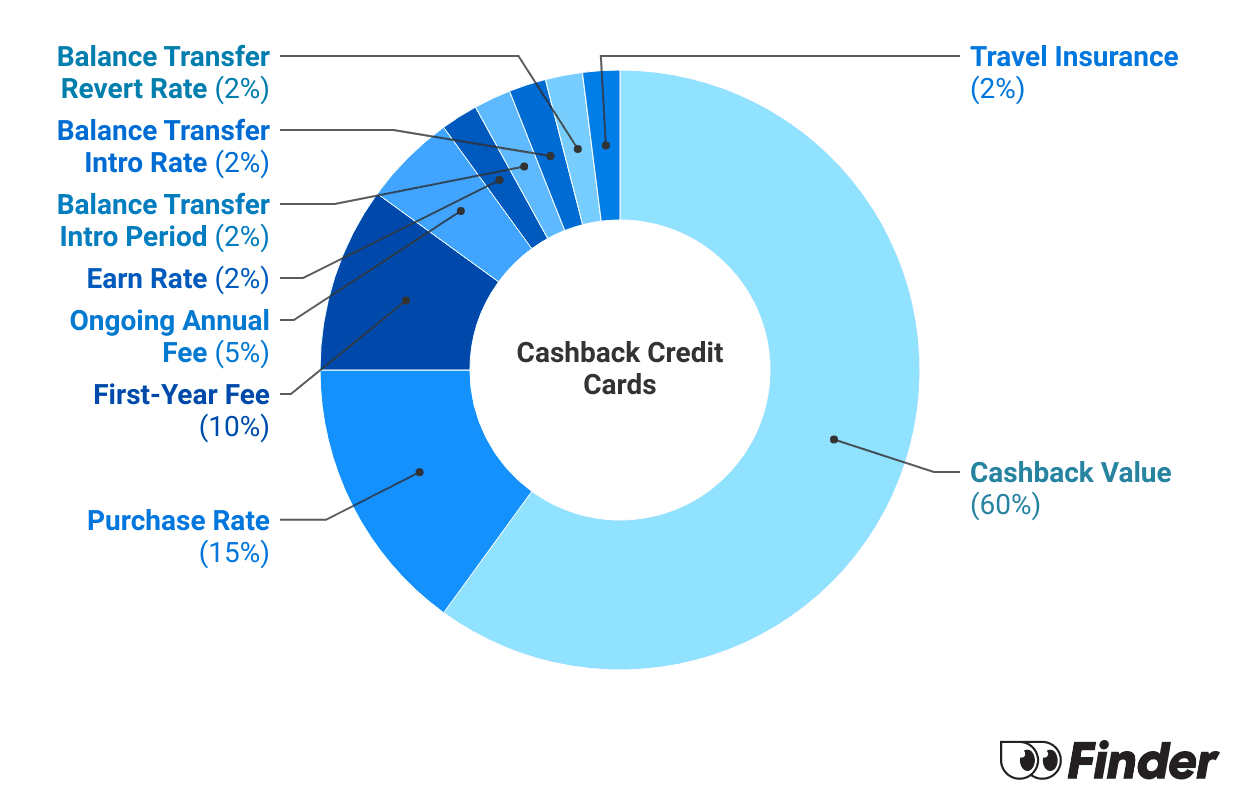
For cashback credit cards, we focus heavily on the quality of the cashback being offered, along with rates and fees.
To qualify for this category, credit cards must:
- Offer some form of cashback on spending. Where cashbacks are based on a % value of spend, we use an average monthly spend derived from RBA figures.
The Finder Score methodology is designed by our insights and editorial team. Commercial partners carry no weight, and all products are reviewed objectively.
Remember that Finder Score is just one factor to consider. Look at other aspects like fees, features, benefits and risks to make sure a product is suitable for you.
Cashback credit cards - score weightings
| Feature | Definition | Assessment | Weight |
|---|---|---|---|
| Cashback Value | The value of cash returned per dollar spent | Higher cashback rewards result in higher scores | 60% |
| Purchase Rate | Interest rate on new purchases | Lower rates receive higher scores (up to 22.49% max) | 15% |
| First-Year Fee | Fee charged for the first year of card ownership | Lower fees receive higher scores ($0 fee scores highest) | 10% |
| Ongoing Annual Fee | Fee charged from the second year onwards | Lower fees receive higher scores ($0 fee scores highest) | 5% |
| Earn Rate | Points earned for every dollar spent on eligible purchases | Points awarded per dollar (up to 1.5) | 2% |
| Balance Transfer Intro Period | The length of the balance transfer period | Longer periods are awarded higher scores | 2% |
| Balance Transfer Intro Rate | The rate applied to balance transfers | Lower rates receive higher scores (up to 22.99% max) | 2% |
| Balance Transfer Revert Rate | The interest rate charged after the BT period ends | Lower rates receive higher scores (up to 22.99% max) | 2% |
| Travel Insurance | Travel insurance offered with card | Cards that include travel insurance receive the full 10 points | 2% |
Breaking down the score tiers
- 9+ Excellent - These cards offer the highest cash returns with the lowest interest rates.
- 7+ Great - Reasonable ongoing purchase rates and cashback offers.
- 5+ Standard - These cards offer some value in return for spending.
- Less than 5 – Basic - These are generally cards targeted at a consumer segment, with cashback as a feature.
Sources
Richard Whitten is Finder’s Senior Money Editor, with over eight years of experience in home loans, property, credit cards and personal finance. His insights appear in top media outlets like Yahoo Finance, Money Magazine, and the Herald Sun, and he frequently offers expert commentary on television and radio, helping Australians navigate mortgages and property ownership. Richard started his career in education and textbook publishing in South Korea. He holds multiple industry certifications, including a Certificate IV in Mortgage Broking (RG 206) and Tier 1 and Tier 2 certifications (RG 146), as well as a Bachelor of Education from the University of Sydney and a Graduate Certificate in Communications from Deakin University. See full bio
- Home loans
- Credit cards
- Personal finance
- Money-saving tips
Get rewarded $$ for switching with Finder Rewards
Find a better deal, save on your bills and get a free gift card. Sign up to be the first to hear about new Finder Rewards.
More guides on Finder
-
Credit card rewards tracker: points, perks and fee changes
We're tracking every cut to a credit card points program ahead of the credit card surcharge ban.
-
Best international credit cards October 2026
Find credit cards that make international spending cheaper with 0% international transaction fees.
-
Health Professionals Bank Credit Card
If you work in the Australian health sector, this card offers an introductory rate of 7.9% p.a. on purchases and balance transfers for 6 months and an ongoing $0 annual fee. Is it right for you?
-
Australian credit and debit card surcharges explained
Compare the surcharges that you can expect when you pay with a credit card and pick up tips to avoid these extra fees.
-
Best credit cards in Australia October 2026
You deserve the best credit card. Let us help you find it.
-
Best Qantas credit cards
Compare the best Qantas frequent flyer credit cards based on bonus point offers, points per $1 spent, rates, fees and other features so you can find a card that works for you.
-
Best Velocity credit cards
Check out bonus point offers and travel perks such as lounge access and complimentary insurance with these Velocity Frequent Flyer credit cards.
-
Woolworths WISH gift cards
Learn how to buy and use a Woolworths WISH gift card in-store and online.
-
No international transaction fee credit cards
Find out how you can keep your overseas spending costs down by comparing credit cards with no foreign transaction fees and no currency conversion fees.