With these credit cards you can earn Velocity Points when you spend and get big bonus points offers, Virgin Lounge access, status credits and complimentary insurance.
4.7 based on 827 reviews
Compare Velocity credit cards
The cards in this table let you earn Velocity Points directly, or earn points in a reward program that you can convert to Velocity Points.
These cards are your ticket to sky-high point earning potential, hefty welcome bonuses, solid ongoing earn rates, and a premium selection of travel-centric perks.
7+
Great
These cards might have slightly less impressive points earning or sign-up bonuses.
5+
Standard
Reliable workhorses for frequent flyers who want a well-balanced card. Enjoy decent point earning potential, competitive rates, and a good mix of practical perks.
0+
Basic
The entry point in the frequent flyer market. Their sign-up bonuses and ongoing earn rates might not be as generous.
This month's best Velocity credit card offers
Here are the best Velocity credit cards based on their frequent flyer Finder Scores:
You can redeem these points for reward flights with Virgin or gift cards, hotels and other rewards.
There are 2 types of Velocity credit card:
Credit cards that earn Velocity Points directly. These cards earn Velocity Points for every dollar you spend, which are added straight to your Velocity account. American Express, NAB, Virgin Money and Westpac offer these "direct earn" Velocity Frequent Flyer credit cards. Earning points directly with one of these cards is usually the best way to maximise your points earning potential.
Reward cards that offer Velocity Points transfers. Some rewards credit cards let you transfer reward points from a credit card rewards program into your Velocity Frequent Flyer account. Some even offer an auto-transfer option. This method is very flexible because you can choose to keep points in your card's reward program or transfer them. And you sometimes get transfer bonuses for converting points.
Transfer rates
But the transfer rates usually result in fewer Velocity Points versus earning them directly. A typical transfer rate is 2 reward points to 1 Velocity Point. For example, if you had 50,000 CommBank Awards Points these would convert to 25,000 Velocity Points.
Velocity Points by the numbers
29% of Australians collect Velocity Points, according to Finder's Consumer Sentiment Tracker, compared to 35% who collect Qantas Points. And 63% of Australians collect Flybuys Points, which convert directly to Velocity Points. The average Australian Velocity Points-earner has a balance of 35,000 points. That's enough for a couple of domestic reward flight with Virgin.
Spending. Every Velocity credit card has an earn rate. The best cards have earn rates of at least 1 point for every dollar you spend. So the more you spend the more points you earn. You earn points on most transactions but typically not on BPAY payments or gambling transactions.
Bonus points. When you get a new credit card (especially if you're a new customer) you can earn bonus points. The best on the market right now give you between 30,000 and 200,000 Velocity Points this way. You need to spend a certain amount on the card in the first few months or hold the card for a year to get all the points. But the bonus points are an incredible way to boost your Velocity balance.
How to find the best credit card for earning Velocity Points
Here's what to look for when comparing cards:
The annual fee. Frequent flyer cards that give you tons of points come with higher annual fees (around $300 or more). Make sure you get more value out of the points to offset this fee. The best cards pay for themselves very quickly, especially if you use Velocity Points for high value redemptions like reward flights or business class upgrades.
The card earn rate. The higher the better, but 1 Velocity Point for every $1 you spend is good.
The bonus points offer. When getting a new card you should plan to take advantage of the bonus points offer if there is one. This is the best way to earn a stack of points quickly.
Complimentary insurance. Most frequent flyer cards give you complimentary travel insurance, and maybe other insurance policies like purchase protection insurance.
Travel perks. Many Velocity cards also give you 2 Virgin Australia Lounge passes per year. Some give you flight credits which can cover the cost of the card annual fee.
The purchase rate. If you don't repay your card spending in full each month you get charged interest on the unpaid balance. And the interest (or purchase) rate on a frequent flyer card is high, often around 20%
Must read: Not in your best interest
If you regularly carry a balance on your credit card you probably won't get much value out of a Velocity card because the rate will be too high. Stick to a low rate credit card instead.
How many Velocity Points do I need for a flight?
You can get Virgin Australia Reward Seat flights from 5,900 Velocity Points, not including carrier charges. For example, this is enough for a one-way Tier 1 economy reward flight from Sydney to Melbourne.
Here are some other examples to give you an idea of the points you'd need for a return flight:
Sydney to Melbourne in business class: 31,000 points (plus $86 in fees)
Brisbane to Perth in economy: 53,800 points (plus $112 in fees)
Sydney to Queenstown (NZ) in economy: 73,800 points (plus $433 in fees).
This means a competitive credit card bonus points offer will give you enough points for a reward flight (or flights).
"I chose Velocity Points over Qantas Points and went with a card that lets me earn Velocity Points directly. My main goal was domestic reward flights, and I shop at Coles more often than Woolies. Now I earn Velocity and Flybuys Points when I shop, and convert the Flybuys to Velocity Points. It pays for multiple domestic reward flights per year."
Choose Velocity Frequent Flyer as the program and put the number of points into this calculator to get a dollar value for them.
Frequently asked questions
Each year the Finder Credit Card Awards recognises Australia's top credit cards, with expert analysis of rates, fees and offers based on 12 months' worth of data. Here are this year's winners in the Velocity Points category:
The American Express Velocity Platinum Card won this year's Velocity frequent flyer credit card award, combining a solid bonus points offer with high points-earning potential, lounge access, status credits and a complimentary domestic flight.
Citi's Premier Card - Velocity Points Offer also came in highly commended thanks to its high bonus points offer and an annual fee that was a touch lower than comparable cards.
The Velocity points you earn on your credit card for regular spending are typically added to your frequent flyer account once a month, after your card's statement is issued.
Point transfers usually take between 1-14 days to show up in your Velocity account, but it varies. For example, the terms and conditions for NAB Rewards transfers to Velocity state that it can take up to 10 business days.
Bonus point offers may take a little longer between the spend criteria being met and the points landing in your account. For example, American Express indicates this process will take 8-10 weeks.
You can earn Velocity Points on most everyday spending, including food and drinks, travel bookings and even medical appointments. While it varies between cards, transactions that don't usually earn points include cash advances, balance transfers, gambling transactions and BPAY payments.
No, you can use your credit card for flights with any airline or travel booking service that accepts credit card payments.
You'll still earn Velocity Points per $1 on eligible spending. But you'd miss out on any additional points and status you'd get if you travelled with Virgin Australia.
If you want to use your Velocity Points to make the booking, you can travel with Virgin or any of their partner airlines, including: Air Canada, Delta, Singapore Airlines and Etihad.
Technically, yes. This process of applying for a card, getting the bonus points and then cancelling the card is called "churning". If you're going to do this, make sure the points have landed in your account and you've paid the balance in full before trying to cancel.
But keep in mind that regularly applying for cards then cancelling them can lower your credit score and reduce your chance of approval. So it's a good idea to keep track of your credit score and limit applications within a 12-18 month period.
Status Credits help you reach higher Velocity membership tiers. Silver, Gold or Platinum status means you can get benefits like Virgin Australia airport lounge access, additional baggage and priority boarding.
Flying is the main way to earn Status Credits but there are a couple of other ways – including credit cards that offer bonus Status Credits. For example, a card might offer 100 Velocity Status Credit when you spend $4,000 in the first 3 months – but this is a rare feature.
According to Finder's credit card database, the American Express Velocity Platinum and the Virgin Australia Velocity High Flyer Card are the only credit cards that currently offer status credits. With the American Express Velocity Platinum, you'll get up to 100 Velocity Frequent Flyer Status Credits when you spend at least $50,000 on eligible purchases within your membership year. The Virgin Australia Velocity High Flyer Card also offers 100 bonus Status Credits when you spend $3,500 on eligible purchases each month for the first 2 months.
There's no single answer to this question, so let's look at a few scenarios:
If you want to fly overseas, Qantas Points offer access to reward flights with 29 partner airlines, including oneworld alliance members. Velocity Points offer access to reward flights with 9 partner airlines.
If you want to fly in Australia or New Zealand, both Qantas and Velocity Points give you plenty of options for economy, premium economy and business class reward flights.
If you already fly with one airline more than the other (e.g. Virgin Australia), focusing on earning points with the linked frequent flyer program can help you redeem reward flights faster.
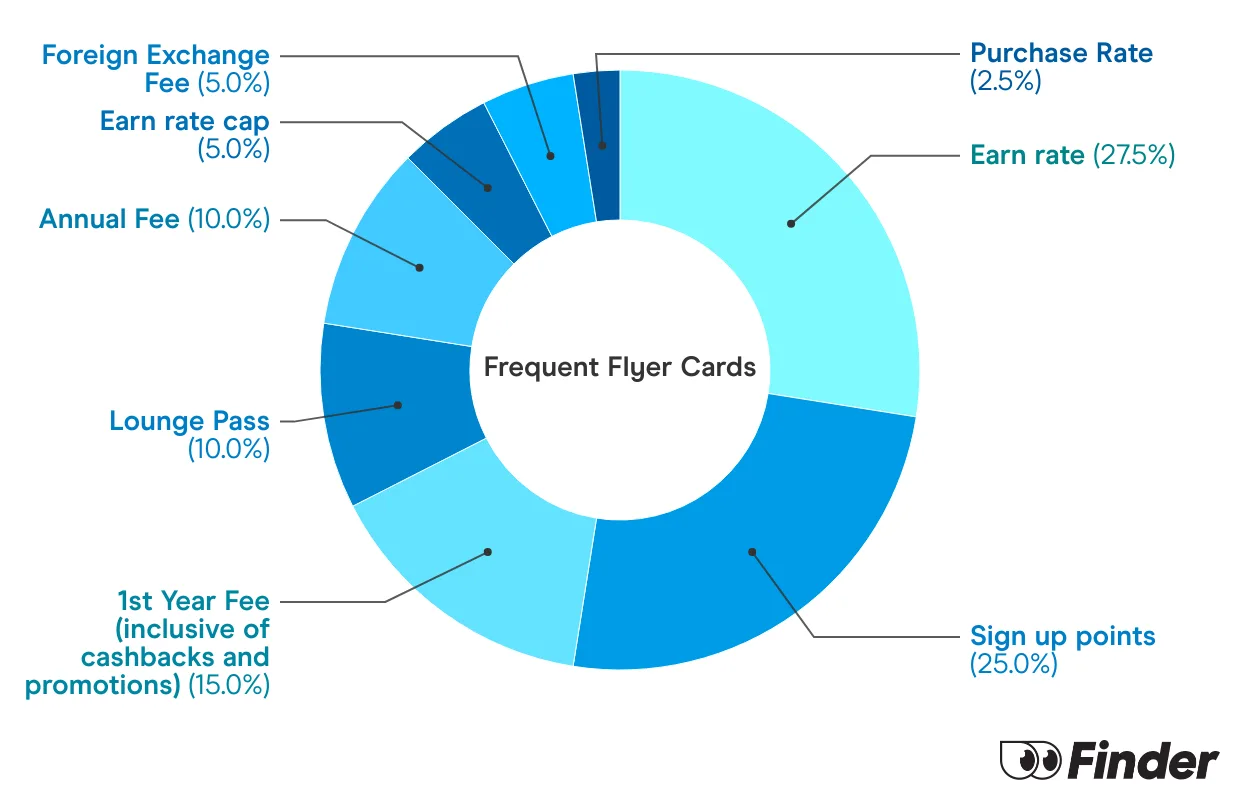
The Finder Score is an easy way you can figure out which frequent flyer credit cards are worth the trip, and which ones aren't worth getting out of bed for.
Here's how the score works:
We analyse over 250 credit cards and assess 8 features, giving a score for each one.
Then we combine these scores using a weighted methodology (because some features are more important than others).
This gives us a final score out of 10: the Finder Score.
Richard Whitten is Finder’s Senior Money Editor, with over eight years of experience in home loans, property, credit cards and personal finance. His insights appear in top media outlets like Yahoo Finance, Money Magazine, and the Herald Sun, and he frequently offers expert commentary on television and radio, helping Australians navigate mortgages and property ownership. Richard started his career in education and textbook publishing in South Korea. He holds multiple industry certifications, including a Certificate IV in Mortgage Broking (RG 206) and Tier 1 and Tier 2 certifications (RG 146), as well as a Bachelor of Education from the University of Sydney and a Graduate Certificate in Communications from Deakin University.
See full bio
Richard's expertise
Richard
has written
795
Finder guides across topics including:
The Wizitcard offers an alternative to traditional credit cards and buy now pay later, with no interest charges, a monthly fee and a virtual account – is it right for you?
With contactless payments, exclusive entertainment offers and online shopping benefits, Visa credit cards offer a wide range of benefits you can enjoy with most issuers in Australia.
Calculate how much you're paying in interest based on your current credit card repayments and discover how much you should pay each month to meet your financial goal.
Important information about this website
Finder is a comparison service. We do not compare every product or every provider in the market.
We make money through commercial arrangements with some of the providers on this site. Products marked 'Sponsored', 'Promoted', 'Featured' or 'Advertisement' appear as a result of a commercial arrangement.
Our editorial content, product reviews and any 'Top Pick' designations are prepared independently of these commercial arrangements.
The default order of products in our tables can be influenced by commercial arrangements. You can re-sort or filter using the controls above each table.
Some content on this site may be generated or supported by AI tools. You should verify details directly with the provider.
Finder is one of Australia's leading comparison websites. We are committed to our readers and stand by our editorial principles.
Our comparison service does not include every product or every provider in the market. Some product issuers offer their products under multiple brands or through associated companies. Where we can, we identify the underlying issuer so you can compare like with like, but you should always check with the provider directly to confirm which brand you are dealing with.
Finder is a comparison website and an intermediary. We are not a product issuer and we do not provide personal financial or credit advice. When you click a link to a product, or apply for a product through our site, you deal directly with the product issuer. We may receive a referral fee, commission or other payment from the issuer if you click through, apply or take out a product. We describe these arrangements in more detail under 'How we make money' below.
Product features, fees, terms and eligibility criteria are set by the product issuer and may change. We rely on information supplied by issuers when we present product details on our site. Before you apply for or take out any product, you should confirm the details directly with the issuer.
We earn revenue from Finder in four principal ways:
Referral fees and commissions. When you click a product link, complete an enquiry form or apply for a product through our site, we may receive a referral fee, commission or other payment from the product issuer. We may also receive payment based on the volume of leads or conversions we send to an issuer.
Sponsored placements. Products marked 'Sponsored', 'Promoted', 'Featured' or 'Advertisement' appear as a result of a commercial arrangement between Finder and the issuer. These labels always indicate a paid placement. We do not use them for editorial choices.
Display advertising. Banner advertising, newsletter advertising and similar display ads on our site are paid by advertisers.
Content sponsorship. Some articles, videos and social media posts are sponsored by an issuer and are clearly labelled as such.
Our editorial opinions, product reviews and any 'Top Pick' designations are prepared independently of these commercial arrangements. A 'Top Pick' is an editorial choice made by our writers and editors based on the criteria described on each comparison page. A 'Top Pick' is not a personal recommendation and does not mean the product is appropriate for your circumstances.
If you would like to know whether we have a commercial arrangement with a specific product issuer, please contact us.
When products are grouped in a table or list, the default order can be influenced by commercial arrangements we have with product issuers. In some categories, sponsored or featured products appear in the top positions of the table by default, and are always labelled as such.
Other factors that influence default order include price, fees and features, and (where relevant) our editorial view of the product.
You can re-sort every comparison table using the controls above the table. You can filter by product features that matter to you. The order you see after re-sorting or filtering is not influenced by commercial arrangements.
Some content on this site is generated or supported by artificial intelligence tools, including our AI-powered assistant FinderBot. AI-generated content may contain errors. Please verify important information directly with the product issuer before making a financial decision. For more information about FinderBot, see the FinderBot Terms of Use and FinderBot Privacy Collection Notice.
Please read our website terms of use and privacy policy for more information about our services and our approach to privacy.
We update our data regularly, but information can change between updates. Confirm details with the provider you're interested in before making a decision.
Our goal is to create the best possible product, and your thoughts, ideas and suggestions play a major role in helping us identify opportunities to improve.