Best
Best income protection insurance Australia 2026
If your income stopped tomorrow, could you cover the mortgage? The best income protection insurance in Australia, rated by Finder's experts.

Best
Top Value
Cheap
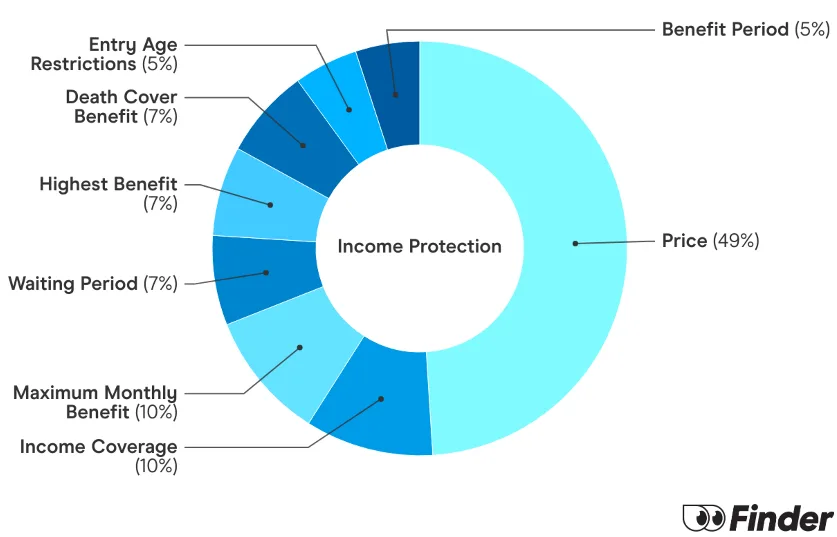
Our insurance team has gathered 200+ quotes from 14 of Australia's most popular providers to compare options. All the policies in this guide can pay you a monthly salary if you need to take time off work due to a sickness or injury. Remember, there's no single best income protection policy that suits everyone's needs, since we all have different budgets and priorities. The below should be used as a guide only.
Why you can trust our research
14 income protection providers analysed
100+ prices gathered
100+ hours of research
Here are 4 features to keep an eye on when choosing the best income protection insurance for you:

This is how long you will be paid. Usually, the insurer will give you a few options to choose from – e.g. 1, 2 or 5 years. The smaller the benefit period you choose, the cheaper your policy will be.

Once you're unable to work, you can submit your claim. You'll then need to wait a specific time before your policy begins. This is the waiting period.
For example, say you submit your claim on 1 November and you select a 14-day waiting period, your policy will begin on 14 November. You will receive your first monthly payment on 14 December.
Most policies let you choose from a few different waiting periods – the bigger the waiting period, the cheaper your policy will be. If you think you can get by on sick leave for a while, it might be worth selecting a bigger waiting period.

Insurers will also put caps on the amount you can claim per month. You'll only be able to earn a percentage of your current salary (usually up to 70%).
Insurers also set a maximum monthly benefit, typically around the $10,000 mark. If you earn more than that per month, insurers such as TAL and NobleOak go up to $30,000.

Stepped premiums go up as you get older but tend to start off cheaper. Level premiums don't increase over time but typically cost more to start off with. If you're worried about payments becoming unaffordable over time, level premiums might be best for you. Otherwise, it's likely that stepped premiums will be cheaper in the shorter term.

"An easy way to reduce your income protection premiums is to choose a longer waiting period. I have my policy set at the maximum: 90 days. I figure this is for a worst case scenario and if I claim on this policy, I should have enough savings to cover me for 90 days while I wait for benefits to kick in. In the meantime, my premiums are quite a bit lower."
Need income protection that won't break the bank?
Compare now and find a better deal.

How much could you save if you lived in a different city in Australia? Let's find out.
Income protection can be a valuable form of cover for Australians when its features are fully understood.
Find out what is and isn't covered by AAMI Income Protection and how to apply.
Income protection for couples ensures your partner isn't hurt financially if you are temporarily unable to work due to illness or injury.
Find out why income protection is still useful if you're over 60, and compare cover.
Salary continuance and income protection both serve to replace income in the event of injuries and illness. However, there are some key differences to know about.
Receive income cover for illness or injury with Suncorp Income Protection.
Life insurance and income protection serve two different purposes but can both offer valuable cover alone and when combined.
Find out how much your income protection insurance policy will pay out in the event of a claim. Receive quotes for income protection and apply securely.