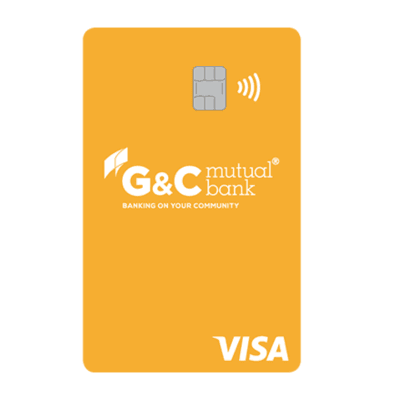
G&C Mutual Bank's Low Rate Visa Credit Card is the winner of this year's low rate credit card award. It has, you guessed it, a very low interest rate. Plus a low annual fee.

These are the market's top low interest rate credit cards based on their Finder Scores:
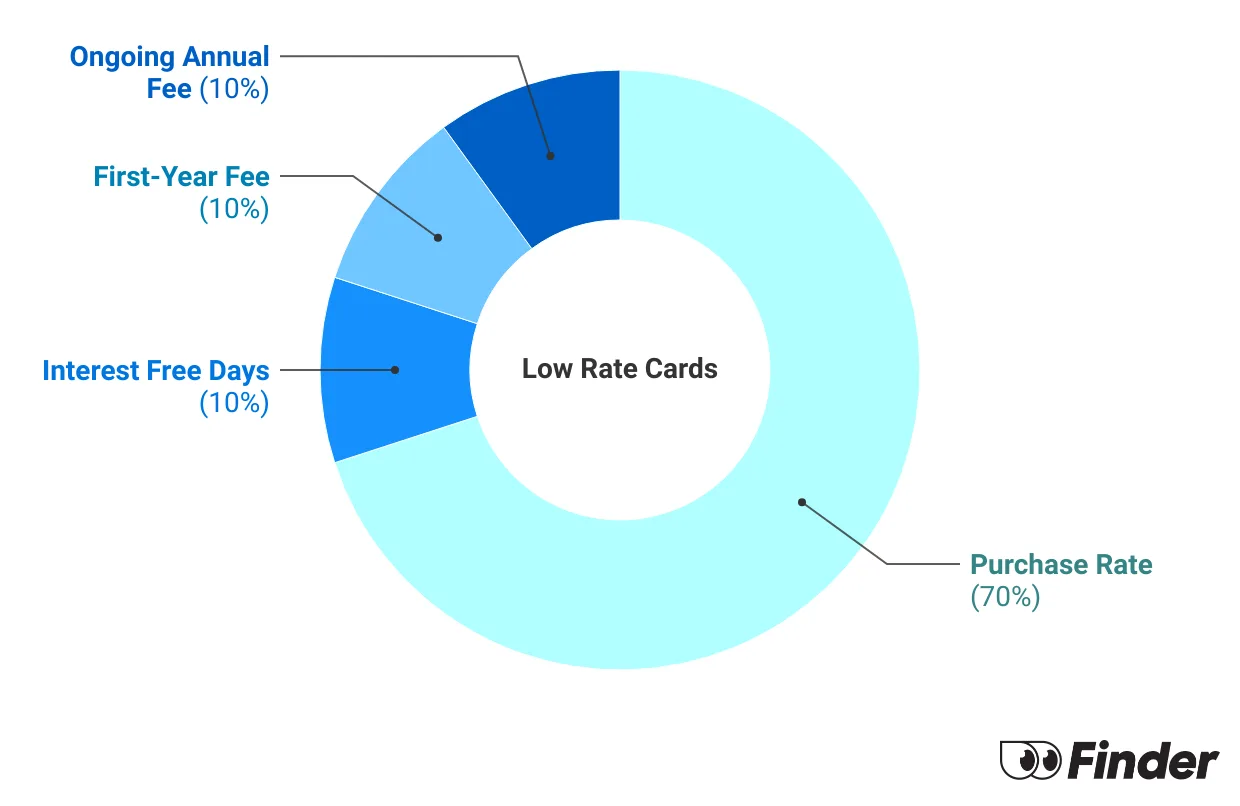
Finder's low rate credit score analyses hundreds of credit cards and ranks each card based on a combination of low rates, annual fees and the number of interest-free days.
Updated in October 2026 by Finder's senior money editor, Richard Whitten.
In Australia anything under 15% is a fairly low purchase rate for a credit card. Some cards have interest rates as low as 8.99% or as high as 27.99%.
Some cards even offer 0% interest rates, but those are usually introductory offers that revert to a much higher rate after 6 months.
A low rate credit card gives you a way to spend money and then pay it off over time without getting hit with high interest rate charges.
Sometimes in life it just isn't possible to pay off your card spending each month before you start getting charged interest. Life is expensive.
If you frequently find you spend more than you earn, you may be in deeper financial trouble long term. But it can't be helped sometimes, and a low rate credit card helps you cut down those interest costs.
The second scenario where people really need a low interest rate credit card is when their existing card spending has gotten them into trouble. That's a where a balance transfer can help.
A good balance transfer credit card offer gives you 0% or very low interest charges for 24 months (or more) on your existing credit card debt. You move the unpaid balance from the old card onto the new one, cancel the old one and then start paying it back.
There are also cards that offer a 0% purchase interest rate. Some cards give you 0% for 6 months, others charge a monthly fee instead interest.
These cards are useful if you have large purchases, like a holiday, wedding or renovation coming up. You can spend now and pay it off over time without interest charges.
You just need to watch out for:
Most Australians pay their credit cards in full each month. This means they don't get charged any interest on their spending.
But Australians with an unpaid credit card balance have on average $1,655. Let's look at how much interest you end up paying on this balance with different interest rates (assuming you take 12 months to pay off the card:
| Balance | Interest rate | Monthly payments (over 12 months) | Total interest charged |
|---|---|---|---|
| $1,655 | 9.0% | $144.73 | $81.79 |
| $1,655 | 12.0% | $147.04 | $109.54 |
| $1,655 | 15.0% | $149.38 | $137.53 |
| $1,655 | 17.0% | $150.94 | $156.33 |
| $1,655 | 20.0% | $153.31 | $184.72 |
The difference between a 20% interest rate and a 9% rate is over $100 in interest over 12 months.
With so many competitive low interest rate credit cards on the market, here are some of the features that can help you narrow down your options:
Let's be clear: low rate credit cards are not the best cards for points, perks and other benefits. Those cards have higher rates and higher annual fees.
But the best low rate cards often come with decent benefits at the price point, such as:
If you often carry over a balance from one month to the next, a low interest credit card could help you save on interest charges. While there is no "best" low rate care, the mix of credit cards available in Australia means you can compare credit card offers and features to help find a card that you want.
Each year the Finder Credit Card Awards recognises Australia's top credit cards, with expert analysis of rates, fees and offers based on 12 months' worth of data. Here are the top performing low rate credit cards.
G&C Mutual Bank's Low Rate Visa Credit Card is the winner of this year's low rate credit card award. It has, you guessed it, a very low interest rate. Plus a low annual fee.
G&C Mutual Bank's Low Rate Visa Credit Card is the winner of this year's low rate credit card award. It has, you guessed it, a very low interest rate. Plus a low annual fee.
 Highly commended
Community First's Low Rate Credit Card finished highly commended in the Low Rate Credit Card category this year with a very low rate.
Community First's Low Rate Credit Card finished highly commended in the Low Rate Credit Card category this year with a very low rate.
The Easy Street Easy Low Rate Visa credit card secured a highly commended distinction thanks to its competitive purchase rate.
The Easy Street Easy Low Rate Visa credit card secured a highly commended distinction thanks to its competitive purchase rate.
MOVE Bank's Low Rate Credit Card scored well this year with one of the market's lowest credit card purchase rates.
MOVE Bank's Low Rate Credit Card scored well this year with one of the market's lowest credit card purchase rates.

You can manage repayments and secure a low or 0% interest offer with a credit card that provides instalment plans.
A credit card cash advance is when you withdraw money or get a “cash equivalent” like gift cards – and it typically attracts high rates and fees.
Most credit cards offer interest-free days on purchases – here's how they actually work.

I receive a flyer in today for 2.99 low interest for 6 months I can not locate this please help. thanks
Hi Barbara,
Thanks for your question.
Unfortunately I’m unable to find a credit card with an offer to match that description. You can, however, use the table on this page to compare similar offers.
Thanks,
Elizabeth
Hi,
I’m a student and am traveling overseas in a few months time. I have a steady, casual work history for the last five years(minus three months following a surgery). I’m wondering if I should apply for a credit card for my overseas trip. I have guaranteed work when I come back and could really use a card. Do you think it would be a wise idea to apply for a low interest credit card, particularly one with x amount of months interest free and repay the debt ASAP once I’m back?
Hi Student,
Thanks for your question.
The “best” option will depend on exactly where you are travelling, your financial situation, and your travel spending habits. It’s always a good idea to have more than one travel money option. So you might want to consider a credit card that is designed for overseas expenses for emergencies and big purchases and a debit or prepaid card and cash for everyday expenses. Consider how you intend to use your travel card and the fees involved to determine which offers the greatest value for money.
For more travel money tips, please see our travel money guide and compare a range of student credit cards to help you with your decision. Please ensure to read through the relevant product disclosure statement and terms and conditions of the card to ensure that you got everything covered before you travel.
Cheers,
Shirley
Hi I am finalising a part ix debt agreement which I have been paying for 5 years which credit card would be best to apply for
Hi Sam,
Thanks for your question.
Credit cards are available to applicants with a good credit rating only. Generally, there are no credit cards designed especially to suit people with bad credit. You are less likely to get approved if you have a bad score. You may have to speak to a bank representative about this. They may want to see in writing that you have addressed the listings on your credit file. Here’s some information on credit cards for people with bad credit.
I hope this helps.
Cheers,
Jacob
Is there a Debit card with Frequent Flyer points?
Hi John,
Thanks for your question.
Currently, there are no debit card products that reward your spending with points; however, there are two travel money cards, one offered by Velocity and the other by Qantas that reward you with points when you make an eligible purchase on the card. These travel money cards were aimed at being used overseas, but they can still be used in Australia.
I hope this helps.
Cheers,
Jacob
If I get a 0% for 8 months on balances transferred credit card and then after the 8 months is up, want to take the remainder of the outstanding credit left to pay off, to another balance transfer card, and then cut up the first card and close the account, are there any fees the first bank can charge me?
Hi Stephanie,
Thanks for your comment.
As long as you don’t have any balances left on your previous credit card, you can cancel it without any fees.
Cheers,
Shirley
Okay so if approved for a balance transfer with the next bank, they’d pay your balance out leaving nothing left on the previous card enabling you to close the account with no fees being charged?
Thanks!
Hi Stephanie,
Thanks for your comment.
Not necessarily, as there are maximums to the amount you can balance transfer. Most banks will allow you to balance transfer about 90% of your credit limit. If your balance transfer amount is less than the maximum then yes, you may be able to balance transfer the full amount.
Please see transferring balances comparison for more information.
Hope this helps,
Shirley