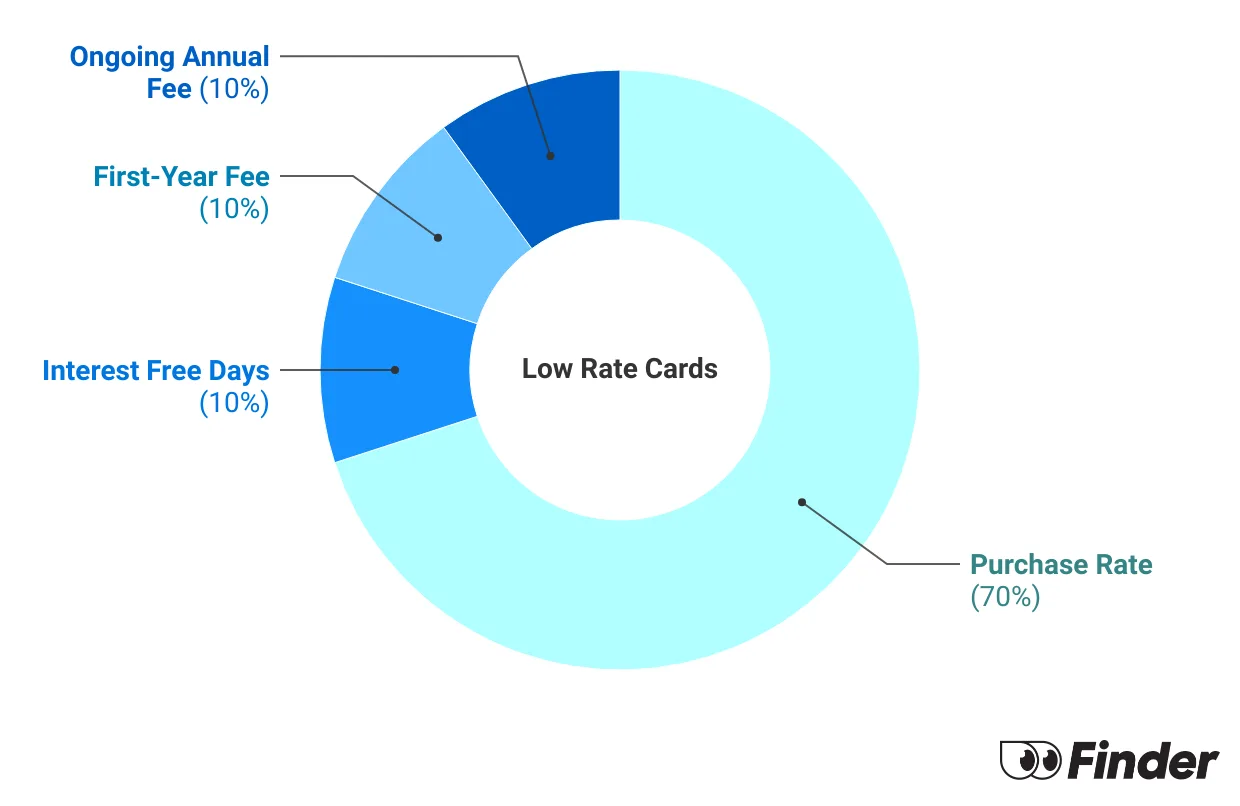
Finder's low rate credit score analyses hundreds of credit cards and ranks each card based on a combination of low rates, annual fees and the number of interest-free days.
Updated in December 2025 by Finder's senior money editor, Richard Whitten.
Number crunching the Finder Score
9+ Excellent - These cards offer the lowest ongoing purchase rates, high number of interest free days, and competitive introductory and ongoing annual fees.
7+ Great - Reasonable ongoing purchase rates and fees, with the potential for additional perks.
5+ Satisfactory - Low interest rates, but watch out for above average ongoing fees.
Less than 5 – Basic - These are generally cards with low interest rates, however could charge high ongoing fees.
Tell me more about the low rate credit card score
Finding the perfect low rate card is about more than just the rate (although that is the most important thing).
That's why we created the Finder Score. It's an easy, data-driven way to judge credit cards at a glance.
Every month, our insights team analyses over 250 credit cards.
We assess ten features for each card, rating each feature.
Then these ratings are combined via a weighted methodology to create a simple score out of 10.
We give different scores for different categories. So a card might get a 9 in the low rate category but an 8 in the balance transfer category.
The Finder Score is designed by our insights and editorial team. We score credit cards objectively. Commercial partnerships don't affect the scores at all.
Remember that Finder Score is just one factor to consider. Look at other aspects like fees, features, benefits and risks to make sure a product is suitable for you. Double-check details that matter to you before applying or buying.
Low rate credit cards - score weightings
Feature
Definition
Assessment
Weight
Purchase Rate
Interest rate on new purchases
Lower rates score higher
70%
Interest Free Days
Number of days with no interest charged on new purchases
Higher number of days score higher
10%
First-Year Fee
Annual fee charged in the first year of ownership
Lower fees score higher. $0 fee receives the maximum points
10%
Ongoing Annual Fee
Annual fee charged from the second year onwards
Lower fees score higher. $0 fee receives the maximum points
10%
Here are some more of our top low rate credit cards, and why we like them.
Best Big 4 Bank low rate credit card: Westpac Lite
The 9.9% p.a. variable interest rate on purchases is much lower than the average standard credit card interest rate in Australia (currently 20.99% p.a.). This card charges 0% on foreign transaction fees, which can help you save around 2-3% compared to cards that charge a foreign transaction fee. Mobile payments through Apple Pay, Google Pay and Samsung Pay.
This card has a Finder Score of 9.53 in the low rate category.
Pros & cons
0% foreign transaction fees
$0 fee for missed payments
Low purchase interest rate of 9.9% p.a.
Only offers up to 45 days interest-free on purchases as opposed to other cards that offer up to 55 days
No rewards points or complimentary insurances
Best low rate cashback credit card: St.George Vertigo
With this card you'll get 10% cashback when you shop at major supermarkets and petrol stations for the first 180 days, capped at a total of $500.
This is also a low rate card, and both the 13.99% p.a. interest rate for purchases and the $55 annual fee are quite competitive compared to similar offers on the market.
Pros & cons
Up to $500 cashback offer
Low $55 annual fee
Shopping cashbacks through ShopBack
Cashback offer could make it tempting to spend more than usual
No rewards program
Does not offer travel perks or insurance covers
Best low rate no annual fee credit card: American Express Low Rate
There is no annual fee for this card at all. It also has a low purchase rate and comes with complimentary card purchase cover.
This card has a Finder Score of 9.47 in the low rate category.
Pros & cons
Low 10.99% p.a. interest rate for purchases
Ongoing $0 annual fee
Complimentary card purchase cover and card refund cover
$30 late payment fee if you miss your minimum repayment
3% foreign currency conversion fee
No rewards program
What is a low interest rate on a credit card?
In Australia anything under 15% is a fairly low purchase rate for a credit card. Some cards have interest rates as low as 8% or as high as 22%.
Some cards even offer 0% interest rates, but those are usually introductory offers that revert to a much higher rate after 6 months.
A low rate credit card gives you a way to spend money and then pay it off over time without getting hit with high interest rate charges.
2 ways to avoid or minimise interest charges on a credit card
Pay the card off completely each month and pay no interest at all. Any credit card becomes a 0% interest rate card if you pay your spending off in full before interest charges kick in.
Get a low rate credit card and pay it off as quickly as you can. If you can't afford to pay off your card spending fully, a low or 0% rate is the next best option. This lets you pay the card spending off over time while minimising the interest charges.
Average credit card interest rates in Australia
Excluding 0% card offers, the average credit card purchase rate in Australia is 17.15%, according to Finder's database. The highest purchase rate is 27.99% and the lowest rate is 7.49%.
Source:Finder's database of over 250 credit cards
Why do people use low rate credit cards?
You can't afford to pay off your card spending in full
Sometimes in life it just isn't possible to pay off your card spending each month before you start getting charged interest. Life is expensive.
If you frequently find you spend more than you earn, you may be in deeper financial trouble long term. But it can't be helped sometimes, and a low rate credit card helps you cut down those interest costs.
You need to repay card debt via a balance transfer
The second scenario where people really need a low interest rate credit card is when their existing card spending has gotten them into trouble. That's a where a balance transfer can help.
A good balance transfer credit card offer gives you 0% or very low interest charges for 24 months (or more) on your existing credit card debt. You move the unpaid balance from the old card onto the new one, cancel the old one and then start paying it back.
What about 0% interest rate cards?
There are also cards that offer a 0% purchase interest rate. Some cards give you 0% for 6 months, others charge a monthly fee instead interest.
These cards are useful if you have large purchases, like a holiday, wedding or renovation coming up. You can spend now and pay it off over time without interest charges.
You just need to watch out for:
The revert rate. Some credit cards give you 0% for 6 months. But on month 7 the rate jumps up to 20%. If you haven't paid off your spending, you're suddenly looking at big interest charges.
The fees. Some of these cards never charge interest but do charge an ongoing fee. This fee could be small but still end up costing more than interest charges over a few months.
Pros and cons of low rate credit cards
Pros
You pay less interest. Low rate credit cards can be a cheaper option as you pay less interest on purchases, which will help you save money and avoid falling into unmanageable debt.
You save on fees. Many low interest rate credit cards also have lower annual fees, which helps you save even more money.
You can get promotional offers. Low interest rate credit cards sometimes offer 0% promotions on purchases and/or balance transfers, allowing you to avoid interest altogether for an introductory period.
Cons
You get fewer rewards. Low rate credit cards tend to have fewer or no rewards or perks, compared to higher rate, premium rewards and frequent flyer cards.
You get fewer extra features. Lower rates generally mean fewer extra features, unlike platinum cards which often come with complimentary insurance options, cashbacks, concierge services and more.
Watch out for revert rates. If your card offers 0% interest on purchases for a promotional period, it will revert to a higher purchase rate that could be up to 26.99% p.a.
How much can you save with a lower rate?
Most Australians pay their credit cards in full each month. This means they don't get charged any interest on their spending.
But Australians with an unpaid credit card balance have on average $1,655. Let's look at how much interest you end up paying on this balance with different interest rates (assuming you take 12 months to pay off the card:
Balance
Interest rate
Monthly payments (over 12 months)
Total interest charged
$1,655
9.0%
$144.73
$81.79
$1,655
12.0%
$147.04
$109.54
$1,655
15.0%
$149.38
$137.53
$1,655
17.0%
$150.94
$156.33
$1,655
20.0%
$153.31
$184.72
The difference between a 20% interest rate and a 9% rate is over $100 in interest over 12 months.
How to compare low interest rate credit cards
With so many competitive low interest rate credit cards on the market, here are some of the features that can help you narrow down your options:
Compare interest rates. The lower the interest rate the better. Below 15% is good, below 10% is very good. If a card offers a 0% promotional rate, check how long it lasts and remember that it will be much higher after this period ends. Some 0% cards jump to 20% after 6 months!
Look at the card's annual fee. Low rate cards have annual fees of around $59 on the lower end but can go as high as $200. The lower the better, but cards with higher fees may offer useful features and perks. There are also some cards that offer $0 annual fee for the first year or for life.
Factor in other fees. If you use your card for foreign currency or overseas purchases (including online), you will usually be charged a foreign transaction fee of around 2-3.5%. But certain credit cards are more tailored to international use and offer 0% foreign transactions fees.
Compare perks and features. Some low rate cards also come with cashback offers, although you'll usually need to meet a certain spend requirement to get the money back. Some low rate cards offer you complimentary travel insurance and purchase cover.
What perks and benefits can you get with these credit cards?
Let's be clear: low rate credit cards are not the best cards for points, perks and other benefits. Those cards have higher rates and higher annual fees.
But the best low rate cards often come with decent benefits at the price point, such as:
Cashbacks. Quite a few of the top scoring low rate cards in Finder's database offer some form of cashback on your spending. Cashbacks usually give you, say, 10% back on eligible spending, capped at a certain amount. This can save you a few hundred dollars.
0% balance transfers. Low rate cards often have some of the best 0% balance transfer deals. Just keep in mind that a balance transfer customer needs to focus on paying off existing debt rather than adding to it with more spending. So the low purchase rate doesn't matter as much because you should be paying the balance transfer off.
0% foreign transaction fees. A few low rate cards offer 0% foreign transaction/international transaction fees, which saves you money when travelling or shopping overseas.
Complimentary insurance cover. While low rate cards are far less likely to offer complimentary travel insurance, some cards do offer this, or other types of cover like purchase protection insurance.
The bottom line
If you often carry over a balance from one month to the next, a low interest credit card could help you save on interest charges. While there is no "best" low rate care, the mix of credit cards available in Australia means you can compare credit card offers and features to help find a card that you want.
2025 Finder Awards for Low Rate Credit Cards
Each year the Finder Credit Card Awards recognises Australia's top credit cards, with expert analysis of rates, fees and offers based on 12 months' worth of data. Here are the top performing low rate credit cards.
G&C Mutual Bank's Low Rate Visa Credit Card is the winner of this year's low rate credit card award. It has, you guessed it, a very low interest rate. Plus a low annual fee.

The Low Rate Credit Card from Illawarra Credit Union is highly commended in the low rate category. It has a competitive rate and a $0 annual fee for the first year.
Frequently asked questions
The cheapest card will depend on how you use it. If you pay off your balance every month, a $0 annual fee credit card would likely be the cheapest option.
If you regularly carry a balance from month to month, the cheapest credit card will have a low interest rate and a modest annual fee (less than $100). There aren't many cards on the market that offer both a $0 annual fee and a low rate, but using the table above you can find what you consider to be a cheap credit card.
There is no one "best" low interest rate credit card in Australia. With so many cards on the market, a card's individual features have an impact on how well it suits your circumstances. So the card that's right for you may not be right for someone else. Comparing low interest rate credit cards based on the features you're looking for will help you find a card for your individual needs.
A low rate credit card can be very useful if you carry a balance (can't repay all your card spending in one month) as it cuts down your interest charges. It's also useful if you need to make a large one-off purchase and pay it off over time.
These cards are less useful if you're a big spender who can afford to pay your card spending off in full. You may get more value out of a reward or frequent flyer credit card.
And if you only use the card occasionally and always pay it off, you might save money with a no annual fee credit card.
Low rate and low fee credit cards can both save you money but in different ways. A low interest rate credit card reduces your interest charges if you can't repay your card balance fully each statement period.
A low fee credit card saves you money on fees. They are more suited to customers who pay off the card in full and don't need to worry about interest charges.
Credit card interest rates are usually advertised by the annual rate that applies to the account, shown as "per annum" or p.a. However, interest on your account balance is typically calculated daily and then charged monthly on the statement due date. This means that for every day that you don't make a payment, the interest charges will build up (or compound).
This depends on the credit card and any applicable balance transfer offers. If the card allows balance transfers, it may come with a 0% interest rate for a promotional period before reverting to a standard rate.
Some low interest rate cards apply the standard purchase rate to balance transfers after the introductory period while others apply the cash advance rate, which can be as high as 29.99% p.a. The average standard credit card interest rate is currently 20.99% according to Finder analysis of Reserve Bank of Australia data.
There isn't a single "cheapest" credit card option because everyone uses credit cards differently. There are other costs to consider beyond the purchase rate, such as annual fees and interest rates for cash advances or balance transfers. On the flip side, some people might find cards with high rates and fees "cheap" because of all the complimentary extras.
When you're looking to find a credit card, consider all of the potential costs based on how you plan to use the account. That way, you'll be able to find one with rates and fees that are affordable for you.
Most frequent flyer and rewards credit cards have higher interest rates and fees than low rate cards. But there is a small selection of low rate credit cards that offer points on eligible spending, including the Coles Low Rate Mastercard and Queensland Country Bank Visa My Rewards Credit Card. These cards typically earn fewer points per $1 spent, so it's important to consider whether rewards or a low rate will offer you more value before choosing a card.
If your credit card offers 55 interest-free days and you make a purchase on the first day of your statement period, you'll have 55 days to pay it back before you're charged interest. If you make that purchase on day 15 of your statement period, you'll have 40 interest-free days, and so on.
This only applies if you pay the amount required by the provider by the due date listed on your statement. See Finder's guide to interest-free days for full details.
Richard Whitten is Finder’s Senior Money Editor, with over eight years of experience in home loans, property, credit cards and personal finance. His insights appear in top media outlets like Yahoo Finance, Money Magazine, and the Herald Sun, and he frequently offers expert commentary on television and radio, helping Australians navigate mortgages and property ownership. Richard started his career in education and textbook publishing in South Korea. He holds multiple industry certifications, including a Certificate IV in Mortgage Broking (RG 206) and Tier 1 and Tier 2 certifications (RG 146), as well as a Bachelor of Education from the University of Sydney and a Graduate Certificate in Communications from Deakin University.
See full bio
Richard's expertise
Richard
has written
680
Finder guides across topics including:
Hi i am in a situation where i am in need of 2000-5000 to pay for a solicitor as i don’t have the money. I am looking into credit cards that i can either afford by myself as i am on centrelink or one that my partner and i can get together with his income and mine. What would be the best way to go? As we have never applied for one before. Thank you
Finder
DebbieFebruary 4, 2016Finder
Hi Kylie,
Thanks for your question.
Please note that you’ve come through finder.com.au and as a financial comparison service, we’re unable to recommend any specific product, service or strategy to our users as the ‘best’ option will always depend on the individual’s financial situation and needs.
Whether you can apply for a credit card will depend on how much you earn per year and what type of Centrelink payments you receive.
You might need to get in touch with the bank directly to confirm your likelihood of approval before applying.
I hope this helps.
Cheers,
Debbie
RhysNovember 19, 2015
Do you no anyone that will help people on disability pensioner with below average credit score to get a low limit credit card with below average credit score to rebuild my credit rating and give me a second chance
Finder
JonathanNovember 20, 2015Finder
Hi Rhys,
Thanks for your inquiry!
You can compare low income credit cards which have lower requirements than higher tier credit cards. Before applying for any card, be sure to check the minimum income requirements and other eligibility criteria and relevant product disclosure statements, and terms, and conditions of the credit card.
Cheers,
Jonathan
ShaniAugust 5, 2015
I have an existing credit card with a balance of 9000.I am looking to transfer to a new card which has 0% on balance transfers and a low interest rate with 55 days interest free. I can pay the balance off in about 12 months or less
Finder
JonathanAugust 6, 2015Finder
Hi Shani,
Thanks for your inquiry!
Please refer to our guide on how much banks allow you to balance transfer to their credit cards. It is a key point to note that no interest-free days will be awarded when you have an outstanding balance, so until your balance transfer debt has been fully cleared you will be unable to utilize this feature.
You may like to compare balance transfer credit cards and see your options on available from offers on low or 0% introductory interest rates. Select ‘Go to Site’ to head over to their website to apply. Please ensure to read through the relevant product disclosure statement and terms and conditions to ensure that you got everything covered before you apply for the card.
Cheers,
Jonathan
MajellaJuly 26, 2015
Is there a low rate credit card for pensioners?
Finder
JonathanJuly 27, 2015Finder
Hi Majella, thanks for your inquiry!
Credit card eligibility for pensioners depends on whether you meet the application requirements. Generally the bank/ lender will request a specific minimum income per year. If your primary form of income is through Centrelink/ pension benefits, contacting the bank before completing the application process to determine whether Centrelink qualifies as a form of income would be ideal.
Cheers,
Jonathan
JennaJune 29, 2015
I am traveling overseas for 12 months in Oct this year to the USA. I have loan approval for money I really don’t need the full amount of (or the stupidly high interest rate) someone suggested I get a low interest credit card to take with me or emergencies and small purchases?
Can you suggest a low interest rate card I can use whilst overseas?
Finder
SallyJune 29, 2015Finder
Hi Jenna,
Thanks for your question.
You may want to consider a card with no annual fee, no foreign transaction fees, and no currency conversion fees.
You can view your options on our no annual fee credit cards with no foreign transaction fees comparison page.
Most credit cards offer interest-free days on purchases – here's how they actually work.
Important information about this website
Finder makes money from featured partners, but editorial opinions are our own.
Finder is one of Australia's leading comparison websites. We are committed to our readers and stand by our editorial principles.
We try to take an open and transparent approach and provide a broad-based comparison service. However, you should be aware that while we are an independently owned service, our comparison service does not include all providers or all products available in the market.
Some product issuers may provide products or offer services through multiple brands, associated companies or different labeling arrangements. This can make it difficult for consumers to compare alternatives or identify the companies behind the products. However, we aim to provide information to enable consumers to understand these issues.
We make money by featuring products on our site. Compensation received from the providers featured on our site can influence which products we write about as well as where and how products appear on our page, but the order or placement of these products does not influence our assessment or opinions of them, nor is it an endorsement or recommendation for them.
Products marked as 'Top Pick', 'Promoted' or 'Advertisement' are prominently displayed either as a result of a commercial advertising arrangement or to highlight a particular product, provider or feature. Finder may receive remuneration from the Provider if you click on the related link, purchase or enquire about the product. Finder's decision to show a 'promoted' product is neither a recommendation that the product is appropriate for you nor an indication that the product is the best in its category. We encourage you to use the tools and information we provide to compare your options.
Where our site links to particular products or displays 'Go to site' buttons, we may receive a commission, referral fee or payment when you click on those buttons or apply for a product.
When products are grouped in a table or list, the order in which they are initially sorted may be influenced by a range of factors including price, fees and discounts; commercial partnerships; product features; and brand popularity. We provide tools so you can sort and filter these lists to highlight features that matter to you.
Please read our website terms of use and privacy policy for more information about our services and our approach to privacy.
We update our data regularly, but information can change between updates. Confirm details with the provider you're interested in before making a decision.
How likely would you be to recommend Finder to a friend or colleague?
0
1
2
3
4
5
6
7
8
9
10
Very UnlikelyExtremely Likely
Required
Thank you for your feedback.
Our goal is to create the best possible product, and your thoughts, ideas and suggestions play a major role in helping us identify opportunities to improve.
The information provided by Frankie is general in nature and has been prepared without considering your objectives, financial situation or needs. Frankie may make mistakes so it's important that you review the information before deciding. By messaging Frankie, you agree to our Terms and have read our Privacy Policy.
Hi i am in a situation where i am in need of 2000-5000 to pay for a solicitor as i don’t have the money. I am looking into credit cards that i can either afford by myself as i am on centrelink or one that my partner and i can get together with his income and mine. What would be the best way to go? As we have never applied for one before. Thank you
Hi Kylie,
Thanks for your question.
Please note that you’ve come through finder.com.au and as a financial comparison service, we’re unable to recommend any specific product, service or strategy to our users as the ‘best’ option will always depend on the individual’s financial situation and needs.
Whether you can apply for a credit card will depend on how much you earn per year and what type of Centrelink payments you receive.
You might need to get in touch with the bank directly to confirm your likelihood of approval before applying.
I hope this helps.
Cheers,
Debbie
Do you no anyone that will help people on disability pensioner with below average credit score to get a low limit credit card with below average credit score to rebuild my credit rating and give me a second chance
Hi Rhys,
Thanks for your inquiry!
You can compare low income credit cards which have lower requirements than higher tier credit cards. Before applying for any card, be sure to check the minimum income requirements and other eligibility criteria and relevant product disclosure statements, and terms, and conditions of the credit card.
Cheers,
Jonathan
I have an existing credit card with a balance of 9000.I am looking to transfer to a new card which has 0% on balance transfers and a low interest rate with 55 days interest free. I can pay the balance off in about 12 months or less
Hi Shani,
Thanks for your inquiry!
Please refer to our guide on how much banks allow you to balance transfer to their credit cards. It is a key point to note that no interest-free days will be awarded when you have an outstanding balance, so until your balance transfer debt has been fully cleared you will be unable to utilize this feature.
You may like to compare balance transfer credit cards and see your options on available from offers on low or 0% introductory interest rates. Select ‘Go to Site’ to head over to their website to apply. Please ensure to read through the relevant product disclosure statement and terms and conditions to ensure that you got everything covered before you apply for the card.
Cheers,
Jonathan
Is there a low rate credit card for pensioners?
Hi Majella, thanks for your inquiry!
Credit card eligibility for pensioners depends on whether you meet the application requirements. Generally the bank/ lender will request a specific minimum income per year. If your primary form of income is through Centrelink/ pension benefits, contacting the bank before completing the application process to determine whether Centrelink qualifies as a form of income would be ideal.
Cheers,
Jonathan
I am traveling overseas for 12 months in Oct this year to the USA. I have loan approval for money I really don’t need the full amount of (or the stupidly high interest rate) someone suggested I get a low interest credit card to take with me or emergencies and small purchases?
Can you suggest a low interest rate card I can use whilst overseas?
Hi Jenna,
Thanks for your question.
You may want to consider a card with no annual fee, no foreign transaction fees, and no currency conversion fees.
You can view your options on our no annual fee credit cards with no foreign transaction fees comparison page.
I hope this has helped answer your question.
Thanks,
Sally