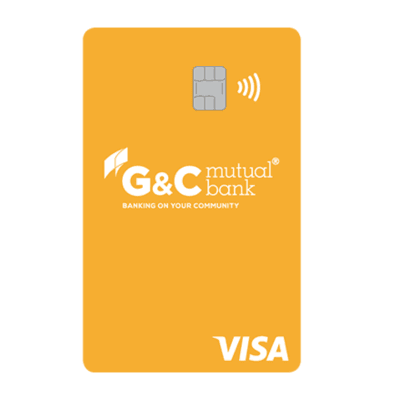
G&C Mutual Bank's Low Rate Visa Credit Card is the winner of this year's low rate credit card award. It has, you guessed it, a very low interest rate. Plus a low annual fee.

These are the market's top low interest rate credit cards based on their Finder Scores:
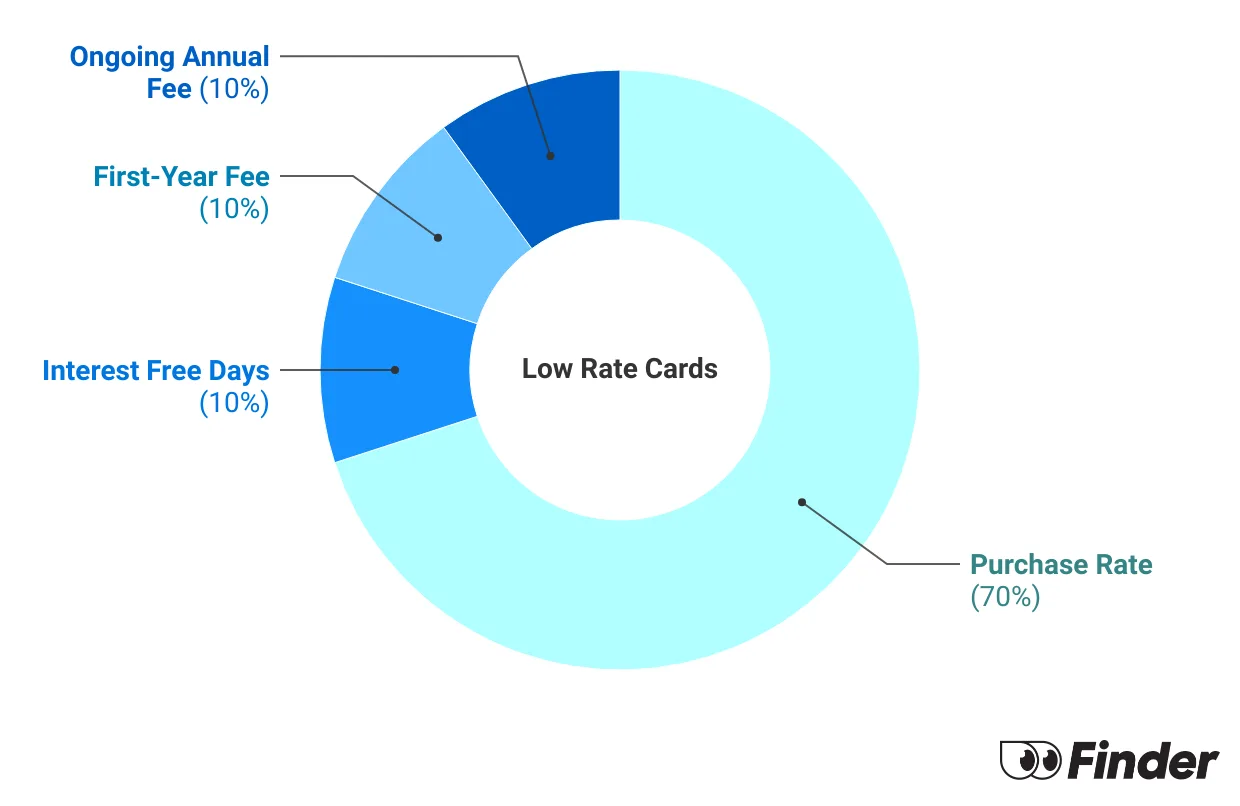
Finder's low rate credit score analyses hundreds of credit cards and ranks each card based on a combination of low rates, annual fees and the number of interest-free days.
Updated in October 2026 by Finder's senior money editor, Richard Whitten.
In Australia anything under 15% is a fairly low purchase rate for a credit card. Some cards have interest rates as low as 8.99% or as high as 27.99%.
Some cards even offer 0% interest rates, but those are usually introductory offers that revert to a much higher rate after 6 months.
A low rate credit card gives you a way to spend money and then pay it off over time without getting hit with high interest rate charges.
Sometimes in life it just isn't possible to pay off your card spending each month before you start getting charged interest. Life is expensive.
If you frequently find you spend more than you earn, you may be in deeper financial trouble long term. But it can't be helped sometimes, and a low rate credit card helps you cut down those interest costs.
The second scenario where people really need a low interest rate credit card is when their existing card spending has gotten them into trouble. That's a where a balance transfer can help.
A good balance transfer credit card offer gives you 0% or very low interest charges for 24 months (or more) on your existing credit card debt. You move the unpaid balance from the old card onto the new one, cancel the old one and then start paying it back.
There are also cards that offer a 0% purchase interest rate. Some cards give you 0% for 6 months, others charge a monthly fee instead interest.
These cards are useful if you have large purchases, like a holiday, wedding or renovation coming up. You can spend now and pay it off over time without interest charges.
You just need to watch out for:
Most Australians pay their credit cards in full each month. This means they don't get charged any interest on their spending.
But Australians with an unpaid credit card balance have on average $1,655. Let's look at how much interest you end up paying on this balance with different interest rates (assuming you take 12 months to pay off the card:
| Balance | Interest rate | Monthly payments (over 12 months) | Total interest charged |
|---|---|---|---|
| $1,655 | 9.0% | $144.73 | $81.79 |
| $1,655 | 12.0% | $147.04 | $109.54 |
| $1,655 | 15.0% | $149.38 | $137.53 |
| $1,655 | 17.0% | $150.94 | $156.33 |
| $1,655 | 20.0% | $153.31 | $184.72 |
The difference between a 20% interest rate and a 9% rate is over $100 in interest over 12 months.
With so many competitive low interest rate credit cards on the market, here are some of the features that can help you narrow down your options:
Let's be clear: low rate credit cards are not the best cards for points, perks and other benefits. Those cards have higher rates and higher annual fees.
But the best low rate cards often come with decent benefits at the price point, such as:
If you often carry over a balance from one month to the next, a low interest credit card could help you save on interest charges. While there is no "best" low rate care, the mix of credit cards available in Australia means you can compare credit card offers and features to help find a card that you want.
Each year the Finder Credit Card Awards recognises Australia's top credit cards, with expert analysis of rates, fees and offers based on 12 months' worth of data. Here are the top performing low rate credit cards.
G&C Mutual Bank's Low Rate Visa Credit Card is the winner of this year's low rate credit card award. It has, you guessed it, a very low interest rate. Plus a low annual fee.
G&C Mutual Bank's Low Rate Visa Credit Card is the winner of this year's low rate credit card award. It has, you guessed it, a very low interest rate. Plus a low annual fee.
 Highly commended
Community First's Low Rate Credit Card finished highly commended in the Low Rate Credit Card category this year with a very low rate.
Community First's Low Rate Credit Card finished highly commended in the Low Rate Credit Card category this year with a very low rate.
The Easy Street Easy Low Rate Visa credit card secured a highly commended distinction thanks to its competitive purchase rate.
The Easy Street Easy Low Rate Visa credit card secured a highly commended distinction thanks to its competitive purchase rate.
MOVE Bank's Low Rate Credit Card scored well this year with one of the market's lowest credit card purchase rates.
MOVE Bank's Low Rate Credit Card scored well this year with one of the market's lowest credit card purchase rates.

You can manage repayments and secure a low or 0% interest offer with a credit card that provides instalment plans.
A credit card cash advance is when you withdraw money or get a “cash equivalent” like gift cards – and it typically attracts high rates and fees.
Most credit cards offer interest-free days on purchases – here's how they actually work.

Hi, I’m worried that by applying for credit cards will reduce my score ,I am on Centrelink and feel maybe there is no point trying as I always get rejected.i only wish to have a credit card as it’s getting harder in this economy and would like to have one as a bit of security incase I need a bit extra .with my score is there any point trying or should I stop applying and accept that my income is just never going to be accepted.please help
Hi Billie-Jo, I’d recommend checking our guide to credit cards for people on Centrelink for more on this topic. But you’re right that making multiple unsuccessful credit card applications can reduce your credit score. Realistically, if your Centrelink payment is largely used for basic living expenses (rent+food+transport) then you’re unlikely to be approved for a credit card. It’s also worth remembering that while a credit card can be a useful emergency option, you’ll have to pay the annual fee up front. Hope this helps.
hi i’m trying to find a best credit card that suits me , first time holder I never hold one in my life .
Hi James,
It’s helpful to consider what’s important to you when choosing a credit card. For example, a low rate credit card can help you save on interest charges if you want to pay off spending over time. A card with low fees or no annual fee could also help keep account costs down. Rewards and extras like complimentary insurance are also features you may want to consider. Finder’s guide to credit cards has more details about the different types of cards and what else to consider. I hope this helps.
Are there any credit cards available for people on disability pension Centrelink please?
Hi Jade,
Thank you for getting in touch with Finder.
You can start comparing credit cards for pensioners and retirees. I suggest that you contact your chosen bank or credit card issuer before submitting your online application to know your chances of getting approved.
Please make sure though to read the eligibility criteria, features, and details of the card, as well as the relevant PDS/ T&Cs of the card before making a decision and consider whether the product is right for you. When you are ready, press the ‘Go to site’ button to apply.
I hope this helps.
Thank you and have a wonderful day!
Cheers,
Jeni
Am I better off to get a personal loan to pay credit cards off and get extra money for travel /
would like to consolidate credit card debt and have some money for travel
Hi Sue,
Thank you for reaching out to Finder.
Depending on how much you would require to consolidate your debt as well as have a bit of extra for travel, a personal loan would be able to help you achieve this. You would not be able to have the extra cash when you use a different method in consolidating your debt. You may refer to our list of personal loan. Kindly review and compare your options on the table displaying the available providers. Once you have chosen a particular provider, you may then click on the “Go to site” button and you will be redirected to the provider’s website where you can proceed with the application or get in touch with their representatives for further inquiries you may have.
Before applying, please ensure that you meet all the eligibility criteria and read through the details of the needed requirements as well as the relevant Product Disclosure Statements/Terms and Conditions when comparing your options before deciding on whether it is right for you. Hope this helps!
Cheers,
Reggie
what card would be best for people on s.s?
Hi Willard,
Thank you for reaching out to finder.
While we do not provide specific product recommendations, we can help guide you through the process of comparing options. You may want to check our page on “Credit cards for retired and pensioner applicants”. The page will also advise you of what documents to provide during the application process. Please click here to be routed to that page. Hope this helps!
Cheers,
Reggie