Most credit cards charge a hefty 2–3.5% international transaction fee when you use it overseas while traveling or shopping online. But not these cards.
We currently don't have that product, but here are others to consider:
Looking for other options? Check out these similar products.
How we picked these
Key takeaways
Many credit cards charge 2%+ all international transactions, which can quickly add up when you're travelling or shopping online. A card with no fees can save you hundreds of dollars.
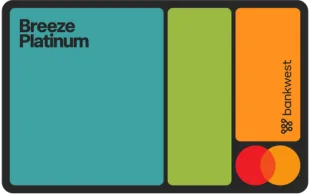
The Bankwest Breeze Platinum Mastercard won the 2026 Finder Award for best travel credit card.
Check the annual fee and pay off your card in full each month to maximise your savings.
How do credit cards with no foreign transaction fees work?
A small selection of credit cards don't charge you the standard 2 to 3.5% fee when using the card overseas. Some cards charge the fee but give you a rebate.
This is a great benefit if you're using the credit card overseas while travelling, or even if you're just shopping online at non-Australian merchants.
Finder ranks the best no foreign transaction fee credit cards using the Finder Score, which considers fees but also benefits like interest-free days and complimentary travel insurance.
How much can I save with a 0% foreign transaction fee card?
If you spent $2,000 on a card with a 3% international transaction fee, it would cost you $60. A 0% fee card would save you $60 in one transaction.
Keep in mind that the cost of foreign transaction fees may not be obvious straight away, as they are added as separate transactions on your credit card account.
In 2024 the ACCC found that credit and debit cards can be cheaper than travel money cards when making purchases overseas, especially cards that don't charge international transaction fees.
Bankwest's Breeze Platinum Mastercard is Finder's winning Travel Credit Card in the latest Finder Credit Card Awards. The card combines 0.00% foreign transaction fees with a low annual fee.
Bankwest's Breeze Platinum Mastercard is Finder's winning Travel Credit Card in the latest Finder Credit Card Awards. The card combines 0.00% foreign transaction fees with a low annual fee.
How to compare no foreign transaction fee credit cards
0% fee conditions. Certain credit cards automatically waive foreign transaction fees when you make an international purchase. Others offer a rebate when you meet specific requirements.
Annual fees. Annual fees typically range from $0 to $400 or more for higher-end cards. You can weigh this fee against the value you'd get from 0% foreign transaction fees and any other card perks.
Interest rates. Interest rates on these cards range from around 10% to 28% for purchases. If you pay off your credit card as you go – or pay the total by the due date on your statement – you'll typically get interest-free days on your purchases. But if you end up carrying over a balance, a low rate credit card could be a more cost-effective option.
Overseas ATM withdrawal fees. Overseas ATM fees typically cost around $5 or between 2-3% of the total transaction. And that's not including any charges added by the overseas ATM operator.
💡 Tip: If you're planning to withdraw international currency from an overseas ATM, a multi-currency account such as Wise means avoiding cash advance fees. You can also check out Finder's guide to travel money for other options.
Want to use your credit card in Australia as well?
The range of credit cards that offer no foreign transaction fees means it's worth looking for other features that you want on your credit card. For example frequent flyer points, 0% interest rate offers, cashback bonuses or something else. The key is to find a card with features that add value when you're shopping in Australia and overseas.
Our expert says: You don't have to use a credit card when you travel
"I use a frequent flyer credit card when booking flights and hotels so I can earn points. But when I go overseas I use a travel card like Wise. This lets me load up money in a foreign currency pretty cheaply and spend it like a local. For me it's the best of both worlds."
When you're planning to use your card overseas spending, keep the following details in mind:
Daily cash withdrawal limits. Some credit card providers have a limit on the amount you can withdraw from an ATM using your credit card – and it could be lower than your available credit limit. Check your credit card account details through Internet or mobile banking, or call your provider for specific information on these limits.
Global ATM alliance networks. Many Australian credit card providers have ATM alliance networks that extend around the world and allow you to get cash out overseas without paying an ATM withdrawal fee. For example, a credit card from Westpac, St.George, BankSA or Bank of Melbourne gives you access to the Global ATM Alliance network, which includes Westpac NZ (New Zealand), Barclays (UK), Bank of America (US) and Deutsche Bank (Germany and Spain).
Exchange rates. Currency exchange rates will apply when you use an Australian credit card for a transaction in another currency. This rate can fluctuate daily, making it harder to work out the cost in Australian dollars (until it's added to your transaction list).
These cards offer lower currency conversion fees and relevant perks for travelers like insurance and ATM access.
7+
Great
Reasonable cards for travelers, however can potentially charge higher fees.
5+
Standard
While eligible to be used to travelers internationally, these cards may charge currency conversion, overseas ATM withdrawal and ongoing fees.
0+
Basic
These cards should be used for international purchases only in the event of an emergency.
The lowdown on Finder Score
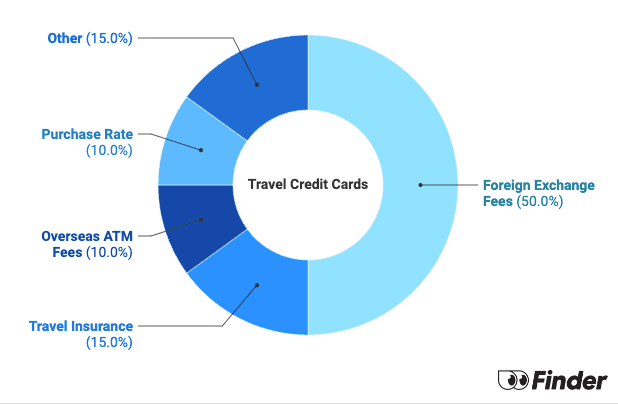
The Finder Score gives you a simple score out of 10, the higher the better. In the travel card category we examine 250+ credit cards and assess six features, assigning them scores out of 10.
We look at features like international transaction fees, travel insurance, annual fees and the purchase rate. Cards with 0% foreign transaction fees and other travel perks score higher.
The methodology is designed by our insights and editorial team. Commercial partnerships carry no weight, all products in the database are scored objectively.
The same card will receive a different score within each category, depending on the features being assessed.
Our intention is to enable informed financial decision-making quickly and easily. Please consider your own financial circumstances when making a decision.
9+ Excellent - These cards offer lower currency conversion fees and relevant perks for travellers like insurance and ATM access.
7+ Great - Reasonable cards for travellers, however can potentially charge higher fees. 5+ Standard - While eligible to be used to travellers internationally, these cards may charge currency conversion, overseas ATM withdrawal and ongoing fees.
Less than 5–Basic - These cards should be used for international purchases only in the event of an emergency.
Finder Score metric assessment - Travel credit cards
Feature
Definition
Assessment
Weight
Foreign Exchange Fees
Fees charge on international transactions
Lower fees score higher
50%
Travel Insurance
Complimentary travel insurance
Full score for complimentary insurances
15%
Overseas ATM Fees
Fees charged by card provider to withdraw from international ATMs
Lower fees score higher
10%
Purchase Rate
Interest rate on new purchases
Lower rates score higher
10%
First-Year Fee
Annual fee charged in the first year of ownership
Lower fees score higher. $0 fee receives the maximum points.
7.5%
Ongoing Annual Fee
Annual fee charged from the second year onwards
Lower fees score higher. $0 fee receives the maximum points.
7.5%
Frequently asked questions
When you use a credit card to make a transaction in another currency, it will be converted back to Australian dollars based on the exchange rate that's applicable for your credit card. For example, if you spent US$100 and the exchange rate was US$0.67 to AUD$1, this transaction would show up on your credit card account as AUD$149.25 (to the nearest cent).
Sometimes when you're travelling, a business will give you the option of paying in the local currency or in Australian dollars. If you choose to pay in Australian dollars, the transaction will be processed using Dynamic Currency Conversion. This usually costs you a lot more than paying in the local currency.
According to the ACCC, this is because overseas banks "usually add a mark-up to the exchange rate". And depending on your credit card, you could still be charged an international transaction fee.
It's often useful to have a couple of different ways to spend money when you're travelling. As well as a credit card, you may want to buy foreign currency before you go or take a debit card in case you end up needing cash. Another option is getting a prepaid travel card that lets you spend money in different currencies so you can avoid foreign transaction fees.
A good credit is always one that matches your needs. If you plan to travel overseas or shop internationally, a no foreign transaction fee credit card is really useful.
But if your main interest is earning frequent flyer points, spending locally while avoiding big fees or paying off existing credit card debt you are probably looking for a different type of card.
Richard Whitten is Finder’s Senior Money Editor, with over eight years of experience in home loans, property, credit cards and personal finance. His insights appear in top media outlets like Yahoo Finance, Money Magazine, and the Herald Sun, and he frequently offers expert commentary on television and radio, helping Australians navigate mortgages and property ownership. Richard started his career in education and textbook publishing in South Korea. He holds multiple industry certifications, including a Certificate IV in Mortgage Broking (RG 206) and Tier 1 and Tier 2 certifications (RG 146), as well as a Bachelor of Education from the University of Sydney and a Graduate Certificate in Communications from Deakin University.
See full bio
Richard's expertise
Richard
has written
795
Finder guides across topics including:
What is the difference between a single currency and a multi currency retailer. NAB charges different rates for these but they are unable to tell me how to determine the difference before I make an online purchase
Finder
JacobJune 24, 2013Finder
Hi Gloria. Thanks for your question. The main difference between a single and multi-currency retailer is whether or not they accept Australian currency. A good example to use is duty free shops at the airport. They will ask you whether you would like to pay in AUD or the local currency. If you pay in AUD, then this is a single currency transaction. A multi-currency transaction is more expensive and is when you convert AUD on your card to the local currency to complete the transaction. The transaction is taking place overseas, so you’ll still get charged a fee by the lender, but the size of the charge will depend on whether the merchant will accept AUD as a form of payment (single currency transaction) or wether they require you to pay in the local currency (multiple currency transaction). I hope this helps. Jacob.
AdamMay 29, 2013
I am looking to exchange my US dollars to AUD and was wondering where the best place/places were to get the best exchange rate with the lowest fees/charges?
Cheers.
Adam.
Finder
JacobMay 29, 2013Finder
Hi Adam. Thanks for your question. If you’re a consumer, there are a number of places where you can get currency exchanged, and the rates you’re likely to get are all quite similar. Banks and foreign exchange offices will apply a margin to the interbank rate (the figure you hear quoted on the evening news), but the rate you get here is likely to be far better than rates offered by exchange offices at airports. You can check out Citibank’s exchange rates, and open a Citibank Plus Transaction Account. This provides fee free international transfers between American and Australian Citibank accounts. If you would like to discuss this further, please provide some more information about your situation and we can look into this in a little more depth. Jacob.
adamMay 29, 2013
okay so I will ask for your assistance (if that’s okay?). so here’s my situation – I am currently working o/seas and get paid (not a lot mind u) in us dollars. as I usually come bak home to aus every say 3-6 months I tend to hold onto this money and change it over to aus dollars wen I get here rather than putting it into a bank/account over there. so in saying that wat do u think my best option would be?? Citibank does sound like a good choice. I am currently a cba client so I don’t know if they would give me any special privileges?? cheers…
Finder
JacobMay 29, 2013Finder
Hi Adam,
Thanks for your inquiry.
I wouldn’t hold your breath waiting for special privileges from your bank, but having said that, it can’t hurt to ask. The worst they can do is say no. My thinking was that you would open a Citibank Account in the States and transfer the funds to your Australian Citibank Plus Transaction Account. How have you been changing the money previously? And how much has it been costing you?
Cheers,
Jacob
AdamMay 29, 2013
Yeah I know what you mean in respect to not holding my breath. Currently I haven’t exchanged any money over as I have just been holding onto it as this is the first time I’ve been back home with any money to deposit. So not quite sure what they would have charged me. It seems like the best rates are around $1.05 AUD for $1 US dollar (without the fees/charges) which as u know can fluctuate pretty heavily. So is the Citibank option only really viable if I transfer the money from overseas or is it still a god option if I just deposit it every time I come home?
Finder
JacobMay 29, 2013Finder
HI Adam. It’s only really going to be a good option if you’re depositing the money in the US in to a US Citibank Account and then transferring it back to your Australian Citibank Account and withdrawing it. If you’re looking to deposit US funds in to an Australian account back home, you will be subject to the normal fees and charges that come with foreign exchange.
AdamMay 29, 2013
Sweet! I will look into what the best option is and will take it from there? Thanks for all your help as its been really helpful and hope u enjoy the rest of the day!
Cheers.
Finder
JacobMay 29, 2013Finder
Hey Adam. No problems buddy. Enjoy America and let us know if there’s anything else you need a hand with. Jacob.
AdamMay 29, 2013
Thanks Jacob as you’re a legend!! I will look into opening a Citibank account and will send u the relevant details if I need any more assistance! rock n roll and have a great day!
CarlMay 15, 2013
I have an ANZ Visa credit card. Can you please tell me which foreign conversion rate will it be converted at, ANZ’s sell foreign exchange rate (where the difference is huge compared to the spot rate) or at the spot exchange rate which is more on par, if I tranfer money from a overseas ATM?
Thanks,
Carl
Finder
JacobMay 15, 2013Finder
Hi Carl. Thanks for this one. The rate is taken from the inter-bank rate. The spot rate is the same I believe? – A consideration here – Visa and MasterCard (American companies) apply a margin to this rate. So I believe the currency is actually being converted to US dollars first, and then in to the currency of the transaction. So the exchange rate you hear quoted on the evening news is not the rate you get from the bank when you make a purchase in a foreign currency. Jacob.
MarkMay 14, 2013
If I buy something in Hong Kong for $1000HKD how many AUD will my 28 degrees mastercard be charged?
Finder
JacobMay 15, 2013Finder
Hi Mark. Thanks for your question. This depends on what the exchange rate is at the day you make the purchase. Jacob.
taraApril 2, 2013
hi, Im about to purchase my first credit card. Ive saved $20,000 which i will be spending in Europe over 4 months. I will be able to always pay the bil on time and will never gain interest bu ti ant to know what is the best card for foreign currency conversions? also which one has the best rewards and points systems?? and free travel insurance??? thank you
Finder
JacobApril 2, 2013Finder
Hi Tara,
Thanks for your inquiry.
If you want to look at cards that are good to take overseas, you definitely want to compare credit cards that have no foreign currency conversion fee. There’s a lot to consider, but the card that is right for you will depend on how you plan to use the card when you’re overseas. You can press the “Go to Site” button of your preferred credit card to proceed with your application. You can also contact the provider if you have specific questions. A gentle reminder, please ensure to read through the relevant product disclosure statement and terms and conditions to ensure that you got everything covered before you apply.
The Wizitcard offers an alternative to traditional credit cards and buy now pay later, with no interest charges, a monthly fee and a virtual account – is it right for you?
With contactless payments, exclusive entertainment offers and online shopping benefits, Visa credit cards offer a wide range of benefits you can enjoy with most issuers in Australia.
Calculate how much you're paying in interest based on your current credit card repayments and discover how much you should pay each month to meet your financial goal.
Important information about this website
Finder is a comparison service. We do not compare every product or every provider in the market.
We make money through commercial arrangements with some of the providers on this site. Products marked 'Sponsored', 'Promoted', 'Featured' or 'Advertisement' appear as a result of a commercial arrangement.
Our editorial content, product reviews and any 'Top Pick' designations are prepared independently of these commercial arrangements.
The default order of products in our tables can be influenced by commercial arrangements. You can re-sort or filter using the controls above each table.
Some content on this site may be generated or supported by AI tools. You should verify details directly with the provider.
Finder is one of Australia's leading comparison websites. We are committed to our readers and stand by our editorial principles.
Our comparison service does not include every product or every provider in the market. Some product issuers offer their products under multiple brands or through associated companies. Where we can, we identify the underlying issuer so you can compare like with like, but you should always check with the provider directly to confirm which brand you are dealing with.
Finder is a comparison website and an intermediary. We are not a product issuer and we do not provide personal financial or credit advice. When you click a link to a product, or apply for a product through our site, you deal directly with the product issuer. We may receive a referral fee, commission or other payment from the issuer if you click through, apply or take out a product. We describe these arrangements in more detail under 'How we make money' below.
Product features, fees, terms and eligibility criteria are set by the product issuer and may change. We rely on information supplied by issuers when we present product details on our site. Before you apply for or take out any product, you should confirm the details directly with the issuer.
We earn revenue from Finder in four principal ways:
Referral fees and commissions. When you click a product link, complete an enquiry form or apply for a product through our site, we may receive a referral fee, commission or other payment from the product issuer. We may also receive payment based on the volume of leads or conversions we send to an issuer.
Sponsored placements. Products marked 'Sponsored', 'Promoted', 'Featured' or 'Advertisement' appear as a result of a commercial arrangement between Finder and the issuer. These labels always indicate a paid placement. We do not use them for editorial choices.
Display advertising. Banner advertising, newsletter advertising and similar display ads on our site are paid by advertisers.
Content sponsorship. Some articles, videos and social media posts are sponsored by an issuer and are clearly labelled as such.
Our editorial opinions, product reviews and any 'Top Pick' designations are prepared independently of these commercial arrangements. A 'Top Pick' is an editorial choice made by our writers and editors based on the criteria described on each comparison page. A 'Top Pick' is not a personal recommendation and does not mean the product is appropriate for your circumstances.
If you would like to know whether we have a commercial arrangement with a specific product issuer, please contact us.
When products are grouped in a table or list, the default order can be influenced by commercial arrangements we have with product issuers. In some categories, sponsored or featured products appear in the top positions of the table by default, and are always labelled as such.
Other factors that influence default order include price, fees and features, and (where relevant) our editorial view of the product.
You can re-sort every comparison table using the controls above the table. You can filter by product features that matter to you. The order you see after re-sorting or filtering is not influenced by commercial arrangements.
Some content on this site is generated or supported by artificial intelligence tools, including our AI-powered assistant FinderBot. AI-generated content may contain errors. Please verify important information directly with the product issuer before making a financial decision. For more information about FinderBot, see the FinderBot Terms of Use and FinderBot Privacy Collection Notice.
Please read our website terms of use and privacy policy for more information about our services and our approach to privacy.
We update our data regularly, but information can change between updates. Confirm details with the provider you're interested in before making a decision.
Our goal is to create the best possible product, and your thoughts, ideas and suggestions play a major role in helping us identify opportunities to improve.



What is the difference between a single currency and a multi currency retailer. NAB charges different rates for these but they are unable to tell me how to determine the difference before I make an online purchase
Hi Gloria. Thanks for your question. The main difference between a single and multi-currency retailer is whether or not they accept Australian currency. A good example to use is duty free shops at the airport. They will ask you whether you would like to pay in AUD or the local currency. If you pay in AUD, then this is a single currency transaction. A multi-currency transaction is more expensive and is when you convert AUD on your card to the local currency to complete the transaction. The transaction is taking place overseas, so you’ll still get charged a fee by the lender, but the size of the charge will depend on whether the merchant will accept AUD as a form of payment (single currency transaction) or wether they require you to pay in the local currency (multiple currency transaction). I hope this helps. Jacob.
I am looking to exchange my US dollars to AUD and was wondering where the best place/places were to get the best exchange rate with the lowest fees/charges?
Cheers.
Adam.
Hi Adam. Thanks for your question. If you’re a consumer, there are a number of places where you can get currency exchanged, and the rates you’re likely to get are all quite similar. Banks and foreign exchange offices will apply a margin to the interbank rate (the figure you hear quoted on the evening news), but the rate you get here is likely to be far better than rates offered by exchange offices at airports. You can check out Citibank’s exchange rates, and open a Citibank Plus Transaction Account. This provides fee free international transfers between American and Australian Citibank accounts. If you would like to discuss this further, please provide some more information about your situation and we can look into this in a little more depth. Jacob.
okay so I will ask for your assistance (if that’s okay?). so here’s my situation – I am currently working o/seas and get paid (not a lot mind u) in us dollars. as I usually come bak home to aus every say 3-6 months I tend to hold onto this money and change it over to aus dollars wen I get here rather than putting it into a bank/account over there. so in saying that wat do u think my best option would be?? Citibank does sound like a good choice. I am currently a cba client so I don’t know if they would give me any special privileges?? cheers…
Hi Adam,
Thanks for your inquiry.
I wouldn’t hold your breath waiting for special privileges from your bank, but having said that, it can’t hurt to ask. The worst they can do is say no. My thinking was that you would open a Citibank Account in the States and transfer the funds to your Australian Citibank Plus Transaction Account. How have you been changing the money previously? And how much has it been costing you?
Cheers,
Jacob
Yeah I know what you mean in respect to not holding my breath. Currently I haven’t exchanged any money over as I have just been holding onto it as this is the first time I’ve been back home with any money to deposit. So not quite sure what they would have charged me. It seems like the best rates are around $1.05 AUD for $1 US dollar (without the fees/charges) which as u know can fluctuate pretty heavily. So is the Citibank option only really viable if I transfer the money from overseas or is it still a god option if I just deposit it every time I come home?
HI Adam. It’s only really going to be a good option if you’re depositing the money in the US in to a US Citibank Account and then transferring it back to your Australian Citibank Account and withdrawing it. If you’re looking to deposit US funds in to an Australian account back home, you will be subject to the normal fees and charges that come with foreign exchange.
Sweet! I will look into what the best option is and will take it from there? Thanks for all your help as its been really helpful and hope u enjoy the rest of the day!
Cheers.
Hey Adam. No problems buddy. Enjoy America and let us know if there’s anything else you need a hand with. Jacob.
Thanks Jacob as you’re a legend!! I will look into opening a Citibank account and will send u the relevant details if I need any more assistance! rock n roll and have a great day!
I have an ANZ Visa credit card. Can you please tell me which foreign conversion rate will it be converted at, ANZ’s sell foreign exchange rate (where the difference is huge compared to the spot rate) or at the spot exchange rate which is more on par, if I tranfer money from a overseas ATM?
Thanks,
Carl
Hi Carl. Thanks for this one. The rate is taken from the inter-bank rate. The spot rate is the same I believe? – A consideration here – Visa and MasterCard (American companies) apply a margin to this rate. So I believe the currency is actually being converted to US dollars first, and then in to the currency of the transaction. So the exchange rate you hear quoted on the evening news is not the rate you get from the bank when you make a purchase in a foreign currency. Jacob.
If I buy something in Hong Kong for $1000HKD how many AUD will my 28 degrees mastercard be charged?
Hi Mark. Thanks for your question. This depends on what the exchange rate is at the day you make the purchase. Jacob.
hi, Im about to purchase my first credit card. Ive saved $20,000 which i will be spending in Europe over 4 months. I will be able to always pay the bil on time and will never gain interest bu ti ant to know what is the best card for foreign currency conversions? also which one has the best rewards and points systems?? and free travel insurance??? thank you
Hi Tara,
Thanks for your inquiry.
If you want to look at cards that are good to take overseas, you definitely want to compare credit cards that have no foreign currency conversion fee. There’s a lot to consider, but the card that is right for you will depend on how you plan to use the card when you’re overseas. You can press the “Go to Site” button of your preferred credit card to proceed with your application. You can also contact the provider if you have specific questions. A gentle reminder, please ensure to read through the relevant product disclosure statement and terms and conditions to ensure that you got everything covered before you apply.
I hope this helps.
Cheers,
Jacob