
These cards offer the best interest free options - either through a high number of interest free days or no interest on purchases, coupled with low fees.
7+
Great
Reasonable interest free options but may charge higher fees or have a lower number of interest free days.
5+
Standard
These cards may offer a lower number of interest free days or higher annual fees.
0+
Basic
While these cards may offer interest free days on new purchases, they may be more suited to other categories.
What is an interest-free credit card?
There are several ways to get 0% interest on your credit card.
0% interest monthly fee credit cards. You can get a credit card that offers a 0% interest rate permanently, but charges a monthly fee rather than an annual fee. Examples include the Wizitcard and the CommBank Neo. These cards have low credit limits and either charge a monthly fee, or require you to pay off your balance in full each month.
Credit cards with 0% introductory offers. Quite a few credit cards offer 0% interest on purchases as a special introductory offer. This is usually for 6 months, but some cards run for longer. After the intro period you'll be charged interest if you haven't paid off your balance in full each month.
Balance transfer offers. If you have multiple unpaid credit card balances and you're struggling to repay them, you can move the debts onto a new card with a 0% balance transfer offer. This is a special interest-free offer with a limited period, usually around 24 months.
Example: How much you can save with an interest-free card
Say you want to book a holiday for $3,000 and plan to pay $250 off the balance each month.
If you paid for it on a credit card with a 20.99% p.a. interest rate, it would take you just over a year (13.58 months) to pay off the balance and cost you around $397 in interest charges.
In comparison, if you had a credit card that offered 0% p.a. on purchases for 12 months and made the same $250 monthly repayments, you could pay off the holiday in 12 months with no interest charges.

What about credit cards with interest-free days?
Most credit cards offer a number of interest-free days for purchases. Basically, on the first day of your monthly credit card statement period you have up to 45 or even 55 days before interest is charged.
You have to pay the balance off before the interest-free days are up, or you get charged interest.
Pros and cons of interest-free credit cards
Pros
Save on interest costs. The obvious benefit of these cards is that you won't have to pay interest for the introductory period, or at all for monthly fee cards.
Pay off debt faster. By not paying interest on your balance, you'll be able to pay it off a lot faster because the amount won't be creeping up every month.
Cons
Revert rate. Some credit cards revert to a high interest rate after the interest-free offer ends.
Potentially higher fees. IF the card has a permanent 0% interest rate there will be a monthly fee. Over time, this fee will add up.
How can I get the best interest-free credit card?
Use the Finder Score. Use the table above and sort credit cards by Finder Score. We rank interest-free cards based on their features. The higher the score, the better the card.
Look for a card with a long 0% interest offer. Unless you've got some short-term purchases in mind, the longer the introductory period, the better. This gives you more time to make interest-free purchases and pay them back.
Factor in the cost of fees. Check if the card charges a monthly or annual fee (or both). Factor those in when looking at no-interest cards. Some cards also charge a fee if you don't pay your balance at the end of the month.
Keep an eye on the revert rate (if there is one). Cards with 0% interest rate offers revert to a higher rate once the intro period finishes. This can be above 20% in some cases. If you pay off your spending on time, you won't pay interest. But it's worth keeping an eye on.
Look at all the card's perks, features and benefits. Some credit cards, even 0% ones, can sometimes let you earn frequent flyer points or other rewards.
Our expert says: How to avoid interest on any credit card
"I've never paid a cent in credit card interest. And it's not because I have a 0% interest card. My credit card has a very high interest rate. But I pay it off on time each month and I never miss a payment. If you do this, any card is interest-free. Of course, if you can't pay off a card right away, a 0% card can really save you money. Just make a plan to pay it off. Don't forget and let the debt build up. "
How do I find the right interest-free card for me?
I'm looking to make a big purchase and pay it off later. A card with a 0% introductory offer could give you 6 months or more before you have to pay the card off.
I want to cover a small amount of monthly spending and I want to pay off my spending in full each month. You could consider a card like the CommBank Neo or the Community First n0w Credit Card. Just keep an eye on any fees, and remember these cards have quite low credit limits (around $1,000).
I have a large credit card debt and the monthly interest charges are killing me. You might want to look at a balance transfer credit card.
Frequently asked questions
Yes, you still need to pay at least the minimum amount required by the due date on each statement. This is usually around 2-3% of your account's closing balance, and the exact amount will be listed on your statement.
As an example, if you spent $3,000 on a credit card with a 3% minimum repayment amount, you'd need to repay at least $90 by the due date on your statement. Paying more than the minimum amount also helps you avoid ongoing debt and costs. You can use Finder's credit card repayment calculator to help figure out how much to pay each month and what's affordable for you.
If you don't pay at least the minimum amount listed on each monthly statement by the due date, some of the issues you could face include:
Late payment fees. If you miss a payment or make it after the statement's due date, you could be charged a late payment fee. Typically, it will cost around $10 to $30 on a standard credit card, or more on a charge card.
Cancelled promotional interest rates. The interest-free promotion may be cancelled if you don't make your minimum required payments. This penalty varies depending on the card, so make sure you check the terms of your offer.
Bad credit. Payment history is included on your credit report, which means late payments (or more extreme default accounts) could lower your credit score.
If you're struggling to make a repayment on time, contact your credit card provider as soon as possible so they can discuss repayment options based on your individual circumstances.
A 0% purchase rate offer lasts for an introductory period when you first get the new card. During this time, you won't be charged interest on your credit card purchases as long as you pay the minimum amount listed on each statement.
In comparison, a credit card with interest-free days gives you a period of time in each statement period when you can make purchases without being charged interest. Usually, you need to pay the total amount owed on each statement to be eligible for interest-free days.
For the length of the promotional 0% purchase rate period, standard interest-free days aren't necessary. If your card comes with interest-free days (for example, up to 55 days), you'll be able to take advantage of them when the promotional period ends.
With a 0% purchase rate credit card offer, the promotional 0% interest rate is available for a fixed time period. For example, let's say you get a card offering no interest for 12 months on purchases from when you activate the card.
If you make a purchase on the day you get (and activate) your card, you will have 12 months to pay it off before any interest is charged. If you make another purchase after 3 months, you will have 9 months remaining for the 0% interest period, and if you make a purchase 11 months after getting the card, you'll only have 1 month interest-free for that purchase. After that, the 12-month 0% interest offer will end and the standard purchase rate will apply to new purchases.
If you repay the total amount listed on your statement by the due date, you'll typically get an interest-free period for purchases. There is also a small range of credit cards in Australia that charge no interest ever, with a flat monthly fee instead, including:
CommBank Neo
Community First n0w
Wizitcard
Yes, many Australian banks and lenders offer 0% interest credit cards, but they are usually for a set period – such as an introductory offer on purchases for 12 months, or on balance transfers for a year or two. The lender's ultimate goal is for you to keep the card after the 0% interest period and eventually start paying interest so they can turn a profit.
A 0% card is the same as any other form of credit, so it can impact your credit score if you miss payments or if you carry high balances from month to month, after the promotional period, and you're paying interest. Managing the card responsibly can benefit your credit score. For a deeper look at how credit cards can impact your finances, check out this guide on how credit cards work.
Interest-free credit cards can be a smart choice if you repay your balance within the promotional period, avoiding interest charges. They also give you the opportunity to build your credit rating and demonstrate that you can manage your debts.
How Finder Score works for interest-free cards
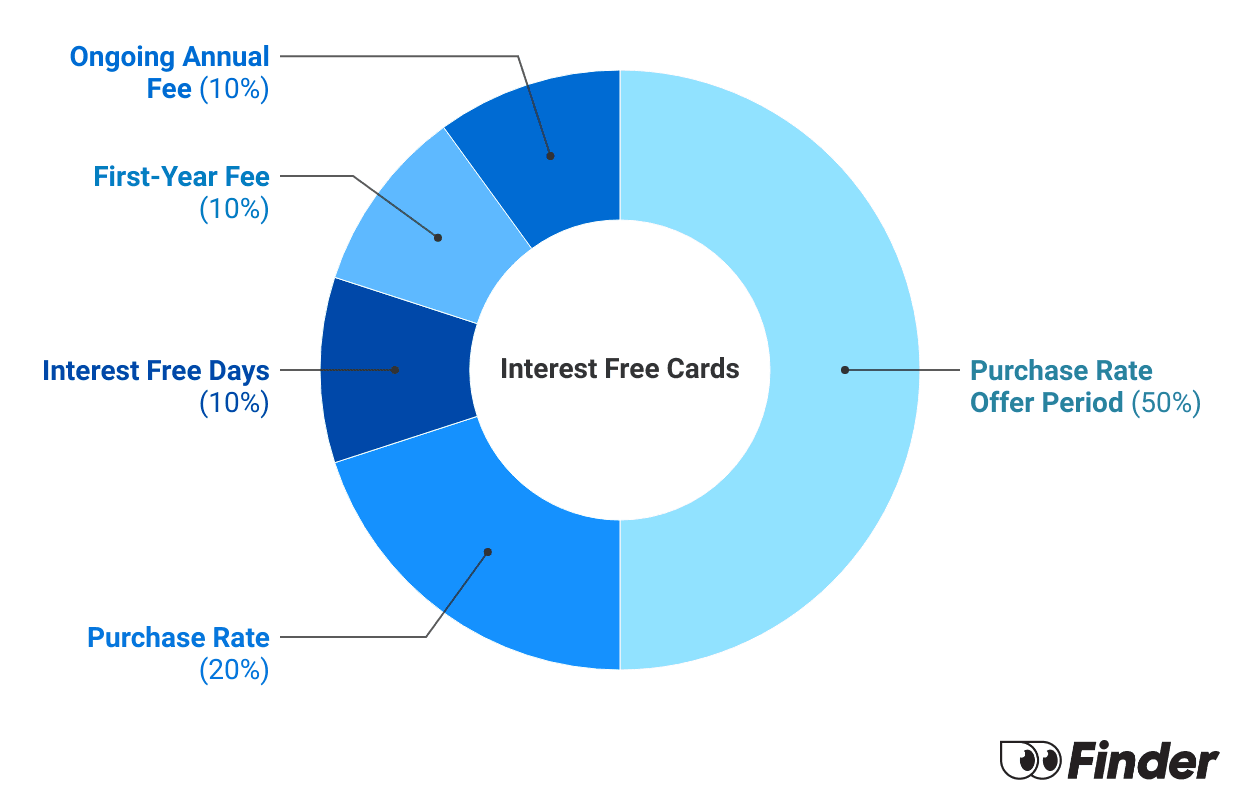
Every month we carefully analyse over 250 credit card products and assess the features and benefits of each card. We assign a Finder Score out of 10 for each feature, and adjust the scores depending on the category.
To be included for the interest-free score, credit cards must:
Be available to general consumers
Have 0% interest rate (ongoing or offers) on new purchases
Credit card scores are category-specific (e.g. cashback, frequent flyer), meaning the same card will receive a different score within each category.
The score process is run by our insights and editorial team, independent of any commercial partnerships. Remember that Finder Score is just one factor to consider. Look at other aspects like fees, features, benefits and risks to make sure a product is suitable for you.
Feature
Definition
Assessment
Weight
Interest-Free Days
Number of days for no interest or fees on new purchases
Longer periods earn more points, up to market maximum. 0% purchase rate cards are assigned a default 30 days
10%
Purchase Rate Offer Period
Number of months for interest-free purchase rate
Higher the number of months, better the score
50%
First-Year Fee
Annual fee charged in the first year of ownership
Lower fees score higher. $0 fee receives the maximum points
10%
Ongoing Annual Fee
Annual fee charged from the second year onwards
Lower fees score higher. $0 fee receives the maximum points
With over 20 years of experience in property, finance and investment journalism, Sarah is a trusted expert whose insights regularly appear across television, radio, and print media, including Sunrise, ABC News, and Yahoo! Finance. She has previously served as managing editor for Your Investment Property and Australian Broker, and her expert advice has been shared in the media over 3,500 times since 2023 alone. Sarah holds a Bachelor’s degree in Communications and a Tier 1 Generic Knowledge certification, which complies with ASIC standards.
See full bio
Sarah's expertise
Sarah
has written
209
Finder guides across topics including:
hello,
im looking at having stomach surgery and I have most of the money but I am still needing about another $10,000 for this and I was wondering what credit card would be the best way for me to go as I would like to pay it off with in 12 months of having surgery.
thank you so much
Finder
JonathanFebruary 9, 2015Finder
Hi Sarah,
Thanks for your inquiry.
Depending on whether the surgery is billed as a purchase or cash advance (would be best to confirm with the medical company) this would determine whether an interest-free credit card would be ideal. You may refer to our page on comparing medical loans. Before applying, please ensure that you meet all the eligibility criteria and read through the details of the needed requirements as well as the relevant Product Disclosure Statements/Terms and Conditions when comparing your options before making a decision on whether it is right for you.
I hope this has helped.
Cheers,
Jonathan
AngelaJanuary 14, 2015
I have an existing credit card that I am trying to pay off. I am finding it hard as the interest I get charged each month is almost the same amount as my monthly repayments, which means I am getting no where. I have talked to some friends that have mentioned I should transfer my debt to an interest free credit card that way I can pay it off within the time of the interest free offer. Will this be beneficial for me? Is there any hidden charges I should be looking for? I am confident I can pay this off within 6-12months, as long as I don’t get charged interest.
Finder
ElizabethJanuary 14, 2015Finder
Hi Angela,
Thanks for your question.
Your friends were likely referring to a balance transfer, which allows you to bring over an existing credit card balance to a new card and pay 0% p.a. interest on it for an extended amount of time. You can compare and apply for balance transfer credit cards as well as learn more about them. A few things to be aware of with balance transfer credit cards:
– Balance transfer rate: The rate you will be charged on the balance you bring over.
– Annual fee: Will you be charged an annual fee to use this product?
– Balance transfer revert rate: This is the rate you are charged after the balance transfer promotional period is over. Most of these cards revert to either the cash advance rate or purchase rate.
– Balance transfer period: How long you will receive the promotional balance transfer rate for.
– Balance transfer fee: Some cards may charge you a fee to bring over your credit card balance. This fee is often a percentage of the balance you bring over (eg. 3%)
This information can all be found in our credit card review pages, which can be found by clicking on ‘more info’ from the comparison table on the page I linked above. After you’ve reviewed your options and found the best card for your needs and situation, you can click ‘Go to Site’ to apply.
I hope this has helped.
Thanks,
Elizabeth
MichaelJuly 11, 2013
If you pay my card right out what interest rate will you charge me?
Finder
JacobJuly 11, 2013Finder
Hi Michael. Thanks for your question, but I’m not sure I understand. Are you referring to the balance transfer rate of interest? You can find this information in the comparison tables and in the review pages for each card. Jacob.
Important information about this website
Finder makes money from featured partners, but editorial opinions are our own.
Finder is one of Australia's leading comparison websites. We are committed to our readers and stand by our editorial principles.
We try to take an open and transparent approach and provide a broad-based comparison service. However, you should be aware that while we are an independently owned service, our comparison service does not include all providers or all products available in the market.
Some product issuers may provide products or offer services through multiple brands, associated companies or different labeling arrangements. This can make it difficult for consumers to compare alternatives or identify the companies behind the products. However, we aim to provide information to enable consumers to understand these issues.
We make money by featuring products on our site. Compensation received from the providers featured on our site can influence which products we write about as well as where and how products appear on our page, but the order or placement of these products does not influence our assessment or opinions of them, nor is it an endorsement or recommendation for them.
Products marked as 'Top Pick', 'Promoted' or 'Advertisement' are prominently displayed either as a result of a commercial advertising arrangement or to highlight a particular product, provider or feature. Finder may receive remuneration from the Provider if you click on the related link, purchase or enquire about the product. Finder's decision to show a 'promoted' product is neither a recommendation that the product is appropriate for you nor an indication that the product is the best in its category. We encourage you to use the tools and information we provide to compare your options.
Where our site links to particular products or displays 'Go to site' buttons, we may receive a commission, referral fee or payment when you click on those buttons or apply for a product.
When products are grouped in a table or list, the order in which they are initially sorted may be influenced by a range of factors including price, fees and discounts; commercial partnerships; product features; and brand popularity. We provide tools so you can sort and filter these lists to highlight features that matter to you.
Please read our website terms of use and privacy policy for more information about our services and our approach to privacy.
We update our data regularly, but information can change between updates. Confirm details with the provider you're interested in before making a decision.
How likely would you be to recommend Finder to a friend or colleague?
0
1
2
3
4
5
6
7
8
9
10
Very UnlikelyExtremely Likely
Required
Thank you for your feedback.
Our goal is to create the best possible product, and your thoughts, ideas and suggestions play a major role in helping us identify opportunities to improve.
The information provided by Frankie is general in nature and has been prepared without considering your objectives, financial situation or needs. Frankie may make mistakes so it's important that you review the information before deciding. By messaging Frankie, you agree to our Terms and have read our Privacy Policy.
hello,
im looking at having stomach surgery and I have most of the money but I am still needing about another $10,000 for this and I was wondering what credit card would be the best way for me to go as I would like to pay it off with in 12 months of having surgery.
thank you so much
Hi Sarah,
Thanks for your inquiry.
Depending on whether the surgery is billed as a purchase or cash advance (would be best to confirm with the medical company) this would determine whether an interest-free credit card would be ideal. You may refer to our page on comparing medical loans. Before applying, please ensure that you meet all the eligibility criteria and read through the details of the needed requirements as well as the relevant Product Disclosure Statements/Terms and Conditions when comparing your options before making a decision on whether it is right for you.
I hope this has helped.
Cheers,
Jonathan
I have an existing credit card that I am trying to pay off. I am finding it hard as the interest I get charged each month is almost the same amount as my monthly repayments, which means I am getting no where. I have talked to some friends that have mentioned I should transfer my debt to an interest free credit card that way I can pay it off within the time of the interest free offer. Will this be beneficial for me? Is there any hidden charges I should be looking for? I am confident I can pay this off within 6-12months, as long as I don’t get charged interest.
Hi Angela,
Thanks for your question.
Your friends were likely referring to a balance transfer, which allows you to bring over an existing credit card balance to a new card and pay 0% p.a. interest on it for an extended amount of time. You can compare and apply for balance transfer credit cards as well as learn more about them. A few things to be aware of with balance transfer credit cards:
– Balance transfer rate: The rate you will be charged on the balance you bring over.
– Annual fee: Will you be charged an annual fee to use this product?
– Balance transfer revert rate: This is the rate you are charged after the balance transfer promotional period is over. Most of these cards revert to either the cash advance rate or purchase rate.
– Balance transfer period: How long you will receive the promotional balance transfer rate for.
– Balance transfer fee: Some cards may charge you a fee to bring over your credit card balance. This fee is often a percentage of the balance you bring over (eg. 3%)
This information can all be found in our credit card review pages, which can be found by clicking on ‘more info’ from the comparison table on the page I linked above. After you’ve reviewed your options and found the best card for your needs and situation, you can click ‘Go to Site’ to apply.
I hope this has helped.
Thanks,
Elizabeth
If you pay my card right out what interest rate will you charge me?
Hi Michael. Thanks for your question, but I’m not sure I understand. Are you referring to the balance transfer rate of interest? You can find this information in the comparison tables and in the review pages for each card. Jacob.