These fixed rate home loans offer low costs, coupled with a host of features, giving the best overall value.
7+
Great
These home loans may have slightly higher interest rates or fewer features but overall, a competitive offering.
5+
Standard
Usually the home loans would offer above average rates. They may still include some competitive features.
0+
Basic
Higher costs and/or fewer features.
Our best refinance home loan for September 2026
What does it mean to refinance a home loan?
Refinancing means switching from your current home loan to a new one. You can refinance your home loan to:
Get a lower interest rate.
Borrow more money.
Switch to a loan that suits your current financial goals.
How to compare home loans when refinancing
To find a better loan:
Enter your current loan amount and interest rate in the fields above the table (or just estimates if you're not sure).
Compare loans by sorting from highest to lowest interest rate or by looking at the amount you can save with each loan (if the rate is lower than your current loan).
Click the green button on any loan in the table if you think it suits your needs and submit an enquiry. It only takes a minute.
Is your mortgage eating your pay cheque?
If your mortgage feels like it's swallowing your whole pay cheque, you're far from alone. Finder's 2026 Home Loan Report found 55% of mortgage holders are spending more than 30% of their take-home pay on repayments, with the average sitting at 38%. More than a quarter (27%) say they're "just scraping by" each month. Sound familiar? It might be time to see what a better rate could do for your budget.
Comparing for yourself is easy. But if you want a shortcut, every month Finder picks our top home loans for the month by looking at loans with the lowest rate and fees.
And you can check out the full list of Finder's 2025 Home Loan Award winners if you want to find loans that had consistently low rates and fees all year.
How much does refinancing cost?
Factoring in fees and charges, you can expect to spend around $1,000 when refinancing your home loan. But this depends on your old loan's fees and the new one too.
In many cases, the amount of money you'll save when refinancing to a cheaper rate will more than outweigh the costs of refinancing.
Discharge fees. Lenders often charge a fee to end a home loan of around $125 to $250.
Government fees. Refinancers may have to pay state government fees to de-register their old loan and register the new one.
Here's a quick example of switching costs in a hypothetical refinance scenario (using government fees from Victoria):
Fee/cost
Amount
Discharge fee (old loan)
$250
Mortgage deregistration fee
$125.70
Mortgage registration fee
$125.70
Application fee (new loan)
$450
Title search fee
$30
Total refinancing costs:
$981.40
Fixed rate break costs
You may have to pay an exit fee for breaking the loan when refinancing a fixed rate loan. Ask your current lender for a break fee estimate before committing to refinancing.
Refinance cashbacks take all the costs away
Some lenders really want your business. To get you to switch, they offer home loan cashbacks to cover your refinancing costs.
This can net you several thousand dollars, which should more than offset most people's loan fees.
What are the benefits of refinancing?
You can get a lower interest rate. The most common reason to refinance is to get a better interest rate on your home loan than your current lender offers. Easy.
You could increase your loan amount. Maybe you want to use your equity to increase your loan amount but your existing lender has turned you down. Refinancing could allow you to borrow more.
You could access new features. If your existing loan doesn't offer things like an offset account or redraw, it's definitely reasonable to want to refinance so you can get them.
What are the disadvantages of refinancing your home loan?
Paying extra fees. Refinancing comes with fees, although the new loan should save you money in the long term.
Paying more overall. This is where the math gets complicated. Let's say you were 10 years into a 30 year loan term. Refinancing your remaining loan value to another 30 year loan could mean you end up paying more over the life of the loan. Confused? Take a look below at our more detailed explainer.
Losing equity. Refinancing to access more cash means you'll probably lose some of the equity you've built in your home.
Refinancing when you own less than 20% of your property is a bad idea
If you want to refinance and you're still fairly early into your loan, and you started with a small deposit, you could end up paying LMI again. You're better off waiting until you own 20% of the property.
How much can you save by refinancing in 2026?
We estimate that the average person could save up to $6,912 a year by switching to a lower rate:
The average Australian home loan is now $730,719, according to the ABS - a record high!
The lowest available variable rate on the market for refinancers is 5.69%.
Assuming a 30-year loan term, if you switched to that lower refinance rate your monthly repayments would drop from $4,813 to $4,237. That's a saving of $576 every month, or $6,912 a year.
Data is correct as of 3 September 2026. The savings example is a hypothetical estimate only. The lowest rate is for an owner-occupier loan with 80% LVR.
Market update by Rebecca Pike – Finder's senior home loans writer
How to find the best refinance rate
Look for a cheaper rate
The lower the interest rate the more money you save. This is true for every borrower and it's the first thing most refinancers look for.
Even just a small difference in rates can end up saving you hundreds of dollars a year in repayments.
Make sure the loan meets your needs
You also need to refinance to a home loan that suits your needs. If you need a loan with an offset account, you want to avoid a basic loan that doesn't have this feature.
A package loan might look attractive, but it might have high annual fees and products you don't need.
Avoid a loan with high fees
There are usually 1 or 2 fees with any new home loan. But the cost of fees can vary widely, from practically nothing to hundreds of dollars. It's worth keeping loan fees in mind when preparing to refinance a home loan.
Check your current interest rate. Look at competitive mortgage rates and see if yours is too high. You could ask your lender to lower your rate or start looking for a better deal.
Compare home loan refinancing options. If you do decide to switch lenders, look for a suitable loan with a better rate and features you need.
Crunch the numbers. Work out the costs of your new loan, including application and ongoing fees, and make sure the new loan really is a better deal. Check the exit costs from your current loan too.
Apply for the new home loan. Collect your mortgage documents, submit your application and then wait for approval from the new lender.
Exit your current loan. When you refinance, your new bank will notify your current lender and you can discharge your old loan.
Our expert says: I rarely refinance, but I call my lender every year
"My current home loan is one of the lowest rates on the market, so I rarely think about refinancing. But I watch my home loan rate like a hawk. Because every now and then my lender offers new customers a slightly better deal than what existing customers get. Sneaky. If I ignore this, my rate gets much worse over time. So I call my lender up and ask for the lower rate. And I get it every time."
Your equity is below 20% of the property's value. If you own less than 20% of the property at its current value, then you will have to pay lenders mortgage insurance (LMI) when you refinance. Even if you paid it for your original loan.
Your loan amount is small or you're selling soon. If you don't have much left to repay on your home loan, then the savings from refinancing might not be worth the hassle. If you're planning on selling within the next 6 months, then the effort and cost involved in refinancing could also cancel out any financial rewards.
You can refinance a fixed rate home loan, but you have to pay a break fee for exiting the loan early during the fixed period. If you are close to the end of the fixed period on your loan, then this fee will be smaller, but if you have a few years left, it could cost thousands. Your current lender can provide you with a break cost estimate to help you decide if the cost is worth it.
Theoretically, you can refinance your loan no matter how much or how little equity you have. But if your equity is under 20% of your property's current value, then refinancing, while possible, gets expensive. This is because your new lender will charge LMI if your equity is below 20%.
You can get a home loan with a deposit or equity below 20%. And that's true for refinancers too. But it's a really expensive idea. You'll have to pay LMI, even if you already paid it.
And if you're in negative equity or simply don't own much of your property, getting a new loan approved is very unlikely.
You're better off building equity by making repayments on your current loan.
Most refinancers switch from a 30-year home loan to another 30-year loan. Even if they're many years into their original loan. That's fine and will keep your monthly repayments low. But you could save more money in the long run by switching to a shorter loan term.
If you refinance 5 years into a 30-year loan term, you could switch to a 25-year loan. You'd pay more each month but end the loan at the same time as your original loan started.
It's really a question of what works better for you. Do you want lower monthly repayments but a longer loan term (and more interest overall)? Or do you want to get a lower rate and pay the loan off faster with a shorter term?
You can also stick to a new 30-year loan term but make extra repayments or build up offset savings. This has the same effect but gives you more options.
It can take 2–4 weeks to get your new loan application approved and the old loan discharged. But it varies widely and depends on your new lender and your old one.
Many online lenders (and even some of the banks) now offer fast digital applications. And it's usually easier for refinancers to get loans approved because they have built up equity and have a track record (hopefully!) of making regular loan repayments.
Every lender sets its own interest rates for home loans. There's no one refinance rate. In fact, most lenders don't even have specific loans with rates just for refinancers (most loans are available to both new borrowers and people refinancing existing loans).
Right now interest rates for owner-occupiers are as low as 5.7%.
When couples get divorced, there are hard decisions to make around property. You may decide to sell the home and share the profits or let one person keep it.
If one person decides to buy out the other person's half, you will need to refinance the mortgage when transferring the property title. Otherwise, the person selling would still be on the mortgage.
You can also decide to keep the home loan as it is and continue to make repayments.
It's always better if a divorcing couple can agree amicably on what to do with their property. But it's still a really good idea to get legal advice.
You can refinance as often as you like, but given the time involved and the cost of registering a mortgage, realistically it doesn't make sense to switch more than once every few years. You're better off finding a loan that will hopefully remain a good deal for a few years.
Yes, it's possible to refinance a home loan in order to pay off personal loan or credit card debts. You can essentially borrow a little more against your equity and use that to clear the debts.
This can save you money because interest rates on credit cards and most personal loans are higher than home loan rates.
But there is a risk that comes with using your home loan to cover smaller debts. A home loan can last 30 years, whereas most people pay off a credit card or personal loan in months or years. Even at a lower rate, a smaller debt costs you much more in interest if you take 30 years to pay it off.
Repaying your home loan faster can help you offset this in the long run.
Yes. You can switch to a better loan with your current lender. Or you may be converting a property from your residence into an investment property. In this case you'd need to refinance your home loan to an investment loan.
The lowdown on the Finder Score for home loans
The Finder Score is an easy, data-driven way to judge home loans at a glance. Here's how:
Every month, our insights team analyses more than 7,000 home loans across 120+ lenders.
We assess the most important features, rate them, and then combine them via a weighted methodology to create a simple score out of 10.
The Finder Score is designed by our insights and editorial team. We score home loans objectively, Finder's commercial partnerships don't affect the scores at all.
Remember that Finder Score is just one factor to consider. Look at other aspects like fees, features, benefits and risks to make sure a product is suitable for you. Double-check details that matter to you before applying or buying.
The nitty gritty: how Finder Score is calculated
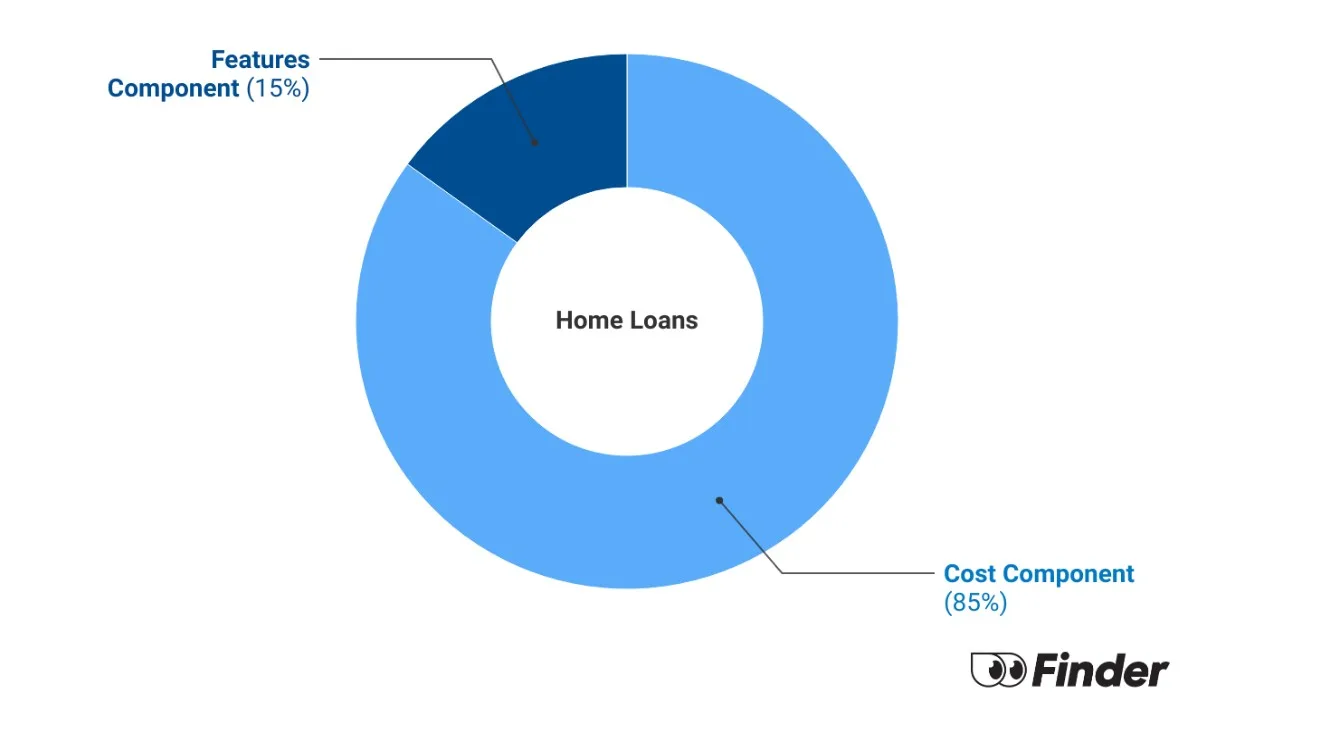
The Finder Score examines the costs and features of each home loan. These are combined to create the final score.
Cost Components (85% of overall score)
Features Component (15% of overall score)
Interest costs
Full and Partials Offsets
Upfront Fees
Extra Repayments and Redraw
Monthly/ Annual Fees
Loyalty Discounts
Cashbacks
The cost of the home loan makes up 85% of the score. The other 15% is made up of features that come with the home loan.
Here's how we weigh each factor in the cost component.
Cost Components (85% of overall score)
Calculation Methodology
Interest
Calculated over a $500,000 loan amount and 30 year loan term. The cumulative interest paid is calculated over 5 years, 3 years and 1 year for variable rates, long term fixed rates and short term fixed rates respectively.
Application Fees
Added to the cost, if applicable
Settlement Fees
Added to the cost, if applicable
Ongoing Fees
Calculated over 5 years, 3 years and 1 year for variable rates, short term fixed rates and long term fixed rates respectively.
Legal Fees
Added to the cost, if applicable
Valuation Fees
Added to the cost, if applicable
Cashback
Added to the cost, if applicable
Frequent Flyer Points
Converted to a dollar value based on ticket prices/redeemable gift cards and deducted from the cost
Here's how we weigh each factor in the features component.
Features Components
Calculation Methodology
Offset Account (5% of final score)
Each variant is assigned 10 points if they have a full offset account and 5 points if they have a partial offset account. No points are awarded if the variant does not have this feature.
Extra Repayments and Redraw (5% of final score)
Each variant is assigned 10 points if they have this feature. No points are assigned if they do not have this feature.
Loyalty Discounts (5% of final score)
Each variant is assigned 10 points if they have this feature. No points are awarded if they do not have this feature.
Sources
Was this content helpful to you?
Thank you for your feedback!
To make sure you get accurate and helpful information, this guide has been reviewed by
James Millard, a member of Finder's
Editorial Review Board.
Richard Whitten is Finder’s Senior Money Editor, with over eight years of experience in home loans, property, credit cards and personal finance. His insights appear in top media outlets like Yahoo Finance, Money Magazine, and the Herald Sun, and he frequently offers expert commentary on television and radio, helping Australians navigate mortgages and property ownership. Richard started his career in education and textbook publishing in South Korea. He holds multiple industry certifications, including a Certificate IV in Mortgage Broking (RG 206) and Tier 1 and Tier 2 certifications (RG 146), as well as a Bachelor of Education from the University of Sydney and a Graduate Certificate in Communications from Deakin University.
See full bio
Richard's expertise
Richard
has written
794
Finder guides across topics including:
Hello there!
I will be 57 years of age in May, am single, working full time, and this would be my first home. My total assets are worth around $75k. I have $25k-$30K deposit total.
If you could just advise me please of how much property price could I afford? The total apartment price that it.
Much appreciated
J
Finder
MayMarch 21, 2018Finder
Hi Jacqui,
Thanks for your inquiry.
The amount you can borrow (relative to the price of the property) for a home loan is basically up to the lender based on their assessment of your overall financial situation. Usually, they would consider some factors like your income, employment, assets, other liabilities, and even credit history. Nevertheless, if you like to calculate an estimate, you may use our calculator for home loan eligibility. Alternatively, you can reach out to a mortgage broker who can offer a range of home loan options.
Hope this helps.
Cheers,
May
ChristineJuly 12, 2017
Hi just wondering what the process is for changing name on the title from sole proprietor to joint proprietors when there is a mortgage on title?
ArnoldJuly 20, 2017
Hi Christine,
Thanks for your inquiry.
Whilst your property is on mortgage, it is still possible to change the ownership of the property. There’s a guide on this page – https://www.finder.com.au/guide-to-changing-property-ownership that outlines how you can go through the process. But first, you’d need to speak to your lender about your plan in changing the type of ownership of your property.
Hope this information helped.
Cheers,
Arnold
PhilJanuary 18, 2017
If I have two St George loans with a mate of mine…(both our names on both…he pays one and I pay the other) what is the best way of getting out of having two loans and having only one with my name and one with his name on it?
Phil.
AnndyJanuary 19, 2017
Hi Phil,
Thanks for your question.
It is possible to refinance a joint home loan to an individual loan and get a better rate through any of the options above. Please note that you should meet certain eligibility criteria to get approved. Please click the name of the loan product on our page so you’ll see the details how to qualify. The ‘go to site’ button is for submitting your application.
You may want to consider getting in touch with a mortgage broker if you need assistance in finding a suitable home refinancing loan.
Cheers,
Anndy
SenitaOctober 12, 2016
How to refinance the exsiting mortgage for low interesr rate
AnndyOctober 13, 2016
Hi Senita,
Thanks for your question.
If you are looking to refinance your existing mortgage, the step-by-step refinancing process is explained in the above infographic.
Should you need assistance in finding a suitable home loan, a mortgage broker can help.
Cheers,
Anndy
RichardJune 10, 2016
I have a rented unit in Sydney that I would like to refinance to buy land in NZ where I now live. I have contacted a broker who came back with 75% LVR (thats OK), but with a whopping 7.35% interest.
What other options are open to me?
Finder
MarcJune 14, 2016Finder
Hi Richard,
thanks for the question.
You’ve come through to finder.com.au, a comparison service. Unfortunately by law we’re unable to suggest specific home loan rates and fees which you could apply for. It might be a good idea to contact a number of lenders that you’re interested in or alternatively speak to another broker to get another recommendation.
Knowing just how much equity you have in your home before you start looking to refinance a home loan is crucial. If you don't have enough equity you might have to pay for LMI again or get stuck with a higher rate.
When you have bad credit it can be harder when refinancing. Home loans are available even with bad credit though – find out how you can refinance today.
Keen to switch home loan to a better deal? Refinancing could save you thousands, but make sure you know all the fees and charges before you switch.
Important information about this website
Finder is a comparison service. We do not compare every product or every provider in the market.
We make money through commercial arrangements with some of the providers on this site. Products marked 'Sponsored', 'Promoted', 'Featured' or 'Advertisement' appear as a result of a commercial arrangement.
Our editorial content, product reviews and any 'Top Pick' designations are prepared independently of these commercial arrangements.
The default order of products in our tables can be influenced by commercial arrangements. You can re-sort or filter using the controls above each table.
Some content on this site may be generated or supported by AI tools. You should verify details directly with the provider.
Finder is one of Australia's leading comparison websites. We are committed to our readers and stand by our editorial principles.
Our comparison service does not include every product or every provider in the market. Some product issuers offer their products under multiple brands or through associated companies. Where we can, we identify the underlying issuer so you can compare like with like, but you should always check with the provider directly to confirm which brand you are dealing with.
Finder is a comparison website and an intermediary. We are not a product issuer and we do not provide personal financial or credit advice. When you click a link to a product, or apply for a product through our site, you deal directly with the product issuer. We may receive a referral fee, commission or other payment from the issuer if you click through, apply or take out a product. We describe these arrangements in more detail under 'How we make money' below.
Product features, fees, terms and eligibility criteria are set by the product issuer and may change. We rely on information supplied by issuers when we present product details on our site. Before you apply for or take out any product, you should confirm the details directly with the issuer.
We earn revenue from Finder in four principal ways:
Referral fees and commissions. When you click a product link, complete an enquiry form or apply for a product through our site, we may receive a referral fee, commission or other payment from the product issuer. We may also receive payment based on the volume of leads or conversions we send to an issuer.
Sponsored placements. Products marked 'Sponsored', 'Promoted', 'Featured' or 'Advertisement' appear as a result of a commercial arrangement between Finder and the issuer. These labels always indicate a paid placement. We do not use them for editorial choices.
Display advertising. Banner advertising, newsletter advertising and similar display ads on our site are paid by advertisers.
Content sponsorship. Some articles, videos and social media posts are sponsored by an issuer and are clearly labelled as such.
Our editorial opinions, product reviews and any 'Top Pick' designations are prepared independently of these commercial arrangements. A 'Top Pick' is an editorial choice made by our writers and editors based on the criteria described on each comparison page. A 'Top Pick' is not a personal recommendation and does not mean the product is appropriate for your circumstances.
If you would like to know whether we have a commercial arrangement with a specific product issuer, please contact us.
When products are grouped in a table or list, the default order can be influenced by commercial arrangements we have with product issuers. In some categories, sponsored or featured products appear in the top positions of the table by default, and are always labelled as such.
Other factors that influence default order include price, fees and features, and (where relevant) our editorial view of the product.
You can re-sort every comparison table using the controls above the table. You can filter by product features that matter to you. The order you see after re-sorting or filtering is not influenced by commercial arrangements.
Some content on this site is generated or supported by artificial intelligence tools, including our AI-powered assistant FinderBot. AI-generated content may contain errors. Please verify important information directly with the product issuer before making a financial decision. For more information about FinderBot, see the FinderBot Terms of Use and FinderBot Privacy Collection Notice.
Please read our website terms of use and privacy policy for more information about our services and our approach to privacy.
We update our data regularly, but information can change between updates. Confirm details with the provider you're interested in before making a decision.
Our goal is to create the best possible product, and your thoughts, ideas and suggestions play a major role in helping us identify opportunities to improve.







Hello there!
I will be 57 years of age in May, am single, working full time, and this would be my first home. My total assets are worth around $75k. I have $25k-$30K deposit total.
If you could just advise me please of how much property price could I afford? The total apartment price that it.
Much appreciated
J
Hi Jacqui,
Thanks for your inquiry.
The amount you can borrow (relative to the price of the property) for a home loan is basically up to the lender based on their assessment of your overall financial situation. Usually, they would consider some factors like your income, employment, assets, other liabilities, and even credit history. Nevertheless, if you like to calculate an estimate, you may use our calculator for home loan eligibility. Alternatively, you can reach out to a mortgage broker who can offer a range of home loan options.
Hope this helps.
Cheers,
May
Hi just wondering what the process is for changing name on the title from sole proprietor to joint proprietors when there is a mortgage on title?
Hi Christine,
Thanks for your inquiry.
Whilst your property is on mortgage, it is still possible to change the ownership of the property. There’s a guide on this page – https://www.finder.com.au/guide-to-changing-property-ownership that outlines how you can go through the process. But first, you’d need to speak to your lender about your plan in changing the type of ownership of your property.
Hope this information helped.
Cheers,
Arnold
If I have two St George loans with a mate of mine…(both our names on both…he pays one and I pay the other) what is the best way of getting out of having two loans and having only one with my name and one with his name on it?
Phil.
Hi Phil,
Thanks for your question.
It is possible to refinance a joint home loan to an individual loan and get a better rate through any of the options above. Please note that you should meet certain eligibility criteria to get approved. Please click the name of the loan product on our page so you’ll see the details how to qualify. The ‘go to site’ button is for submitting your application.
You may want to consider getting in touch with a mortgage broker if you need assistance in finding a suitable home refinancing loan.
Cheers,
Anndy
How to refinance the exsiting mortgage for low interesr rate
Hi Senita,
Thanks for your question.
If you are looking to refinance your existing mortgage, the step-by-step refinancing process is explained in the above infographic.
Should you need assistance in finding a suitable home loan, a mortgage broker can help.
Cheers,
Anndy
I have a rented unit in Sydney that I would like to refinance to buy land in NZ where I now live. I have contacted a broker who came back with 75% LVR (thats OK), but with a whopping 7.35% interest.
What other options are open to me?
Hi Richard,
thanks for the question.
You’ve come through to finder.com.au, a comparison service. Unfortunately by law we’re unable to suggest specific home loan rates and fees which you could apply for. It might be a good idea to contact a number of lenders that you’re interested in or alternatively speak to another broker to get another recommendation.
Cheers,
Marc.