How much is travel insurance?

Here's the average Aussie pays for travel insurance, why prices moved and how to keep premiums low.

4.7 based on 828 reviews

Key takeaways

  • Finder research put the average cost of travel insurance at around $105 in September 2026. Your own cost will differ based on your personal circumstances
  • Many factors influence the cost of your travel insurance policy, including the destination, your age and planned activities.
  • The cost of travel insurance has changed, but there are still a few things that you can do to get more value out of your chosen policy.

From flights to accomodation and activities, there are may costs associated with travel. One expense that often gets left to the last minute is travel insurance. However, travel insurance is best purchased as soon as you book your flight, as it can cover you against unforeseen flight cancellations or delays.

The average cost of travel insurance for Australians was $105 in September 2026. But keep in mind, this is going to be different for everyone since the price is based on so many factors like your destination, length of your trip, your age and if you have any pre-existing medical conditions.

Let's go through some of these factors below.

What impacts the cost of travel insurance premiums?

Travel insurers determine the cost of your premium based on your individual level of risk. Are you elderly? Or maybe someone who craves adventure? Perhaps even both. These factors play out in the cost of your travel insurance policy, but remember, there are ways to save and get better value – you just have to compare travel insurance.

Here are some things that can impact your travel insurance cost:
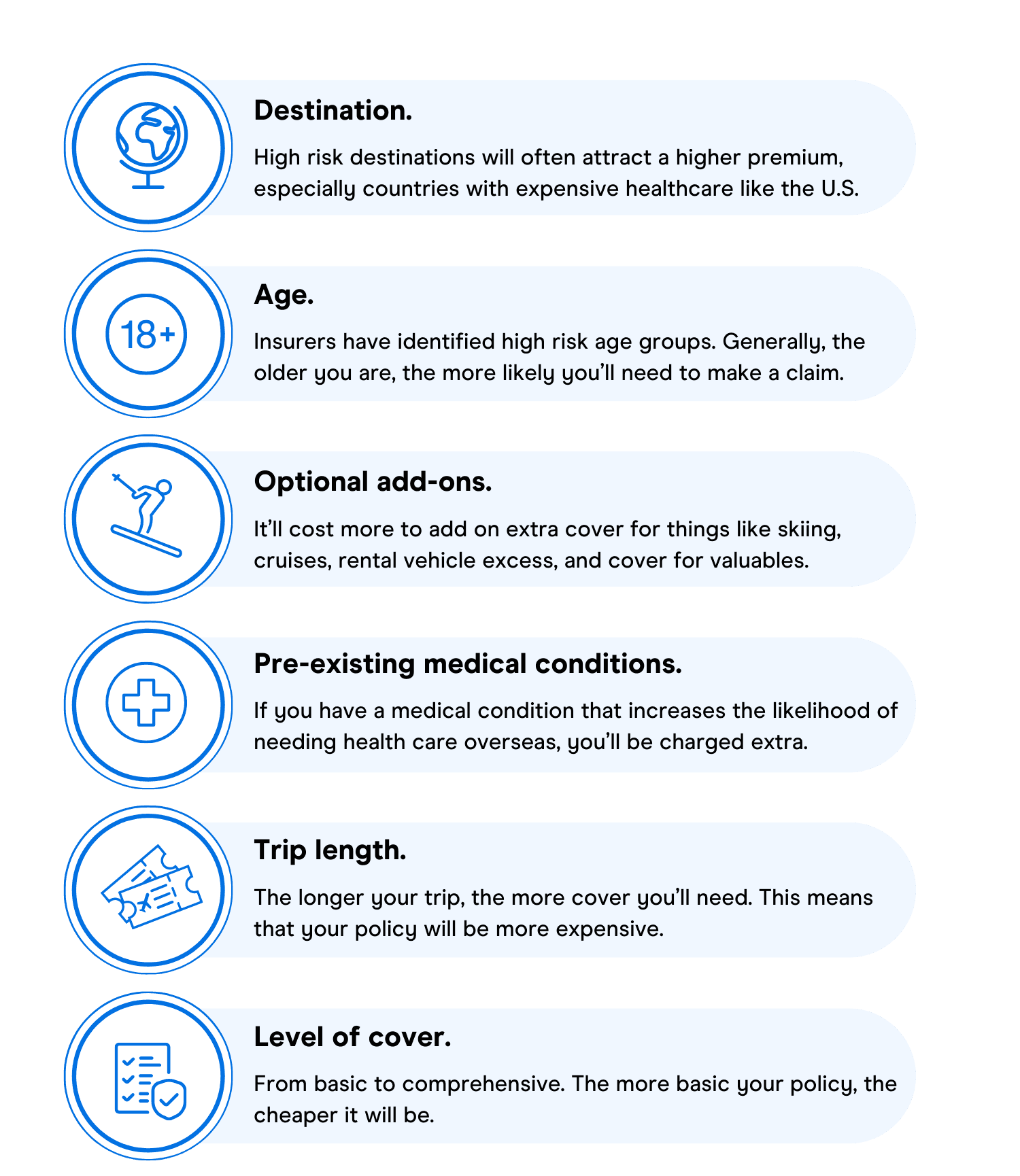
Infographic of factors that impact the cost of travel insurance

    How has the cost of travel insurance changed over the years?

    Travel insurance prices have been on a rollercoaster over the past decade. Premiums sat fairly steady through the late 2010s, disappeared almost entirely when borders closed in 2020, then came back sharply once Australians started travelling again. By 2023 the average policy was costing noticeably more than it had before the pandemic, as insurers priced in higher medical costs, more flight cancellations and a wave of disruption claims.

    The good news is that the surge appears to have peaked. To see how prices have shifted for a real trip rather than an average, we compared quotes from the same insurers for the same holiday: a two-week trip to Bali for a 30-year-old with a $200 excess.

    Travel insurance quotes from 2019

    CostPolicy type
    Fast Cover$58.90Comprehensive
    Zoom Travel Insurance$58.65Comprehensive

    Travel insurance quotes from 2024

    CostPolicy type
    Fast Cover$125.99Comprehensive
    Zoom Travel Insurance$122.15Comprehensive

    Travel insurance quotes from 2026

    CostPolicy type
    Fast Cover$107.99Comprehensive
    Zoom Travel Insurance$78.37Comprehensive
    *Last updated: September 2026

    Do you need travel insurance?

    Well, of course we're going to say yes, but we're not the only ones. Smartraveller's signature line is "If you can't afford travel insurance, you can't afford to travel".

    That being said, only a few countries have mandated travel insurance as an entry requirement to enter the country. But if you're travelling with a private tour company, travel insurance is usually compulsory to join the tour.

    Cheap or comprehensive: does it really make a difference?

    Basic and medical-only policies cost less because they cover less. That's a reasonable trade for some trips and a bad one for others.

    What's coveredBasicComprehensive
    Overseas medical and hospitalYesYes
    Emergency evacuationYesYes
    Personal liabilityUsuallyYes
    Luggage and personal itemsLimited or excludedYes
    Trip cancellationUsually excludedYes
    Travel delayUsually excludedYes
    Rental vehicle excessExcludedOften included or optional

    A basic policy makes sense for a cheap, flexible trip where losing the booking wouldn't hurt. For an expensive trip booked months ahead, the extra premium usually buys more than it costs. Our guide to cheap travel insurance goes through where it's safe to save.

    Can I use my credit card's travel insurance instead?

    Complimentary travel insurance comes with a lot of premium credit cards, and if it covers your trip properly, it's the cheapest option available. The catch is that it often doesn't, and people tend to find that out at the worst possible moment.

    Things to check before you rely on it:

    1. How to activate it. Most cards require you to spend a minimum amount on prepaid travel costs, usually flights or accommodation, using that card. Some also require you to register the trip before you leave. If you booked with points or a different card, you may not be covered at all.
    2. Who's covered. Cover usually extends to your spouse and dependent children travelling with you, but not always to other family members or friends on the same trip.
    3. Age limits. Complimentary cover commonly stops applying above a certain age, or requires a medical assessment and an extra payment to continue.
    4. Pre-existing conditions. This is the biggest gap. Most complimentary policies either exclude pre-existing conditions outright or require you to apply and pay for an assessment.
    5. Trip length. Cover is typically capped at a set number of days per trip, so longer holidays can run past the end of your cover.
    6. What the limits actually are. Complimentary cover often has lower caps on luggage, cancellation and rental vehicle excess than a standalone policy.

    Did you know?

    Price isn't the only reason people go without. Finder research from 2024 found 11% of Australians skipped travel insurance because they didn't think anything bad would happen to them, 10% didn't know what it covered, and 5% simply forgot to buy a policy.

    How can I keep the cost of travel insurance down?

    If you're trying to get more bang for your buck, there are a few things that you can do to get more value out of your travel insurance.

    1. Compare travel insurance. We've got a nifty tool that can help you compare different travel insurers side-by-side so you can understand what benefits you're getting and at what cost.
    2. Look for discount codes. Travel insurers frequently offer discounts between 5% and 15% off their policies. This can really make a difference if you're someone who's high risk or if you're travelling for a long time.
    3. Play with your excess amounts. Have a think about how likely you are to make a claim on your policy. If it's very unlikely, opt for a higher excess – usually between $200 and $300. This will often give you a cheaper policy.
    4. Get last-minute travel insurance. This is riskier. Some insurers will automatically cover you for pre-departure cancellation, which means they could be covering you for longer than you need and charging you for it. But remember, this option leaves you at risk of not being covered if you do need that pre-departure cancellation.

    Mistakes that cost travellers money

    • Buying at the airport. Cancellation cover starts from the day you buy your policy, not the day you fly. Buying when you book means you're covered for the months leading up to the trip, usually for the same price.
    • Not declaring a medical condition. Declaring costs more upfront. Not declaring can mean a declined claim and a medical bill you pay in full.
    • Assuming your activities are covered. Skiing, riding a moped, diving and adventure sports are commonly excluded or need an add-on. Moped accidents in Bali are one of the most common claims Australians make, and cover usually depends on holding a valid licence for that vehicle.
    • Ignoring sub-limits. Your policy's total luggage limit isn't what you'd get for one item. Check the per-item cap before you travel with expensive gear.
    • Only insuring part of the trip. If you're stopping over somewhere on the way, make sure that country is on your policy.
    • Not reading the excess. A higher excess lowers your premium, which is fine until you claim for something that costs barely more than the excess itself.

    Frequently asked questions

    Sources

    Jason Loewenthal's headshot
    To make sure you get accurate and helpful information, this guide has been edited by Jason Loewenthal as part of our fact-checking process.
    Ceyda Erem's headshot

    Ceyda Erem is Finder’s senior writer for insurance and has almost 10 years of experience writing about personal finance. Formerly a copywriter for several business and finance clients, Ceyda has written hundreds of articles, guides, blogs and more to ensure Australians stay in the loop about how to best manage their money. She has a Bachelor of Arts, Majoring in Writing from Macquarie University. See full bio

    Ceyda's expertise
    Ceyda has written 216 Finder guides across topics including:
    • Insurance

    Get rewarded $$ for switching with Finder Rewards

    Find a better deal, save on your bills and get a free gift card. Sign up to be the first to hear about new Finder Rewards.

    Ask a question

    You are about to post a question on finder.com.au:

    • Do not enter personal information (eg. surname, phone number, bank details) as your question will be made public
    • finder.com.au is a financial comparison and information service, not a bank or product provider
    • We cannot provide you with personal advice or recommendations
    • Your answer might already be waiting – check previous questions below to see if yours has already been asked

    Finder only provides general advice and factual information, so consider your own circumstances, or seek advice before you decide to act on our content. By submitting a question, you're accepting our Terms Of Service and Finder Group Privacy & Cookies Policy.

    This site is protected by reCAPTCHA and the Google Privacy Policy and Terms of Service apply.

    4 Responses

      steve's avatar
      steveJune 7, 2024

      travelling to france and scotland for 4 weeks plane, rail and hire car. have fully comprehensive travel insurance with racv. do i need to take out full insurance with car hire

        Sarah Megginson's headshotFinder
        SarahJune 11, 2024Finder

        Hi Steve, Your best bet is to look at the inclusions of your policy with RACV. It will stipulate your specific cover around car insurance. Many insurance policies provide coverage up to a certain excess amount, eg. $3000, and you can then elect to take out insurance with the car hire company to reduce this excess to a lower amount if you wish.

        Best of luck!

      Beverley's avatar
      BeverleyDecember 6, 2016

      Iwantalnsurancefora43and47yearoldstotasmania

        Richard Laycock's headshotFinder
        RichardDecember 7, 2016Finder

        Hi Beverley,

        Thanks for getting in touch. To receive quote from the brands in our panel, please head over to our domestic travel insurance page.

        All the best,
        Richard

    More guides on Finder

    • Best travel insurance Australia September 2026

      The best travel insurance policies are different for each individual traveller.

    • InsureandGo Travel Insurance Review

      InsureandGo Travel Insurance can save you time with a comprehensive range of policies that are easy to digest and understand. Its policies include winter sports coverage plus both single and multiple trip policies.

    • AllClear Travel Insurance

      Our verdict: AllClear Travel Insurance covers globetrotters of any age and more than 1,300 pre-existing medical conditions, including heart complications and diabetes.

    • RACQ Travel Insurance

      Compare RACQ Travel Insurance, see features, and more.

    • Boomers Travel Insurance

      This article reviews Boomers Travel Insurance's various policies and extra coverage options, as well as outlining any extra benefits, how to claim, who's eligible and any other information that may be useful to the reader.

    • Travel Insurance for Countries with Travel Warnings

      If you’re planning to travel to a country that has high travel risks, learn how cover is and is not provided.

    • HCF Travel Insurance

      Compare HCF Travel Insurance, see features, and more.

    • CommBank Travel Insurance

      CBA Travel Insurance offers budget-friendly cover for younger travellers. Learn more.

    • WorldCare travel insurance discount and coupons

      WorldCare provides value for money travel insurance to both domestic and overseas travellers, offering a range of benefits for those who travel frequently within Australia plus 24/7 overseas emergency help through Allianz Global Assistance.

    • Defence Health Travel Insurance

      Compare Defence Health Travel Insurance, see features, and more.

    Go to site