

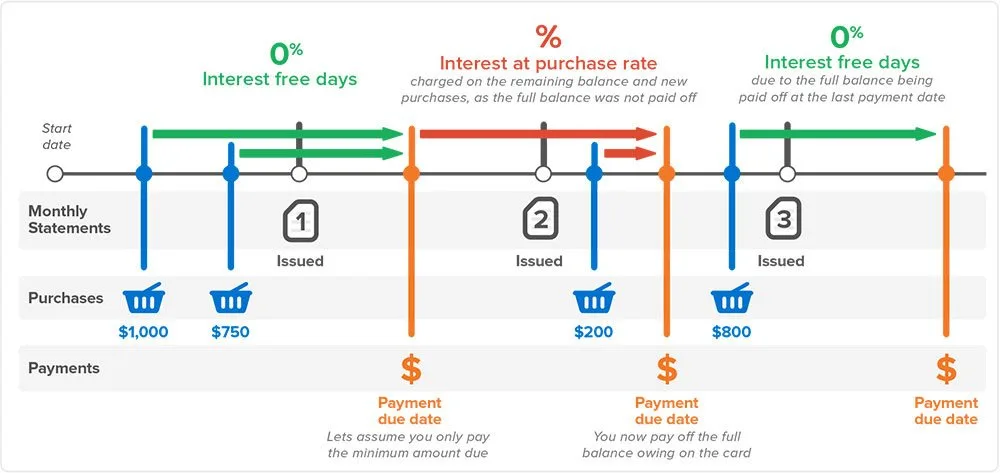
Key terms for interest-free days
- Statement period or billing cycle. The statement period shows activity on your credit card account and usually runs for 30 days, or from when your last statement was issued to when the next one is issued.
- Payment due date. This date is listed on your statement and tells you when you need to pay at least the minimum amount. If you want to get interest-free days, you'll usually have to pay the total balance by the due date.
- Closing balance or payment closing balance. The total you need to pay by the due date on your statement if you want to get interest-free days for the next statement period. A "closing balance" is usually the total of what's owed on your account.
- Minimum monthly payments. This is the minimum you need to pay by the due date on your statement to avoid late fees and a late payment listing on your credit report. You usually can't get interest-free days for purchases if you only pay this amount.
- Purchase rate. The interest rate charged on purchases. Interest-free days help you avoid this interest charge.

Do any of the 55 days interest free credit cards require a monthly minimum spend?
There’s information about cash advances and making payments but I’d like to know if any credit cards require a minimum amount is spent each billing period (particularly if you plan to pay the balance by the due date?).
Hi Jenny,
Credit cards don’t require you to spend a minimum amount each month. So you could spend between $0 up to your available credit limit in a billing cycle. Just keep in mind there is a minimum repayment amount, which will be shown on each statement. I hope that helps.
Is paying telstra, synergy, Alinta gas , western power also a cash advance or can I use my credit card
Hi Nicole,
Thanks for your inquiry.
If these falls under bill payments then typically they may be considered as cash advances. I suggest that you speak to your credit card provider directly to confirm whether the payments for the mentioned services or utility providers are considered as cash advances. You can also revisit your cardholder agreement with your credit card provider to learn more about their terms.
To know more which credit card transactions fall on cash advances, kindly refer to our guide on cash advances.
I hope this helps.
Cheers,
Debbie
Hi,
If my statement closes on say the 30th October and I owe $100 on my credit card which is due 15th November, if I pay the $100 off on the 10th November and then proceed to spend another $50 on my credit card that same day, is my balance considered cleared on the 15th November and that $50 goes to next months billing cycle or will I be charged interest on that new $50 now?
Hi Hayley, thanks for your inquiry!
To allow us to assist you further could you provide us with a specific bank please?
Cheers,
Jonathan
Hi Jonathan,
ANZ – Platinum rewards
Hi Hayley, thanks for your response.
Even if you had cleared your $100 outstanding balance, your entire balance (including the $50) would have to be cleared before your payment due date in order to receive interest-free days on your purchases.
I hope this helps.
Cheers,
Jonathan
Hi
Iv just got a mortgage and want to utilize a credit card with my monthly day to day spending so I can pay my weekly income straight off the mortgage. I then want to redraw from my mortgage to pay off my credit card each month.
Can I get a card which will allow me to make both purchases and cash withdrawals which will be interest free over a 1 month period?
Hi Ben,
Thanks for your inquiry.
Please refer to the following link for a list of 0% purchase cards. As of this time, there are no interest-free rates on cash advances, although there are low rate cash advance cards available.
You can press the “Go to Site” button of your preferred credit card to proceed with your application. You can also contact the provider if you have specific questions. A gentle reminder, please ensure to read through the relevant product disclosure statement and terms and conditions to ensure that you got everything covered before you apply.
Cheers,
Jonathan
My question is:
If I paid in full one period, it supposes I am not going to be charged with interest for that period (which is reflected in my next statement). My bank charged me interest anyway the next period. I asked the bank and they replied that only if I pay in full every period I am not getting charged with interest.
Is that correct?
Thanks…
Maria
Hi Maria,
Thanks for your question.
This is correct. Only by paying your balance in full each month are you able to avoid interest on purchases each statement period.
Hope this has helped.
Thanks,
Elizabeth