These products offer the best value and outcomes considering various product features and price.
7+
Great
Competitive products within their group.
5+
Standard
But these products still offer reasonable value and have the basics sorted.
0+
Basic
Offering basic cover with limited features or higher pricing.
What is pay as you go car insurance?
Pay as you go car insurance, also known as pay as you drive, is where premiums are based on the actual distance you drive. The insurers allow you to pay less for your insurance, as they recognise the chance of you having an accident is lower, as you're on the road less.
Insurers often use specific product nomenclature for these offerings, such as a Gold Low Kilometres Policy (a specialised tier designed to provide high-level protection for those who spend less time on the road).
Unlike traditional policies with fixed premiums, this model adjusts costs in line with your driving habits. Because your "risk" is lower, so are your premiums.
How does pay as you go car insurance work?
It doesn't necessarily mean you pay "as you drive" – you can still pay your premium annually. But insurers will calculate your premiums based on your vehicle's estimated and actual usage. There are a few ways they do this:
It is important to understand the operational mechanics: while a standard low-km discount is a flat reduction based on your estimated yearly travel, a true Pay As You Drive (PAYD) policy involves more dynamic tracking or specific odometer-based pricing.
Odometer reading
When you're getting a quote, you provide your odometer reading. Then you select how many kilometres you want to pay for — for example, 3,000km per year. You pay and you're ready to hit the road. If your odometer starts to near this limit but your policy term is not yet expired (meaning you haven't hit 12 months yet), you contact your insurer to top it up. The more kilometres you add, the more you'll pay.
Low kilometres options
Certain policies allow drivers to pre-select a kilometres cap, such as 5,000km or 10,000k, based on anticipated usage. You end up with a policy that's the same as regular comprehensive car insurance, however because you've selected your expected kilometres travelled in a year to be lower, you'll pay less in premiums.
Use of a tracker
Some insurers install telematics devices or use mobile apps to monitor the kilometres you're driving in real-time. This allows the insurer to charge you on a per kilometre basis as they'll know how many kilometres you're travelling. It can be a cost effective solution but, unsurprisingly, some get the ick on this because it feels like an invasion of privacy.
Is pay as you drive car insurance the same as comprehensive car insurance?
Yes, the benefits you receive and the coverage you're eligible for are the same as a standard policy. The difference is the way you track your kilometres and pay the insurer.
If you record your odometer reading and are required to 'top up' if you go over the amount of kilometres you've bought — that's a pay as you drive policy. Similarly, if you install a tracking device so the insurer can record your kilometres travelled and charge you accordingly — that's a pay as you drive policy.
Pay as you drive insurance is essentially a type of comprehensive cover, with your premium structured around how much you drive.
What's covered under pay as you drive car insurance?
Coverage typically mirrors that of comprehensive policies, including:
Accidental damage: Repairs for damages from collisions or other accidents.
Theft and vandalism: Protection against vehicle theft or malicious damage.
Fire damage: Coverage for damages resulting from fire.
It's essential to review individual policies, as coverage details and limits can vary between insurers.
Is pay as you drive car insurance good for seniors?
For seniors who often drive less frequently, pay as you drive insurance can be worth considering. By aligning premiums with actual usage, it offers potential cost savings.
However, it's worth noting that many popular car insurance providers offer coverage options for those who drive an average of 5,000 kilometres per year. If you're expecting to drive around this amount or less, then it's worth considering these providers in your car insurance comparison. While pay as you drive options can provide a cheaper option, this doesn't immediately make them the cheapest or the best for your needs.
Pros and cons of pay as you drive car insurance
Pros
Cost savings: Potentially lower premiums for those who drive less.
Personalised coverage: Policies tailored to individual driving habits.
Incentive to drive less: Potential to reduce driving, benefiting the environment and personal health.
Cons
Kilometres monitoring: Requires tracking of driving distance, which some may find intrusive.
Potential extra costs: Exceeding agreed mileage can lead to additional charges.
Compare pay as you go car insurance options
5 of 5 results
Compare other products
We currently don't have that product, but here are others to consider:
Looking for other options? Check out these similar products.
How we picked these
Finder Score for car insurance
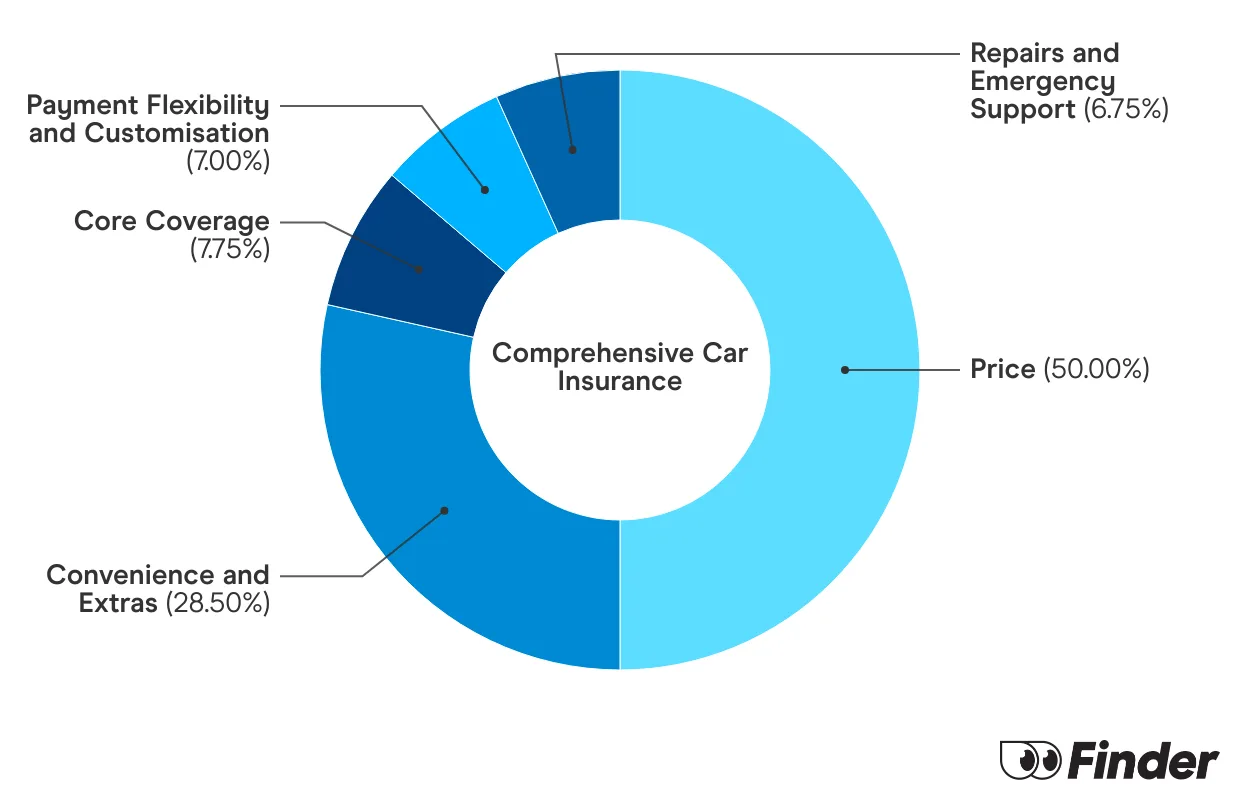
We analyse over 30 car insurance products across insurance providers, and rate each one for price and features. We collect up to 36 quotes per product, for male and female drivers in New South Wales, Victoria, Queensland, South Australia, Tasmania and Western Australia. Quotes are collected for 20 year olds, 30 year olds and 60 year olds, assuming an excess of $850 for a 2020 Toyota Corolla 4 door sedan model, with an average 15,000 kms driven each year. While we are not allowed to display actual quotes, our Finder Score aims to serve as an indicative guide to how cost and feature competitive a product might be for you.
Our feature score assesses each product for more than 15 features across loss and damage coverage, repairs and assistance coverage, personal items coverage and policy coverage. Features we assess include but are not limited to legal liability, essential repairs, new car replacement, car hire events, roadside assistance, agreed or market value, windscreen damage and natural disaster coverage.
"A pay as you drive policy can be great for those who are driving less than 15,000km per year. However, it's worth knowing that a lot of regular insurers charge a lower premium when you drive less kilometres. Compare a few options from pay as you drive providers and normal providers to be sure that you're getting the best deal."
Peta Taylor
Associate publisher
FAQs
Traditional car insurance involves fixed premiums based on projected usage that typically exceeds 15,000km, while pay as you drive insurance adjusts costs based on actual kilometres travelled, benefiting those who drive less.
Exceeding the predetermined mileage may result in additional charges or a reassessment of your premium. It's crucial to understand the terms of your policy to avoid unexpected costs. In most cases, if you think you're going to exceed your agreed mileage, you can pay to top it up.
Yes, many insurers allow policyholders to switch between pay as you drive and traditional policies. If you anticipate an increase in your driving frequency, discuss options with your insurer to ensure continuous and appropriate coverage.
Monitoring methods differ by insurer. Some may require periodic odometer readings, while others utilise telematics devices or mobile apps to track kilometres in real-time.
Peta Taylor is a publisher at Finder, working across all of insurance. She's been analysing product disclosure statements and publishing articles for over 2 years. Peta is passionate about demystifying complex insurance products to help users make well educated decisions with confidence. Peta is part of Finder's insurance awards team and works alongside editorial and insights experts to bring users the best insurance products every year.
See full bio
Compare cover from a range of car insurance providers and find out some of the things you will be covered for under a comprehensive policy.
Important information about this website
Finder is a comparison service. We do not compare every product or every provider in the market.
We make money through commercial arrangements with some of the providers on this site. Products marked 'Sponsored', 'Promoted', 'Featured' or 'Advertisement' appear as a result of a commercial arrangement.
Our editorial content, product reviews and any 'Top Pick' designations are prepared independently of these commercial arrangements.
The default order of products in our tables can be influenced by commercial arrangements. You can re-sort or filter using the controls above each table.
Some content on this site may be generated or supported by AI tools. You should verify details directly with the provider.
Finder is one of Australia's leading comparison websites. We are committed to our readers and stand by our editorial principles.
Our comparison service does not include every product or every provider in the market. Some product issuers offer their products under multiple brands or through associated companies. Where we can, we identify the underlying issuer so you can compare like with like, but you should always check with the provider directly to confirm which brand you are dealing with.
Finder is a comparison website and an intermediary. We are not a product issuer and we do not provide personal financial or credit advice. When you click a link to a product, or apply for a product through our site, you deal directly with the product issuer. We may receive a referral fee, commission or other payment from the issuer if you click through, apply or take out a product. We describe these arrangements in more detail under 'How we make money' below.
Product features, fees, terms and eligibility criteria are set by the product issuer and may change. We rely on information supplied by issuers when we present product details on our site. Before you apply for or take out any product, you should confirm the details directly with the issuer.
We earn revenue from Finder in four principal ways:
Referral fees and commissions. When you click a product link, complete an enquiry form or apply for a product through our site, we may receive a referral fee, commission or other payment from the product issuer. We may also receive payment based on the volume of leads or conversions we send to an issuer.
Sponsored placements. Products marked 'Sponsored', 'Promoted', 'Featured' or 'Advertisement' appear as a result of a commercial arrangement between Finder and the issuer. These labels always indicate a paid placement. We do not use them for editorial choices.
Display advertising. Banner advertising, newsletter advertising and similar display ads on our site are paid by advertisers.
Content sponsorship. Some articles, videos and social media posts are sponsored by an issuer and are clearly labelled as such.
Our editorial opinions, product reviews and any 'Top Pick' designations are prepared independently of these commercial arrangements. A 'Top Pick' is an editorial choice made by our writers and editors based on the criteria described on each comparison page. A 'Top Pick' is not a personal recommendation and does not mean the product is appropriate for your circumstances.
If you would like to know whether we have a commercial arrangement with a specific product issuer, please contact us.
When products are grouped in a table or list, the default order can be influenced by commercial arrangements we have with product issuers. In some categories, sponsored or featured products appear in the top positions of the table by default, and are always labelled as such.
Other factors that influence default order include price, fees and features, and (where relevant) our editorial view of the product.
You can re-sort every comparison table using the controls above the table. You can filter by product features that matter to you. The order you see after re-sorting or filtering is not influenced by commercial arrangements.
Some content on this site is generated or supported by artificial intelligence tools, including our AI-powered assistant FinderBot. AI-generated content may contain errors. Please verify important information directly with the product issuer before making a financial decision. For more information about FinderBot, see the FinderBot Terms of Use and FinderBot Privacy Collection Notice.
Please read our website terms of use and privacy policy for more information about our services and our approach to privacy.
We update our data regularly, but information can change between updates. Confirm details with the provider you're interested in before making a decision.
Our goal is to create the best possible product, and your thoughts, ideas and suggestions play a major role in helping us identify opportunities to improve.