EV insurance
Car insurance for an electric vehicle can be more costly than regular cars, but it still pays to compare your options.

We currently don't have that product, but here are others to consider:
How we picked theseElectric cars are becoming a common sight on Australian roads. Recent figures from the Federal Chamber of Automotive Industries found EV sales rose 88.9% in March 2026 to 15,839 units, reaching a record 14.6% share of the 105,058-vehicle Australian market.
But as more Aussies decide to go electric with their wheels, so do the number of EV insurance policies.
Electric car insurance in Australia covers the unique risks that come with owning an electric vehicle (EV), from high-value batteries to specialised repair costs. Here's everything you need to know about electric car insurance in Australia.
EV insurance covers many of the same things as a standard car insurance policy, but with a few important extras tailored to how EVs are built and used. For instance, most EV policies include the core protections you'd expect, including:
EV-specific insurance also includes cover for core EV components/issues, such as:
Like standard policies, EV insurance generally won't cover:
Yes, it can be. But the difference isn't always as large as many people expect. In Australia, EV premiums are often higher on average, largely due to the way these vehicles are built and repaired. However, the actual cost can vary significantly depending on the model you drive, your personal risk profile and the insurer you choose, meaning some drivers may find comparable pricing to traditional car insurance.
Electric cars can cost more to insure than petrol or diesel cars, though the gap is narrowing. A few things drive the higher premiums:
That said, EV insurance won't always be "more expensive". As more electric cars enter the market and repair networks expand, insurers are becoming more competitive in their pricing. Factors like your driving history, location and the specific EV model you choose can all influence your premium.
At its core, EV insurance works just like a standard comprehensive car insurance policy: it covers accidental damage, theft, fire and weather events, and damage you cause to others. The difference is in the extra, EV-specific cover you should look for:
Just as importantly, EV insurance generally won't cover battery degradation over time, that's treated as normal wear and tear, not an insured event, the same way it would be on any car. When comparing policies, the key is checking these EV-specific inclusions are actually there, rather than assuming a standard policy covers them.
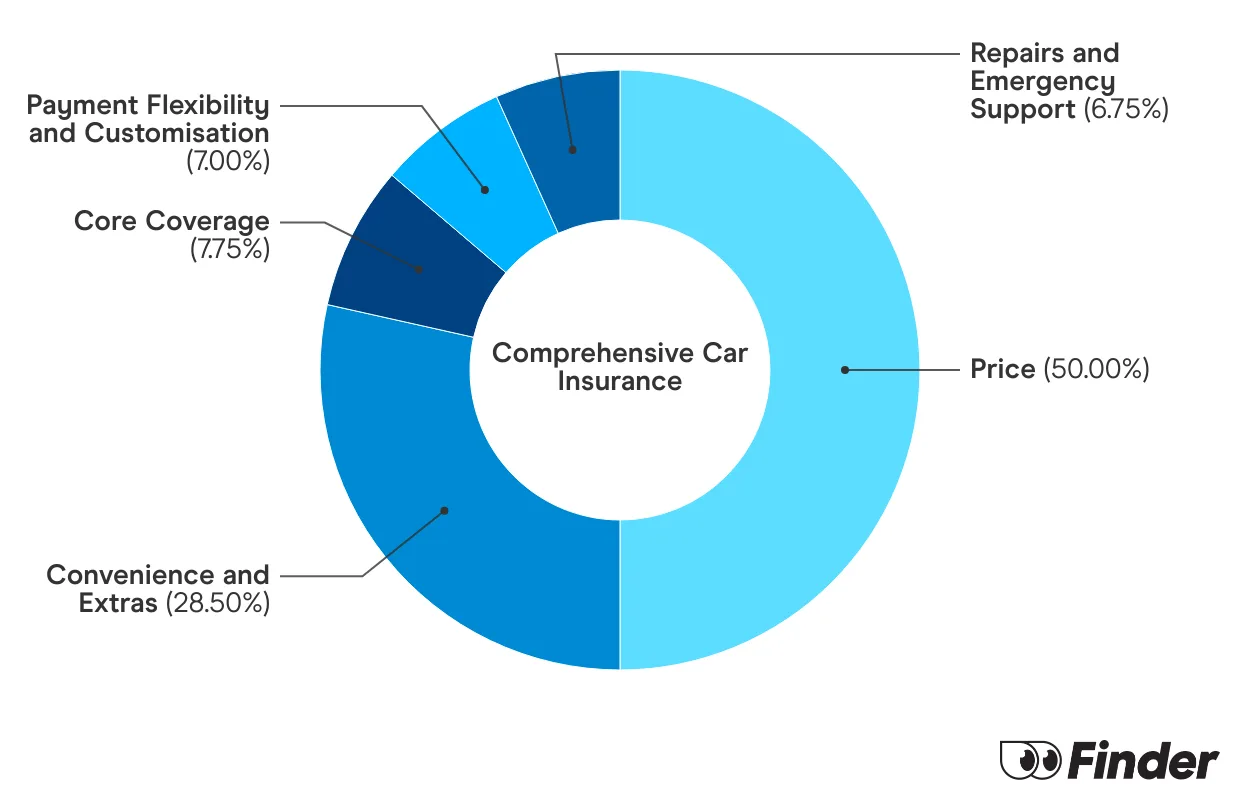
We analyse over 30 car insurance products across insurance providers, and rate each one for price and features. We collect up to 36 quotes per product, for male and female drivers in New South Wales, Victoria, Queensland, South Australia, Tasmania and Western Australia. Quotes are collected for 20 year olds, 30 year olds and 60 year olds, assuming an excess of $850 for a 2020 Toyota Corolla 4 door sedan model, with an average 15,000 kms driven each year. While we are not allowed to display actual quotes, our Finder Score aims to serve as an indicative guide to how cost and feature competitive a product might be for you.
Our feature score assesses each product for more than 15 features across loss and damage coverage, repairs and assistance coverage, personal items coverage and policy coverage. Features we assess include but are not limited to legal liability, essential repairs, new car replacement, car hire events, roadside assistance, agreed or market value, windscreen damage and natural disaster coverage.

"Every year when I get a renewal for my car insurance, I treat it like an opening offer. In the last few years especially, insurance premiums have skyrocketed. So I will always shop around when I get the renewal to make sure I’m not paying too much. The last time I received my Tesla insurance renewal, it had increased over $100 a month. So I compared and found another insurer for the same amount I was previously paying. Every insurer prices risk differently so don’t make the mistake of thinking they’re all going to be about the same. You can potentially save a huge amount of money by shopping around! "
The best car insurance for your electric vehicle is going to be one that covers you for all you need at a price you're happy to pay. To find this, here's a few key details to check for in the product disclosure statement (PDS):
Once you've compiled a list of insurers that can meet these needs, be sure to get quotes for all of them. You'll likely find hundreds of dollars in difference.
Finding the right policy for your electric car comes down to matching the cover to how EVs actually work, then comparing on price. A few tips:
Once you've shortlisted policies that cover what your EV needs, price becomes the deciding factor, and that's where comparing really pays off.
Whether an EV is worth it depends on your budget and how you drive, but it's worth weighing the full running costs, not just the sticker price. On the plus side, EVs are usually much cheaper to run day to day: charging costs less than petrol, and with fewer moving parts, servicing and maintenance tend to be lower too.
On the other hand, EVs often cost more to buy upfront and can cost more to insure, though that varies by model and is becoming more competitive. Depreciation and battery longevity are also worth factoring in.
For many Australians, the lower running and servicing costs offset the higher purchase and insurance costs over time, especially for higher-mileage drivers. If you're weighing it up, it's worth getting an insurance quote for the specific model before you buy, since insurance is a real ongoing cost that's easy to overlook. For the full picture on choosing and financing a car, check out our car buying guide and car loans comparison.
Explore comprehensive cover designed for Tesla drivers. We cover the pros, cons and other details you need to know about InsureMyTesla.
Teslas are more expensive to insure than traditional cars but there's ways to cut costs.
Learn the factors that may cause you to be considered a high-risk driver and whether you might be eligible for cover.
A quick summary of NRMA Roadside Assistance.
Find out what car insurance options are available for rideshare drivers, including Ubers.
Discover the steps to get affordable car insurance if you are under 25.
This article runs through the ins and outs of choosing a good third party property damage car insurance policy.
Explore our analysis and see how you can find the best car insurance for your needs.
Compare cover from a range of car insurance providers and find out some of the things you will be covered for under a comprehensive policy.

I do a search for the vehicle I want a quote for and the model isn’t listed. Dead end. The vehicle is a 2016 Nissan eNV200 24kWh van.
Hi Jim,
Thanks for reaching out. Although your car model isn’t listed, you can still request for a personalised quote. Simply click the Get Quote icon on this page. You’ll be directed to the insurer’s website where you can provide the details of your vehicle.
Make sure you read each policy’s Product Disclosure Statement (PDS) to make sure you’re covered for what you need.
Regards,
James