The Big Four banks are Australia's largest banks. But are they Australia's best banks? Here's how their savings accounts stack up compared to smaller banks.
Big Four savings accounts offer competitive rates but smaller banks often provide the market's highest interest.
Max interest rates on Big Four savings accounts often require meeting specific conditions like monthly deposits or no withdrawals.
While many Australians trust Big Four banks, smaller banks often receive higher customer satisfaction ratings.
Big Four bank savings accounts
Commonwealth Bank, Westpac, NAB and ANZ are known as Australia's "Big Four" banks, and together they dominate the market. Here are the savings accounts offered by the Big Four.
We currently don't have that product, but here are others to consider:
Looking for other options? Check out these similar products.
How we picked these
How the Finder Score helps you find a better savings account
The Finder Score is a simple score out of 10. The higher a savings account's score, the better we think it is for the average customer.
We score each savings account in our database of hundreds based on a data-driven methodology with 2 main criteria: Does the account offer a high interest rate? And is it easy for savers to actually earn that rate?
"If you're trying to decide between the big four banks or the smaller ones, why not both? Accounts cost nothing to open or maintain, so I like having a few; it means I can move my money around to wherever I can get the best interest rate in a given month."
Biggest doesn't necessarily mean best. And 'best' means different things to different people, depending on what you're looking for in a bank.
Best bank for consumer trust
Every month Finder surveys hundreds of Australians about their finances in our Consumer Sentiment Tracker.
24% of Australians say they trust the Big Four banks.
23% of Australians say they do not trust the Big Four banks.
23% of Australians say they trust small banks.
9% of Australians say they do not trust small banks.
Best bank accounts for customer satisfaction
Bank
Overall satisfaction
Trustworthy/reliable
★★★★★ 4.63/5
97%
★★★★★ 4.48/5
100%
★★★★★ 4.39/5
91%
★★★★★ 4.31/5
97%
★★★★★ 4.23/5
91%
The Finder Customer Satisfaction Awards ask Australians which brands and products they trust and love the most. We surveyed hundreds of Australians to rate their bank accounts, with Up Bank coming out as number one.
Finder survey: What is the most popular bank for Australian savings accounts?
Finder surveyed over 1,100 Australians about which bank they have a savings account with and found that nearly 30% of respondents have a Commonwealth Bank savings account.
Response
Commbank
29.65%
ANZ
14.2%
Other
11.23%
Westpac
10.6%
NAB
10.24%
ING
6.83%
St.George
4.13%
Bendigo Bank
3.41%
Macquarie
2.07%
BOQ
1.89%
I don't have a savings account
1.71%
Great Southern Bank
1.35%
Ubank
1.35%
HSBC
0.81%
Rabobank
0.36%
Up Bank
0.18%
Source: Finder survey by Pure Profile of 1113 Australians, December 2023
Our expert says
"The vast majority of Australians are not comparing banks to find the best service and product for their needs. Most of us stick to the bank we had as kids. We're missing out on higher interest rates for the sake of convenience."
To get a sense of just how big the Big Four banks are, here's the dollar value of household deposits currently held by each bank.
CBA: $390.118 billion
Westpac: $303.394 billion
NAB: $204.034 billion
ANZ: $172.620 billion
Now compare that to the amount of household savings deposited at Australia's largest non-Big Four banks.
Macquarie Bank: $63.083 billion
ING: $49.655 billion
Bendigo & Adelaide Bank: $44.291 billion
Suncorp: $34.464 billion
Bank of Queensland: $34.811 billion
The Big Four hold $800 billion more than their 5 closest competitors combined.
How to find the best bank in Australia for your needs
You'll have to decide for yourself what the best bank is for your specific needs. Here are some factors to consider when making a decision:
Compare rates, fees and features. When you're looking to get a new bank account, loan or credit card, you should always compare rates and fees to make sure the product is competitive (high rate for a saving account, low rate for a loan). Make sure the product has features that suit your needs.
What level of service are you looking for? If you want a personal touch and branch support, a Big Four bank with a local branch might be your best option. If you want really fast online support or don't have a Big Four bank branch near you, then you might look at other banks.
Customer reviews. Reading online reviews can help you get a sense for a bank's level of customer service. This is particularly true for smaller and newer banks.
Convenience. The Big Four banks have useful smartphone apps that let you manage your bank, card and loan accounts easily. Many other banks have good apps too, but some simply don't. You might also decide that the convenience of having all your accounts in one place outweighs the benefits that come with a higher savings rate or lower fees.
The Big Four aren't just competing with other banks. They own or invest in many other familiar financial institutions:
Commonwealth Bank owns Unloan, an online lender, and Bankwest. The bank is also a major investor in Aussie Home Loans.
Westpac owns St.George, Bank of Melbourne, BankSA and RAMS.
NAB owns digital bank ubank, which merged with smaller digital lender 86 400 in 2022.
ANZ acquired Suncorp Bank in July 2024, which continues to operate under its own banking licence as Norfina Limited, so deposits with Suncorp Bank are guaranteed separately from ANZ's.
Having all your financial products in one place makes managing your money very easy. Especially if your bank has a good online banking service or a well-designed app.
Doing all your banking with one bank means you can transfer money between accounts almost instantly. This makes it easier to move cash from your savings account into your transaction account when you're running low. It makes it easier to manage your credit card and pay it off on time.
For some, this convenience might even outweigh the benefits of getting a better deal on specific products.
Several banks offer bank accounts specifically designed for students, providing features and benefits tailored to their needs.
Most students have very basic requirements of a bank account: the ability to make purchases and track their spending on an app are key, along with low or no monthly fees or minimum balance requirements. When comparing different options, look for accounts that provide fee waivers, free ATM access and student discounts.
Student savings accounts: These accounts are designed to help students start saving and often offer competitive interest rates. Look for accounts with no or minimal fees, no minimum balance requirements and easy accessibility.
Some banks also provide additional perks for student accounts, such as discounts on shopping or entertainment, or special interest rates that only students can access. Check out some of the options for bank accounts designed for those under the age of 18.
In recent years online lenders and smaller credit unions have had the lowest interest rates. There are times when the Big Four has offered comparable rates, and it's always worth comparing the big banks when looking for a home loan. It is also worth noting that you should consider home loan fees and rates, as they can end up making the rate less competitive with other banks that have lower home loan fees.
It's worth pointing out that Unloan has some of the market's lowest rates and is owned by CommBank.
The size of a bank doesn't necessarily make it safer. But Australia's Big Four are highly profitable and well capitalised. These banks are regulated by the Australian Prudential Regulation Authority (APRA), which requires all banks to maintain a buffer of capital to meet sudden unexpected withdrawals from customers. The biggest banks are subject to stronger requirements than other banks.
But for the ordinary consumer all Australian banks are relatively safe. If you bank with any authorised deposit-taking institution (ADI), which includes big banks, small banks and credit unions, money in your savings accounts is protected by the Financial Claims Scheme.
This scheme protects up to $250,000 of your savings, per ADI, per account holder, if the institution collapses.
While it's hard to measure a bank's convenience, it's undeniable that the Big Four banks have the most extensive network of ATMs and physical bank branches. Westpac for example has 997 bank branches across the country.
Major bank call centres can operate for longer hours (typically 8am–8pm) and you may have access to customer service 24/7 for financial emergencies or if you're overseas.
Smaller Australian banks and credit unions cannot offer a similar level of service. Smaller banks are often entirely online (like ING) or have branches in specific regions only. But these banks also have call centres and generally deal with a lower volume of calls.
If you value in-person banking support then you may prefer banking with one of the Big Four. But this depends on where you live. As even the biggest banks shut down branches in smaller towns, you may find your only in-person option is a local credit union.
Sources
Karen Eley is the founder of Women Talking Finance, which provides money coaching and financial literacy and education services. An experienced and former financial adviser who has worked in financial services industry for 22 years, Karen is a Certified Money Coach (CMC), holds a Bachelor of Accounting and an Advanced Diploma in Financial Planning and CFP.
Alison is an editor at Finder and a personal finance journalist with over 10 years of experience, having contributed to major financial institutions and publications such as Westpac, Money Magazine, and Yahoo Finance. She is frequently quoted in media outlets like SmartCompany and SBS, offering expert insights on superannuation and money management. Alison holds a Bachelor of Communications in Public Relations and Journalism from the University of Newcastle, and has earned three ASIC RG146 certifications in superannuation, securities and managed investments and general financial advice, ensuring her expertise is fully aligned with ASIC standards.
See full bio
Alison's expertise
Alison
has written
648
Finder guides across topics including:
Sarah is the author of How to Raise Rich Kids. With over 20 years of experience in property, finance and investment journalism, she is a trusted expert whose insights regularly appear across television, radio and print media, including Sunrise, Channel 7 News, Bloomberg and Yahoo! Finance. She has previously served as managing editor for Your Investment Property and Australian Broker. Her expert advice has been shared in the media over 4,000 times. Sarah holds a Bachelor’s degree in Communications and a Tier 1 Generic Knowledge certification, which complies with ASIC standards.
See full bio
Sarah's expertise
Sarah
has written
260
Finder guides across topics including:
Hi
Which one of the big 4 banks offers easiest bank opening procedure, with no service service charges on having a current (no interest ) account? I only wish to open an account with no long list of documents requirement, a debit card and no fee for keeping current account . Thanks
Finder
MayApril 6, 2018Finder
Hi MN,
Thanks for your inquiry.
Typically, opening a bank account is free and simple. You can either do it online and in-person. Just be prepared with the docs like proof of identification and TFN. But best to check with the bank first the full requirements so you can open the account quickly. As to bank accounts with no fees, please refer to our comparison table to compare your options and click on the ‘Go to site’ button to find out the requirements.
Cheers,
May
AnneNovember 17, 2017
How do I find out which banks and building societies covered by the ADI are the same brand. For example I want to invest $200,000 in 4 places in term deposits or savings accounts so that the $800,000 will be covered by the ADI. Would it be ok to go for Commonwealth Bank, Ing, Bankwest and St George or are some of these the same brand?
Finder
HaroldNovember 17, 2017Finder
Hi Anne,
Thank you for your inquiry.
We have a handy guide that might help find out if your bank is owned by another bank. This guide explains which brands are owned by the big 4 banks in Australia. As for ownership of building societies, it’s not common for multiple credit union brands to be owned by the one holding company. Acquisitions and mergers are common, but usually, one company rebrands as the other.
I hope this information has helped.
Cheers,
Harold
KimOctober 17, 2017
Which banks, both the big 4 and outside the big 4, are the best for home-loans?
LiezlOctober 17, 2017
Hi Kim,
Thanks for your question.
As a comparison website, we are unable to name a bank that stands out for its home loan products since banks, as well as non-bank lenders, have different home loan offers packed with benefits and features. It’s up to you to decide which one works best for you based on the features you are looking for, the purpose of your home loan, your eligibility, and the costs that you have to pay.
You can learn more about comparing home loans. You can use our comparison table to help narrow down your options. You can click the name of the lender or the “More info” link to be redirected to our review page and learn more about the lender’s loan offer, rates, and requirements as well as the pros and cons of using their loan service. When you are ready, you may then click on the “Go to site” button and you will be redirected to the lender’s website where you can proceed with the application or get in touch with their representatives for further inquiries you may have.
Before applying, please ensure that you meet all the eligibility criteria and read through the details of the needed requirements as well as the relevant Product Disclosure Statements/Terms and Conditions when comparing your options before making a decision on whether it is right for you. You can also contact the provider if you have specific questions. Alternatively, you can speak to a mortgage broker who can take your personal circumstance into account and offer you a range of borrowing options.
Cheers,
Liezl
EmAugust 7, 2017
I currently have an account with ANZ, but speaking with various people, apparently, there are other banks that offer higher interest rates for accounts such as progress savers.
Upon arriving at the page, you can search for the best option by filling in information such as initial deposit, monthly deposit and period. Do this so you can further personalise our comparison table. You may now hit the calculate button to view the results of your search.
Once you’re done comparing, you can then select the “Go to site” button to be redirected to your chosen provider’s official website. Before you use any financial product, please read through its terms, conditions, and features to see if they are the right choice or not.
Hope this information helped.
Cheers,
Arnold
AndyJuly 19, 2017
HI there
I am thinking to buy a house in 3-4 years time and want to change bank but now sure which bank is best for small money.
Finder
HaroldJuly 20, 2017Finder
Hi Andy,
Thank you for your inquiry.
Should you have long term plans you may want to consider a long term deposit.
International banking transactions can be made easy with the help of a multi currency account. If you find that you are consistently trying to manage currencies other than the Australian dollar, then consider banking your money in this type of account.
If you need help getting your savings back on track, a bonus saver account with competitive interest may provide you with the incentive and features you need.
Important information about this website
Finder is a comparison service. We do not compare every product or every provider in the market.
We make money through commercial arrangements with some of the providers on this site. Products marked 'Sponsored', 'Promoted', 'Featured' or 'Advertisement' appear as a result of a commercial arrangement.
Our editorial content, product reviews and any 'Top Pick' designations are prepared independently of these commercial arrangements.
The default order of products in our tables can be influenced by commercial arrangements. You can re-sort or filter using the controls above each table.
Some content on this site may be generated or supported by AI tools. You should verify details directly with the provider.
Finder is one of Australia's leading comparison websites. We are committed to our readers and stand by our editorial principles.
Our comparison service does not include every product or every provider in the market. Some product issuers offer their products under multiple brands or through associated companies. Where we can, we identify the underlying issuer so you can compare like with like, but you should always check with the provider directly to confirm which brand you are dealing with.
Finder is a comparison website and an intermediary. We are not a product issuer and we do not provide personal financial or credit advice. When you click a link to a product, or apply for a product through our site, you deal directly with the product issuer. We may receive a referral fee, commission or other payment from the issuer if you click through, apply or take out a product. We describe these arrangements in more detail under 'How we make money' below.
Product features, fees, terms and eligibility criteria are set by the product issuer and may change. We rely on information supplied by issuers when we present product details on our site. Before you apply for or take out any product, you should confirm the details directly with the issuer.
We earn revenue from Finder in four principal ways:
Referral fees and commissions. When you click a product link, complete an enquiry form or apply for a product through our site, we may receive a referral fee, commission or other payment from the product issuer. We may also receive payment based on the volume of leads or conversions we send to an issuer.
Sponsored placements. Products marked 'Sponsored', 'Promoted', 'Featured' or 'Advertisement' appear as a result of a commercial arrangement between Finder and the issuer. These labels always indicate a paid placement. We do not use them for editorial choices.
Display advertising. Banner advertising, newsletter advertising and similar display ads on our site are paid by advertisers.
Content sponsorship. Some articles, videos and social media posts are sponsored by an issuer and are clearly labelled as such.
Our editorial opinions, product reviews and any 'Top Pick' designations are prepared independently of these commercial arrangements. A 'Top Pick' is an editorial choice made by our writers and editors based on the criteria described on each comparison page. A 'Top Pick' is not a personal recommendation and does not mean the product is appropriate for your circumstances.
If you would like to know whether we have a commercial arrangement with a specific product issuer, please contact us.
When products are grouped in a table or list, the default order can be influenced by commercial arrangements we have with product issuers. In some categories, sponsored or featured products appear in the top positions of the table by default, and are always labelled as such.
Other factors that influence default order include price, fees and features, and (where relevant) our editorial view of the product.
You can re-sort every comparison table using the controls above the table. You can filter by product features that matter to you. The order you see after re-sorting or filtering is not influenced by commercial arrangements.
Some content on this site is generated or supported by artificial intelligence tools, including our AI-powered assistant FinderBot. AI-generated content may contain errors. Please verify important information directly with the product issuer before making a financial decision. For more information about FinderBot, see the FinderBot Terms of Use and FinderBot Privacy Collection Notice.
Please read our website terms of use and privacy policy for more information about our services and our approach to privacy.
We update our data regularly, but information can change between updates. Confirm details with the provider you're interested in before making a decision.
Our goal is to create the best possible product, and your thoughts, ideas and suggestions play a major role in helping us identify opportunities to improve.










Hi
Which one of the big 4 banks offers easiest bank opening procedure, with no service service charges on having a current (no interest ) account? I only wish to open an account with no long list of documents requirement, a debit card and no fee for keeping current account . Thanks
Hi MN,
Thanks for your inquiry.
Typically, opening a bank account is free and simple. You can either do it online and in-person. Just be prepared with the docs like proof of identification and TFN. But best to check with the bank first the full requirements so you can open the account quickly. As to bank accounts with no fees, please refer to our comparison table to compare your options and click on the ‘Go to site’ button to find out the requirements.
Cheers,
May
How do I find out which banks and building societies covered by the ADI are the same brand. For example I want to invest $200,000 in 4 places in term deposits or savings accounts so that the $800,000 will be covered by the ADI. Would it be ok to go for Commonwealth Bank, Ing, Bankwest and St George or are some of these the same brand?
Hi Anne,
Thank you for your inquiry.
We have a handy guide that might help find out if your bank is owned by another bank. This guide explains which brands are owned by the big 4 banks in Australia. As for ownership of building societies, it’s not common for multiple credit union brands to be owned by the one holding company. Acquisitions and mergers are common, but usually, one company rebrands as the other.
I hope this information has helped.
Cheers,
Harold
Which banks, both the big 4 and outside the big 4, are the best for home-loans?
Hi Kim,
Thanks for your question.
As a comparison website, we are unable to name a bank that stands out for its home loan products since banks, as well as non-bank lenders, have different home loan offers packed with benefits and features. It’s up to you to decide which one works best for you based on the features you are looking for, the purpose of your home loan, your eligibility, and the costs that you have to pay.
You can learn more about comparing home loans. You can use our comparison table to help narrow down your options. You can click the name of the lender or the “More info” link to be redirected to our review page and learn more about the lender’s loan offer, rates, and requirements as well as the pros and cons of using their loan service. When you are ready, you may then click on the “Go to site” button and you will be redirected to the lender’s website where you can proceed with the application or get in touch with their representatives for further inquiries you may have.
Before applying, please ensure that you meet all the eligibility criteria and read through the details of the needed requirements as well as the relevant Product Disclosure Statements/Terms and Conditions when comparing your options before making a decision on whether it is right for you. You can also contact the provider if you have specific questions. Alternatively, you can speak to a mortgage broker who can take your personal circumstance into account and offer you a range of borrowing options.
Cheers,
Liezl
I currently have an account with ANZ, but speaking with various people, apparently, there are other banks that offer higher interest rates for accounts such as progress savers.
Hi Em,
Thanks for your inquiry.
Please feel free to explore and compare high interest saving accounts.
Upon arriving at the page, you can search for the best option by filling in information such as initial deposit, monthly deposit and period. Do this so you can further personalise our comparison table. You may now hit the calculate button to view the results of your search.
Once you’re done comparing, you can then select the “Go to site” button to be redirected to your chosen provider’s official website. Before you use any financial product, please read through its terms, conditions, and features to see if they are the right choice or not.
Hope this information helped.
Cheers,
Arnold
HI there
I am thinking to buy a house in 3-4 years time and want to change bank but now sure which bank is best for small money.
Hi Andy,
Thank you for your inquiry.
Should you have long term plans you may want to consider a long term deposit.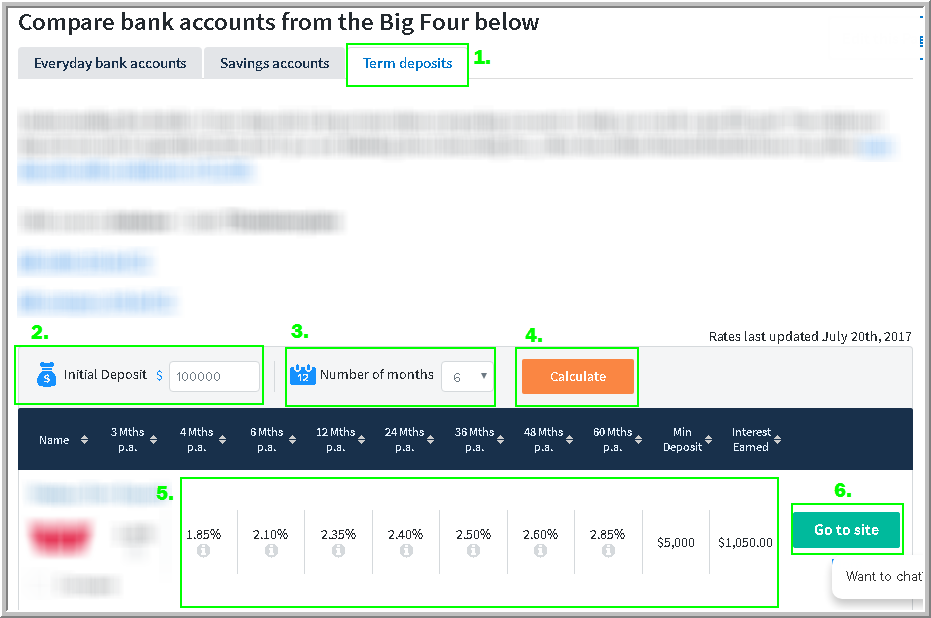
I hope this information has helped.
Cheers,
Harold