Does home insurance cover foundation repairs?

Home insurance can cover foundation repairs, but only if the cause of damage is a specific insured event like storm or flood.


Key takeaways

  • Home insurance isn't likely to cover you for preventable events that lead to foundation damage.
  • Foundation repairs are only covered when the damage is from specific events including fire, natural disasters, and malicious damage.
  • You should think about your property's risk and location when you're buying home insurance.

Does home insurance cover foundation repairs?

Home insurance can help you pay for significant costs that can come with any foundation repairs that need to be made to your property. However, most policies will only cover you if the damage is caused by specific events like fire, lightning, and floods.

Foundation repairs can include things like crack filling, wall bracing, or preventing your house from sinking. However, with home insurance covering a wide range of events, it can be hard to know if your specific foundation repairs are included.

We’ve broken things down into the most common situations where home insurance will cover your foundation repairs.

When can home insurance cover foundation repairs?

If your home insurance covers whatever caused the foundation damage, then it'll pay out for the foundation repairs too. Your product disclosure statement (PDS) will tell you everything your policy covers. Common inclusions are:

  • Fire
  • Impact (for example, a vehicle, or falling tree)
  • Lightning
  • Storms and rainwater
  • Earthquake or tsunami
  • Vandalism or malicious damage
  • Explosion
  • Escape of liquid
  • Floods (often an extra add-on)

When won't home insurance cover foundation repair?

If your home insurance doesn't cover the event which caused the foundation damage, then it won't pay out for the repairs. What's covered by your policy will vary between different insurers – but some common exclusions are:

  • Normal wear and tear
  • Damage by your carelessness or neglect
  • Termite damage
  • Damage caused by your illegal behaviour
  • Pre-existing damage
  • Faulty construction
  • Damage from natural events that you opted not to include
  • Faulty construction
  • Storm surges
  • Tree-root damage
  • Shifting soil

Compare home insurance options with foundation repair

7 of 128 results
Finder Score Is there cover for foundation repair? Temporary Accommodation Sum Insured Safeguard Accidental Damage to Home or Belongings
Finder score
10% of sum insured - Up to 12 months
Optional
Optional
Our verdict: The most popular insurer on Finder, Budget Direct prioritises low-cost cover. You need to pay extra for flood cover and accidental damage.
Get a quote More info
Compare product selection
Finder score
Optional
Our verdict: Finder’s 2022 Insurer of the Year for Customer Satisfaction and our Top Pick for Fire Damage cover. It’s good if you want a tailored quote over the phone.
Get a quote More info
Compare product selection
Finder score
10% of home sum insured
Optional
Our verdict: This policy is ideal for customers looking for reasonably priced coverage across a range of categories.
Get a quote More info
Compare product selection
Budget Direct Home Insurance logo
Finder score
Finder score
10% of sum insured - Up to 12 months
Optional
Optional
Our verdict: The most popular insurer on Finder, Budget Direct prioritises low-cost cover.
Get a quote More info
Compare product selection
Qantas Home Insurance logo
Finder score
Finder score
10% of sum insured - Up to 12 months
Optional
Optional
Get a quote More info
Compare product selection
ING Home Insurance logo
Finder score
Finder score
10% of sum insured - Up to 12 months
Optional
Optional
Get a quote More info
Compare product selection
QBE Home Insurance logo
Finder score
Finder score
20% of buildings sum insured - Up to 24 months
Optional
Our verdict: Finder's Top Pick for Floods plus cover for other common claims such as fire and theft.
Get a quote More info
Compare product selection
loading
Showing 7 of 24 results

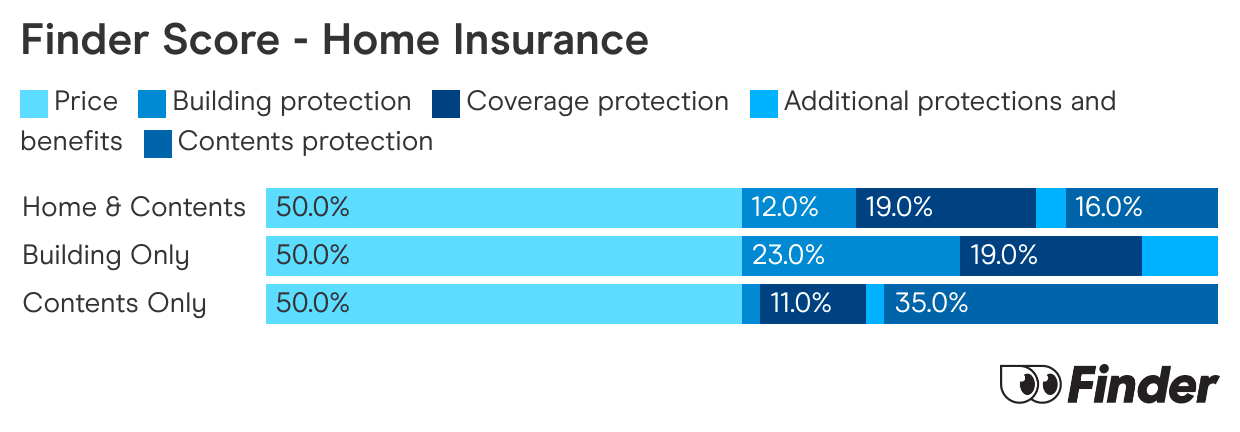
Finder Score - Home Insurance

We crunch eligible home insurance products in Australia to see how they stack up. We rank over 50 products on 16 different features, including price. We end up with a single score out of 10 that helps you compare home insurance a bit faster. We assess home and contents, building only and contents only products individually.

Read the full methodology

Is underpinning covered by home insurance?

Unfortunately, the typical answer is no. Underpinning can strengthen and stabilise an existing foundation, which can be particularly helpful if a property lies on weakened soil. But, because it is a preventative measure it generally won’t be covered by most home and content policies.

From our research of Australian providers we haven’t found any that cover underpinning. However, it’s always a good idea to consult with your provider and check the Product Disclosure Statement (PDS).

Is soil shift caused by floods covered by home insurance?

Soil shifts caused by floods may be covered by your home insurance, but it’s not always straightforward. Cover largely depends on whether the flood is seen as the immediate cause of soil movement.

Soil shifts can happen for a number of reasons like earthquakes, subsidence, or erosion.
If you can show that a flood directly led to events like landslides or erosion and your policy includes flood cover, you might be able to file a claim.

However, if the flood subtly altered the soil’s condition and it shifted later, your claim might be denied, even with flood cover. Insurers often have different definitions for covered events, which can make it tricky to determine what’s included. As in most cases, it’s important to carefully review a policy’s PDS or contact your insurer to clarify the specifics of your coverage.

What are my options if I'm not covered by insurance?

More often than not, if foundation damage happens to your property and the cause of damage isn’t covered by your insurance, you’ll have to pay for the repairs yourself. This can include any specialists or engineers to assess the damage and recommend repairs, so it can be a costly expense.

But before you decide to start the process, it can be helpful to reach out to a foundation specialist for a second opinion if your claim gets denied. For instance, if your insurer suggests that flooding was an indirect factor in causing the damage, a specialist might be able to clarify that it was, in fact, the direct cause.

Find and compare Australian home insurance providers with Finder today.

FAQs

Sources

Cameron Thach's headshot
Written by

Writer

With a background in writing across education, Web3, and finance, Cameron’s mission is to create content that speaks directly to readers in a way that’s easy to understand, helping them navigate complex topics with confidence. Cameron studied a Bachelor of Commerce, Economics and Marketing at Macquarie University, graduating in 2019. See full bio

Nicola Middlemiss's headshot
Co-written by

Journalist

Nicola Middlemiss is a journalist with nearly a decade of experience in personal finance and insurance. She has contributed to Domain, Yahoo Finance, Money Magazine and Insurance Business Australia, offering in-depth insights into commercial insurance in the Australian market. Nicola holds a Bachelor’s degree in English from the University of Leeds and a Tier 1 General Insurance (General Advice) certification, which complies with ASIC standards. See full bio

Nicola's expertise
Nicola has written 257 Finder guides across topics including:
  • Personal finance
  • Personal insurance, including car, health, home, life, pet and travel insurance
  • Commercial business insurance

Get rewarded $$ for switching with Finder Rewards

Find a better deal, save on your bills and get a free gift card. Sign up to be the first to hear about new Finder Rewards.

Ask a question

You are about to post a question on finder.com.au:

  • Do not enter personal information (eg. surname, phone number, bank details) as your question will be made public
  • finder.com.au is a financial comparison and information service, not a bank or product provider
  • We cannot provide you with personal advice or recommendations
  • Your answer might already be waiting – check previous questions below to see if yours has already been asked

Finder only provides general advice and factual information, so consider your own circumstances, or seek advice before you decide to act on our content. By submitting a question, you're accepting our Terms Of Service and Finder Group Privacy & Cookies Policy.

This site is protected by reCAPTCHA and the Google Privacy Policy and Terms of Service apply.

More guides on Finder

  • Home Insurance Excess Australia

    Confused about home insurance excess in Australia works? We’ll share how it works and how you can use it to lower the cost of your premium.

  • Home insurance for water damage

    Find out how home insurance can cover water damage and how to avoid some of the pitfalls. 

  • How to cancel your home insurance

    Cancelling your home insurance is actually quite simple and you can do it at any time.

  • Kogan home insurance review

    How does Kogan home insurance compare? See how it works, and some of the fine print to look out for.

  • Motor burnout insurance

    Motor burnout covers those big appliances in your home in the event that they let you down. This article will show you what it is, why it's important and how much it can cost you.

  • Bank of Melbourne home insurance

    Review of Bank of Melbourne Home Insurance.

  • BankSA Home Insurance

    Get cover for things like storms, lightning, theft and malicious acts. Choose from 3 levels of cover: essential, quality and premier care.

  • Phone insurance – all you need to know

    With a variety of insurance options to protect your mobile phone, here's what you need to know.

  • Renters insurance

    Find out what renter's insurance is, what it covers and how to find the right policy for your needs.

  • Best home insurance Australia

    What you need to know about finding the best home insurance for you. Compare policies and learn what questions to ask when researching insurance policies.
Go to site