Key takeaways
- Many home and contents policies include food spoilage cover for power outages or accidental breakdown.
- Insurers may require proof such as a BOM lightning record, and often cap food spoilage claims at around $500 to $2000.
- Review your policy as planned outages or appliance age (over 15 years) often exclude coverage.
Compare policies with food spoilage insurance
Looking for other options? Check out these similar products.
How we picked theseFinder survey: How often do Australians compare or switch their home insurance?
| Response | |
|---|---|
| Once a year | 31.87% |
| I never compare or switch | 27.31% |
| Once every 3+ yrs | 21.85% |
| Every 2 yrs | 17.3% |
| More than once a year | 1.67% |
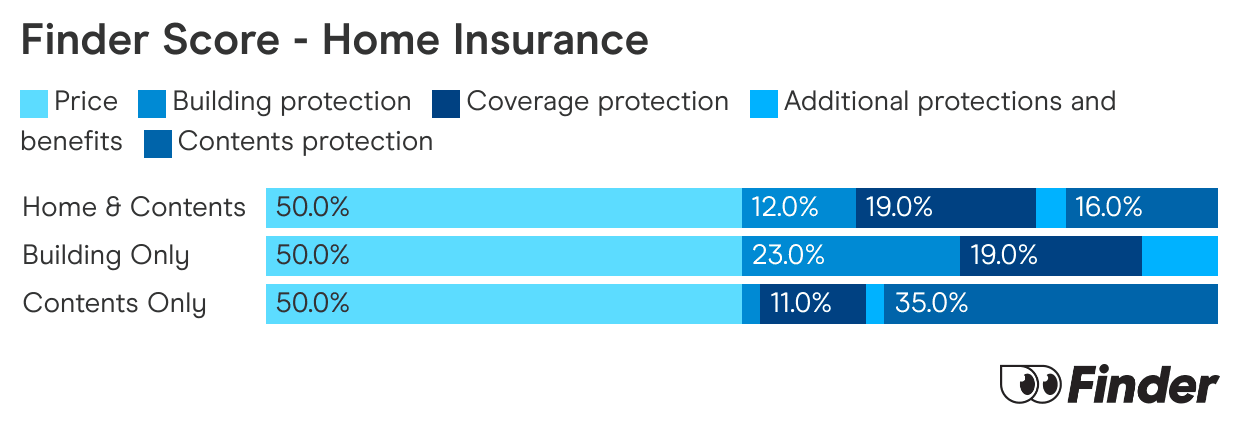
Finder Score - Home insurance
We crunch eligible home insurance products in Australia to see how they stack up. We rank over 50 products on 16 different features, including price. We end up with a single score out of 10 that helps you compare home insurance a bit faster. We assess home and contents, building only and contents only products individually.
Can I claim food spoilage from a power outage?
Yes. Many home and contents insurers will cover loss or damage caused by a power outage. Generally, you'll find that it's included under the contents insurance part of your policy and covers you for situations like:
- Your freezer accidentally breaking down
- The public electricity supply failing because of an accident
- Insured events such as lightning, storms or water damage
- Electrical motor damage (in some cases and so long as it was caused by an insured event like lightning)
There are some insurers who might require additional criteria in order for your claim to be successful. For instance,
- The Bureau of Meteorology needs to have a record of lightning in your area at the time of the incident.
- You won't be covered if you leave the door ajar or you accidentally disconnect the power supply.
- Some don't cover you for the motor burning out or fusing, unless it was caused by an insured event.
What is food spoilage insurance?
Food spoilage insurance covers you for loss of or spoilage to frozen or refrigerated food, caused by an insured event such as your freezer accidentally breaking, a power outage or in some cases, electrical motor damage. Food spoilage cover is generally included in the contents section of your home and contents insurance policy because that's the part of your cover that protects the items and belongings kept at your home.
How do I get food spoilage insurance?
You'll need a policy that includes contents cover, so you can choose from either;

Contents insurance.
A contents insurance policy can help you cover the cost of lost, damaged or spoiled food if your fridge blows out. Contents insurance is usually cheaper than buying a complete home and contents insurance policy and it can also cover the other belongings you keep at home too.
Home and contents insurance.
A normal home and contents insurance policy can also cover the cost of food spoilage if something goes wrong with your fridge or freezer. This could be a good option if you want to play it safe and get cover for everything, your home and the stuff you keep inside.
What do the home insurers say?
It's similar across most home insurers, however some make mentions of how they cover you in a power outage, and if medications are included.
We looked at the product disclosure statements (PDS) of 3 Australian insurers to show you how it can differ.
When will this be handy?
Food spoilage insurance is a really handy benefit to have included with home insurance. Here are a few reasons why:
- You have expensive taste. If you're a passionate foodie then it's likely your fridge and freezer is full of good stuff. One power outage or accident and it could all be gone. Not only have you lost good food, you've wasted a lot of money.
- You have a big family. On average, a family of 4 spends $336 a week on food. That's a lot of money to risk losing and one more way home insurance can come in handy.
- You buy food in bulk. If you like to stock up on supplies, there's a lot of money in your fridge and freezer if there's a power outage. Food spoilage insurance can make sure you get reimbursed. Most policies pay you up to $500 towards food loss.
- You live in an area where power outages are common. Some parts of the country have more power outages than others. If you've experienced a power outage in the past, it's worth protecting your fridge full of goods for the next one.
- You live in an area with unpredictable weather. If the area you live in is prone to lightning, storms or other bad weather, there's an increased chance of a power outage. Food spoilage insurance could come in handy.
Do I really need food spoilage insurance?
Since we've already seen fires, storms and strong winds damage power lines and cause outages for thousands of households across Australia, particularly in bushfire-affected towns, it's wise to get food spoilage insurance included in your home insurance policy. It can reimburse you for the fridge full of food you could lose if something like a power outage or electricity supply failure occurs.
With global warming affecting Australia more severely than other countries, the chances of power outages and blackouts happening again are increasingly likely. You might not need it, but it's covered by most home insurance policies, so is it really worth the risk?
When won't food spoilage insurance cover me?
There are some situations where you might not be covered for food spoilage. These include loss:
- If the food spoilage was caused by a planned power outage.
- If the public electricity supply failed due to industrial action or civil commotion.
- If your freezer is over a certain age, usually 15 years old.
- If you deliberately cause the food to spoil.
- If your claim is related to lightning, and there was no evidence of it in your area at the time of the incident.
- If you leave the door ajar.
- If you accidentally disconnect the power supply.
- If the motor burns out, unless it was caused by an insured event.
Frequently Asked Questions
-
It depends on your insurer and policy. Some home insurance policies may waive the excess if you are only claiming for food spoilage. However, others may apply a standard excess as part of your overall home or contents claim. Always check your Product Disclosure Statement for specific details about your policy.
-
The payout limit for food spoilage varies between insurers. Generally, you can expect a sub-limit ranging from $500 to $2,000 per claim. This means that even if your overall contents cover is higher, the maximum amount you can receive specifically for spoiled food will be capped at this sub-limit.
-
To make a claim for spoiled food, contact your insurer as soon as possible after the incident occurs. You will typically need to provide details about the power outage or other insured event, a list of the spoiled food items and their estimated value. Your insurer will guide you through the specific steps required for your claim.
-
Insurers generally ask for proof of the incident and the spoiled items. This might include a confirmation from your energy provider about a power outage in your area, a record from the Bureau of Meteorology for severe weather events like lightning or storms and photos of the spoiled food. Creating a detailed list of all affected items with their purchase prices or estimated values is also very helpful.
-
Some home and contents insurance policies extend food spoilage cover to include refrigerated prescription medicines. This is not standard across all policies so it is important to review your Product Disclosure Statement or speak with your insurer to confirm if this benefit is included in your cover.
-
Yes, if you have a contents insurance policy in place. Food spoilage cover is typically included as part of the contents section of a policy which protects your personal belongings inside your home. Renters who have contents insurance can usually claim for spoiled food under the same conditions as homeowners.
-
Food spoilage insurance primarily covers the cost of replacing the spoiled food items. Damage to the fridge or freezer appliance itself is generally covered under a different section of your contents policy such as "electrical motor burnout" or general accidental damage if it resulted from an insured event. Check your policy to understand what is covered regarding your appliances.
-
Many insurers have a minimum duration requirement for a power outage before you can make a food spoilage claim. This period commonly ranges from 12 to 24 consecutive hours. Always refer to your policy documents for the exact timeframe specified by your insurer.
-
Insurers understand that people do not keep receipts for every food item. While receipts are ideal you can still make a claim without them. You should provide a comprehensive list of the spoiled items, their estimated purchase prices and any supporting evidence such as photos of the food or the conditions causing the spoilage. Be as accurate and detailed as possible in your assessment.
-
Finder writers are subject matter experts and use primary sources, in-depth research and interviews with other experts to ensure you're getting accurate, up-to-date information. Articles are fact checked in line with our editorial guidelines.
Gary Ross Hunter has over 6 years of expertise writing about insurance, including life, health, home, and car insurance. Having reviewed hundreds of product disclosure statements and published over 800 articles, he loves simplifying complex insurance topics for everyday readers. Gary has contributed to major outlets like Yahoo Finance, The Sydney Morning Herald, and news.com.au, and holds a Bachelor of Arts (Honours) in English Literature from the University of Glasgow, along with a Tier 2 General Advice certification, ensuring his work adheres to ASIC’s RG146 standards. See full bio
- Health, home, life, car, pet and travel insurance
- Managing the cost of living
Get rewarded $$ for switching with Finder Rewards
Find a better deal, save on your bills and get a free gift card. Sign up to be the first to hear about new Finder Rewards.
More guides on Finder
-
House break-ins in Australia: How to stay safe and reduce risk
Find out how many house break-ins happen in Australia each year, why the numbers are rising and what it means for your home insurance.
-
Fixtures and fittings: Why they matter in home insurance
Knowing the difference between fixtures and fittings can help you decide which home insurance policy is right for you.
-
Are outdoor living areas covered by home insurance?
From gazebos to furniture to water features, outdoor living home insurance can cover a range of things we keep outside.
-
Cyclone insurance
Find out how home insurance can cover you for cyclones.
-
Wear and tear in a rental property
Want to know the difference between fair wear and tear and accidental damage? Find out here.
-
Jewellery insurance
A surprising range of factors will shape your jewellery insurance options. Find out how to make the best choice.
-
CBA Home Insurance Review
Compare features and benefits of CBA's home insurance policy. Discover if it's right for you with this handy guide.
-
RACV home insurance
Find out what you will be covered for with RACV Home Insurance.
-
Cheapest home insurance in Australia 2026
Follow these steps to find affordable home insurance that won't leave you stranded.
-
Best home insurance November 2026
What you need to know about finding the best home insurance for you. Compare policies and learn what questions to ask when researching insurance policies.