Home warranty insurance protects homeowners against builder insolvency death or disappearance.
Builders must secure this insurance for projects over varying thresholds, ranging from $3,300 in QLD to $20,000 in NSW.
It is a last resort, covering up to 20% of the contract value and does not replace standard home insurance.
Homeowners who are left with incomplete or defective construction jobs may be protected by mandatory home warranty insurance in many parts of Australia – but only if the builder has gone missing, passed away, become insolvent or lost their licence.
This type of insurance is purchased by the builder doing the work and has many different names depending on the state you live in.
What is home warranty insurance?
Home warranty insurance is designed to protect homeowners against incomplete building work and defects from construction in residential projects but it only covers you in specific situations. For example, if your builder:
Goes missing
Dies
Becomes insolvent
Loses their license
It's taken out by the builders and tradespeople themselves but is only mandatory when the build project reaches a certain value. This differs between states, as does what it's called.
Finder survey: Do Australians think home insurance is worth it?
Response
Gen Z
Gen Y
Gen X
Baby Boomers
Yes
55.06%
70.38%
65.46%
72.16%
No
24.72%
17.12%
18.09%
17.33%
I don't know
20.22%
12.5%
16.45%
10.51%
Source: Finder survey by Pure Profile of 1113 Australians, December 2023
Home warranty insurance in NSW and WA
Home warranty insurance functions largely the same way in both NSW and WA. The main difference is that it's often called "home building compensation" in NSW and "home indemnity insurance" in WA. It can cover you for the completion of building work or fixing defects but only if:
The builder is unable to finish the work due to death, financial insolvency or disappearance within six years of finishing the contract.
Any builder or tradesperson is required to take out this insurance for each building project over $20,000. Sub-contractors are covered by the head contractor's cover.
Builders warranty insurance in Victoria
Builders warranty insurance is known as "domestic building insurance" in Victoria. It can cover homeowners plus subsequent owners for incomplete or defective building work.
Applies if the builder cannot finish due to death, disappearance, financial insolvency within six years of completing the contract, or if the builder fails to comply with a court order to repair substandard work (applicable to contracts signed after 1 July 2015).
Builders are only required to take out this insurance for each building project over $16,000.
Home warranty insurance in QLD
In Queensland, home warranty insurance can cover the homeowner for incomplete construction work, defects and subsidence or settlement but:
You must make a claim within three months of noticing the defect for structural issues and within seven months of contract completion for non-structural defects.
Builders are required to take out this insurance for most residential projects valued above $3,300.
Home warranty insurance in other states like ACT, SA and TAS
Home warranty insurance is mandatory in South Australia, the ACT and the Northern Territories for projects above $12,000 but not in Tasmania. It covers homeowners for incomplete construction and structural defects in a similar way to other states. It can apply if
The work has not been completed or faulty work has not been fixed and the builder dies, disappears or is declared bankrupt.
Builders are required to take out this insurance for most residential projects valued above $12,000.
Summary of the facts
State
Minimum value of work
Length of cover for structural work
Length of cover for non-structural work
Minimum cover to be provided by insurer
ACT
$12,000
6 years
$85,000
NSW
$20,000
6 years
2 years
$340,000
SA
$12,000
5 years
$150,000
VIC
$16,000
6 years
2 years
$300,000
WA
$20,000
6 years
$100,000
Pros and cons of home warranty insurance
Pros
It can sometimes cover incomplete or defective building work.
It can be an effective "last resort" system, where you can claim only if the builder doesn't complete the work due to death, disappearance or financial insolvency.
Cons
It's only mandatory on residential building projects that exceed a certain threshold depending on the state.
It doesn't protect you from dishonest builders (you generally won't be covered if a builder refuses to repair their work or give you a refund.)
In-built cap regardless of the building project (you'll only be covered for a maximum of 20% of the contract price).
It won't cover commercial buildings.
Is it time to look at your home insurance?
Whether you're buying your first home insurance policy or looking to switch from your existing one, it always pays to compare. You can choose up to four policies at a time, select "Compare" and view the benefits side-by-side to make sure you get the right cover.
Compare other products
We currently don't have that product, but here are others to consider:
Looking for other options? Check out these similar products.
These products offer a balance between low pricing and more features.
7+
Great
Competitive products within their group.
5+
Standard
Usually these products would either have fewer benefits or higher pricing.
0+
Basic
Offering basic cover with limited features or higher pricing.
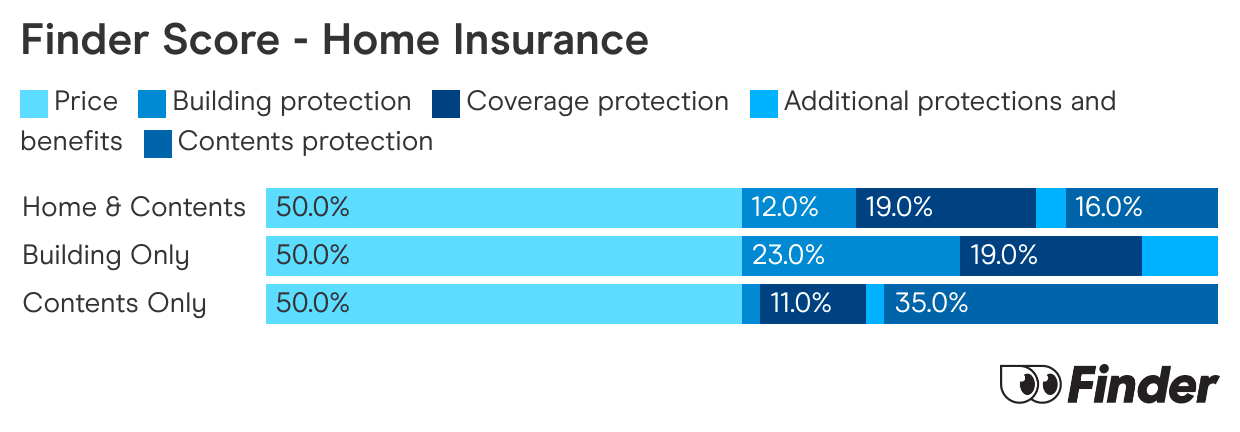
Finder Score - Home insurance
We crunch eligible home insurance products in Australia to see how they stack up. We rank over 50 products on 16 different features, including price. We end up with a single score out of 10 that helps you compare home insurance a bit faster. We assess home and contents, building only and contents only products individually.
Frequently asked questions about home warranty insurance
Home warranty insurance primarily covers residential building work including new home construction, major renovations, alterations and additions. It is designed to protect homeowners from specific issues arising from their builder's failure to complete work or rectify defects. Commercial buildings are not typically covered by this type of insurance.
Yes home warranty insurance can cover renovations or additions to existing homes provided the project value meets the minimum threshold set by your state or territory. These thresholds vary across Australia so it is important to check the specific requirements for your location.
In most states and territories owner-builders are exempt from needing home warranty insurance for work on their own primary residence. However if an owner-builder sells their home within a certain period after the work is completed they may be required to obtain home warranty insurance for the benefit of the new owner. The specific rules and timeframes vary by state.
Home warranty insurance protects you against structural defects or incomplete work if your builder dies disappears becomes insolvent or loses their license. Standard home insurance covers your property against perils like fire storm theft and accidental damage. They are distinct types of cover for different risks.
You should always ask your builder for a certificate of home warranty insurance before any work begins or money changes hands. You can also verify the validity of the certificate with the relevant state or territory insurance provider or regulatory body. It is crucial to ensure the details on the certificate match your building contract.
Home warranty insurance is generally only mandatory for residential building projects that exceed a specific monetary threshold. These thresholds differ significantly across states and territories ranging from a few thousand dollars up to $20,000 or more. For work valued below these amounts home warranty insurance is typically not required.
Home warranty insurance does not typically cover situations where a builder simply refuses to fix defects or honour their contractual obligations if they are still trading. This insurance is a "last resort" mechanism for when a builder is unable to complete work or rectify defects due to death disappearance insolvency or license loss. For disputes with an active builder you would generally need to pursue other avenues such as consumer protection bodies or legal action.
Gary Ross Hunter has over 6 years of expertise writing about insurance, including life, health, home, and car insurance. Having reviewed hundreds of product disclosure statements and published over 800 articles, he loves simplifying complex insurance topics for everyday readers. Gary has contributed to major outlets like Yahoo Finance, The Sydney Morning Herald, and news.com.au, and holds a Bachelor of Arts (Honours) in English Literature from the University of Glasgow, along with a Tier 2 General Advice certification, ensuring his work adheres to ASIC’s RG146 standards.
See full bio
Gary Ross's expertise
Gary Ross
has written
554
Finder guides across topics including:
A home insurance calculator can give you a rough estimate on the value of your home and contents. But is that what you really want? Find out how to not underinsure or overinsure your home.
What you need to know about finding the best home insurance for you. Compare policies and learn what questions to ask when researching insurance policies.
Compare home and contents insurance - our research shows you can save up to $1,653 by switching.
Important information about this website
Finder is a comparison service. We do not compare every product or every provider in the market.
We make money through commercial arrangements with some of the providers on this site. Products marked 'Sponsored', 'Promoted', 'Featured' or 'Advertisement' appear as a result of a commercial arrangement.
Our editorial content, product reviews and any 'Top Pick' designations are prepared independently of these commercial arrangements.
The default order of products in our tables can be influenced by commercial arrangements. You can re-sort or filter using the controls above each table.
Some content on this site may be generated or supported by AI tools. You should verify details directly with the provider.
Finder is one of Australia's leading comparison websites. We are committed to our readers and stand by our editorial principles.
Our comparison service does not include every product or every provider in the market. Some product issuers offer their products under multiple brands or through associated companies. Where we can, we identify the underlying issuer so you can compare like with like, but you should always check with the provider directly to confirm which brand you are dealing with.
Finder is a comparison website and an intermediary. We are not a product issuer and we do not provide personal financial or credit advice. When you click a link to a product, or apply for a product through our site, you deal directly with the product issuer. We may receive a referral fee, commission or other payment from the issuer if you click through, apply or take out a product. We describe these arrangements in more detail under 'How we make money' below.
Product features, fees, terms and eligibility criteria are set by the product issuer and may change. We rely on information supplied by issuers when we present product details on our site. Before you apply for or take out any product, you should confirm the details directly with the issuer.
We earn revenue from Finder in four principal ways:
Referral fees and commissions. When you click a product link, complete an enquiry form or apply for a product through our site, we may receive a referral fee, commission or other payment from the product issuer. We may also receive payment based on the volume of leads or conversions we send to an issuer.
Sponsored placements. Products marked 'Sponsored', 'Promoted', 'Featured' or 'Advertisement' appear as a result of a commercial arrangement between Finder and the issuer. These labels always indicate a paid placement. We do not use them for editorial choices.
Display advertising. Banner advertising, newsletter advertising and similar display ads on our site are paid by advertisers.
Content sponsorship. Some articles, videos and social media posts are sponsored by an issuer and are clearly labelled as such.
Our editorial opinions, product reviews and any 'Top Pick' designations are prepared independently of these commercial arrangements. A 'Top Pick' is an editorial choice made by our writers and editors based on the criteria described on each comparison page. A 'Top Pick' is not a personal recommendation and does not mean the product is appropriate for your circumstances.
If you would like to know whether we have a commercial arrangement with a specific product issuer, please contact us.
When products are grouped in a table or list, the default order can be influenced by commercial arrangements we have with product issuers. In some categories, sponsored or featured products appear in the top positions of the table by default, and are always labelled as such.
Other factors that influence default order include price, fees and features, and (where relevant) our editorial view of the product.
You can re-sort every comparison table using the controls above the table. You can filter by product features that matter to you. The order you see after re-sorting or filtering is not influenced by commercial arrangements.
Some content on this site is generated or supported by artificial intelligence tools, including our AI-powered assistant FinderBot. AI-generated content may contain errors. Please verify important information directly with the product issuer before making a financial decision. For more information about FinderBot, see the FinderBot Terms of Use and FinderBot Privacy Collection Notice.
Please read our website terms of use and privacy policy for more information about our services and our approach to privacy.
We update our data regularly, but information can change between updates. Confirm details with the provider you're interested in before making a decision.
Our goal is to create the best possible product, and your thoughts, ideas and suggestions play a major role in helping us identify opportunities to improve.