Home insurance and tree damage

Home insurance can cover tree damage, but not pruning or damage by tree root. Compare 6+ policies that’ll protect you.

7 of 107 results
Finder Score Fire, Storm & Theft Damage Flood Accidental damage Escape of Liquid
Finder score
Optional
Get $250 worth of smart sensors with a combined policy. T&Cs apply.
Our verdict: This policy is ideal for customers looking for reasonably priced coverage across a range of categories.
Get a quote More info
Compare product selection
Finder score
Save up to 10% on your policy in the first year. T&Cs apply.
Get a quote More info
Compare product selection
Huddle Home Insurance logo
Finder score
Finder score
Save up to 10% on your policy in the first year. T&Cs apply.
Get a quote More info
Compare product selection
Huddle Home Insurance logo
Finder score
Finder score
Save up to 10% on your policy in the first year. T&Cs apply.
Get a quote More info
Compare product selection
Real Home Insurance logo
Finder score
Finder score
Get a quote More info
Compare product selection
Real Home Insurance logo
Finder score
Finder score
Get a quote More info
Compare product selection
Honey Home Insurance logo
Finder score
Finder score
Optional
Get $250 worth of smart sensors when you buy a home insurance policy. T&Cs apply.
Our verdict: Ideal for property owners seeking budget-friendly and fair coverage on their building only.
Get a quote More info
Compare product selection
loading
Showing 7 of 12 results

You should be covered for fallen trees and branches if they're considered an 'act of nature'.

You won't be covered if the tree fell as a result of pruning or for damage by tree roots.

This is how home insurance covers tree damage

The way insurance covers tree damage varies between policies, but generally the following applies:

  • You are covered for falling trees and branches: if a tree or branch falls on your property then you are covered for resulting damage under the "impact" insured event section of the policy. Depending on the policy, this might only be available as an optional extra, and might only cover the cost of removal of debris that actually damaged your home. It typically doesn't cover the costs of digging up and removing tree stumps that remain after a tree falls, or any related landscaping or gardening costs.
  • You are covered for damage to pipes or drains: if tree roots are destroying or blocking them – the insured event is commonly known as 'Escape of liquid'.
  • You are not covered for damage caused tree lopping or pruning: either by yourself or someone who was doing it with your approval.
  • You are not covered for damage caused by tree roots if: tree roots cause damage to your home or its surroundings.

If my neighbour's tree falls on my property, who is responsible?

Your neighbour is generally liable
  • If they have altered the tree in any way – such as removed its roots to repair a driveway.
  • If there is evidence to suggest that they knew the tree was dangerous – for example, an arborist recommended its removal.
  • If the tree is on their property and they have home insurance policy that includes liability cover.
You are generally liable
  • If the tree is solely on or also on your property.
  • If you were responsible for altering the tree – for example tree lopping or pruning.
Storm
Bad weather and storms
These are 'acts of nature' where nobody is liable. This means that, should a storm bring down your neighbour's tree onto your home, you may have to cover the costs, unless you have home insurance.

Finder survey: Why do Australians of different ages have home and contents insurance?

ResponseGen ZGen YGen XBaby Boomers
Theft14.61%26.09%33.55%34.66%
Peace of mind11.24%27.99%36.51%53.41%
Flood protection10.11%10.05%9.87%6.82%
Fire protection8.99%22.55%32.24%40.34%
Storm damage8.99%16.3%23.68%35.23%
Because it is a requirement of my home loan9.51%7.89%3.98%
Other0.27%0.33%0.57%
Source: Finder survey by Pure Profile of 1113 Australians, December 2023

What happens if my tree roots are causing damage to my neighbour's property?

When dealing with issues with your neighbours, you should always do your best to keep things friendly and resolve things amicably. Ordinarily, damage as a result of tree roots either to you or your neighbour's home is not something that home insurance covers. If this is the case, it may be worth coming to a solution with your neighbour about removing the tree.

However, in some cases, if the tree roots are causing serious harm to your neighbour's home, you may be liable to pay. This can include things like structural damage to the property, such as crushed pipes, damaged roofs and walls or cracked foundations.

If you do have a large tree on your property, you may want to look into getting cover for damage to your home or other's property. Many policies will specifically exclude damage caused by roots so finding cover can be difficult.

What happens if your neighbour's tree roots are causing damage to your property?

If your neighbour's tree roots are damaging your property, it can be difficult to get cover. That's because it's common for insurers not to cover the cost of removing tree stumps and roots still in the ground. However, there are some things you can do:

One symbol

Speak to your neighbour

If the tree roots are doing damage to your property, speak to your neighbour and try to come to an amicable agreement. You might be able to go through their insurance or split the costs 50/50.

Two symbol

Take note of the damage

If you can prove that their tree roots are causing serious damage to your home, they may be liable to pay. This can include things like structural damage to the property, such as crushed pipes, damaged roofs and walls or cracked foundations.

Three symbol

Go through your insurer

You may have to go through your insurer if your neighbour is refusing to pay. If this is the case, you'll need to make sure you are covered. While many insurers do not cover you for the roots of trees, you can find cover, for example, if your pipes or drains are destroyed or blocked by roots under the insured event commonly known as 'Escape of liquid'. This might be an easier option that taking the matter to court.

What are the general exclusions when it comes to tree damage?

General exclusions are restrictions that apply to all cover types, including the liability component.

For example, a common general exclusion is “movement of the earth”. If a tree’s roots undermine your neighbour’s property and end up causing the ground to collapse, you might not be covered by your policy.

Get home insurance that covers tree damage

7 of 63 results
Finder Score Fire, Storm & Theft Damage Flood Accidental damage Escape of Liquid
Finder score
Optional add-on
Optional
30% off your first year's premium for new combined Home & Contents policies purchased online. T&Cs apply.
Our verdict: The most popular insurer on Finder, Budget Direct prioritises low-cost cover.
Get a quote More info
Compare product selection
Finder score
Optional
Our verdict: Finder’s 2022 Insurer of the Year for Customer Satisfaction and our Top Pick for Fire Damage cover. It’s good if you want a tailored quote over the phone.
Get a quote More info
Compare product selection
Finder score
Optional
Get $250 worth of smart sensors with a combined policy. T&Cs apply.
Our verdict: This policy is ideal for customers looking for reasonably priced coverage across a range of categories.
Get a quote More info
Compare product selection
QBE Home Insurance logo
Finder score
Finder score
Optional
Get 20% off your first year with a combined policy. T&Cs apply.
Our verdict: Finder's Top Pick for Floods plus cover for other common claims such as fire and theft.
Get a quote More info
Compare product selection
Qantas Home Insurance logo
Finder score
Finder score
Optional add-on
Optional
Earn up to 40,000 Qantas Points for joining by 28 Jan 2026. Plus save 30% on your 1st year’s premium for purchasing a combined home and contents policy online. T&Cs apply.
Get a quote More info
Compare product selection
Huddle Home Insurance logo
Finder score
Finder score
Save up to 10% on your policy in the first year. T&Cs apply.
Get a quote More info
Compare product selection
Real Home Insurance logo
Finder score
Finder score
Get a quote More info
Compare product selection
loading
Showing 7 of 8 results

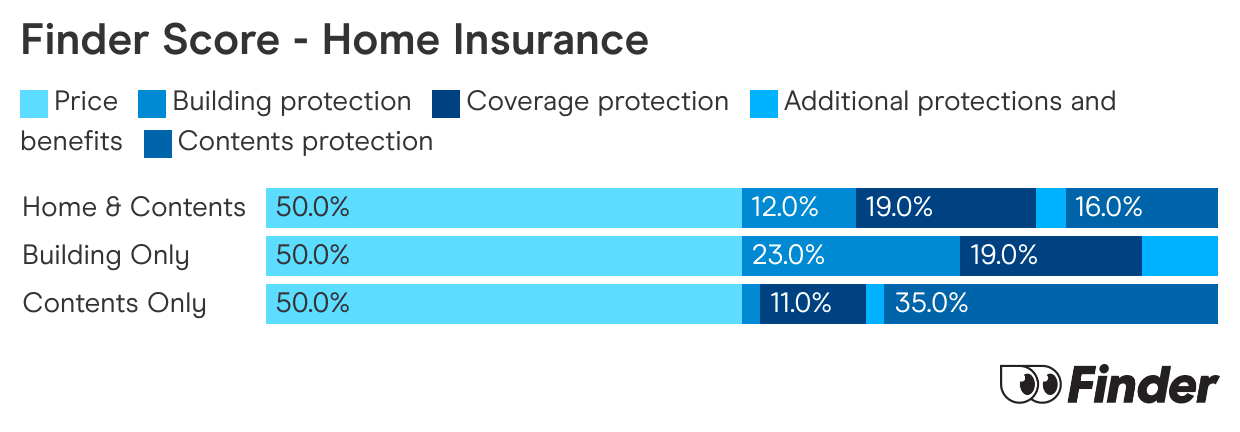
Finder Score - Home Insurance

We crunch eligible home insurance products in Australia to see how they stack up. We rank over 50 products on 16 different features, including price. We end up with a single score out of 10 that helps you compare home insurance a bit faster. We assess home and contents, building only and contents only products individually.

Read the full methodology

Angelo Azar's headshot
Expert insight

"With some insurance policies, you may need to add on more for the demolition, removal of debris and redesign costs. This component alone could cost tens of thousands of dollars."

Angelo Azar's headshot
Angelo Azar
Honey Insurance

FAQs about home insurance tree damage

Gary Ross Hunter's headshot
Journalist

Gary Ross Hunter has over 6 years of expertise writing about insurance, including life, health, home, and car insurance. Having reviewed hundreds of product disclosure statements and published over 800 articles, he loves simplifying complex insurance topics for everyday readers. Gary has contributed to major outlets like Yahoo Finance, The Sydney Morning Herald, and news.com.au, and holds a Bachelor of Arts (Honours) in English Literature from the University of Glasgow, along with a Tier 2 General Advice certification, ensuring his work adheres to ASIC’s RG146 standards. See full bio

Gary Ross's expertise
Gary Ross has written 589 Finder guides across topics including:
  • Health, home, life, car, pet and travel insurance
  • Managing the cost of living

Get rewarded $$ for switching with Finder Rewards

Find a better deal, save on your bills and get a free gift card. Sign up to be the first to hear about new Finder Rewards.

Ask a question

You are about to post a question on finder.com.au:

  • Do not enter personal information (eg. surname, phone number, bank details) as your question will be made public
  • finder.com.au is a financial comparison and information service, not a bank or product provider
  • We cannot provide you with personal advice or recommendations
  • Your answer might already be waiting – check previous questions below to see if yours has already been asked

Finder only provides general advice and factual information, so consider your own circumstances, or seek advice before you decide to act on our content. By submitting a question, you're accepting our Terms Of Service and Finder Group Privacy & Cookies Policy.

This site is protected by reCAPTCHA and the Google Privacy Policy and Terms of Service apply.

More guides on Finder

  • Home Insurance Excess Australia

    Confused about home insurance excess in Australia works? We’ll share how it works and how you can use it to lower the cost of your premium.

  • Home insurance for water damage

    Find out how home insurance can cover water damage and how to avoid some of the pitfalls. 

  • How to cancel your home insurance

    Cancelling your home insurance is actually quite simple and you can do it at any time.

  • Kogan home insurance review

    How does Kogan home insurance compare? See how it works, and some of the fine print to look out for.

  • Motor burnout insurance

    Motor burnout covers those big appliances in your home in the event that they let you down. This article will show you what it is, why it's important and how much it can cost you.

  • Bank of Melbourne home insurance

    Review of Bank of Melbourne Home Insurance.

  • BankSA Home Insurance

    Get cover for things like storms, lightning, theft and malicious acts. Choose from 3 levels of cover: essential, quality and premier care.

  • Phone insurance – all you need to know

    With a variety of insurance options to protect your mobile phone, here's what you need to know.

  • Renters insurance

    Find out what renter's insurance is, what it covers and how to find the right policy for your needs.

  • Best home insurance Australia

    What you need to know about finding the best home insurance for you. Compare policies and learn what questions to ask when researching insurance policies.

Go to site