These products offer great value, with a good score across both features and price.
7+
Great
These are competitive products, though they didn't quite get top scores.
5+
Standard
These products might offer less value or command a higher premium than others in the market.
0+
Basic
These products might only offer a basic set of features or aren't very competitive on price.
Compare Australian life insurance policies for over 65s
You may have noticed that there are only a handful of life insurance providers in the table below. This is because some insurers won't take applications for people aged over 65. To make it easier for you, our table only shows the Finder partners that do.
Finder Score - Life Insurance
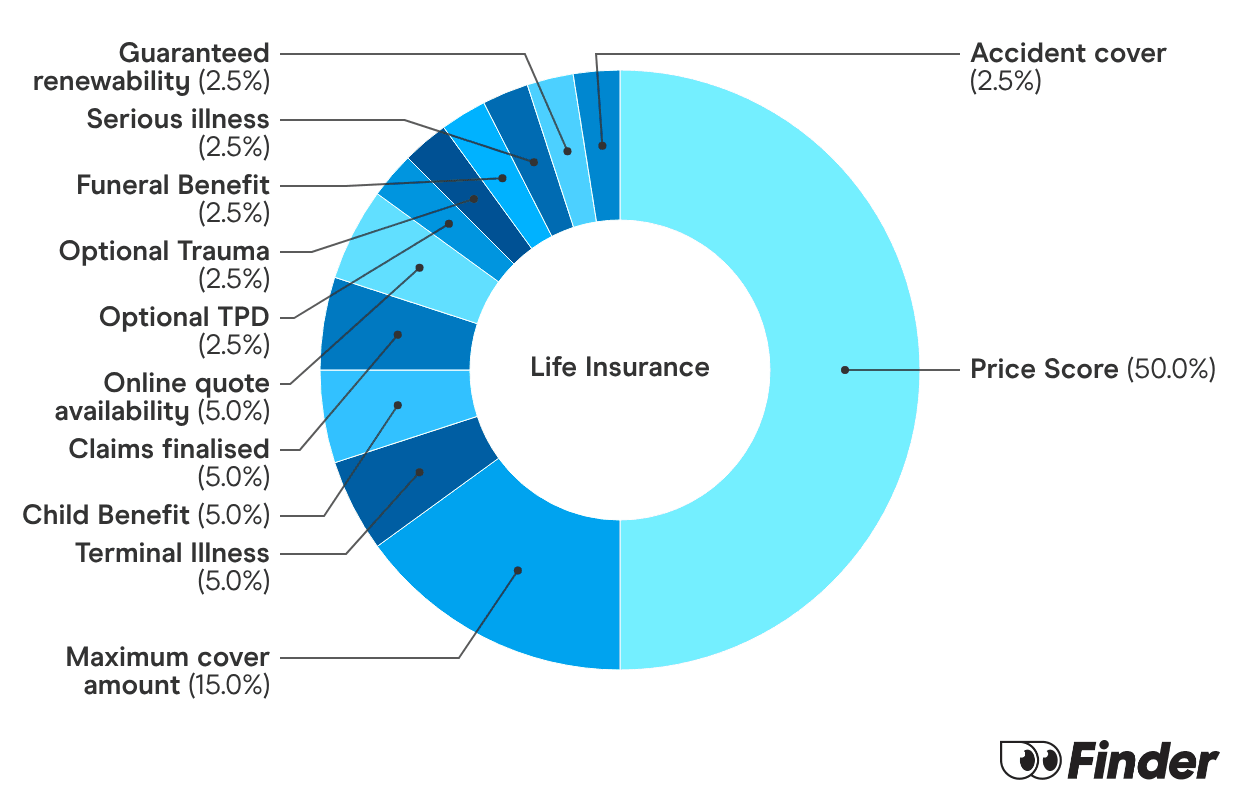
Life Insurance is a little complicated and a lot overwhelming. That's why we made the Finder Score, to make it easier to compare Life Insurance products against each other. Our experts analysed over 30 products and gave each one a score out of 10.
But a higher score doesn't always mean a product is better for you. Your situation is unique, so your policy choice will be too. Don't think of Finder Score as the final word, but as a good place to start your life insurance comparison.
Quotes are based on a 65-year-old non-smoker living in NSW, looking for $500,000 life insurance cover. Prices are subject to change.
Speak to an expert to help you find tailored life insurance cover
How long will life insurance cover last?
The maximum entry age on life insurance policies in Australia can vary between providers but generally, people can take out cover if they are between the ages of 18 and 75.
A policy expiry age can also impact the length of your life insurance policy. This is the age at which your policy will automatically terminate. It is usually between 99 and 130 years of age. For example, if you're currently 70, you could purchase a policy with a maximum entry age of 70 or above and an expiry age of 100 and be covered until you turn 100 years old.
The figures in this table were correct at the time of publishing. Make sure you check the Product Disclosure Statement (PDS) to see you if you're eligible to apply.
What types of life insurance are over 65s eligible for?
Term life insurance, also known as 'death cover', is the standard type of life insurance you can get in Australia. It covers you for a period of time (for example - until the age of 99) and will pay a lump sum benefit to your loved ones if you die during this time.
Terminal illness benefit. Receive 100% of your life cover sum insured if a certified medical practitioner diagnoses you with a terminal illness.
Benefit indexation. Ensures your sum insured (and premiums) keeps pace with inflation over the life of the loan.
Premium freeze. Freeze premium payments for a specified period. This feature is generally only available with stepped premiums.
Funeral expenses benefit. An advanced payment of a portion of the sum-insured is paid to nominated beneficiaries to help them cover immediate expenses following death.
Financial planning reimbursement. Beneficiaries are reimbursed for the cost of obtaining a financial plan from a certified financial adviser.
Trauma insurance for people over 65
People over age 65 may wish to consider adding Trauma Insurance to their life insurance plan, either as a linked benefit on their policy or as a standalone policy.
Trauma cover, also known as 'critical illness cover', can offer policyholder protection for up to 50 different medical conditions including heart attacks and strokes.
Some of the key features of trauma insurance include:
Buy-Back option. If the trauma cover is linked to a life insurance plan and a benefit is paid for a trauma event, the life insurance sum insured is reduced by what was paid for the trauma benefit. The buy-back feature allows the policy owner to repurchase the sum-insured 12 months after the claim was paid.
Chronic Diagnosis Advancement Benefit. Some policies will provide policy owners with an advancement of a portion of the sum insured following the diagnosis of a specified condition.
Conversion to loss of independence. As most trauma policies will only provide cover to age 70, some policies will allow policy owners to convert the benefit to a "loss of independence" benefit. This benefit can generally remain in force until the age of 100.
Financial planning benefit. Some insurers will reimburse financial planning costs so you can plan how to use your lump sum payout.
Death benefit. A lump-sum payout may be awarded if there is a death within 14 days of suffering from a critical condition.
Total and Permanent Disability cover for people over 65
Total and Permanent Disability (TPD) cover pays a lump sum benefit if you can't work again due to a permanent illness or injury. It's important to note that most insurance policies have a maximum entry age of 65 but there are a few that have their cut off point in the 70s.
Some of the main benefits of TPD include:
Partial disability benefit. You can be paid a lump-sum amount in the event of partial disablement (e.g. loss of one arm or sight in one eye).
Buy-back option. If your TPD cover is bundled with your life insurance, when a TPD benefit is paid, the amount gets deducted from your life insurance sum insured. A buy-back option lets you reinstate that amount.
Death benefit. If your TPD cover is a standalone policy a benefit amount can be paid in the event of your death.
Benefit indexation. Your sum insured will increase annually in line with the Consumer Price Index to keep up with inflation.
Sum insured. What is the maximum amount of cover that can be taken out on the policy?
Cost. Are you getting good value for money? Does the policy have expensive extras that you don't really need?
Waiting period. How long is the period between the claim being made and the benefit being provided to the policy beneficiaries?
Maximum entry age. What is the cut-off age for applying for cover?
Cooling off period. What is the duration of time after the policy being taken out that cover can be cancelled and premiums refunded?
Claims process. What is the insurance provider's claims process? This should be stated on the insurers website.
Cover renewal. To what age can cover be renewed?
These are just a few components of the policy to review when comparing quotes. An insurance consultant can help you compare different policies and explain any exclusions that may apply.
Richard Laycock is Finder’s insights editor after spending the last five years writing and editing articles about insurance. His musings can be found across the web including on MoneyMag, Yahoo Finance and Travel Weekly. Richard studied Media at Macquarie University and The Missouri School of Journalism and has a Tier 1 Certification in General Advice for Life Insurance.
See full bio
Find a better deal, save on your bills and get a free gift card. Sign up to be the first to hear about new Finder Rewards.
Important information about this website
Finder makes money from featured partners, but editorial opinions are our own.
Finder is one of Australia's leading comparison websites. We are committed to our readers and stand by our editorial principles.
We try to take an open and transparent approach and provide a broad-based comparison service. However, you should be aware that while we are an independently owned service, our comparison service does not include all providers or all products available in the market.
Some product issuers may provide products or offer services through multiple brands, associated companies or different labeling arrangements. This can make it difficult for consumers to compare alternatives or identify the companies behind the products. However, we aim to provide information to enable consumers to understand these issues.
We make money by featuring products on our site. Compensation received from the providers featured on our site can influence which products we write about as well as where and how products appear on our page, but the order or placement of these products does not influence our assessment or opinions of them, nor is it an endorsement or recommendation for them.
Products marked as 'Top Pick', 'Promoted' or 'Advertisement' are prominently displayed either as a result of a commercial advertising arrangement or to highlight a particular product, provider or feature. Finder may receive remuneration from the Provider if you click on the related link, purchase or enquire about the product. Finder's decision to show a 'promoted' product is neither a recommendation that the product is appropriate for you nor an indication that the product is the best in its category. We encourage you to use the tools and information we provide to compare your options.
Where our site links to particular products or displays 'Go to site' buttons, we may receive a commission, referral fee or payment when you click on those buttons or apply for a product.
When products are grouped in a table or list, the order in which they are initially sorted may be influenced by a range of factors including price, fees and discounts; commercial partnerships; product features; and brand popularity. We provide tools so you can sort and filter these lists to highlight features that matter to you.
Please read our website terms of use and privacy policy for more information about our services and our approach to privacy.
We update our data regularly, but information can change between updates. Confirm details with the provider you're interested in before making a decision.
How likely would you be to recommend Finder to a friend or colleague?
0
1
2
3
4
5
6
7
8
9
10
Very UnlikelyExtremely Likely
Required
Thank you for your feedback.
Our goal is to create the best possible product, and your thoughts, ideas and suggestions play a major role in helping us identify opportunities to improve.