Mortgage protection insurance can cover your mortgage repayments if you have a serious illness but there are other options that may be better value for money.
Mortgage protection insurance covers homeowners in the event they cannot pay their home loan due to redundancy, illness or disability.
Flexible policy options are available, allowing you to choose a policy that covers you against the risks that matter to you.
Life insurance and total and permanent disability (TDP) insurance can provide more comprehensive coverage.
What is mortgage protection insurance?
Mortgage protection insurance is a type of life insurance that is designed to protect one very specific but important asset: your home. Sometimes referred to as mortgage life insurance, mortgage protection insurance can cover you, the borrower, in case you can't pay your loan. It can pay the cost of regular monthly mortgage repayments if you die, become seriously ill or in some circumstances, lose your job.
Not to be confused with lenders mortgage insurance (a type of insurance that lenders can take out if they think a borrower is high risk), mortgage protection insurance covers the borrower, not the lender.
Mortgage protection insurance: Pros and cons
Pros
You can protect one of your biggest investments. A mortgage ties together your financial security, your investment and your house.
It can protect your mortgage from any loss of income. Whether due to death, disability, redundancy, illness or other involuntary unemployment you are unable to pay your mortgage, your payments are covered.
It has flexible options. You are able to choose a policy that covers you against fewer or more risks as desired. Options include big lump sums to be paid if you die so that your family can repay the entire mortgage, policies that will cover mortgage repayment costs for a set period of time, and more.
It can be budgeted for alongside the mortgage itself. You can budget for mortgage protection insurance by calculating its costs alongside the mortgage itself. Consider how your insurance premiums will extend your repayment period and affect the total cost of your mortgage to get a clearer idea of its value for money.
Cons
It only covers your mortgage. Your home is definitely worth protecting, but there are other insurance options that will protect your home and everything else. Income protection cover, for example, can cover mortgage repayments, along with other debts like a car loan.
Only one payout. In the event that both parties named on the policy were to pass away, any surviving dependents would only receive the one benefit.
If the housing market collapses or your property loses value. If this happens, you might end up with an overpriced and over-comprehensive mortgage protection policy.
Relationship breakdowns. Issues can arise in the event that a relationship breaks down and the policy needs to be split.
Poor consumer outcomes. As a form of consumer credit insurance (CCI), mortgage protection insurance is a product that's fallen out of favour in recent years including with the Australian Securities and Investments Commission (ASIC).
Compare mortgage protection insurance in Australia
We only found 2 insurance companies in Australia that still offer mortgage protection insurance:
Compare income protection policies to help protect your mortgage
Income protection could be a good alternative to mortgage protection as it pays a monthly benefit to replace lost income if you become sick or injured. These monthly benefits can help you manage your regular mortgage payments if you're unable to work so you can focus on recovery.
Click Get Quote below to start comparing your options. Or if you'd prefer, speak to an insurance specialist today.
These products offer great value, with a good score across both features and price.
7+
Great
These are competitive products, though they didn't quite get top scores.
5+
Standard
These products might offer less value or command a higher premium than others in the market.
0+
Basic
These products might only offer a basic set of features or aren't very competitive on price.
{"userFilters":[{"componentType":"MULTI-SELECT CHECKBOX","options":{"comparator":"contains","includeAllSelection":false,"defaultMatcher":"ANY","values":["8.95-10","6.95-8.94999","4.95-6.94999","0-4.94999"],"fields":[{"label":"[[FINDER_SCORE_BADGE|9+]] Excellent: 9+","value":"8.95-10","comparator":"range"},{"label":"[[FINDER_SCORE_BADGE|7+]] Great: 7+","value":"6.95-8.94999","comparator":"range"},{"label":"[[FINDER_SCORE_BADGE|5+]] Standard: 5+","value":"4.95-6.94999","comparator":"range"},{"label":"[[FINDER_SCORE_BADGE|0+]] Basic: 0+","value":"0-4.94999","comparator":"range"}]},"dataSelector":{"recordType":"PRODUCT","fieldCode":"FINDER_SCORE.FINDER_SCORE"},"dataType":"NUMBER","label":"Finder Score","queryParameter":"finderScore"},{"dataSelector":{"recordType":"UI_FILTER_COMPONENT","fieldCode":"SPECIAL_OFFERS"},"dataType":"BOOLEAN","label":"Special offers","componentType":"SpecialOffersFilter","config":{"VALUES":"1","fields":[{"value":"exclusive_only","label":"Finder Rewards & exclusives"},{"value":"all_offers_no_rewards","label":"All offers"}]},"options":{"comparator":"eq"},"queryParameter":"special-offers"},{"config":{},"dataSelector":{"recordType":"product","fieldCode":"GENERAL.PROVIDER_ID"},"dataType":"UUID","label":"Providers","order":100},{"config":{"MULTISELECT":true,"VALUES":"6 months,1 year,2 years,5 years,To the age of 65,To the age of 70,2 year benefit to age 70"},"dataSelector":{"recordType":"product","fieldCode":"FILTERS.BENEFIT_PERIOD_OPTIONS"},"dataType":"TEXT","label":"Benefit Period Options","order":null},{"config":{},"dataSelector":{"recordType":"product","fieldCode":"FILTERS.MAXIMUM_MONTHLY_BENEFIT"},"dataType":"MONEY","label":"Maximum Monthly Benefit","order":null},{"config":{},"dataSelector":{"recordType":"product","fieldCode":"FILTERS.MAXIMUM_PERCENT_OF_INCOME_COVERED"},"dataType":"PERCENTAGE","label":"Maximum % of Income Covered","order":null},{"config":{"VALUES":"Yes, No, Optional"},"dataSelector":{"recordType":"product","fieldCode":"FILTERS.REDUNDANCY_COVER"},"dataType":"TEXT","label":"Redundancy Cover","order":null},{"config":{"MULTISELECT":true,"VALUES":"14 Days,28 Days,30 Days,56 Days,60 Days,90 Days,6 Months,1 Year,2 Years"},"dataSelector":{"recordType":"product","fieldCode":"FILTERS.WAITING_PERIOD_OPTIONS"},"dataType":"TEXT","label":"Waiting Period Options","order":null},{"config":{"VALUES":"0"},"dataSelector":{"recordType":"UI_FILTER_COMPONENT","fieldCode":"FULL_MARKET"},"dataType":"FULL_MARKET","label":"More products","queryParameter":"full-market"}],"niche":{"currencySymbol":"$","decimalPoint":".","decimalPlaces":"2","thousandsSeparator":",","filterBoundsMap":{"product.GENERAL.PROVIDER_ID":null,"product.FILTERS.BENEFIT_PERIOD_OPTIONS":null,"product.FILTERS.MAXIMUM_MONTHLY_BENEFIT":{"minimum":"10000","maximum":"42000"},"product.FILTERS.MAXIMUM_PERCENT_OF_INCOME_COVERED":{"minimum":"70","maximum":"85"},"product.FILTERS.REDUNDANCY_COVER":null,"product.FILTERS.WAITING_PERIOD_OPTIONS":null}},"prefilled":false,"experimental":false}
We currently don't have that product, but here are others to consider:
Looking for other options? Check out these similar products.
How we picked these
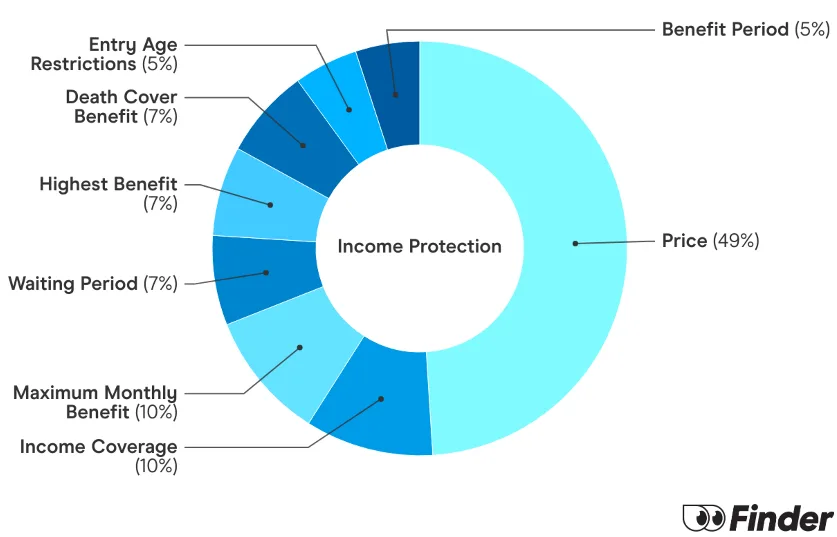
Finder Score - Income Protection
Income Protection is a little complicated and a lot overwhelming. That's why we made the Finder Score, to make it easier to compare Life Insurance products against each other. Our experts analysed over 12 products and gave each one a score rank out of 10.
But a higher score doesn't always mean a product is better for you. Your situation is unique, so your policy choice will be too. Don't think of Finder Score as the final word, but as a good place to start your life insurance comparison.
Mortgage protection insurance can cover mortgage repayments for the following:
Disability. If you suffer temporary disablement, permanent disablement and are unable to work.
Loss of job. If you are made redundant but not if you simply quit your job (many policies do not offer this benefit, so check beforehand).
Death. If you pass away, mortgage protection will continue to pay your mortgage repayments, so that your family doesn't have to.
Keep in mind that most policies exclude any pre-existing condition prior to purchasing mortgage insurance protection. So if you receive a medical consultation for any ailment or condition in the 12 months before you purchase the policy, and that medical condition leads to a claim after the policy commences, you won't be covered.
You also won't be covered if you work part-time, casual, contract, or in a temporary capacity for less than 20 hours per week. This is generally also the case if you are self employed and work less than 20 hours per week.
Is mortgage protection insurance worth it?
Mortgage protection insurance only covers your mortgage. As you know, your mortgage is simply a part of your day-to-day expenses, albeit a significant portion of it. This means if you were forced to stop work and made a successful claim, you would still have other bills to pay, such as:
School tuition fees. If you have children, you will need to continue paying their fees.
Other loans. Whether it's a car loan, or a student loan, many of us are paying off more than just our home loan at some point in our lives.
Living expenses. With mortgage protection insurance, you'll still need to find money to pay for essentials like food, energy bills and transport costs.
If you have these expenses covered already, then mortgage protection insurance might be worth it for you. If you don't want to eat into your savings though, income protection is probably the more financially viable option.
What insurance can I get instead of mortgage protection insurance?
Mortgage protection insurance is a type of life insurance. However, it's not necessarily the most comprehensive life insurance option. Here are some others worth considering, all of which can help with mortgage repayments.
Income protection. Income protection is designed to replace your income by up to 85% should you become sick or injured. To get covered, you'll need to pay a monthly fee and get peace of mind knowing you're covered for all your expenses, not just the mortgage, if something stops you from working. If you die, many policies will pay your entire benefit in one lump sum, helping your loved ones pay off the mortgage.
Life insurance. Death cover, more commonly just referred to as life insurance, pays out a lump sum of money when you die. This money goes to the people you nominate on your policy, so could easily help pay off your mortgage.
Total and permanent disability (TPD). This is often included with death cover, and provides you with a lump sum for permanent loss of work due to serious illness or injury. This lump sum payment can go towards mortgage repayments as well as other day-to-day expenses.
What to look for when doing a mortgage protection insurance comparison
Mortgage protection is looking after the most important thing in your life – your family's security, so here's how to find the most reputable insurer, the most inclusive policy and the best benefits for your needs.
Coverage. Look at what the benefit payout amount is designed to cover and make sure it can pay all of the expenses related to your mortgage including your interest and repayments. It is also a good time to consider how much coverage you should take out to be truly protected.
Waiting period. If something happens to the main income earner of the family there will be enough emotional turmoil in the house without adding financial problems, so make sure that your benefit will pay out as soon as possible so your family isn't put under financial stress.
Your dependents. Consider whether you have children, or even ageing parents, who depend on you, and how long they are likely to be dependent for. This will help you decide on the level and the term of cover.
Other income. You may be able to look at lower levels of cover if your family has other sources of income, such as investments, or assets that could be sold. At the same time you don't want your family to sell assets to pay the mortgage and then be left without any other assets – and where does the money come from when there's nothing left to sell?
Your risk factors. The costs of mortgage protection can vary depending on your health and lifestyle factors, so you may need to seek out a specialised insurer who has experience in catering to your needs.
The provider. As well as insurers who specialise in certain health and lifestyle factors, when comparing insurers make sure you choose an established and well-respected company, and one that is friendly and easy to deal with.
Frequently asked questions
Mortgage protection can be taken out on both residential and commercial properties. The policyholder can either live in the property or hold it as an investment.
Mortgage protection insurance does work in a similar way to PPI in that it will ensure an outstanding loan is repaid in the event that the policyholder passes away. Mortgage protection insurance is generally offered as a standalone policy by life insurance providers and is designed specifically for repayment of the policyholder's mortgage in the event of their death.
Generally, the premiums payable for mortgage protection are not tax-deductible as the payment is not an expense in gaining assessable income. Benefit payments are not assessable for income tax purposes. Learn more about life insurance and tax.
No. Lender's mortgage insurance (LMI) is a type of insurance that lenders can take out to protect themselves if they believe a borrower is high risk e.g. likely to stop paying their home loan. The premiums for an LMI policy get added to the borrower's loan amount.
Speak to an insurance specialist to help you find cover
Gary Ross Hunter has over 6 years of expertise writing about insurance, including life, health, home, and car insurance. Having reviewed hundreds of product disclosure statements and published over 800 articles, he loves simplifying complex insurance topics for everyday readers. Gary has contributed to major outlets like Yahoo Finance, The Sydney Morning Herald, and news.com.au, and holds a Bachelor of Arts (Honours) in English Literature from the University of Glasgow, along with a Tier 2 General Advice certification, ensuring his work adheres to ASIC’s RG146 standards.
See full bio
Gary Ross's expertise
Gary Ross
has written
554
Finder guides across topics including:
James Martin was the insurance editor at Finder. He has written on a range of insurance and finance topics for over 7 years. James often shares his insurance expertise as a media spokesperson and has appeared on Prime 7 News, Insurance News, 7NEWS and The Guardian. An experienced journalist, James' work has featured in publications including The Irish Times, Companies100 and In Business. He holds a Tier 1 General Insurance (General Advice) certification and a Tier 1 Generic Knowledge certification, both of which meet the requirements of ASIC Regulatory Guide 146 (RG146).
See full bio
James's expertise
James
has written
178
Finder guides across topics including:
Review the Australian Seniors Life and compare options available.
Important information about this website
Finder is a comparison service. We do not compare every product or every provider in the market.
We make money through commercial arrangements with some of the providers on this site. Products marked 'Sponsored', 'Promoted', 'Featured' or 'Advertisement' appear as a result of a commercial arrangement.
Our editorial content, product reviews and any 'Top Pick' designations are prepared independently of these commercial arrangements.
The default order of products in our tables can be influenced by commercial arrangements. You can re-sort or filter using the controls above each table.
Some content on this site may be generated or supported by AI tools. You should verify details directly with the provider.
Finder is one of Australia's leading comparison websites. We are committed to our readers and stand by our editorial principles.
Our comparison service does not include every product or every provider in the market. Some product issuers offer their products under multiple brands or through associated companies. Where we can, we identify the underlying issuer so you can compare like with like, but you should always check with the provider directly to confirm which brand you are dealing with.
Finder is a comparison website and an intermediary. We are not a product issuer and we do not provide personal financial or credit advice. When you click a link to a product, or apply for a product through our site, you deal directly with the product issuer. We may receive a referral fee, commission or other payment from the issuer if you click through, apply or take out a product. We describe these arrangements in more detail under 'How we make money' below.
Product features, fees, terms and eligibility criteria are set by the product issuer and may change. We rely on information supplied by issuers when we present product details on our site. Before you apply for or take out any product, you should confirm the details directly with the issuer.
We earn revenue from Finder in four principal ways:
Referral fees and commissions. When you click a product link, complete an enquiry form or apply for a product through our site, we may receive a referral fee, commission or other payment from the product issuer. We may also receive payment based on the volume of leads or conversions we send to an issuer.
Sponsored placements. Products marked 'Sponsored', 'Promoted', 'Featured' or 'Advertisement' appear as a result of a commercial arrangement between Finder and the issuer. These labels always indicate a paid placement. We do not use them for editorial choices.
Display advertising. Banner advertising, newsletter advertising and similar display ads on our site are paid by advertisers.
Content sponsorship. Some articles, videos and social media posts are sponsored by an issuer and are clearly labelled as such.
Our editorial opinions, product reviews and any 'Top Pick' designations are prepared independently of these commercial arrangements. A 'Top Pick' is an editorial choice made by our writers and editors based on the criteria described on each comparison page. A 'Top Pick' is not a personal recommendation and does not mean the product is appropriate for your circumstances.
If you would like to know whether we have a commercial arrangement with a specific product issuer, please contact us.
When products are grouped in a table or list, the default order can be influenced by commercial arrangements we have with product issuers. In some categories, sponsored or featured products appear in the top positions of the table by default, and are always labelled as such.
Other factors that influence default order include price, fees and features, and (where relevant) our editorial view of the product.
You can re-sort every comparison table using the controls above the table. You can filter by product features that matter to you. The order you see after re-sorting or filtering is not influenced by commercial arrangements.
Some content on this site is generated or supported by artificial intelligence tools, including our AI-powered assistant FinderBot. AI-generated content may contain errors. Please verify important information directly with the product issuer before making a financial decision. For more information about FinderBot, see the FinderBot Terms of Use and FinderBot Privacy Collection Notice.
Please read our website terms of use and privacy policy for more information about our services and our approach to privacy.
We update our data regularly, but information can change between updates. Confirm details with the provider you're interested in before making a decision.
Our goal is to create the best possible product, and your thoughts, ideas and suggestions play a major role in helping us identify opportunities to improve.