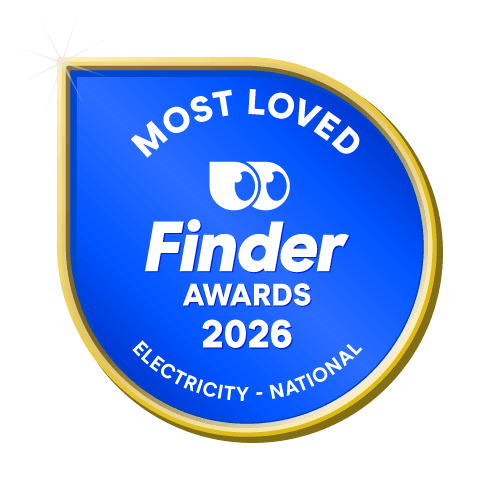
Most Loved Electricity - National: Red Energy
Red Energy was the winner for Most Loved Electricity - National with a score of 4.10.
See Red Energy's plans










If you're comparing electricity plans, there are a few things to check, including the rates.
The usage rate is what you pay for each unit of electricity you use, measured in cents per kWh. The supply charge is a flat daily fee for being connected. You pay it no matter how little power you use. If your household doesn't use much electricity, keeping the supply charge low makes the bigger difference; if you use a lot, a low usage rate matters more. For most homes, you're better off with 2 reasonable rates than one really cheap rate that's dragged down by a much higher one.
A single-rate tariff charges the same no matter when you use power. A time-of-use tariff is cheaper off-peak and higher at peak times. If you can run appliances during the day or late at night, time-of-use can be a good option as long as you have a smart meter. You can read about other tariff types to see what else is available.
In most of the country, electricity plans are advertised as a percentage below a government-set benchmark called the reference price. The further below the reference price a plan sits, the better the deal. (We'll explain how this works in more detail, including how the terminology varies between states and territories, in the next section.)
Sign-up credits and pay-on-time discounts can be great, but read the conditions. A big welcome credit paired with high usage rates and/or supply charges can cost you more over the year than a plan with low rates.
Check for things like the disconnection fees, credit card fees and how long any introductory offer lasts.
If you want greener power, look for a GreenPower add-on. You'll pay a little extra for your retailer to match your electricity usage with renewable energy. Some providers also offer a carbon neutral option, where they buy carbon offsets from projects that reduce or store greenhouse gas emissions.
If you have solar panels, check the feed-in tariff, which is the credit you're paid for the electricity your panels send back to the grid. It's best to avoid choosing a plan on the feed-in rate alone: a high credit can be wiped out by expensive usage rates, so look at what the plan charges you as well.
When comparing electricity plans, the reference price gives you a simple way to see if a deal is actually good value.
It's the estimated cost of the default plan you'd be on if you didn't choose a different offer.
In NSW, South Australia and South East QLD, this is called the Default Market Offer (DMO). It acts as a benchmark for comparing other electricity plans.
So, if a plan says it's "15% less than the reference price", it's expected to cost about 15% less than that benchmark for a typical home.
Generally, the bigger the discount, the better the deal.
The rules vary slightly depending on where you live.
What you pay depends on your state, your network distributor and your tariff.
Here's an example of the average cost of electricity across all states and territories for single rate plans.
You'll see a range for NSW in the table below because the state has 3 electricity distribution networks.
As of 1 July 2026, there's a new opt-in energy plan worth knowing about.
The Solar Sharer Offer gives eligible households 3 hours of free electricity every day, during the middle of the day when solar floods the grid.
Here's how it works:
You can find out more about the rates and use our Solar Sharer Offer calculator guide to see whether it's worth it for you.
This will depend on where you live and what type of plan you're after. There's no single cheapest provider for everyone.
Your best option is to use our engine up top to compare energy plans for your area and find the cheapest deal.
That said, a few things hold almost everywhere:
You can also check out our guide to the cheapest energy plans to see which providers are slinging the lowest rates this month.
Each year we survey thousands of Aussies to highlight which electricity brands they love the most, based on their overall satisfaction and experience.
Here's a look at the most loved brands nationally and across the major states for 2026.
Red Energy was the winner for Most Loved Electricity - National with a score of 4.10.
See Red Energy's plans
Red Energy won Most Loved Electricity - NSW with a score of 4.03.
See Red Energy's plans
Red Energy won Most Loved Electricity - VIC with a score of 4.10.
See Red Energy's plans
Alinta Energy won Most Loved Electricity - QLD with a score of 3.87.
See Alinta Energy's plans
Lumo Energy was the winner for Most Loved Electricity - SA with a score of 4.18.
See Lumo Energy's plansCheck out the full awards list to see which electricity providers topped in other categories, including trust and service.
Once you've found a better plan, the switch itself usually takes 5 minutes, as long as the electricity account is in your name.
Here's what you need to do:
You can read our in-depth guide on switching energy providers for more details.
Reading your electricity bill can be daunting if you don't know what any of it means. Check out our glossary to make sense of the jargon.

We know our stuff. Our experts review hundreds of plans each month. It's hard work, but we love it.

You can rely on us. We update plan data on dozens of providers daily, and we're constantly fact-checking.

We're here to help. We've helped millions of Aussies find cheaper energy. That's pretty powerful.
Find out what energy providers offer special plans for seniors, and what rebates and concessions are available.
Thinking of switching to Tango Energy? Find out which plans you can sign up to and whether Tango's running any deals this month.
Find out how 1st Energy’s plans fare in your state.
One of Australia’s largest providers of electricity and gas, AGL has a wide range of competitive plans.
Find this month's cheapest electricity and gas plans in Adelaide and across South Australia.
Find this month's cheapest electricity and gas providers in South East Queensland, plus what regional QLD households can do to save.
ActewAGL Energy provides electricity and gas services to homes and businesses in New South Wales and the ACT.
Compare Lumo Energy residential and business plans for customers in Victoria and South Australia.
EnergyAustralia provides a variety of options for electricity and gas supply to residential and business clients.
If you’re looking to go green with your power then Diamond Energy can help, offering one of the greenest power sources in all of Australia.
