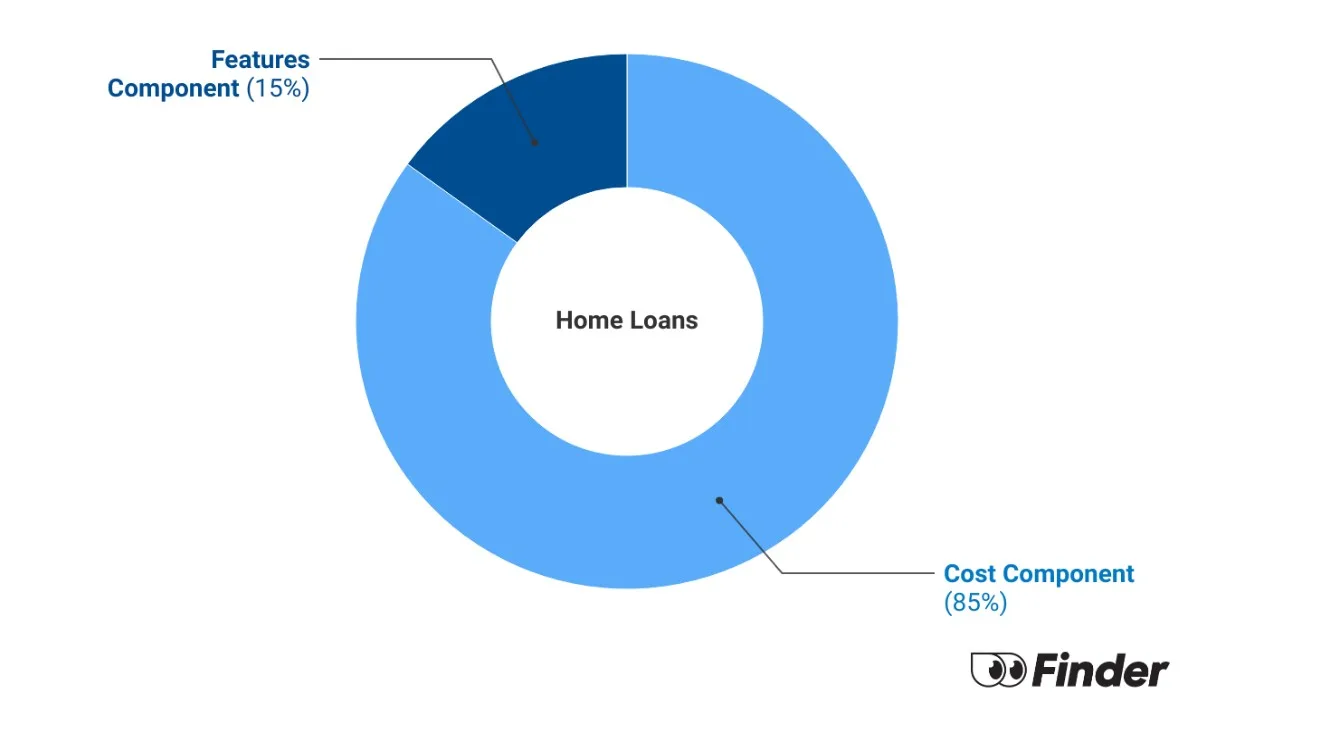

Aussie Home Loans can help you sort through overwhelming jargon and find the right home loan from thousands of products.
With an extensive broker network across the country, you'll be given a dedicated mortgage broker to walk you through the entire journey from saving your deposit to refinancing your home loan over the years to come.
Variable rate home loans have interest rates which can go up or down at any time, changing the cost of your repayments.
These home loans are more flexible as you can usually make extra repayments and repay the loan early without penalty.
The best variable rate loans have low interest rates and fees. You're also more likely to benefit from features like offset accounts.
How to compare variable rate home loans
Don't settle for a third-rate home loan. Make sure you get the best variable rate home loan deal by looking at 4 things:
1. The interest rate
The interest rate determines how expensive your repayments will be. The lower the rate, the better.
2. Fees
Most home loans have some fees, but some have almost none. The key ones to watch out for are application fees, monthly fees and settlement fees.
3. Loan purpose
If you're looking to finance an investment property then you will need an investment loan.
If you're buying (or refinancing) a loan for your home then you need an owner-occupier home loan.
4. Loan features
Variable rate loans come with the most features. You can make extra repayments to pay the loan off faster. And most variable rate loans have a redraw facility too.
Some variable rate loans have an offset account, which functions like a bank account. But instead of earning interest on the savings it reduces your loan's interest charges and gets you out of debt faster.
What's a comparison rate?
When you look at variable interest rates you'll see there's also a comparison rate. The comparison rate can be a more accurate reflection of the interest you'll be paying, as it includes additional fees.
However, it's based on a fairly small loan amount over 25 years so won't be a true reflection for every borrower.
Our expert says
"If you have a variable loan, it's a great idea to also have an offset account. While that can mean extra costs, it allows you to offset your savings against your loan and can save a lot in a high-interest world."
Loan-to-value ratio: The minimum deposit you have will impact the variable interest rate you get. A higher loan against the property price will usually lead to a higher interest rate.
RBA: As the RBA decides what the national cash rate is doing, variable interest rates will follow.
Home type: Whether you're buying a home to live in or an investment property will change the interest rate you get.
Features: Very often, variable loans with additional features like an offset account might mean you pay a slightly higher interest rate.
Pros and cons of a variable rate home loan
Pros
You benefit from rate cuts: Even if rates rise during your loan term you may still have benefited over the longer term
More flexibility: Variable rate loans usually allow you to make unlimited extra repayments, whereas fixed rate loans have limits.
Early repayment: You can usually pay off your loan without penalty.
Cons
You deal with rate hikes: If interest rates rise, so will your mortgage repayments.
Harder to budget: Because rate changes can make your repayments change, you'll need to keep reassessing your budget.
Higher rates: With interest rate cuts in 2025, variable rates have been slightly higher than some fixed rates on the market.
Variable home loans market update for December 2025
The lowest variable home loan rate right now on Finder is 4.99%.
The average variable home loan rate on the market is 6.46%.
Variable home loan rates decreased throughout 2025 as the RBA cut the cash rate. Halfway through the year there were expectations that the rate cuts could continue into 2026. But in the final month of 2025, that's all changed.
The October and November inflation figures even led some to question whether December could see a rate increase. But the RBA announced on Tuesday, 9 December it would be keeping the cash rate where it is.
For variable rates this means nothing should change, although it is entirely up to the banks to do what they want with rates. In Finder's RBA survey for December, experts are completely split between whether interest rates will rise, fall or stay where they are over the next 12 months.
Is now a good time to get a variable rate home loan?
Fixed rate loans are great when rates are rising fast. That was the case in 2022–23.
During 2025 we saw 3 interest rate cuts. This was good news if you have a variable rate loan. But it's important to remember that you can never actually guarantee how rates will move.
When deciding between fixed and variable it's more important to think about how comfortable you are with the current rate and whether you can afford more rate rises.
What's the difference between fixed rate and variable rate home loans?
Variable rate mortgages...
Go up and down over time. Lenders can change your rate at any time (usually when the RBA changes the official cash rate). In 2025 so far, the cash rate has fallen twice and most home loan rates have dropped with it.
Are flexible. You can repay a variable rate loan early or refinance and your lender won't charge any fees.
Usually have lower rates. Fixed rates are typically higher than variable rates (that's the price of certainty). But as we can see in the current rate environment that's not always the case. Fixed rates are currently lower than variable rates.
Fixed rate mortgages...
Won't change (for the fixed period). You can fix your rate for 1 to 5 years. And your repayments won't change during this time.
Turn into variable rates anyway. Once the fixed period ends you're back on a variable rate, but often this is higher than the advertised variable rate.
Are harder to break. Refinancing or repaying a fixed rate loan early comes with a break fee. This can cost thousands of dollars.
Still unsure? Consider the split rate option
Australian borrowers don't have to pick between variable and fixed. Many lenders allow you to split your loan into fixed and variable portions.
Most borrowers go for a variable rate
A variable rate loan is really about flexibility: paying the loan off faster via an offset account or extra repayments.
And it's about being able to exit the loan or refinance without paying a break fee.
Most Australian borrowers choose a variable rate. According to the AFG Index, just 4% of borrowers chose a fixed rate in last 3 months of 2024.
"I'm team variable interest rate all the way. I don't fix my rate and I don't bother with a split rate either. For me, the value of a variable rate loan's flexibility and getting the full benefit of an offset account is so important. I can refinance whenever I need without penalty and if I decide to sell or make a big change that requires a new loan, it's so much easier."
Frequently asked questions about variable rate home loans
Interest rates have changed a lot over the last couple of years and they could change over the next few months as well. While good interest rates are important, remember to look at what other features and fees come with the loan.
While variable rate home loans are typically lower than fixed rates, situations arise where fixed rates become lower. This usually happens when lenders anticipate that variable rates will remain low for an extended period, or if the market believes the official cash rate will fall in the future, making fixed rates less expensive.
The choice between a fixed and variable rate home loan depends on individual circumstances.
Variable rates offer flexibility, often come with lower fees, and features like offset accounts, and are easier to refinance. Fixed rates provide repayment stability and protection against rising interest rates, but typically have less flexibility regarding extra repayments, offset accounts, and incur break fees for early exit.
Use our repayment calculator and speak to a mortgage broker if you want more information on what the right rate is for you.
Lenders are free to move your variable interest rate up or down whenever they want. In practice, lenders move rates in response to wider market and economic conditions.
While you can't really predict rate changes perfectly, it is possible to get a good sense of which direction rates are moving in.
The Reserve Bank of Australia (RBA) sets the official cash rate each month. This is a benchmark for lenders to set interest rates on variable rate home loans.
The RBA lowers interest rates to stimulate economic growth and encourage spending. When inflation is high, the RBA raises rates to cool spending and drive prices down.
Variable interest rates in Australia can change at any time, moving either up or down, based on market conditions and lender decisions.
Credit unions and online lenders have the lowest variable rate home loans. And for most borrowers, lowest rate = best.
But the big banks have really good apps and in-branch service. That can be a very big benefit.
Most lenders offer multiple variable rate home loans.
Basic variable home loans. A basic variable loan has a lower rate than a lender's other products (usually) and doesn't come with an offset account. These loans are all about the low rate.
Introductory discount home loans. These loans (sometimes called honeymoon home loans) are often the lowest variable rate loans a lender offers. But after the initial discounted period, the rate will revert to a higher rate. That's usually a good time to switch to a better loan.
Package home loans. These loans let you combine your mortgage with an offset account plus a credit card or other financial products. In exchange, you get discounted fees on the products and the convenience of having all your banking in one place. The downside? You pay an annual package fee of several hundred dollars.
Standard variable home loans. Standard variable rates are a bit of a throwback. These are the benchmark variable rates used for home loans with the Big Four banks and some other lenders. Most lenders discount the actual rate you get or will recommend a similar loan with a lower rate.
Interest rates rose rapidly in 2022 and into 2023, and didn't move much in 2024.
But in 2025 the RBA has begun lowering the cash rate again. Lenders have responded by lowering their variable rates.
A "good" interest rate will really depend on the loan you need for your circumstances. Right now, a high 5% interest rate is still competitive. The lowest variable interest rate on the Finder website at the moment is 4.99%, but not every borrower will necessarily be right for the lowest rate.
Variable home loan rates in Australia are largely pegged to the Reserve Bank of Australia (RBA)'s official cash rate. Changes in the RBA cash rate often lead to corresponding adjustments in variable home loan rates, although banks don't always pass on every change in full.
The primary drawback of a variable rate home loan is the uncertainty of repayment amounts. As interest rates can change at any time, your regular repayments may increase if rates go up, potentially impacting your budget and financial planning.
Yes, variable rate home loans generally offer greater flexibility, allowing borrowers to make extra repayments without incurring penalties. This feature can help you pay off your loan faster and save on interest.
Yes, it is generally possible to switch from a variable rate home loan to a fixed rate home loan, typically by refinancing your existing mortgage. Variable rate loans are often easier to refinance compared to fixed-rate loans, which may involve break fees.
Variable rate home loans often come with lower fees than their fixed-rate counterparts. While some competitive variable loans may have no application, ongoing, or exit fees, it's important to check the specific product disclosure statement as some may still carry certain charges. Variable loans typically do not have 'break fees' for exiting early, unlike fixed-rate loans.
Beyond the fluctuating interest rate, variable home loans commonly include features such as redraw facilities, which allow you to access extra repayments you've made, and offset accounts, which can reduce the interest you pay by linking your savings to your loan. They also often provide flexible repayment options.
Finding the best variable rate home loan for you
Every month, our home loan experts analyse more than 50 home loan rates from our database to find our best home loan picks. We only select home loans that are suitable for a typical borrower, so we don't include loans that require enormous deposits or have extra eligibility requirements.
We then rank these loans, with a scoring system that awards a higher score for loans with the lowest rates and fewest fees.
All our picks are from lenders with whom Finder has a commercial partnership. The best home loan looks a little different for every borrower and our picks may not be the best option for your situation.
These variable rate home loans offer low costs, coupled with a host of features, giving the best overall value.
7+
Great
These home loans may have slightly higher interest rates or fewer features but overall, a competitive offering.
5+
Standard
Usually the home loans would offer above average rates. They may still include some competitive features.
0+
Basic
Higher costs and/or fewer features.
What is Finder Score?
The Finder Score crunches 7,000 home loans across 120+ lenders. It takes into account the product's interest rate, fees and features, as well as the type of loan eg investor, variable, fixed rate - this gives you a simple score out of 10.
To provide a Score, we compare like-for-like loans. So if you're comparing the best home loans for cashback, you can see how each home loan stacks up against other home loans with the same borrower type, rate type and repayment type. We also take into consideration the amount of cashback offered when calculating the Score so you can tell if it's really worth it.
Richard Whitten is Finder’s Senior Money Editor, with over eight years of experience in home loans, property, credit cards and personal finance. His insights appear in top media outlets like Yahoo Finance, Money Magazine, and the Herald Sun, and he frequently offers expert commentary on television and radio, helping Australians navigate mortgages and property ownership. Richard started his career in education and textbook publishing in South Korea. He holds multiple industry certifications, including a Certificate IV in Mortgage Broking (RG 206) and Tier 1 and Tier 2 certifications (RG 146), as well as a Bachelor of Education from the University of Sydney and a Graduate Certificate in Communications from Deakin University.
See full bio
Richard's expertise
Richard
has written
680
Finder guides across topics including:
Hi If I reach retirement age and still have a home loan of say $100000, what is the longest term you can pay interest only repayments?
Thanks
Carol
Finder
MarcJune 20, 2016Finder
Hi Carol,
thanks for the question.
This will depend on the lender, as each will have its own unique lending criteria. It might be a good idea to consult a mortgage broker to find out the longest term available to you for your situation.
For future reference, you can use the search tool (with the magnifying glass) on the top right-hand corner of this page to search for certain comparisons.
Cheers,
Shirley
JeffAugust 19, 2014
My bank charges 5.98% variable rate , am I in my right to ask for a better rate like other lenders are give. We have a offset account and does that make difference.
Finder
MarcAugust 20, 2014Finder
Hi Jeff,
thanks for the question.
You’re completely within your rights to ask for a better rate, and starting a comparison of what else is out there in the market already is a great place to start. If you let your lender know that you’re unhappy with your rate and thinking of refinancing, there’s a range of incentives they can offer for you to stay, including cash and decreased rates. It never hurts to ask.
I hope this helps,
Marc.
MeganJuly 11, 2014
If I choose a variable loan am I locked into that loan for a certain amount of time or can I opt out or change my loan whenever I choose???
Finder
ShirleyJuly 14, 2014Finder
Hi Megan,
Thanks for your question.
It usually depends on the home loan you’ve committed to. Some lenders could charge a break fee if you leave the loan early and some may not charge this fee when you’ve stayed with the loan for a certain period of time.
You can check these fees by clicking on the ‘fees’ tab on our home loan reviews, and you can check the PDS of the product to see how long you may need to commit to the loan.
Generally variable rate home loans are more flexible than fixed rate home loans in terms of exiting – best of luck!
Cheers,
Shirley
kateAugust 6, 2013
my home has just been valuaterd at 800000
what is the most i can borrow and best interest rate
Finder
ShirleyAugust 6, 2013Finder
Hi Kate,
Thanks for your comment.
Please use the borrowing power calculator to give you an indication. You can then compare our featured home loans that might interest you. Please make sure to read through eligibility requirements together with terms and conditions prior to application.
Construction loan comparison is as simple as finding out how much you can borrow, then reviewing some of the best construction loans on the market to find the right fit.
What is an offset account? It can save you thousands in interest and help you own your home sooner.
Important information about this website
Finder makes money from featured partners, but editorial opinions are our own.
Finder is one of Australia's leading comparison websites. We are committed to our readers and stand by our editorial principles.
We try to take an open and transparent approach and provide a broad-based comparison service. However, you should be aware that while we are an independently owned service, our comparison service does not include all providers or all products available in the market.
Some product issuers may provide products or offer services through multiple brands, associated companies or different labeling arrangements. This can make it difficult for consumers to compare alternatives or identify the companies behind the products. However, we aim to provide information to enable consumers to understand these issues.
We make money by featuring products on our site. Compensation received from the providers featured on our site can influence which products we write about as well as where and how products appear on our page, but the order or placement of these products does not influence our assessment or opinions of them, nor is it an endorsement or recommendation for them.
Products marked as 'Top Pick', 'Promoted' or 'Advertisement' are prominently displayed either as a result of a commercial advertising arrangement or to highlight a particular product, provider or feature. Finder may receive remuneration from the Provider if you click on the related link, purchase or enquire about the product. Finder's decision to show a 'promoted' product is neither a recommendation that the product is appropriate for you nor an indication that the product is the best in its category. We encourage you to use the tools and information we provide to compare your options.
Where our site links to particular products or displays 'Go to site' buttons, we may receive a commission, referral fee or payment when you click on those buttons or apply for a product.
When products are grouped in a table or list, the order in which they are initially sorted may be influenced by a range of factors including price, fees and discounts; commercial partnerships; product features; and brand popularity. We provide tools so you can sort and filter these lists to highlight features that matter to you.
Please read our website terms of use and privacy policy for more information about our services and our approach to privacy.
We update our data regularly, but information can change between updates. Confirm details with the provider you're interested in before making a decision.
How likely would you be to recommend Finder to a friend or colleague?
0
1
2
3
4
5
6
7
8
9
10
Very UnlikelyExtremely Likely
Required
Thank you for your feedback.
Our goal is to create the best possible product, and your thoughts, ideas and suggestions play a major role in helping us identify opportunities to improve.
The information provided by Frankie is general in nature and has been prepared without considering your objectives, financial situation or needs. Frankie may make mistakes so it's important that you review the information before deciding. By messaging Frankie, you agree to our Terms and have read our Privacy Policy.
Hi If I reach retirement age and still have a home loan of say $100000, what is the longest term you can pay interest only repayments?
Thanks
Carol
Hi Carol,
thanks for the question.
This will depend on the lender, as each will have its own unique lending criteria. It might be a good idea to consult a mortgage broker to find out the longest term available to you for your situation.
I hope this helps,
Marc.
Hi, how do i search for interest only loans?
Hi Jon,
Thanks for your question.
Please see for a comparison of interest-free home loans.
For future reference, you can use the search tool (with the magnifying glass) on the top right-hand corner of this page to search for certain comparisons.
Cheers,
Shirley
My bank charges 5.98% variable rate , am I in my right to ask for a better rate like other lenders are give. We have a offset account and does that make difference.
Hi Jeff,
thanks for the question.
You’re completely within your rights to ask for a better rate, and starting a comparison of what else is out there in the market already is a great place to start. If you let your lender know that you’re unhappy with your rate and thinking of refinancing, there’s a range of incentives they can offer for you to stay, including cash and decreased rates. It never hurts to ask.
I hope this helps,
Marc.
If I choose a variable loan am I locked into that loan for a certain amount of time or can I opt out or change my loan whenever I choose???
Hi Megan,
Thanks for your question.
It usually depends on the home loan you’ve committed to. Some lenders could charge a break fee if you leave the loan early and some may not charge this fee when you’ve stayed with the loan for a certain period of time.
You can check these fees by clicking on the ‘fees’ tab on our home loan reviews, and you can check the PDS of the product to see how long you may need to commit to the loan.
Generally variable rate home loans are more flexible than fixed rate home loans in terms of exiting – best of luck!
Cheers,
Shirley
my home has just been valuaterd at 800000
what is the most i can borrow and best interest rate
Hi Kate,
Thanks for your comment.
Please use the borrowing power calculator to give you an indication. You can then compare our featured home loans that might interest you. Please make sure to read through eligibility requirements together with terms and conditions prior to application.
Cheers,
Shirley