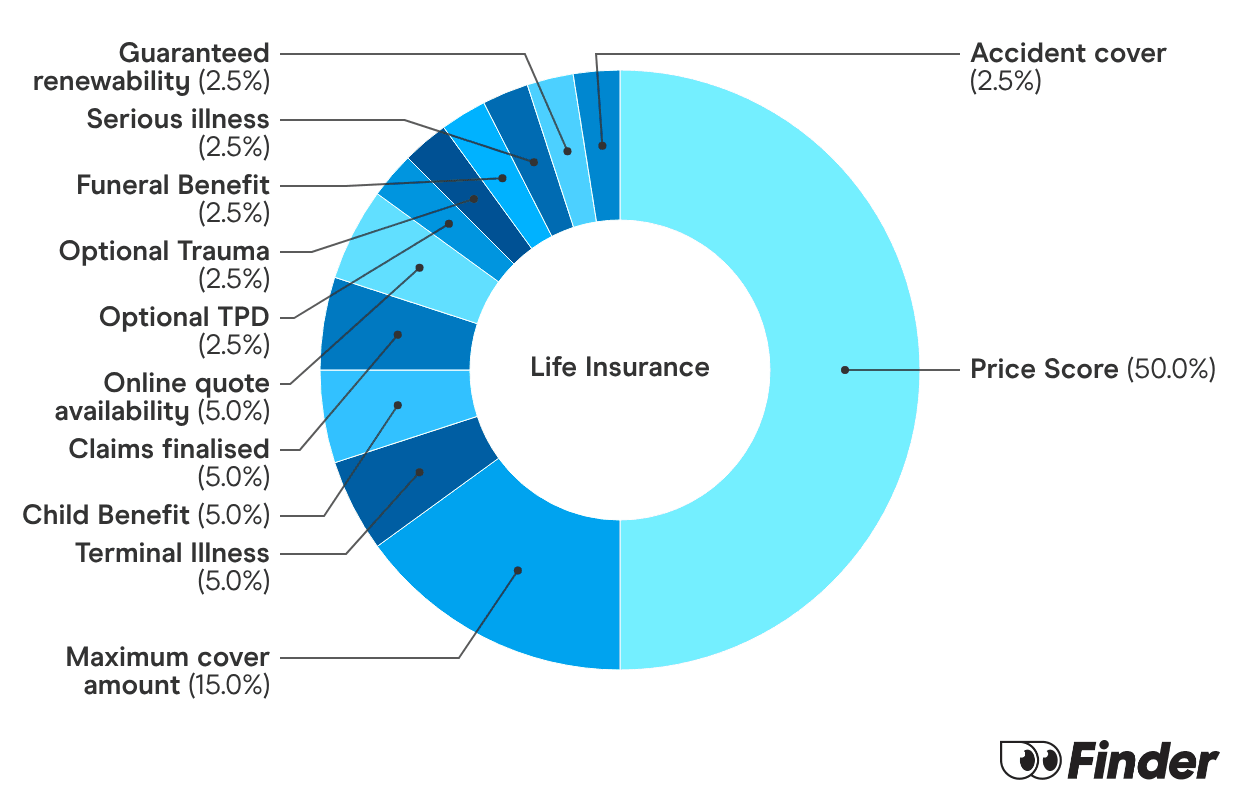
These products offer great value, with a good score across both features and price.
7+
Great
These are competitive products, though they didn't quite get top scores.
5+
Standard
These products might offer less value or command a higher premium than others in the market.
0+
Basic
These products might only offer a basic set of features or aren't very competitive on price.
What is a life insurance beneficiary?
A life insurance beneficiary is the person, or persons, you nominate to receive your life insurance payout when you die.
You choose your beneficiary when you take out a policy (though you can change it further down the line) and you're able to select how much you'd like each person to receive, if you have more than one person you'd like to nominate.
To receive the payout, a life insurance beneficiary must be over the age of 18. If they're under this age when you pass away, it can usually be held with a nominated trustee until they reach 18. This is usually a spouse or family member.
How to change a life insurance beneficiary
Contact your life insurer
Changing life insurance beneficiary or beneficiaries is fairly straightforward for policyholders. Contact your insurer and let them know you'd like to make changes to who receives the payout.
Fill out the necessary documents
Most insurance providers will require you to fill out a change of beneficiary form. You can usually do this online; others will require you to print them out and mail them through to them.
Send to the insurer
Send the updated beneficiary information to your insurer. They should confirm with you when they've received and updated your nominated life insurance beneficiaries.
How are life insurance benefits allocated?
Life insurance benefits can be allocated among your beneficiaries however you wish. Below is an example of how you might allocate your life insurance payout if you had four beneficiaires:
Nominated beneficiary
Allocation
Spouse
40%
Child 1
20%
Child 2
20%
Child 3
20%
How to find out if you're the beneficiary of a life insurance policy
Find and contact the life insurer (if your name appears in the search).
Begin the claims process.
Who gets the life insurance payout if the beneficiary is dead?
Another beneficiary
If a beneficiary you have nominated dies, you should contact your insurer and nominate someone else. Remember, don't assume the benefit will be automatically reallocated if you have other nominated beneficiaries – it might not. You'll need to contact the insurer and do that yourself.
The people in your Will
If you don't nominate another beneficiary, your life insurance payout will go to your estate and be distributed according to your Will, provided you have one in place. If you die without a Will, you leave what is called an "intestacy" which means your payout will be distributed by the state government based on a legal process.
Don't have a will? Here's how to get one
Get a solicitor to write your will
You could seek legal help to get peace of mind your will is valid and has been drawn up properly. Getting a solicitor or lawyer to draft a will on your behalf will be a more expensive option. They can charge anything from a few hundred dollars to more than a thousand bucks. Costs vary depending on your circumstances, including where you live.
Create a will online (and get it checked)
Another option you have is going through an online legal service. This can cost upwards of $200 and may include a basic will service that is reviewed by a legal expert. Alternatively, there are DIY will kits. These can be even cheaper, but you may well want to get these checked by a legal professional to ensure the validity of such an important document.
Is there a difference between life insurance and super beneficiaries?
Yes, if you take out life insurance through super, you need to be aware of the following:
The benefit goes to the trustee first. A superannuation life insurance benefit payment will be paid to the fund trustee, who will then distribute it to the beneficiaries. This can result in delays.
A binding death nomination. This means the super fund trustee must pay your life insurance benefit to the person or persons you nominate as your beneficiary. You need to make a binding death nomination with super or the trustee will distribute the benefit to your dependents as they see fit, which may not necessarily be as you'd like.
Tax may apply Benefit payments may be subject to tax depending on whether the beneficiaries are defined as financially tax dependent or not, whether it is paid as a lump sum or income stream and whether the super is tax-free or taxable, and whether the super fund has already paid tax on the taxable component.
How does policy ownership work?
When you take out a life insurance policy, you'll often have a few different ownership options. This determines who has total control over the policy. For example, the policy owner (or policyholder) can change the beneficiaries on the policy. They're also responsible for paying the premiums.
The most common policy ownership options include:
Ownership type
Overview
Self ownership
The life insured owns their policy.
Cross ownership
Third party ownership where someone else, often your spouse, owns the policy.
You still have some control over your policy, but you won't be able to make any decisions without your partner, who jointly owns the policy.
Super fund ownership
The trustee of your super fund owns the policy. Any changes will need to be processed by the fund.
Tenants-in-common ownership
Where benefits are received by the owner in proportion to their share in the policy. Not offered by many insurers these days.
Business entity ownership
Where the policy is held for a revenue purpose. Here the business can claim a tax deduction for the premium and have the proceeds under its control.
Life insurance beneficiary rules FAQs
You can nominate almost any person or entity as a beneficiary for your life insurance policy. This includes non-family members such as a close friend, a charity, an organisation or a trust. When nominating a trust you typically designate the trustee as the beneficiary who then holds the funds for the benefit of the trust's stated beneficiaries. Ensure you provide clear and accurate details for any non-individual nominations.
The time it takes for a beneficiary to receive a life insurance payout can vary. Once a claim is lodged and all necessary documentation is provided the process can take anywhere from a few weeks to several months. Factors influencing this timeline include the complexity of the claim, the insurer's processing times, whether the claim is contested and the availability of all required documents such as a death certificate proof of identity and the original policy documents.
Yes, a life insurance beneficiary designation can sometimes be contested or challenged. This usually happens when there are disputes among family members, questions about the deceased's mental capacity at the time of nomination or claims of undue influence. If a designation is successfully challenged the payout may be redirected to the deceased's estate to be distributed according to their will or intestacy laws. Having an up-to-date will and clear beneficiary nominations helps minimise the likelihood of such challenges.
If a policyholder becomes mentally incapacitated and has an enduring power of attorney in place their appointed attorney may be able to manage the life insurance policy including changing beneficiaries if the power of attorney document explicitly grants this authority. Without an enduring power of attorney a court may need to appoint a guardian or administrator to manage the incapacitated person's affairs including their life insurance policy. This highlights the importance of comprehensive estate planning well in advance.
No, you generally do not need your beneficiary's consent to nominate or change them on your life insurance policy. The policyholder has the sole right to decide who receives the benefit and can update this information with the insurer at any time without needing approval from the nominated beneficiary. This process ensures your privacy and control over your policy.
Gary Ross Hunter has over 6 years of expertise writing about insurance, including life, health, home, and car insurance. Having reviewed hundreds of product disclosure statements and published over 800 articles, he loves simplifying complex insurance topics for everyday readers. Gary has contributed to major outlets like Yahoo Finance, The Sydney Morning Herald, and news.com.au, and holds a Bachelor of Arts (Honours) in English Literature from the University of Glasgow, along with a Tier 2 General Advice certification, ensuring his work adheres to ASIC’s RG146 standards.
See full bio
Gary Ross's expertise
Gary Ross
has written
554
Finder guides across topics including:
James Martin was the insurance editor at Finder. He has written on a range of insurance and finance topics for over 7 years. James often shares his insurance expertise as a media spokesperson and has appeared on Prime 7 News, Insurance News, 7NEWS and The Guardian. An experienced journalist, James' work has featured in publications including The Irish Times, Companies100 and In Business. He holds a Tier 1 General Insurance (General Advice) certification and a Tier 1 Generic Knowledge certification, both of which meet the requirements of ASIC Regulatory Guide 146 (RG146).
See full bio
James's expertise
James
has written
178
Finder guides across topics including:
Was your life insurance application denied? This article looks at the top reasons why your application might have been denied and what you can do to get the right cover.
finder's guide to choosing between stepped and level insurance premiums.
Important information about this website
Finder is a comparison service. We do not compare every product or every provider in the market.
We make money through commercial arrangements with some of the providers on this site. Products marked 'Sponsored', 'Promoted', 'Featured' or 'Advertisement' appear as a result of a commercial arrangement.
Our editorial content, product reviews and any 'Top Pick' designations are prepared independently of these commercial arrangements.
The default order of products in our tables can be influenced by commercial arrangements. You can re-sort or filter using the controls above each table.
Some content on this site may be generated or supported by AI tools. You should verify details directly with the provider.
Finder is one of Australia's leading comparison websites. We are committed to our readers and stand by our editorial principles.
Our comparison service does not include every product or every provider in the market. Some product issuers offer their products under multiple brands or through associated companies. Where we can, we identify the underlying issuer so you can compare like with like, but you should always check with the provider directly to confirm which brand you are dealing with.
Finder is a comparison website and an intermediary. We are not a product issuer and we do not provide personal financial or credit advice. When you click a link to a product, or apply for a product through our site, you deal directly with the product issuer. We may receive a referral fee, commission or other payment from the issuer if you click through, apply or take out a product. We describe these arrangements in more detail under 'How we make money' below.
Product features, fees, terms and eligibility criteria are set by the product issuer and may change. We rely on information supplied by issuers when we present product details on our site. Before you apply for or take out any product, you should confirm the details directly with the issuer.
We earn revenue from Finder in four principal ways:
Referral fees and commissions. When you click a product link, complete an enquiry form or apply for a product through our site, we may receive a referral fee, commission or other payment from the product issuer. We may also receive payment based on the volume of leads or conversions we send to an issuer.
Sponsored placements. Products marked 'Sponsored', 'Promoted', 'Featured' or 'Advertisement' appear as a result of a commercial arrangement between Finder and the issuer. These labels always indicate a paid placement. We do not use them for editorial choices.
Display advertising. Banner advertising, newsletter advertising and similar display ads on our site are paid by advertisers.
Content sponsorship. Some articles, videos and social media posts are sponsored by an issuer and are clearly labelled as such.
Our editorial opinions, product reviews and any 'Top Pick' designations are prepared independently of these commercial arrangements. A 'Top Pick' is an editorial choice made by our writers and editors based on the criteria described on each comparison page. A 'Top Pick' is not a personal recommendation and does not mean the product is appropriate for your circumstances.
If you would like to know whether we have a commercial arrangement with a specific product issuer, please contact us.
When products are grouped in a table or list, the default order can be influenced by commercial arrangements we have with product issuers. In some categories, sponsored or featured products appear in the top positions of the table by default, and are always labelled as such.
Other factors that influence default order include price, fees and features, and (where relevant) our editorial view of the product.
You can re-sort every comparison table using the controls above the table. You can filter by product features that matter to you. The order you see after re-sorting or filtering is not influenced by commercial arrangements.
Some content on this site is generated or supported by artificial intelligence tools, including our AI-powered assistant FinderBot. AI-generated content may contain errors. Please verify important information directly with the product issuer before making a financial decision. For more information about FinderBot, see the FinderBot Terms of Use and FinderBot Privacy Collection Notice.
Please read our website terms of use and privacy policy for more information about our services and our approach to privacy.
We update our data regularly, but information can change between updates. Confirm details with the provider you're interested in before making a decision.
Our goal is to create the best possible product, and your thoughts, ideas and suggestions play a major role in helping us identify opportunities to improve.







 Get a solicitor to write your will
 Create a will online (and get it checked)