We currently don't have that product, but here are others to consider:
Looking for other options? Check out these similar products.
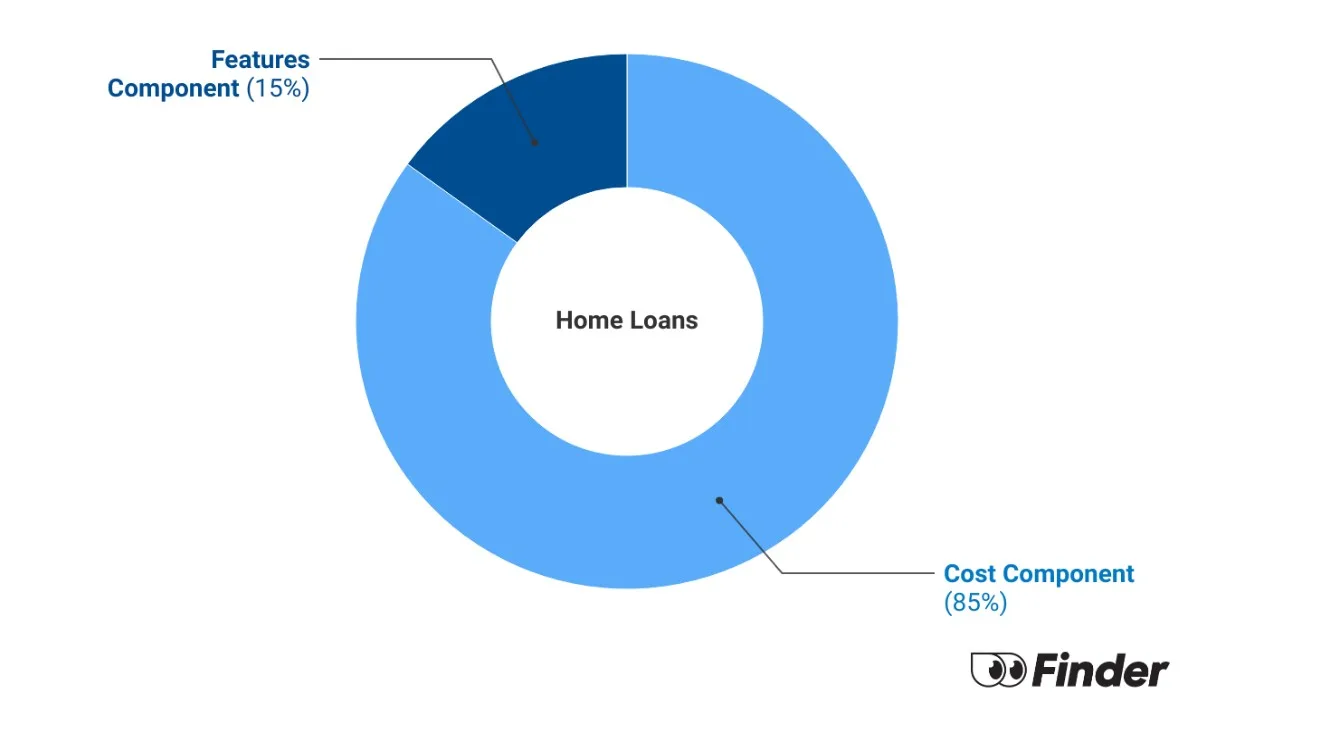
How we picked these
How is a 95% mortgage different to other home loans?
Most home loans require a 20% deposit (80% maximum loan-to-value ratio). But some products have a maximum insured loan-to-value ratio of 90 or even 95%. This means you can forget the 20% deposit and buy your property with a smaller deposit.
The 'insured' LVR means they'll lend 90% or 95% of the property value as long as you have lenders mortgage insurance (LMI).
There are few differences between an 80% mortgage and a 95% mortgage. It could be virtually the same product, even with the same interest rate.
So what's the catch?
There are 2 key differences:
Lenders mortgage insurance. If your deposit is under 20% lenders require you to pay an insurance premium which gives them added protection. Depending on your deposit size and property value, LMI can add thousands of dollars to your mortgage. Use Finder's LMI calculator to estimate your premium.
Stricter lending criteria. A lender will scrutinise your application more closely if your deposit is under 20%. You need to make sure all your mortgage documents and paperwork are in order to maximise your chance of success.
First home buyers opt for low deposits
According to Finder's First Home Buyers Report 2025, 70% of recent and prospective first home buyers have bought or will buy with less than a 20% deposit.
Using the table above you can sort through loans with 95% LVRs and read reviews of the various products and lenders. Look at the fees, flexibility and features the loans come with to get a better idea of which ones work for you.
Lenders will assess high LVR home loan applications much more stringently than those with lower LVRs.
Strengthen your application by:
Getting your bank statements, identification and other documents together.
Demonstrating that you have a long history of savings.
Checking your credit score before applying.
Reducing your spending as much as possible in the 6 months leading up to your application.
Most lenders require your deposit to be 'genuine savings'. This is often defined as money that's been sitting in your account for at least 6 months.
There may be ways around this though:
Parental guarantor. If your parents own a property they can use it as security to guarantee your mortgage. You have the option of saving 5% yourself and getting your parents to guarantee the other 15% of the deposit. This way you can avoid LMI. But some lenders will allow your guarantor to cover the full 20% of the deposit.
First home owners grant (FHOG). If you're eligible for a first home owners grant this can form part of your deposit, making it even easier to get to 5%.
Selling shares or other assets. You can sell off an investment and use the cash as a deposit but you may still need to satisfy the genuine savings rule.
Cash gift or inheritance. If you're fortunate enough to receive a cash gift or inheritance you could use this as your deposit but again, watch out for the genuine savings rule. Some lenders may accept a 10% deposit made of a gift or inheritance, but you need to do your research.
"Make sure that you really look at the credit policy and the criteria to qualify for a 95% loan.
Some banks will look more strictly at a 95% loan-to-value ratio, given that it's aimed at a higher risk loan.
95% LVR loans are absolutely worth it. If you're buying your own home it means you probably stop renting, you're able to get into the market and able to put down roots. I think there's so much to be said for that because as you continue to save, the property market continues to increase in value.
Yes, you pay LMI. Some banks will charge a higher rate based on the fact that it's 95%. Some banks won't. You may consider a fixed rate loan, for example, to keep your payments at a decent interest rate."
Aside from LMI costs and more scrutiny from lenders, getting a mortgage with a 5% deposit means you're borrowing more money and therefore paying more interest. It means your repayments will be higher than if you had a higher deposit. This is why banks assess these applications so much more diligently, because the risk of you being unable to repay is higher,
It also means having less equity in your property, which is potentially risky if your property falls in value and you can't repay your mortgage.
Let's look at both situations.
A smaller deposit means paying more in interest
Getting a loan with such a small deposit inevitably means paying more in interest over time. To get a clearer idea of the difference in interest costs, use our loan repayment calculator and enter your borrowing details. Use the same interest rate and loan term but try entering different loan amounts. The difference in interest you'll pay over the life of the loan can be significant. Here's an example:
Property cost: $600,000
20% deposit = $120,000 (loan amount of $480,000)
Interest rate: 5.50%
Loan term: 30 years
Monthly repayments: $2,726
Total interest payable: $501,140
Property cost: $600,000
5% deposit = $30,000 (loan amount of $570,000)
Interest rate: 5.50%
Loan term: 30 years
Monthly repayments: $3,237
Total interest payable: $595,104
The risk of negative equity
Equity refers to the amount of your property that you actually own. In other words, the value of the property minus the mortgage debt. If you buy a home with a 20% deposit you have 20% equity at the start. As you repay the loan principal (the money you borrowed), your equity increases.
But if property prices fall (as they sometimes do) your equity will decrease. If you'd paid off half your mortgage then you're still in a decent position. But if you've just bought a property with only a 5% deposit then even a small price fall could see you end up in negative equity. Having negative equity makes it much harder to sell your property or refinance your mortgage.
As long as you keep making repayments on the mortgage principal your equity should increase in the long term.
Frequently Asked Questions
Many Australian banks and lenders offer 95% LVR home loans, including major banks like ANZ, CBA, and NAB. However, strict eligibility criteria apply and the amount of LMI payable to secure one of these loans is very high.
LVR stands for Loan-to-Value Ratio. A 95% LVR means the loan amount is 95% of the property's value, and the borrower needs just 5% as a deposit. For instance, on an $800,000 loan, a 95% LVR is a $40,000 deposit and $760,000 loan.
Yes, it is possible to buy a house in Australia with a 5% deposit with a 95% home loan, where the lender finances the remaining 95% of the property value. However, these loans typically require you to pay Lender's Mortgage Insurance (LMI) unless you qualify for a government scheme, like the Australian Government 5% Deposit Scheme.
In Australia, the highest percent mortgage you can typically get is 95% LVR, meaning you need a minimum 5% deposit. Some lenders may offer 100% loans under specific conditions, such as having a guarantor.
Yes, it is possible to buy an investment property with a 5% deposit. Your elgiibilty depends on your personal income and debts, and the type and price of the property.
The Finder Score crunches 7,000 home loans across 120+ lenders. It takes into account the product's interest rate, fees and features, as well as the type of loan eg investor, variable, fixed rate - this gives you a simple score out of 10.
To provide a Score, we compare like-for-like loans. So if you're comparing the best home loans for cashback, you can see how each home loan stacks up against other home loans with the same borrower type, rate type and repayment type. We also take into consideration the amount of cashback offered when calculating the Score so you can tell if it's really worth it.
Richard Whitten is Finder’s Senior Money Editor, with over eight years of experience in home loans, property, credit cards and personal finance. His insights appear in top media outlets like Yahoo Finance, Money Magazine, and the Herald Sun, and he frequently offers expert commentary on television and radio, helping Australians navigate mortgages and property ownership. Richard started his career in education and textbook publishing in South Korea. He holds multiple industry certifications, including a Certificate IV in Mortgage Broking (RG 206) and Tier 1 and Tier 2 certifications (RG 146), as well as a Bachelor of Education from the University of Sydney and a Graduate Certificate in Communications from Deakin University.
See full bio
Richard's expertise
Richard
has written
794
Finder guides across topics including:
If you’re having trouble securing a home loan through traditional means, there are some government programs that might help you achieve your property goals.
Pensioners can have a tough time getting a home loan because each lender treats pension payments differently. Here are some tips you can use to find out whether or not you could get a home loan.
If you haven't sold your house yet, but want to buy your next one before the sale is completed a bridging loan may be able to help. Read on to discover how bridging finance can help.
Low doc home loans allow you to get a mortgage if you're self-employed or don't have regular payslips. check your eligibility and compare competitive offers now.
Important information about this website
Finder is a comparison service. We do not compare every product or every provider in the market.
We make money through commercial arrangements with some of the providers on this site. Products marked 'Sponsored', 'Promoted', 'Featured' or 'Advertisement' appear as a result of a commercial arrangement.
Our editorial content, product reviews and any 'Top Pick' designations are prepared independently of these commercial arrangements.
The default order of products in our tables can be influenced by commercial arrangements. You can re-sort or filter using the controls above each table.
Some content on this site may be generated or supported by AI tools. You should verify details directly with the provider.
Finder is one of Australia's leading comparison websites. We are committed to our readers and stand by our editorial principles.
Our comparison service does not include every product or every provider in the market. Some product issuers offer their products under multiple brands or through associated companies. Where we can, we identify the underlying issuer so you can compare like with like, but you should always check with the provider directly to confirm which brand you are dealing with.
Finder is a comparison website and an intermediary. We are not a product issuer and we do not provide personal financial or credit advice. When you click a link to a product, or apply for a product through our site, you deal directly with the product issuer. We may receive a referral fee, commission or other payment from the issuer if you click through, apply or take out a product. We describe these arrangements in more detail under 'How we make money' below.
Product features, fees, terms and eligibility criteria are set by the product issuer and may change. We rely on information supplied by issuers when we present product details on our site. Before you apply for or take out any product, you should confirm the details directly with the issuer.
We earn revenue from Finder in four principal ways:
Referral fees and commissions. When you click a product link, complete an enquiry form or apply for a product through our site, we may receive a referral fee, commission or other payment from the product issuer. We may also receive payment based on the volume of leads or conversions we send to an issuer.
Sponsored placements. Products marked 'Sponsored', 'Promoted', 'Featured' or 'Advertisement' appear as a result of a commercial arrangement between Finder and the issuer. These labels always indicate a paid placement. We do not use them for editorial choices.
Display advertising. Banner advertising, newsletter advertising and similar display ads on our site are paid by advertisers.
Content sponsorship. Some articles, videos and social media posts are sponsored by an issuer and are clearly labelled as such.
Our editorial opinions, product reviews and any 'Top Pick' designations are prepared independently of these commercial arrangements. A 'Top Pick' is an editorial choice made by our writers and editors based on the criteria described on each comparison page. A 'Top Pick' is not a personal recommendation and does not mean the product is appropriate for your circumstances.
If you would like to know whether we have a commercial arrangement with a specific product issuer, please contact us.
When products are grouped in a table or list, the default order can be influenced by commercial arrangements we have with product issuers. In some categories, sponsored or featured products appear in the top positions of the table by default, and are always labelled as such.
Other factors that influence default order include price, fees and features, and (where relevant) our editorial view of the product.
You can re-sort every comparison table using the controls above the table. You can filter by product features that matter to you. The order you see after re-sorting or filtering is not influenced by commercial arrangements.
Some content on this site is generated or supported by artificial intelligence tools, including our AI-powered assistant FinderBot. AI-generated content may contain errors. Please verify important information directly with the product issuer before making a financial decision. For more information about FinderBot, see the FinderBot Terms of Use and FinderBot Privacy Collection Notice.
Please read our website terms of use and privacy policy for more information about our services and our approach to privacy.
We update our data regularly, but information can change between updates. Confirm details with the provider you're interested in before making a decision.
Our goal is to create the best possible product, and your thoughts, ideas and suggestions play a major role in helping us identify opportunities to improve.