
Comparing home loan interest rates can save you thousands yearly, potentially over $7,000 based on average loans.
Filter for key features like offset or redraw facilities to improve loan flexibility.
Explore Finder Rewards exclusive deals for cashback offers when applying for a new loan.
What is a home loan?
A home loan is the money you borrow to buy a property. You save a deposit first, which is usually 5-20% of the property's value and then you borrow the rest. This is your loan amount or your loan principal.
Your lender charges you interest based on the loan principal amount and your home loan's interest rate. The higher the home loan interest rate, the higher your repayments will be.
How do I compare home loan interest rates?
A good home loan comparison starts with a careful look at interest rates. The lower the rate, the lower your repayments will be.
Let's compare 2 otherwise identical home loans with slightly different interest rates.*
Interest rate
6.92%%
5.69%
Loan amount
$734,878
$734,878
Loan term
30 years
30 years
Monthly repayment
$4,850
$4,261
Monthly saving
N/A
$589
Annual saving
N/A
$7,068
As you can see, with the lower interest rate, you save $589 a month – or $7,068 a year.
*We're using the average owner-occupier home loan size from the ABS, the average variable rate loan in Finder's database of the full market and the lowest variable rate available for refinancers.
Finder's lowest monthly home loan rate tracker
Home loan comparison is hard if you have no clue what a low rate looks like. That's why we analyse all the loans in our database to find the most competitive rates each month.
The graph below shows the market's lowest* fixed and variable rates for home buyers and investors.
*Rates must have LVRs of 80% or higher and exclude unique or unusual loan products that aren't suitable for most borrowers.
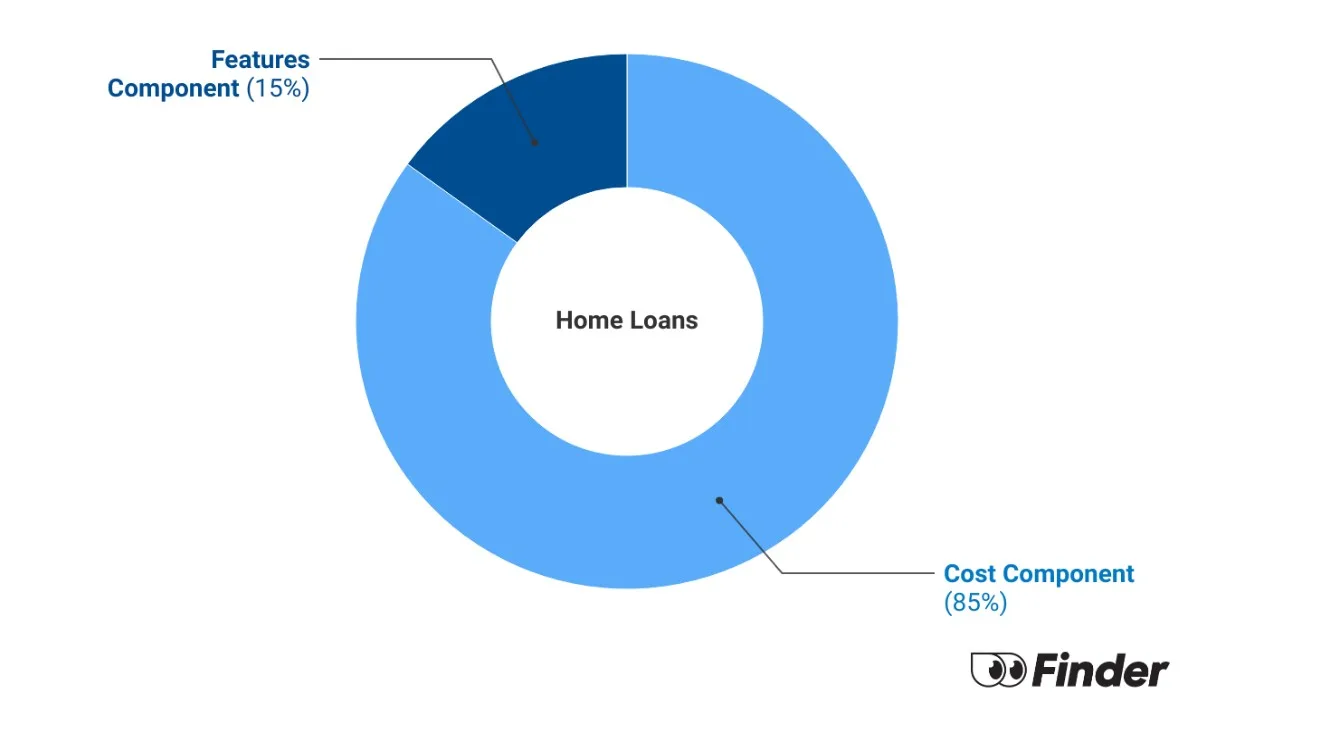
The interest rate is the most important factor you'll want to compare to determine how much your loan will cost you. But fees and features are also really important.
Application fees. This one-off fee can run as high as $600.
Ongoing fees. Some loans come with a monthly or annual fee, usually worth around $120 a year or $10 a month. Package loans have an annual fee of up to $500.
Valuation fees. This covers your lender's cost to have your property professionally valued. It can cost several hundred dollars.
Discharge fees. A discharge fee is only charged when you end a home loan, either by refinancing or paying off the loan.
Comparing home loan features
The following are the most common and useful home loan features:
Offset account. A 100% offset account is a bank account attached to your home loan. Functioning like any other bank account, any money held in the account reduces the amount of the loan you're charged interest on. It's not available with every loan, such as fixed rate and basic loans. Many offset loans attract a monthly or annual fee, or a higher rate.
Extra repayments. If your loan allows you to make extra repayments, you can pay it off faster. This will save you in interest charges. These days, most variable rate loans allow extra repayments, although some fixed rate loans don't.
Redraw facility. A redraw facility is common on home loans that allow extra repayments. A redraw allows you to withdraw extra repayments from your loan and spend them if you need to. Some lenders charge a redraw fee or restrict how much money you can access.
Split facility. Some loans allow you to split your mortgage into both fixed and variable portions. This lets you create a flexible loan that offers the benefits of both a fixed and variable rate.
Look at a home loan's comparison rate
The comparison rate is designed to help borrowers understand the true cost of a loan by adding in fee costs over time. But it's only a hypothetical calculation based on a specific loan amount and term. It's not that useful because every borrower's situation is unique.
You're better off working out how much your loan will cost you every month and factoring in the cost of fees on top of that.
Our expert says
"I've switched my home loan 6 times in the last 10 years. Each year, I'll search and compare for a better deal. My thinking is, why spend more on my home loan than I need to? Whether you're getting your first loan or your fifth, it's not as hard as you might think. Be clear on the features you want (like offset or redraw), and look at both the fees and the interest rate to work out the best deal for you."
Home loan comparison is just one step. Once you've found a suitable home loan it's time to apply.
Get your information ready. Your lender needs to see some ID, check your credit score, examine recent pay slips (or view your transaction history online). They'll need your property address too.
Complete the mortgage application. Some lenders make this a fast, easy online process. Some may still require some actual paperwork and take a week or more to process your application.
Wait for approval. The lender may have some follow-up questions. You may need to supply more documents or information.
Get ready for settlement today. Once your loan's approved you wait for settlement day. This is when the money changes hands and you get the keys (if you're refinancing there's no keys, but there's still settlement between your old lender and your new one).
Home loan pre-approval
Some lenders will give you a pretty good indication of how much you borrow before you've even found a house to buy. This is called pre-approval or conditional approval. It lets you house hunt with confidence and shows you're a serious buyer (which can be very helpful at auction).
Alternatively, let a broker help
At Finder we're big believers in DIY comparison. You can get a better rate than a mortgage broker with a little search.
But brokers don't just help you compare home loans, they also guide you through the application process at every step. Brokers also have a good sense of specific lenders' eligibility criteria, which increases your chances of getting a loan approved.
Home loan rates on hold, for now
The Reserve Bank of Australia kept rates on hold again this month. But inflation remains high, and there's a strong chance the RBA board will raise rates again later in the year. 44% of the experts Finder surveyed in August predict another rate rise by December.
This would take interest rates to levels not seen since 2011. And it would likely continue to push house prices down. But another rate hike would put serious pressure on borrowers. According to Finder's 2026 Home Loan Report, 55% of Australian borrowers are currently spending more than 30% of their income on home loan repayments. That's the traditional definition of mortgage stress.
Updated by Finder's money editor, Richard Whitten in August 2026.
Finder's home loans awards celebrate stand-out home loan products across 15 different categories. Our experts analysed 12 months' worth of interest rate and fee data to find the best solutions for any borrower type. Our team of experts reviewed over 7,490 home loan rates from across 100+ lenders to select our Finder Home Loans Awards winners for 2026.
Variable rates can change at any time, but it's easier (and fewer fees apply) to switch to a new loan or make extra repayments.
Fixed rates don't change but are often slightly higher and less flexible (harder to exit the loan or make extra repayments).
Most borrowers choose home loans with principal-and-interest repayments. This means you borrow the money (principal) and pay it back each month, plus interest on top.
There is another option, which is interest-only repayments. This type of home loan starts out cheaper because you don't pay any principal at the start. You just pay the interest charge on top. But later, you'll have to pay the principal back and you'll end up paying more.
To the ordinary person looking to buy a property, there's usually no actual difference between the words "mortgage" and "home loan". They are used interchangeably to mean the money you borrow to buy a property.
However, if you want to get very technical, a home loan refers to the money you borrow. The mortgage is a legal document that ties you and your property to the lender. In the event you cannot repay the home loan, the mortgage acts as the lender's security and gives it the right to sell your home to recover your debt.
Home loan approval times vary from lender to lender and also depend on how complex your borrowing situation is.
A lender may be understaffed or very busy when you apply, and an approval might take several weeks. Some online lenders have developed faster digital approvals that allow them to process an application in a matter of days. A big bank may take weeks to approve a loan.
If you have all your loan paperwork, financial information and identity documents organised, the approval process might be faster.
If you're finding it too hard or confusing to compare home loans, a mortgage broker can help. Brokers are qualified professionals who compare home loans for you. They don't compare every loan on the market, but they have access to a panel of up to 30 lenders – and sometimes more.
It's tough to definitively state what the cut-off point is for getting home loan approval, as banks and lenders consider their own internal credit assessments along with your score when reviewing your application.
However, credit score providers like Experian do have benchmarks that can be useful in getting an idea of how likely you are to be approved for a home loan. Below is a guide of how your credit score could influence your home loan approval odds with Experian, who run their credit scores between 0 and 1000. The higher the number, the better your credit score is.
Excellent: A score between 800-1,000 is considered Excellent. This means the bank view you as being extremely low risk of defaulting on your loan. If your score is in this range, home loan approval is likely. Very Good: A score from 700-799 is considered Very Good and puts you in the second-top tier of creditworthiness. Most lenders would look very favourably on your application. Good: A score from 625-699 is classified as Good. This still puts you in good standing and the bank views the likelihood of an "adverse event" occurring on your credit file in the next 12 months to be low. Fair: A score from 550-624 puts you in the Fair category. This means you're more likely to suffer an adverse event on your credit file in the next 12 months, so lenders may apply additional loan criteria or charge you a higher rate. Weak: Any score below 549 puts you in the Weak category. Lenders consider the likelihood of an adverse credit event high. You may have trouble obtaining finance from traditional lenders.
There are many lenders in the Australian mortgage market. Most of them are regulated as banks, and all of them must follow the National Credit Code.
The Big Four banks. The Big Four are the dominant players across Australian banking. Most customers stick with Commonwealth Bank, NAB, Westpac or ANZ. They all offer banking apps, large customer service teams, extensive branch and ATM coverage, and lots of mortgages to choose from. You won't get the absolute lowest rates with the Big Four, but they are always competitive.
Other banks. There's more to mortgages than the biggest players, of course. There are state and regional banks as well as nationwide operators and local arms of international banks like ING and Citibank.
Digital banks, fintechs, neo-banks and online lenders. There are lenders that do business entirely online (with phone support). Lenders such as loans.com.au, Tiimely Home and UBank are examples of online lenders with competitive rates. Some newer players in the market include neobank or fintech lender like Athena, which use apps and big data to offer customers a convenient online mortgage experience.
Banks, credit unions, building societies and online lenders are supervised by the Australian Prudential Regulation Authority (APRA) as authorised deposit-taking institutions (ADIs).
Lenders are also subject to the National Credit Code, which is administered by the Australian Securities and Investments Commission (ASIC) under the National Consumer Credit Protection Act (2009).
Some smaller lenders may not be treated as ADIs. The main drawback here is that if you have money saved with the lender (in a savings account or offset), you might not be covered by the bank guarantee if the lender goes bust.
The loan-to-value ratio (LVR) is another way of defining the minimum deposit you have to save. Banks prefer a maximum LVR of 80%, meaning you need a 20% deposit. Many loans also have a maximum insured LVR of up to 95%. This means that you can get the loan with a smaller deposit, but you will need to pay lenders mortgage insurance (LMI) if your deposit is under 20%. Some professions enable higher LVRs without the need for LMI. Typically these professions include doctors, lawyers and accountants, and more recently police officers, nurses and other university trained occupations, but different banks have different policies in relation to this benefit.
Although you possibly can get a home loan while on maternity leave, lenders may see you as a riskier borrower because your income is reduced. This means you would not be able to borrow as much as you would on a full income.
There are a few things you could do to improve your chances of being approved:
Get documention from your employer detailing the terms of your maternity leave, such as the dates and your salary upon your return.
Save at least a 20% deposit.
Set a realistic budget and loan amount.
Talk to multiple lenders before applying. Too many rejected applications will look bad on your credit report, so be sure you get the answers before you apply.
Consider talking to a mortgage broker.
If you want to increase an existing home loan, you may be able to do this while on maternity leave. The increase would need to be a reasonable amount with a lender who will accept you and you can prove that you can afford it.
The vast majority of Australian borrowers get home loans with 30-year loan terms. This is the maximum amount most lenders allow. But it is possible to get a loan with a longer term of 40 years. A 40-year home loan is otherwise identical to other home loans: You borrow money and pay it back with interest charged on top.
The difference is the time involved and the amount of interest you pay. The main benefit for borrowers who take out 40-year loans is that they pay reduced ongoing repayments, as the debt is structured over a longer time period. The main drawback is that because they have their loan for longer, they end up paying a higher amount of interest in total.
It's a really good idea to talk to a mortgage broker before committing to a 40-year home loan.
What is the Finder Score?
Finder Score is an easy, data-driven way to judge home loans at a glance. Our insights team compares more than 7,000 home loan variants across 120+ lenders to give each product a score out of 10 comparative to other products of its type.
This means we compare home loan products against others of its type. For example, variable rate home loans against variable rate home loans, and investor home loans against investor home loans. In total, there are 12 different product groupings.
Variable Rate Owner Occupier, Principal and Interest
Variable Rate Owner Occupier, Interest Only
Variable Rate Investor, Principal and Interest
Variable Rate Investor, Interest Only
Fixed Rate Owner Occupier, Principal and Interest, Short Term
Fixed Rate Owner Occupier,Principal and Interest, Long Term
Fixed Rate Investor, Principal and Interest, Short Term
Fixed Rate Investor, Principal and Interest, Long Term
Fixed Rate Owner Occupier, Interest Only, Short Term
Fixed Rate Owner Occupier, Interest Only, Long Term
Fixed Rate Investor, Interest Only, Short Term
Fixed Rate Investor, Interest Only, Long Term
We filter the loans in our database for each category so that we're only looking at loans that work for the borrower type. The final Finder Score takes into account the home loan's interest rate, its major fees and the presence of useful features like offset accounts.
The higher the score, the lower the cost compared to other products of its type.
What the Finder Score mean for home loans
9+ Excellent - These are the home loans which offer the lowest costs coupled with plenty of features, giving the best overall value.
7+ Great - These home loans may have slightly higher interest rates, maybe a fee or two, or fewer features, but overall, a competitive offering.
5+ Satisfactory - Usually these home loans would offer above average rates and may still include some competitive features, but they're not the best value for the overall cost.
Less than 5 - Basic - These home loans have higher costs and/or fewer features than other home loans on the market.
Sarah is the author of How to Raise Rich Kids. With over 20 years of experience in property, finance and investment journalism, she is a trusted expert whose insights regularly appear across television, radio and print media, including Sunrise, Channel 7 News, Bloomberg and Yahoo! Finance. She has previously served as managing editor for Your Investment Property and Australian Broker. Her expert advice has been shared in the media over 4,000 times. Sarah holds a Bachelor’s degree in Communications and a Tier 1 Generic Knowledge certification, which complies with ASIC standards.
See full bio
Sarah's expertise
Sarah
has written
248
Finder guides across topics including:
I’m not sure what kind of help you need? You might be eligible for a no-interest loan through Good Shepherd, worth up to $3,000. Otherwise, you can search our site for other opportunities to access lending.
Hope this helps!
SusanMarch 13, 2023
I have a current mortgage with Bendigo Bank on fixed interest rate of 2.090% which expires in July.
I want to know my options when it expires.
Small mortgage which is due to be paid off in 2029.
None of your options seem to include this issue.
Can I speak with someone?
Finder
SarahMarch 13, 2023Finder
Hi Susan,
You have a couple of options. You could:
– Stick with Bendigo Bank and either roll over onto a variable rate loan option in July, or choose another fixed rate home loan.
– Refinance to a different bank, and choose either a fixed or variable rate.
Your eligibility to refinance depends on a number of things, including your age, income and loan amount. As a first step, it might be worth contacting your bank so they can let you know what their current rates and offers are, so you have an idea of what your repayments will be from July onwards. You can then compare this to other options in the mortgage market to see if you can get a better deal elsewhere.
Hope this helps!
ChrisApril 21, 2022
Useless tool – no way to select weekly payments.
Finder
SarahMay 2, 2022Finder
Hi Chris,
We appreciate your feedback.
Our tables contain quite a bit of information in them. In the interests of brevity, we currently allow you to compare home loans by monthly payments. If you’d like to know the estimated weekly payments, you can divide these estimates by 4.3. For instance, if the monthly estimate was $3,000, once you divide it by 4.3, the weekly amount would be $697.67.
Hope this helps, and thanks again for the feedback – we’ll explore whether this functionality can be added.
Many thanks
Sarah
MichaelDecember 18, 2021
I’d like speak to someone about refinancing a please?
Finder
RichardDecember 22, 2021Finder
Hi Michael,
If you already have a preferred lender, you can visit their website to submit an application and/or request to speak with their home finance representative.
Alternatively, you can speak with a professional mortgage broker to get personalised advice. You can call one of the mortgage brokers found on our page to schedule an appointment or search for a mortgage broker in your area on Google.
I hope this helps!
Richard
JDMAugust 12, 2019
I am an Australian citizen returning to Australia after several years abroad. I will be entering into employment with the Australian branch of my existing employer with a new employment contract (but without a probation period). Can you advise limits to home loan borrowing upon arrival. e.g. is their a qualifying period for work/residence in Australia for lenders?
NikkiAugust 13, 2019
Hi JDM,
Thanks for your question!
All Australian citizens are eligible to apply for a home loan. This is one of the basic requirements. Others include age, income, and other unique requirements of the lender.
As a friendly reminder, carefully review the eligibility criteria of the loan before applying to increase your chances of approval. Read up on the terms and conditions and product disclosure statement and contact the bank should you need any clarifications about the policy.
A mortgage broker is the best person to reach out to see your options for home loans. They can give you a multitude of options according to your situation. In the meantime, to give you an estimate of your monthly repayments, you can use our home loan eligibility calculator.
Hope this helped. Feel free to reach back out for further assistance.
Finder is a comparison service. We do not compare every product or every provider in the market.
We make money through commercial arrangements with some of the providers on this site. Products marked 'Sponsored', 'Promoted', 'Featured' or 'Advertisement' appear as a result of a commercial arrangement.
Our editorial content, product reviews and any 'Top Pick' designations are prepared independently of these commercial arrangements.
The default order of products in our tables can be influenced by commercial arrangements. You can re-sort or filter using the controls above each table.
Some content on this site may be generated or supported by AI tools. You should verify details directly with the provider.
Finder is one of Australia's leading comparison websites. We are committed to our readers and stand by our editorial principles.
Our comparison service does not include every product or every provider in the market. Some product issuers offer their products under multiple brands or through associated companies. Where we can, we identify the underlying issuer so you can compare like with like, but you should always check with the provider directly to confirm which brand you are dealing with.
Finder is a comparison website and an intermediary. We are not a product issuer and we do not provide personal financial or credit advice. When you click a link to a product, or apply for a product through our site, you deal directly with the product issuer. We may receive a referral fee, commission or other payment from the issuer if you click through, apply or take out a product. We describe these arrangements in more detail under 'How we make money' below.
Product features, fees, terms and eligibility criteria are set by the product issuer and may change. We rely on information supplied by issuers when we present product details on our site. Before you apply for or take out any product, you should confirm the details directly with the issuer.
We earn revenue from Finder in four principal ways:
Referral fees and commissions. When you click a product link, complete an enquiry form or apply for a product through our site, we may receive a referral fee, commission or other payment from the product issuer. We may also receive payment based on the volume of leads or conversions we send to an issuer.
Sponsored placements. Products marked 'Sponsored', 'Promoted', 'Featured' or 'Advertisement' appear as a result of a commercial arrangement between Finder and the issuer. These labels always indicate a paid placement. We do not use them for editorial choices.
Display advertising. Banner advertising, newsletter advertising and similar display ads on our site are paid by advertisers.
Content sponsorship. Some articles, videos and social media posts are sponsored by an issuer and are clearly labelled as such.
Our editorial opinions, product reviews and any 'Top Pick' designations are prepared independently of these commercial arrangements. A 'Top Pick' is an editorial choice made by our writers and editors based on the criteria described on each comparison page. A 'Top Pick' is not a personal recommendation and does not mean the product is appropriate for your circumstances.
If you would like to know whether we have a commercial arrangement with a specific product issuer, please contact us.
When products are grouped in a table or list, the default order can be influenced by commercial arrangements we have with product issuers. In some categories, sponsored or featured products appear in the top positions of the table by default, and are always labelled as such.
Other factors that influence default order include price, fees and features, and (where relevant) our editorial view of the product.
You can re-sort every comparison table using the controls above the table. You can filter by product features that matter to you. The order you see after re-sorting or filtering is not influenced by commercial arrangements.
Some content on this site is generated or supported by artificial intelligence tools, including our AI-powered assistant FinderBot. AI-generated content may contain errors. Please verify important information directly with the product issuer before making a financial decision. For more information about FinderBot, see the FinderBot Terms of Use and FinderBot Privacy Collection Notice.
Please read our website terms of use and privacy policy for more information about our services and our approach to privacy.
We update our data regularly, but information can change between updates. Confirm details with the provider you're interested in before making a decision.
Our goal is to create the best possible product, and your thoughts, ideas and suggestions play a major role in helping us identify opportunities to improve.
i need help.
Hi there,
I’m not sure what kind of help you need? You might be eligible for a no-interest loan through Good Shepherd, worth up to $3,000. Otherwise, you can search our site for other opportunities to access lending.
Hope this helps!
I have a current mortgage with Bendigo Bank on fixed interest rate of 2.090% which expires in July.
I want to know my options when it expires.
Small mortgage which is due to be paid off in 2029.
None of your options seem to include this issue.
Can I speak with someone?
Hi Susan,
You have a couple of options. You could:
– Stick with Bendigo Bank and either roll over onto a variable rate loan option in July, or choose another fixed rate home loan.
– Refinance to a different bank, and choose either a fixed or variable rate.
Your eligibility to refinance depends on a number of things, including your age, income and loan amount. As a first step, it might be worth contacting your bank so they can let you know what their current rates and offers are, so you have an idea of what your repayments will be from July onwards. You can then compare this to other options in the mortgage market to see if you can get a better deal elsewhere.
Hope this helps!
Useless tool – no way to select weekly payments.
Hi Chris,
We appreciate your feedback.
Our tables contain quite a bit of information in them. In the interests of brevity, we currently allow you to compare home loans by monthly payments. If you’d like to know the estimated weekly payments, you can divide these estimates by 4.3. For instance, if the monthly estimate was $3,000, once you divide it by 4.3, the weekly amount would be $697.67.
Hope this helps, and thanks again for the feedback – we’ll explore whether this functionality can be added.
Many thanks
Sarah
I’d like speak to someone about refinancing a please?
Hi Michael,
If you already have a preferred lender, you can visit their website to submit an application and/or request to speak with their home finance representative.
Alternatively, you can speak with a professional mortgage broker to get personalised advice. You can call one of the mortgage brokers found on our page to schedule an appointment or search for a mortgage broker in your area on Google.
I hope this helps!
Richard
I am an Australian citizen returning to Australia after several years abroad. I will be entering into employment with the Australian branch of my existing employer with a new employment contract (but without a probation period). Can you advise limits to home loan borrowing upon arrival. e.g. is their a qualifying period for work/residence in Australia for lenders?
Hi JDM,
Thanks for your question!
All Australian citizens are eligible to apply for a home loan. This is one of the basic requirements. Others include age, income, and other unique requirements of the lender.
As a friendly reminder, carefully review the eligibility criteria of the loan before applying to increase your chances of approval. Read up on the terms and conditions and product disclosure statement and contact the bank should you need any clarifications about the policy.
A mortgage broker is the best person to reach out to see your options for home loans. They can give you a multitude of options according to your situation. In the meantime, to give you an estimate of your monthly repayments, you can use our home loan eligibility calculator.
Hope this helped. Feel free to reach back out for further assistance.
Cheers,
Nikki