We currently don't have that product, but here are others to consider:
Looking for other options? Check out these similar products.
How we picked these
How the Finder Score helps you find a better broadband plan
We designed the Finder Score to simplify your search for the best NBN and Home Wireless plans. By analysing hundreds of options from 40+ providers, we evaluate pricing, speeds, data allowances and plan features. Each factor is weighted and combined to generate a score out of 10 — helping you quickly spot the most competitive plans on the market. Read the full breakdown.
FTTP is probably the best internet tech in Australia right now.
It can get wicked fast with speeds up to 2,000Mbps. Probably faster than you could ever need.
If your place is not connected to FTTP, fear not - NBN Co is still upgrading the network and your household might be on the list.
What is FTTP?
Fibre to the Premises (FTTP) refers to an NBN connection type where high-speed fibre optic cables run directly to your home. FTTP is sometimes also referred to as FTTH – Fibre to the Home.
Because FTTP connections don't require a mix of new and old internet technologies, it's considered the fastest and most reliable NBN connection around.
This is unlike Fibre to the Node (FTTN) connections, which use a mix of fibre optic cables and old copper phone lines and is considered one of the poorer connection types.
Can I get an FTTP connection?
The technology used to connect a property to the NBN is determined by NBN Co and isn't a choice. This means that if FTTP hasn't been chosen for your property, you won't have it as a connection.
If you're not sure what NBN connection type you have access to, simply input your address in the field below and we'll show you the NBN plans available for your home.
NBN Co enabled around 3.5 million FTTN premises to upgrade to full fibre by the end of 2025, and is upgrading the remaining 622,000 or so FTTN premises by 2030. Across the wider upgrade program, more than 10 million premises (around 90% of the fixed line network) can access the fastest NBN speeds.
You can check your household's eligibility by popping in your address on NBN's website. If you're eligible and your property is ready, the upgrade will be triggered when you sign up for an NBN 100 plan or above.
If you're not eligible for a free upgrade and are willing to pay the price, the NBN Technology Choice program can help you make it happen.
It's only available to certain single premises and costs can vary from premise to premise. You can expect to pay at least $10,000.
It can also take up to 6 months to connect to FTTP. You can get a quote online and apply if NBN deems your address eligible.
The average cost of a month-to-month NBN 100 plan on Finder is around $81 a month as of September 2026. The good news is that plenty of providers tend to offer sign-up deals, so it's easy to avoid paying full price from the get-go.
What FTTP speed can I get?
FTTP connections are capable of reaching the fastest speeds available on an NBN connection, all the way up to 2,000Mbps, which is the NBN 2000 speed tier.
In theory, fibre optic cables can reach even higher speeds, but commercial and technical limitations mean that 2,000Mbps (which is 2Gbps) is the fastest NBN speed available in Australia.
As with any fixed-line internet, your connection might slow down during busy periods, especially between 7pm and 11pm.
How do you set up NBN FTTP?
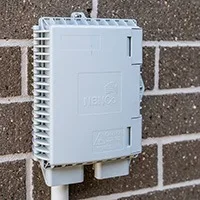
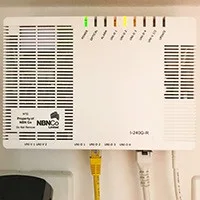
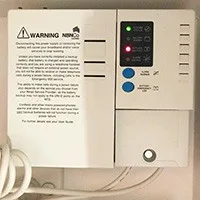
Fortunately, you don't need to do much of anything, since the installation is handled by an NBN technician. You or someone else may need to be home to give them access as they install the following:
NBN utility box
(installed outside)
NBN connection box
(can be installed either inside or outside)
NBN backup battery
(installed inside)
The only thing you need to do is hook up a modem, which can be purchased separately or from your internet provider. Plug the modem into one of the NBN connection box's yellow UNI-D ports with the included ethernet cable. You can see this in the above image of the NBN connection box, where the ethernet cable has been plugged into the UNI-D 2 port.
How much does it cost to get an FTTP supported NBN plan?
An FTTP plan will cost you the same as any other NBN plan. Fixed-line plan costs don't change based on your connection type (only satellite and fixed wireless NBN plans are priced a little differently). Here's a look at the costs involved:
Installation: Assuming your address is eligible for FTTP to begin with, this is free. Technicians from NBN and your provider will do whatever installation work is required at no cost.
Plan: Your internet plan will be the main thing you have to pay for. Prices start from $43 a month and go up from there, depending on what speed you're after. The faster the speeds, the more you'll pay per month.
Modem: Some providers will include this with their plan, or you can choose to purchase it separately. While the average modem price in our database is $185, costs can vary widely by provider, so shopping around is the best way to find a good deal.
Additional charges: If your home is part of a greenfield development, you may be subject to a $300 NBN installation fee as part of the End User Contribution Charge.
How does FTTP compare to other NBN connection types?
Fibre to the Premises is widely considered to be the best NBN connection you can get. Here's how it compares to other technologies:
FTTP vs FTTN: Fibre to the Node (FTTN) is actually considered the worst fixed-line connection type in Australia, making it the polar opposite of an FTTP connection. FTTP runs fibre optic cables directly to your house from the wider NBN network. On FTTN, your house is connected to a telephone exchange by older copper cables, so the signal gets significantly worse the further you are from the node. Some FTTN customers aren't even lucky enough to hit 100Mbps.
FTTP vs FTTC: Where fibre optic cables are run straight to your home with FTTP, Fibre to the Curb (FTTC) technology connects to a distribution point just outside. From there, fibre optic cables link to the NBN, while older copper cables complete the connection to your home.
FTTP vs HFC: Hybrid Fibre Coaxial (HFC) uses "pay TV" coaxial cables to connect you to the greater fibre network. While this isn't as bad as the old copper cables, FTTP's fibre optic cables are overall better.
FTTP vs FTTB: A Fibre to the Basement/Building (FTTB) connection uses fibre optic cables to reach the building's basement, while individual apartments are connected via different types of cables, often including copper. FTTP beats FTTB since it's a full fibre optic connection with no other cabling as part of its set-up.
"I didn't realise what a difference an FTTP connection meant until I moved apartments onto an HFC connection. My FTTP connection had a much more reliable connection to handle faster NBN speeds thanks to its full fibre build."
FTTP is the good stuff - it's fibre optic cables that bring super fast internet straight to your place, like right into your living room. No more dealing with old copper wires or wireless issues, just lightning-fast speeds.
Some good options for FTTP are TPG, Superloop, Exetel, and More, but there are a tonne on the market. They all have their pros - you just gotta decide what's most important, like speed, price, customer service, or flexible plans. Read out top NBN providers page for more.
Yeah, FTTP is way faster than other NBN options like FTTN (to the node) and FTTC (to the curb). FTTP can hit gigabit speeds, while the others max out at 100 Mbps. But the actual speed you get depends on your plan and provider.
FTTP is probably more reliable and consistent than 5G home wireless, which can be affected by distance and obstacles. But if FTTP isn't available in your area yet, 5G wireless is still a pretty sweet option.
For FTTP, you'll need an NBN box installed by their techs. It connects to your home network via Ethernet. Then you just plug in a router to that box to get WiFi and Ethernet ports for all your devices.
NBN might cover the cost of upgrading to FTTP if you're eligible. But if your place is tricky or needs extra work, there might be some charges. Check with NBN or your provider to see what's up.
Mariam Gabaji is a journalist with 13 years of experience, specialising in consumer topics like mobile services and energy costs. Her work appears in the ABC, Yahoo Finance, 9News, The Guardian, SBS, 7News, A Current Affair and Money Magazine. Mariam holds a Bachelor of Arts in Journalism and was a finalist for the 2024 and 2025 IT Journalism Award for Best Telecommunications Journalist.
See full bio
Mariam's expertise
Mariam
has written
621
Finder guides across topics including:
Hey b2, thanks so much for your feedback! We’re always working to improve the user experience, and we’ll definitely take your thoughts on board to help with that 😊
JohnApril 8, 2016
How do I find out if the recent NBN connection to my home is FTTP or FTTN?
BrodieApril 12, 2016
Hi John,
Easy. Enter your full address into our NBN Rollout Tracker to see if the NBN is available and compare plans instantly. This will also let you know what technology is available at your address.
Thanks,
Brodie
PaddoMay 8, 2017
Does “fixed line” mean FTTP or FTTN?
AnndyMay 9, 2017
Hi Paddo,
Thanks for your question.
All types of nbn network connections that use a physical line running to the premises are considered to be fixed line connections which include FTTP, FTTN and FTTB. The difference between each type of connection has to do with how your existing network technology will be used in connecting you to the nearest available fibre node to your specific premises.
Living in rural or regional Australia and need fast Internet? NBN fixed wireless uses radio signals to get you online.
Important information about this website
Finder is a comparison service. We do not compare every product or every provider in the market.
We make money through commercial arrangements with some of the providers on this site. Products marked 'Sponsored', 'Promoted', 'Featured' or 'Advertisement' appear as a result of a commercial arrangement.
Our editorial content, product reviews and any 'Top Pick' designations are prepared independently of these commercial arrangements.
The default order of products in our tables can be influenced by commercial arrangements. You can re-sort or filter using the controls above each table.
Some content on this site may be generated or supported by AI tools. You should verify details directly with the provider.
Finder is one of Australia's leading comparison websites. We are committed to our readers and stand by our editorial principles.
Our comparison service does not include every product or every provider in the market. Some product issuers offer their products under multiple brands or through associated companies. Where we can, we identify the underlying issuer so you can compare like with like, but you should always check with the provider directly to confirm which brand you are dealing with.
Finder is a comparison website and an intermediary. We are not a product issuer and we do not provide personal financial or credit advice. When you click a link to a product, or apply for a product through our site, you deal directly with the product issuer. We may receive a referral fee, commission or other payment from the issuer if you click through, apply or take out a product. We describe these arrangements in more detail under 'How we make money' below.
Product features, fees, terms and eligibility criteria are set by the product issuer and may change. We rely on information supplied by issuers when we present product details on our site. Before you apply for or take out any product, you should confirm the details directly with the issuer.
We earn revenue from Finder in four principal ways:
Referral fees and commissions. When you click a product link, complete an enquiry form or apply for a product through our site, we may receive a referral fee, commission or other payment from the product issuer. We may also receive payment based on the volume of leads or conversions we send to an issuer.
Sponsored placements. Products marked 'Sponsored', 'Promoted', 'Featured' or 'Advertisement' appear as a result of a commercial arrangement between Finder and the issuer. These labels always indicate a paid placement. We do not use them for editorial choices.
Display advertising. Banner advertising, newsletter advertising and similar display ads on our site are paid by advertisers.
Content sponsorship. Some articles, videos and social media posts are sponsored by an issuer and are clearly labelled as such.
Our editorial opinions, product reviews and any 'Top Pick' designations are prepared independently of these commercial arrangements. A 'Top Pick' is an editorial choice made by our writers and editors based on the criteria described on each comparison page. A 'Top Pick' is not a personal recommendation and does not mean the product is appropriate for your circumstances.
If you would like to know whether we have a commercial arrangement with a specific product issuer, please contact us.
When products are grouped in a table or list, the default order can be influenced by commercial arrangements we have with product issuers. In some categories, sponsored or featured products appear in the top positions of the table by default, and are always labelled as such.
Other factors that influence default order include price, fees and features, and (where relevant) our editorial view of the product.
You can re-sort every comparison table using the controls above the table. You can filter by product features that matter to you. The order you see after re-sorting or filtering is not influenced by commercial arrangements.
Some content on this site is generated or supported by artificial intelligence tools, including our AI-powered assistant FinderBot. AI-generated content may contain errors. Please verify important information directly with the product issuer before making a financial decision. For more information about FinderBot, see the FinderBot Terms of Use and FinderBot Privacy Collection Notice.
Please read our website terms of use and privacy policy for more information about our services and our approach to privacy.
We update our data regularly, but information can change between updates. Confirm details with the provider you're interested in before making a decision.



can we sort without the honeymoon rates please.
Hey b2, thanks so much for your feedback! We’re always working to improve the user experience, and we’ll definitely take your thoughts on board to help with that 😊
How do I find out if the recent NBN connection to my home is FTTP or FTTN?
Hi John,
Easy. Enter your full address into our NBN Rollout Tracker to see if the NBN is available and compare plans instantly. This will also let you know what technology is available at your address.
Thanks,
Brodie
Does “fixed line” mean FTTP or FTTN?
Hi Paddo,
Thanks for your question.
All types of nbn network connections that use a physical line running to the premises are considered to be fixed line connections which include FTTP, FTTN and FTTB. The difference between each type of connection has to do with how your existing network technology will be used in connecting you to the nearest available fibre node to your specific premises.
Cheers,
Anndy