
Personal Accident
- Only covers accidental injuries
- Comes with a maximum benefit period of 5 years
- Can be cancelled by your insurer


By
Gary Ross Hunter&
James MartinUpdated
Personal accident and income protection insurance are designed to replace your income if you're temporarily unfit to work. However, personal accident insurance (sometimes referred to as personal injury insurance) only covers you for accidental injuries, whereas income protection can pay you if you're sick or injured.
Here's are the main differences between personal accident insurance and income protection:


Still not sure which is for you? Check out our more detailed break down of differences below.
| Key Differences | Personal Accident Insurance | Income Protection Insurance |
|---|---|---|
| How does it pay me? | Usually in one lump-sum payment | In monthly instalments, similar to your income |
| When does it pay me? | If you're injured in a common accident. E.g. you suffer a fracture, dislocation, loss of sight | If you become sick or injured and can't work |
| How much does it pay me? | It's typically based on your income from the previous 12 months | Up to 75% of your income |
| What can it cover? | Everyday expenses including groceries, mortgage repayments, school fees and more | Everyday expenses including groceries, mortgage repayments, school fees and more |
| How long can you receive cover for? | 5 years | Generally between 2 and 5 years, or up until a specific age. E.g. 65 |
| Are the premiums tax deductible? | Only if cover is in the form of income protection insurance | Yes, premiums are usually tax deductible |
| Can the insurer cancel the policy on me? | Yes, but more specifically they can choose not to renew your policy. | No, so long as you keep paying your premiums you'll continue to be covered. |
| What's the application process like? | You generally won't be asked medical questions or tests. | You'll be asked questions about your lifestyle and health including your age, smoking status and pre-existing conditions |
Personal accident and sickness insurance is the same product as personal accident insurance insofar as it can be cancelled by your insurer at any time, usually has a maximum benefit period of 5 years and is offered by general insurance companies. The only difference is that it also covers you for some illnesses — though not all — which will be outlined in the insurer's product disclosure statement (PDS).
Income protection insurance, on the other hand, is only available from life insurance companies and protects you if you're unable to work for a specified period due to almost any illness or injury.
Because personal accident and sickness insurance only covers you for specific accidents and some illnesses, it is generally cheaper than income protection, which is far more wide-ranging.
Our tables can't show you prices because your premiums are based on your specific circumstances. If you're ready to get an income protection or personal accident quote, compare from our list of providers and click through for your personalised quote. If you'd like to know more about the differences in cost, we've put together a table outlining the costs at different ages. The quote is based on a non smoking, female graphic designer.
Compare income protection policies Compare personal accident policies
Looking for other options? Check out these similar products.
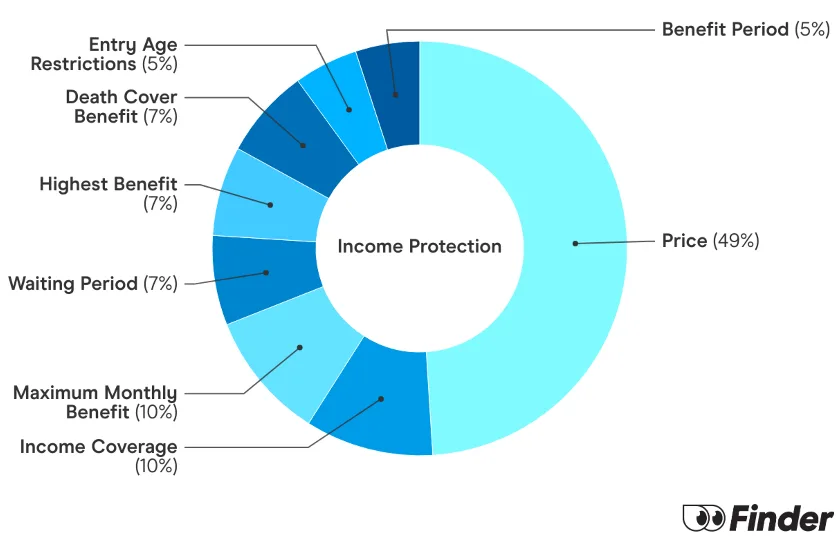
How we picked theseIncome Protection is a little complicated and a lot overwhelming. That's why we made the Finder Score, to make it easier to compare Life Insurance products against each other. Our experts analysed over 21 products and gave each one a score rank out of 10, to make it easier to compare Income Protection products against each other.
But a higher score doesn't always mean a product is better for you. Your situation is unique, so your policy choice will be too. Don't think of Finder Score as the final word, but as a good place to start your life insurance comparison.
You pay the same price as buying directly from the insurer.
We're not owned by an insurer (unlike other comparison sites).
We've done 100+ hours of policy research to help you understand what you're comparing.
Looking for other options? Check out these similar products.
How we picked theseLooking for other options? Check out these similar products.
How we picked theseQuotes are based on 35-year old non smoking male and female carpenter from NSW with an annual income of $80,000. Each person has a $3,000 monthly benefit and the benefit period is as near to 6 months as possible. The waiting period was selected as near to 90 days as possible. Correct as of Jan 2026.
Here's a summary of the pros and cons of both personal accident and income protection insurance to help you decide which one is right for you.
Pros
Cons
Pros
Cons
With income protection insurance, there's usually a waiting period before your benefit payments kick in; that is, the time you need to wait between submitting an income protection insurance claim and receiving monthly benefits. This period could be a minimum of 14 days but can be much longer depending on the policy that you've chosen. The longer you're willing to wait, the cheaper your premiums will be.
In the case of personal accident insurance, you can sometimes opt for the benefit payments to begin from the first day of your accident without any waiting period. Other options include:
Compare policies and get a quote
Income protection can cover a portion of your income if you are unable to work due to illness or injury, but it typically does not directly replace superannuation contributions, annual leave or sick leave benefits in the same way an employer might. As a freelancer or self-employed, you would need to factor these into your cover amount when setting up your policy to ensure sufficient financial protection.
Yes, it is possible to hold both types of policies. However, it is important to review the terms and conditions of each policy to understand how they would interact if you needed to make a claim. Some policies might have clauses about benefits from other insurance, which could affect your payout. It is often more comprehensive and cost effective to choose one policy that best suits your overall needs. And for most people this is income protection insurance, due to its broader coverage.
Neither standard income protection nor personal accident insurance policies are designed to cover redundancy or general job loss. These policies are specifically for situations where you cannot work due to illness or injury. Some income protection policies may offer an optional add on for redundancy cover, but this is not a standard inclusion.
Income protection pays you a regular monthly benefit for a defined period if you are temporarily unable to work due to illness or injury. Total and Permanent Disability TPD insurance on the other hand pays a single lump sum if you become permanently disabled and are unlikely to ever work again in any occupation or your own occupation depending on your policy definition. They serve different purposes, one for temporary incapacity and the other for permanent.
Personal accident insurance might be a suitable option if you cannot qualify for income protection due to medical history or if you are looking for a more affordable policy that specifically covers accidental injuries. It can also be quicker to obtain as it often involves fewer medical questions. However, remember it has limited coverage compared to income protection, which also covers illnesses.
Gary Ross Hunter has over 6 years of expertise writing about insurance, including life, health, home, and car insurance. Having reviewed hundreds of product disclosure statements and published over 800 articles, he loves simplifying complex insurance topics for everyday readers. Gary has contributed to major outlets like Yahoo Finance, The Sydney Morning Herald, and news.com.au, and holds a Bachelor of Arts (Honours) in English Literature from the University of Glasgow, along with a Tier 2 General Advice certification, ensuring his work adheres to ASIC’s RG146 standards. See full bio
James Martin was the insurance editor at Finder. He has written on a range of insurance and finance topics for over 7 years. James often shares his insurance expertise as a media spokesperson and has appeared on Prime 7 News, Insurance News, 7NEWS and The Guardian. An experienced journalist, James' work has featured in publications including The Irish Times, Companies100 and In Business. He holds a Tier 1 General Insurance (General Advice) certification and a Tier 1 Generic Knowledge certification, both of which meet the requirements of ASIC Regulatory Guide 146 (RG146). See full bio
Find a better deal, save on your bills and get a free gift card. Sign up to be the first to hear about new Finder Rewards.
How much could you save if you lived in a different city in Australia? Let's find out.
Income protection can be a valuable form of cover for Australians when its features are fully understood.
Find out what is and isn't covered by AAMI Income Protection and how to apply.
Income protection for couples ensures your partner isn't hurt financially if you are temporarily unable to work due to illness or injury.
Find out why income protection is still useful if you're over 60, and compare cover.
Salary continuance and income protection both serve to replace income in the event of injuries and illness. However, there are some key differences to know about.
Receive income cover for illness or injury with Suncorp Income Protection.
Life insurance and income protection serve two different purposes but can both offer valuable cover alone and when combined.
Find out how much your income protection insurance policy will pay out in the event of a claim. Receive quotes for income protection and apply securely.
Looking for the best income protection insurance but not exactly sure where to start? Compare the Finder Awards 2025 insurance winners.
Finder is a comparison service. We do not compare every product or every provider in the market.
We make money through commercial arrangements with some of the providers on this site. Products marked 'Sponsored', 'Promoted', 'Featured' or 'Advertisement' appear as a result of a commercial arrangement.
Our editorial content, product reviews and any 'Top Pick' designations are prepared independently of these commercial arrangements.
The default order of products in our tables can be influenced by commercial arrangements. You can re-sort or filter using the controls above each table.
Some content on this site may be generated or supported by AI tools. You should verify details directly with the provider.
Finder is one of Australia's leading comparison websites. We are committed to our readers and stand by our editorial principles.
Our comparison service does not include every product or every provider in the market. Some product issuers offer their products under multiple brands or through associated companies. Where we can, we identify the underlying issuer so you can compare like with like, but you should always check with the provider directly to confirm which brand you are dealing with.
Finder is a comparison website and an intermediary. We are not a product issuer and we do not provide personal financial or credit advice. When you click a link to a product, or apply for a product through our site, you deal directly with the product issuer. We may receive a referral fee, commission or other payment from the issuer if you click through, apply or take out a product. We describe these arrangements in more detail under 'How we make money' below.
Product features, fees, terms and eligibility criteria are set by the product issuer and may change. We rely on information supplied by issuers when we present product details on our site. Before you apply for or take out any product, you should confirm the details directly with the issuer.
We earn revenue from Finder in four principal ways:
Referral fees and commissions. When you click a product link, complete an enquiry form or apply for a product through our site, we may receive a referral fee, commission or other payment from the product issuer. We may also receive payment based on the volume of leads or conversions we send to an issuer.
Sponsored placements. Products marked 'Sponsored', 'Promoted', 'Featured' or 'Advertisement' appear as a result of a commercial arrangement between Finder and the issuer. These labels always indicate a paid placement. We do not use them for editorial choices.
Display advertising. Banner advertising, newsletter advertising and similar display ads on our site are paid by advertisers.
Content sponsorship. Some articles, videos and social media posts are sponsored by an issuer and are clearly labelled as such.
Our editorial opinions, product reviews and any 'Top Pick' designations are prepared independently of these commercial arrangements. A 'Top Pick' is an editorial choice made by our writers and editors based on the criteria described on each comparison page. A 'Top Pick' is not a personal recommendation and does not mean the product is appropriate for your circumstances.
If you would like to know whether we have a commercial arrangement with a specific product issuer, please contact us.
When products are grouped in a table or list, the default order can be influenced by commercial arrangements we have with product issuers. In some categories, sponsored or featured products appear in the top positions of the table by default, and are always labelled as such.
Other factors that influence default order include price, fees and features, and (where relevant) our editorial view of the product.
You can re-sort every comparison table using the controls above the table. You can filter by product features that matter to you. The order you see after re-sorting or filtering is not influenced by commercial arrangements.
Some content on this site is generated or supported by artificial intelligence tools, including our AI-powered assistant FinderBot. AI-generated content may contain errors. Please verify important information directly with the product issuer before making a financial decision. For more information about FinderBot, see the FinderBot Terms of Use and FinderBot Privacy Collection Notice.
Please read our website terms of use and privacy policy for more information about our services and our approach to privacy.
We update our data regularly, but information can change between updates. Confirm details with the provider you're interested in before making a decision.
Thank you for your feedback
Our goal is to create the best possible product, and your thoughts, ideas and suggestions play a major role in helping us identify opportunities to improve.