Pros
- Cheaper when you first take out a policy.
- Good for people who don't want life insurance long term.
Cons
- It usually costs more long-term.
- It can become unaffordable as you get older.


When you take out life insurance, you'll often be given a choice between variable age-stepped premiums and variable premiums. Variable premiums are locked in at the age you apply, so they are steadier over the long run, though the amount you pay can still rise a little each year with indexation. Variable age-stepped premiums, on the other hand, often work better over the short term because they won't increase that much.

Variable age-stepped premiums will generally increase with your age e.g. every year at the "policy anniversary" your premium is re-calculated.

Variable premiums will remain the same despite your age e.g. you'll usually pay more in the beginning but it will even out over time.
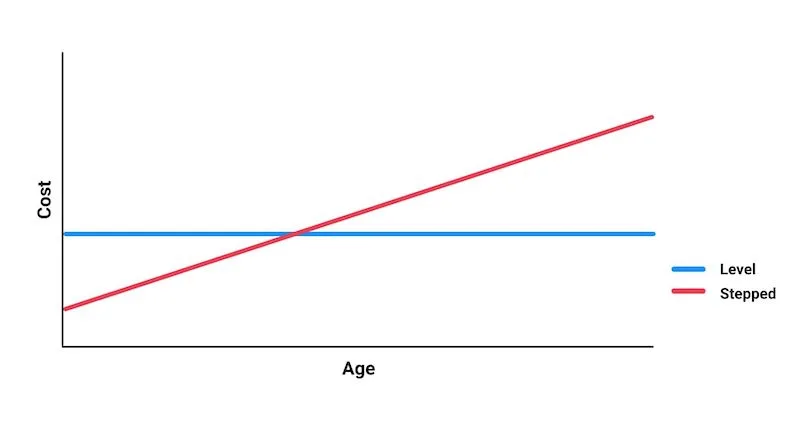
Here's a side by side example of a hypothetical variable age-stepped variable premium over 10 years. As you can see, variable age-stepped premiums generally start out cheaper but in the long run, it's likely to cost you more.
| Age | Variable age-stepped premium | Variable premium |
|---|---|---|
| 31 | $145.96 | $200 |
| 32 | $159.86 | $200 |
| 33 | $173.77 | $200 |
| 34 | $187.67 | $200 |
| 35 | $215.47 | $200 |
| 36 | $222.42 | $200 |
| 37 | $229.37 | $200 |
| 38 | $243.27 | $200 |
| 39 | $243.27 | $200 |
| 40 | $250.22 | $200 |
| 10 year average | $207.13 | $200.00 |
| Total premium to age 40 | $2,071.28 | $2,000.00 |
Variable age-stepped premium are based on a sample profile from NobleOak Premium Direct Life Insurance in February 2019. Variable premium is made up for illustrative purposes.
Variable age-stepped premiums increase over time as you age. The older you are, the more likely that your health may deteriorate and therefore, your premiums (under age-stepped structure) will increase significantly, especially once you're older than 50 years.
Variable premiums don't increase as you age. Instead, your rates will be calculated based on your age at the time of application and locked in at a fixed rate for the duration of your policy.
| Key differences | Variable age-stepped premiums | Variable premiums |
|---|---|---|
| Do payments increase? | Yes. Premiums are reviewed and calculated on a yearly basis on every policy anniversary. | The rate stays the same, but the amount you pay still rises a little each year due to indexation to keep up with inflation (usually around 5% or higher than the CPI). |
| Is it more expensive as I get older? | Yes. Your premiums will increase significantly once your reach age 50 and over. | No. Your premiums stay the same no matter your health or age. |
| Who is it suitable for? | Those who have limited disposable income and are looking to secure short-term life insurance cover. | Those looking to secure long-term life insurance cover. |
Hybrid premiums are the middle point between stepped and level premiums.
Hybrid premiums cost more at the beginning of the policy than stepped but lower than level premiums. Premiums increase until the policy reaches a predetermined age when the premiums level off.
Once this happens the premiums are higher than level but are lower than stepped.
Financial literacy advocate Pascale Helyar-Moray on what women do to avoid losing out to higher costs.
Was your life insurance application denied? This article looks at the top reasons why your application might have been denied and what you can do to get the right cover.
Find out how the underwriting process actually works if considering taking out cover.
Ever wondered how much more life insurance for smokers costs in Australia? Learn about how smoking and vaping can impact your policy.
Find out how smoking will impact what you pay for life insurance, and what you can do to have your premium reviewed.
Not sure what life insurance is? We take you through the basics of life insurance with our easy to understand guide.
Read our guide to updating life insurance beneficiaries and making sure your money goes to the right people.
Depending on the applicant and the type of life insurance policy, there may be no medical tests required.
