These products offer great value, with a good score across both features and price.
7+
Great
These are competitive products, though they didn't quite get top scores.
5+
Standard
These products might offer less value or command a higher premium than others in the market.
0+
Basic
These products might only offer a basic set of features or aren't very competitive on price.
Why compare life insurance with Finder?
You pay the same price as buying directly from the life insurer.
We're not owned by an insurer (unlike other comparison sites).
We've done 100+ hours of policy research to help you understand what you're comparing.
Finder Score - Life Insurance
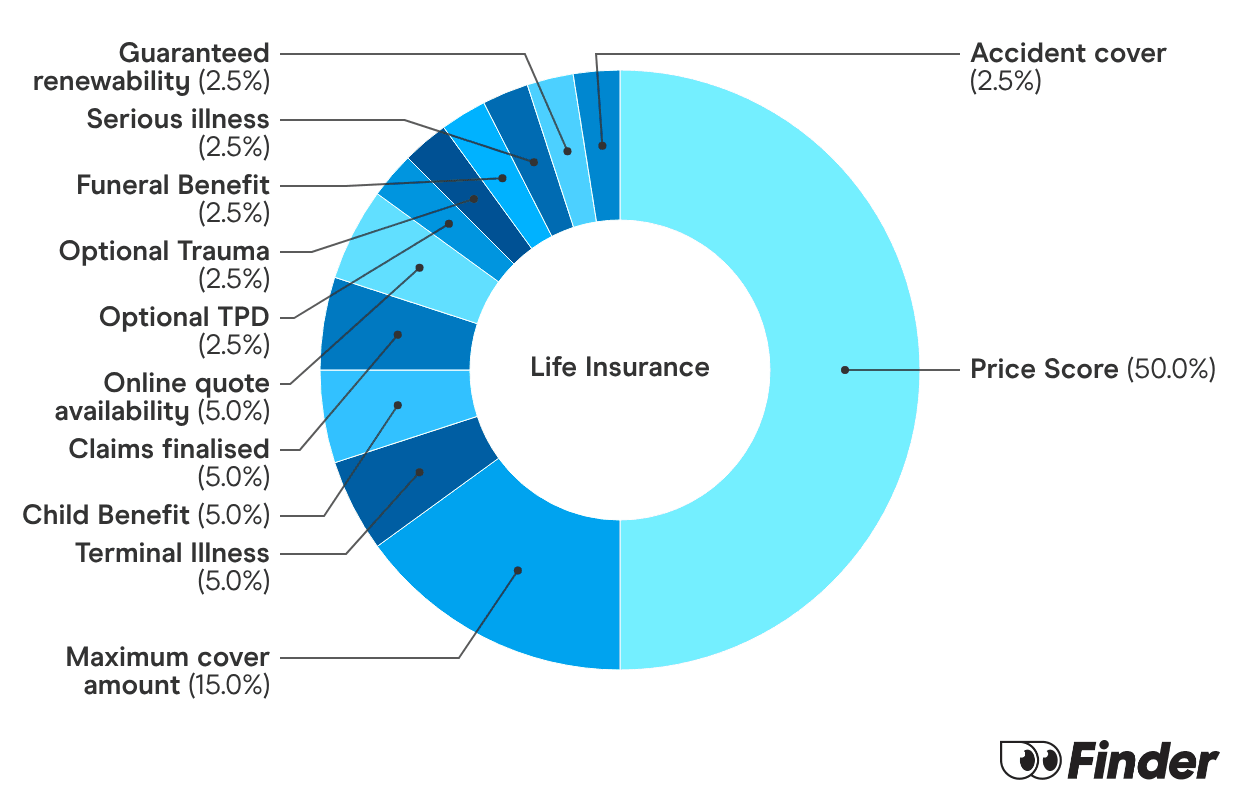
Life Insurance is a little complicated and a lot overwhelming. That's why we made the Finder Score, to make it easier to compare Life Insurance products against each other. Our experts analysed over 30 products and gave each one a score out of 10.
But a higher score doesn't always mean a product is better for you. Your situation is unique, so your policy choice will be too. Don't think of Finder Score as the final word, but as a good place to start your life insurance comparison.
Life insurance ensures your family is able to maintain the same quality of life in the event that you pass away or suffer a terminal illness. Many Australian life insurance providers also offer what is known as family cover, which provides extra protection under the same policy for your spouse and children.
Why should I consider family life insurance?
Having life insurance that covers the main income provider in a family offers protection in the event of their passing. However, if a family member dies or becomes terminally ill, there are other costs that can arise that won't be covered on a standalone life insurance policy, including the following:
The cost of replacing the duties of a homemaker (e.g. a spouse)
The cost treatment of a child with a serious illness or injury
Coping with the loss of a loved one is hard enough to manage without having to worry about the financial loss that could also occur, which is why families should ensure the right cover is in place for each family member.
Why should I consider family life insurance?
Having life insurance that covers the main income provider in a family offers protection in the event of their passing. However, if a family member dies or becomes terminally ill, there are other costs that can arise that won't be covered on a standalone life insurance policy, including the following:
The cost of replacing the duties of a homemaker (e.g. a spouse)
The cost treatment of a child with a serious illness or injury
Coping with the loss of a loved one is hard enough to manage without having to worry about the financial loss that could also occur, which is why families should ensure the right cover is in place for each family member.
Speak to an insurance specialist to help you find personalised cover
How can I take out family life insurance?
Family cover can be taken out as the following:
A joint life insurance policy to protect both the policy owner and their spouse
An additional benefit for the child or spouse
Joint life insurance with a spouse
A joint policy will pay a lump-sum benefit following the death of either policyholder. Under this arrangement, the spouse is a co-owner of the policy, and the benefit is paid to both or to one owner following the death of the other. There are a number of benefits to this arrangement:
Can be more affordable: Joint ownership policies are generally much more affordable than having 2 separate policies in place with some providers offering premium discounts as high as 10%.
Security for both people: Joint policies ensure that both parties will be protected from financial loss if the other is to pass away or suffer a terminal illness.
Less fees: There will only be one set of fees for policy owners to worry about. Such fees can include the policy fee (around $70 per year), premium frequency charge and stamp duty fee.
More convenient to manage: Joint policies offer the convenience of only having one policy to maintain. This includes the initial policy application, premium payments and future policy adjustments.
Additional cover: "Family protection benefit"
The family protection benefit will provide policy owners with a lump-sum payment following the occurrence of an event that happens to the policyholder's spouse or children. This benefit can usually be attached to the policy owner's life cover or trauma policy.
What events will generally be covered under the family protection benefit?
Conditions covered will differ from policy to policy but will generally include the following:
Death
Terminal illness
Cancer events such as leukaemia, invasive cancer and skin cancer
Coronary attacks including heart attack, stroke and cardiomyopathy
Coma
Blindness
Kidney failure
Major burns
Paralysis
Major burns
Can I add child cover to my existing policy?
Most insurers will allow applicants to add child cover to their existing cover for an additional premium loading. The convenience of child cover is that it is often included as an additional benefit to trauma or life policies.
What are some features to consider when comparing family protection options?
Conversion option. Can the sum-insured be converted to a trauma policy in their own name once they turn 21?
Indexation: Will the benefit amount for family protection increase with inflation?
Range of conditions covered. Does the policy provide cover for a comprehensive range of different medical conditions?
Sum insured. What is the maximum sum-insured that could be taken out on the policy?
Number of children covered. How many children can be covered under the policy?
Should I consider children's insurance in my family life cover plan?
Many may consider children's insurance cover as something that is not absolutely necessary. But safeguarding your family's well-being should also include having adequate protection for your children as you may never know if one day they get sick or passes away unexpectedly.
Some policies include cover
Some insurance providers may provide children protection as an additional option at an extra cost or others may include it in the family life policy free of charge. If you are looking to protect your family as a whole, make sure you keep on a lookout for children's benefits when comparing family life insurance quotes.
Children's insurance will pay a benefit to the parents if the child ends up suffering from the following:
Major head trauma
Meningitis
Encephalitis
Total and permanent loss of 2 limbs
Loss of sensory abilities, such as deafness or blindness
Paralysis
Accidental death
These conditions will vary between insurance providers, so it is important to read the fine print of the children's cover before you sign on the dotted lines.
What kind of expenses can family life insurance cover?
Its important for applicants to have an understanding of the expenses that surface following the loss of a loved one that is not the main income earner. Below are some typical costs that can arise:
Immediate costs
Loss of spousal income to household budget
Funeral expenses
Medical expenses incurred before loss
Home Duties
Cost of child care
Homemaker to carry out daily chores
Transport for children
The significance of these expenses will differ from policy to policy, so it is important for applicants to assess their own situation to help them determine an appropriate benefit.
What factors do I need to consider when it comes to family life insurance?
In addition to calculating the family's current and future finances, there are other factors that you may need to consider in determining your family's life policy coverage:
Your age and your spouse/partner's respective ages
Replacing your income and your future expected earnings in line with inflation
Whether your spouse/partner is working
The amount of contributions of each parent to the family (such as family savings and paying off debts)
The number of children you have and their age
The number of years you are considering to cover your family's ongoing needs
Total available assets and superannuation funds (which can be used to reduce the amount of life coverage that you may need to take out)
Using your family's needs approach works well, especially if you are looking to find out what sort of expenses your family will have to cover if you were no longer around. It is particularly helpful in calculating the right life-cover amount, without paying too much in premiums. You may like to utilise Life Insurance Finder, a life insurance calculator to help you work out this amount.
It can help to discuss life insurance with your family
It is important to discuss life insurance with your family, particularly with your partner, before you take out a life insurance plan. When you take out life insurance cover, you need to have an idea of what sort of plan you want to opt for and how much coverage you should choose. This is something that you should probably talk over with your partner and perhaps with your children if they are older or grown up, as they may have some valuable input that can help you to make a more informed decision.
You can determine what level of coverage is going to be sufficient by discussing the following factors with your family:
Your family's financial needs in the event of your death
Whether you are the main income earner
Your level of debt
What financial commitments you have
Reviewing life insurance after you have taken out your plan
It is also important to discuss life insurance after you have taken out your policy, even if you have already spoken to your family prior to taking out the cover. The importance of discussing cover with your family, and especially with your partner, after you've taken out a policy comes from the need to go over exactly what the policy covers and to discuss the claims procedure.
Knowing what's covered. Having an understanding of what's covered will help your family avoid any false expectations.
Claims procedure if something happens. Knowing what to do in the event of a claim will mean the family can focus less energy on working out what to do and more time on grieving or recovering.
Whether your premium will go up each year. Some premiums will rise each year.
If your benefit remains the same with inflation. Benefits can increase to keep pace with inflation. It's a good idea to let anyone who pays for the policy in your family about this.
A startling number of people take out life insurance cover and then fail to talk to their partner or family about it. In the event of their death, which is what the policy is designed to cover, the family is then left to try and work through the plan, work out what the coverage and exclusions are and try and work out how to make a claim. All this has to be done, of course, without the help of the person who actually took out the cover, as they are no longer around, which makes things all the more difficult for the family at a time when they already have enough to cope.
Key tips for finding family life insurance
To help you find the right life insurance policy to cover your family, consider the following tips:
Obtain and compare multiple quotes . Do not just go with the first cheapest policy you can get. It is important to get as many quotes as possible to determine which policy can give you the most comprehensive cover, without sacrificing affordability.
When in doubt, speak to an insurance adviser. Doing all the research on different types of family life insurance on your own may be time-consuming and confusing; however, you can always ask for assistance from an insurance broker. They can assess your needs and personal circumstances and recommend life insurance policies that are tailored to match your needs.
Consider jointly-owned life policy with your partner/spouse. Besides having the advantage of costing less than individually-owned policies, it provides an additional layer of protection should one or both parents pass away unexpectedly.
Include children cover. It is important to consider adding a children's benefit onto your family life policy to give you the additional layer protection to include your entire family.
Frequently asked questions
The cost of family life insurance varies significantly based on several factors. These include your age, health, occupation, the level of cover you choose, and whether you add optional benefits like TPD or trauma cover. Generally, premiums increase with age and if you have pre-existing health conditions. Comparing quotes from multiple insurers can help you find a policy that suits your budget and needs.
Yes, it is possible to get family life insurance with a pre-existing medical condition. However, the insurer may assess your application differently. They might apply special conditions, such as an exclusion for the pre-existing condition, charge a higher premium, or, in some cases, decline cover for that specific condition. It is crucial to disclose all relevant medical history when applying to avoid issues with future claims.
If your family structure changes due to events like marriage, divorce, separation, the birth of a new child, or children becoming adults, it is important to review your family life insurance policy. You may need to update beneficiaries, adjust cover amounts, or add or remove family members from the policy. Contact your insurer or a financial advisor to ensure your policy continues to meet your evolving family needs.
Yes, most family life insurance policies have exclusions. Common exclusions can include claims resulting from self-inflicted injury, criminal acts, war, or acts of terrorism. Some policies may also have specific exclusions related to dangerous hobbies or occupations if not declared and accepted by the insurer during the application process. Always read the Product Disclosure Statement carefully to understand all exclusions.
To make a claim on a family life insurance policy, you typically need to contact the insurer as soon as possible. You will usually be required to provide documentation such as the death certificate, medical reports, and the policy details. The insurer will guide you through the process and inform you of any other necessary paperwork. It is helpful to have all policy information readily accessible.
The number of children you can cover under a family life insurance policy can vary by insurer and policy type. Some policies may allow you to cover all your children automatically up to a certain age, while others might specify a maximum number or require individual listing. It is best to check the policy terms or speak with your insurer to understand the specific limits and conditions for child cover.
Yes, single parents can absolutely obtain family life insurance. While the term "family life insurance" often implies cover for a couple and children, it generally means a policy structured to protect dependents. A single parent can take out a policy that names their children as beneficiaries, ensuring financial protection for them in the event of the parent's death or terminal illness.
Many family life insurance policies extend coverage to stepchildren and adopted children in addition to biological children. The definition of "child" or "dependent" within a policy's terms and conditions usually outlines who is eligible for cover. It is important to confirm with your insurer that all relevant children are included on your policy.
You can generally hold certain types of life insurance cover, such as death cover and Total and Permanent Disability (TPD) cover, inside your superannuation. However, specific "family protection benefits" or trauma cover for children may not be available or comprehensive through super. It is advisable to consult with a financial advisor to understand the implications of holding insurance in super and whether it meets your family's needs.
Generally, family life insurance premiums are not tax deductible in Australia if the policy is held personally. However, if the policy is held through your superannuation fund, there may be tax implications that differ. Always seek advice from a qualified financial advisor or tax professional regarding your specific tax situation.
Sources
Was this content helpful to you?
Thank you for your feedback!
To make sure you get accurate and helpful information, this guide has been edited by
David Gregory
as part of our
fact-checking process.
Willam Eve is the country manager for Finder's Canada operations. He has previously held the positions of group publisher of insurance for Finder Australia and lead publisher for the Finder global team. William has a Bachelor of Communications from the University of Technology Sydney, Australia. He loves the challenge of launching Finder into new markets while helping grow Finder’s global team.
See full bio
James Martin was the insurance editor at Finder. He has written on a range of insurance and finance topics for over 7 years. James often shares his insurance expertise as a media spokesperson and has appeared on Prime 7 News, Insurance News, 7NEWS and The Guardian. An experienced journalist, James' work has featured in publications including The Irish Times, Companies100 and In Business. He holds a Tier 1 General Insurance (General Advice) certification and a Tier 1 Generic Knowledge certification, both of which meet the requirements of ASIC Regulatory Guide 146 (RG146).
See full bio
James's expertise
James
has written
177
Finder guides across topics including:
Providing protection for your children with life insurance.
Important information about this website
Finder is a comparison service. We do not compare every product or every provider in the market.
We make money through commercial arrangements with some of the providers on this site. Products marked 'Sponsored', 'Promoted', 'Featured' or 'Advertisement' appear as a result of a commercial arrangement.
Our editorial content, product reviews and any 'Top Pick' designations are prepared independently of these commercial arrangements.
The default order of products in our tables can be influenced by commercial arrangements. You can re-sort or filter using the controls above each table.
Some content on this site may be generated or supported by AI tools. You should verify details directly with the provider.
Finder is one of Australia's leading comparison websites. We are committed to our readers and stand by our editorial principles.
Our comparison service does not include every product or every provider in the market. Some product issuers offer their products under multiple brands or through associated companies. Where we can, we identify the underlying issuer so you can compare like with like, but you should always check with the provider directly to confirm which brand you are dealing with.
Finder is a comparison website and an intermediary. We are not a product issuer and we do not provide personal financial or credit advice. When you click a link to a product, or apply for a product through our site, you deal directly with the product issuer. We may receive a referral fee, commission or other payment from the issuer if you click through, apply or take out a product. We describe these arrangements in more detail under 'How we make money' below.
Product features, fees, terms and eligibility criteria are set by the product issuer and may change. We rely on information supplied by issuers when we present product details on our site. Before you apply for or take out any product, you should confirm the details directly with the issuer.
We earn revenue from Finder in four principal ways:
Referral fees and commissions. When you click a product link, complete an enquiry form or apply for a product through our site, we may receive a referral fee, commission or other payment from the product issuer. We may also receive payment based on the volume of leads or conversions we send to an issuer.
Sponsored placements. Products marked 'Sponsored', 'Promoted', 'Featured' or 'Advertisement' appear as a result of a commercial arrangement between Finder and the issuer. These labels always indicate a paid placement. We do not use them for editorial choices.
Display advertising. Banner advertising, newsletter advertising and similar display ads on our site are paid by advertisers.
Content sponsorship. Some articles, videos and social media posts are sponsored by an issuer and are clearly labelled as such.
Our editorial opinions, product reviews and any 'Top Pick' designations are prepared independently of these commercial arrangements. A 'Top Pick' is an editorial choice made by our writers and editors based on the criteria described on each comparison page. A 'Top Pick' is not a personal recommendation and does not mean the product is appropriate for your circumstances.
If you would like to know whether we have a commercial arrangement with a specific product issuer, please contact us.
When products are grouped in a table or list, the default order can be influenced by commercial arrangements we have with product issuers. In some categories, sponsored or featured products appear in the top positions of the table by default, and are always labelled as such.
Other factors that influence default order include price, fees and features, and (where relevant) our editorial view of the product.
You can re-sort every comparison table using the controls above the table. You can filter by product features that matter to you. The order you see after re-sorting or filtering is not influenced by commercial arrangements.
Some content on this site is generated or supported by artificial intelligence tools, including our AI-powered assistant FinderBot. AI-generated content may contain errors. Please verify important information directly with the product issuer before making a financial decision. For more information about FinderBot, see the FinderBot Terms of Use and FinderBot Privacy Collection Notice.
Please read our website terms of use and privacy policy for more information about our services and our approach to privacy.
We update our data regularly, but information can change between updates. Confirm details with the provider you're interested in before making a decision.
Our goal is to create the best possible product, and your thoughts, ideas and suggestions play a major role in helping us identify opportunities to improve.