Health insurance for drug and alcohol addiction
Treatments for drug and alcohol addiction are available on gold hospital policies. Alternatively, there is some support available via Medicare or via support services that the government offers.

All prices are based on a single individual with less than $105,000 income and living in Sydney.
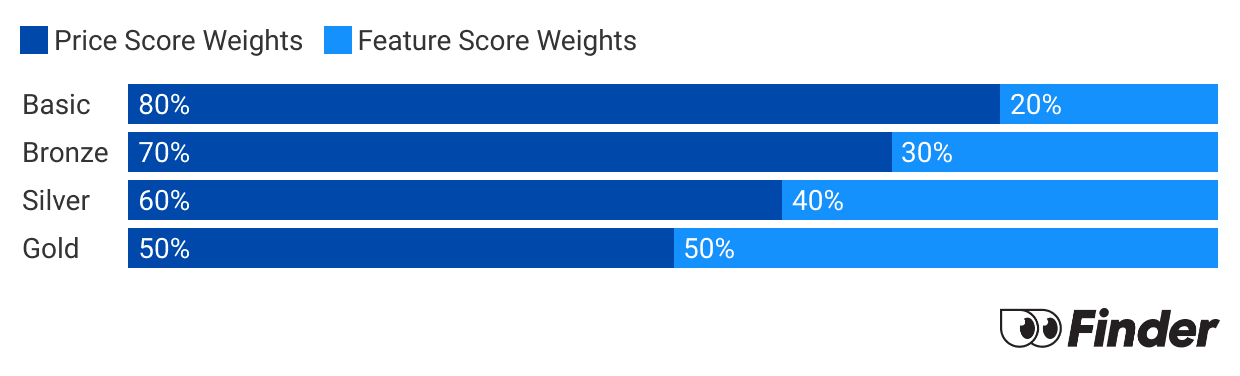
Each month we analyse our hospital insurance products and rate each one on price and features. What we end up with is a nice round number out of 10 that helps you compare hospital cover a bit faster.
Before we start scoring, we need to make sure we're comparing like-for-like. Just as it doesn't make sense to compare a bicycle with a Ferrari, it doesn't make sense to compare basic hospital policies to top-tier Gold policies. Each policy is given a price score and feature score. These are then combined to determine each policies's Finder Score.
Drug and alcohol addiction can be treated in a lot of ways, but it is generally classed as a psychiatric or mental health condition. Treatment generally requires a residential stay at a hospital or inpatient facility, generally from a few weeks to a month or so. In Australia, inpatient care is covered under private hospital insurance (as opposed to extras).
To get access to 'psychiatric care' you'll need a gold hospital policy. Residential care is expensive, so it tends to be only available in top tier policies. If you have a lower tier policy you might have what's called restricted cover on psychiatric care. You should consider this to not have coverage - you'd pay a lot out-of-pocket if you used it. However, there are waiting period exceptions for mental health that can help you.
It's important to note that outpatient rehabilitation is not covered by private health insurance. Even the treatments that are covered may still carry out of pocket expenses as every insurer has benefit limits that will apply. Additionally, a gold policy will typically have waiting periods of 2 months before you can access these services, however, there are some exceptions if you're eligible for the mental health waiver, which you can only use once in your lifetime. There's more information about that further down the page.
| Treatment | Description | How a gold health insurance policy can help |
|---|---|---|
| Withdrawal or detoxification | Ceasing drug and alcohol use, while minimising side-effects and the risk of harm. | If this is taking place in a hospital, private health insurance can cover your in-patient costs (hospital bed, medications used while in hospital). |
| Pharmacotherapy | Substitution of a harmful drug with medication to reduce cravings and the risk of overdose. | If this takes place in a hospital, you'd be covered under 'in-patient' treatments. |
| Counselling | Different approaches include talking through your problems and learning how to change the way you think and deal with difficult situations. | Health insurance doesn't cover this unless it's in a hospital with a psychiatrist |
| Rehabilitation programs | A long-term approach to achieving a drug and alcohol-free lifestyle, with no further medication provided once withdrawal is successfully completed. | If this rehab is done in a hospital, you may be covered under 'in-hospital treatments', 'rehabilitation' or 'psychiatry'. |
| Complementary therapies | Treatments such as relaxation therapies and natural remedies, which can be useful in managing withdrawal symptoms. | Health insurance won't cover this. |
| Support groups | Support programs such as Alcoholics Anonymous and Narcotics Anonymous | Health insurance doesn't cover this. They're typically free community groups. |
The Australian government has a range of support services available to help those who are struggling with drug and alcohol addiction. These services are also available to those who are affected by someone else's addiction.
If you or someone you care about is experiencing problems with drugs or alcohol, the below help lines are available for counseling, treatment, information and support.
Mental health services are available via Medicare, but this can be limited. Every Australian resident is entitled to 10 Medicare-rebated psychology (allied mental health) sessions per calendar year under a Mental Health Treatment Plan, which Medicare will cover a certain amount for. Psychiatrist appointments attract separate Medicare rebates and aren't included in this 10-session cap. However, oftentimes, the practitioner will charge more than what Medicare covers so you're still left with some out of pocket expenses.
Think you may have sleep apnoea? Here's what you need to know about public and private healthcare cover.
Doing a medical costs comparison could save you a lot of money. Here's how to reduce your out-of-pocket medical expenses.
Think you may need hernia surgery? See what's involved.
If you need knee surgery in Australia, see how private and public works and explore your options.
Think you may need hip surgery in the future? Compare your options for public and private treatment.
Medicare and private health insurance can work together to bring down the costs of your gender reassignment surgery.
Find out if being treated as an inpatient or an outpatient will affect your private health insurance cover.
Palliative care is the practice of easing the pain of a patient with a terminal illness and making them as comfortable as possible before death.
Find the answers to the most common questions about health cover excesses in this helpful guide.
Learn the pros and cons of private vs public health in this handy guide to the differences between public and private health insurance.