These products offer great value, with a good score across both features and price.
7+
Great
These are competitive products, though they didn't quite get top scores.
5+
Standard
These products might offer less value or command a higher premium than others in the market.
0+
Basic
These products might only offer a basic set of features or aren't very competitive on price.
Key takeaways
You can get life insurance if you have a pre-existing medical condition, but that condition is often excluded from cover.
In some cases, you might be able to get a life insurance policy that covers a pre-existing condition but you will pay more.
You might be able to get covered for the pre-existing condition but often only if you can prove it is no longer an issue.
What is a pre-existing condition for life insurance?
A pre-existing medical condition is a condition you have or have had prior to buying life insurance.
It can be something that requires ongoing treatment or that you have been treated for in the past. It can also be a condition that's been resolved – essentially, any health issue that could affect your life expectancy and health or ability to work. If you die or suffer a severe illness as a result of a pre-existing condition, your claim can be refused if it's listed as an exclusion on your life insurance policy. Some common pre-existing conditions examples are:
Heart disease
High blood pressure
Cancer
Kidney or liver disease
Depression
Diabetes
Sleep apnoea
Musculoskeletal conditions
Financial adviser Brenton Tong on life insurance for pre-existing conditions
How do I apply for life insurance with a pre-existing condition?
"Typically, when applying for any type of life insurance policy, whether it be life insurance, total and permanent disability, income protection or trauma, your medical history and any pre-existing medical conditions will be taken into consideration. Your medical history will either be a hurdle at the time of applying for insurance, or it will be a hurdle in making a claim on your policy.
As a rule, if your medical history isn't examined when you apply for insurance, you run a very real risk that a claim isn't going to be paid on your policy in the future as the insurance company can lean on pre-existing medical conditions as a reason not to pay – so in most regards, it's best to deal with the pain (medical examination) upfront and remove any uncertainty about your ability to get insurance."
Can I get life insurance with a pre-existing condition?
"An insurer is going to look at your pre-existing medical condition in light of the type of insurance policy that you're applying for. As an example, if you have a back injury and seek regular treatment from a chiropractor, it's not likely to affect a life insurance policy. However, higher cholesterol and heart disease will. The easiest way to think about it is to consider if your medical condition may shorten your life."
Will I pay more if I can get life insurance with a pre-existing condition?
"If you do have a pre-existing medical condition that the insurer feels may have a material effect, then you're likely to either have your policy accepted at a higher rate – called a loading. If you're a smoker, premiums for insurance are usually higher as you represent a higher risk to the insurance company. If you have other medical issues that the insurer feels put you at a similar risk as a smoker to early death, then they will charge you accordingly. You can expect to pay from 50 – 100% more for your premiums in this situation."
What happens if I am declined due to a pre-existing condition?
"If you are declined for your insurance, it's always best to ask why – sometimes the answer isn't what you were thinking of. While it may be based on a pre-existing medical condition, it may be a combination of things. It could be a family history of heart disease coupled with higher blood pressure, high cholesterol and a high BMI. In this circumstance, you may be able to focus on improving your health and losing weight and then applying again. Sometimes just 5kg could make the difference. The family history might still be there, but there is one less factor for the insurance company to be worried about.
Sometimes your medical history is bad enough that it's a flat no and you won't be able to be accepted no matter what you do. You may be tempted to find a less reputable insurance company to see if they will insure you – if you go down this path, be very careful and read all the fine print."
What is a life insurance pre-assessment?
"Even if you do have a complicated medical history, it's worth getting pre-assessed for an insurance application. This is a shortened version of an insurance application that a medical underwriter will assess and give guidance on how they would likely deal with such an application. They may indicate that it's still worth putting it in, or that they need further information. As with most things in life, if you don't try, you'll never know. "
Brenton Tong is the managing director and senior financial adviser at Financial Spectrum.
How does life insurance cover pre-existing conditions?
If you're able to get cover, a life insurer will generally apply one of the following to your policy:
A loading
A loading is when you will be covered for that pre-existing condition but there is an increase to the cost of your premium.
"For example, you may have a loading applied instead of/in addition to an exclusion if you suffer from: high BMI (typically over 32 is where you may start to see loadings, but some insurers will allow a BMI of up to 37 before a loading is applied)," says Inspired FP's financial adviser Grant Millar. "The extent to which a loading is applied could be up to +300%, or 4 times, the original premium in extreme cases".
An exclusion
An exclusion is when you can get life insurance but you won't be covered for claims related to your pre-existing condition. Mental health conditions are common exclusions.
"Any symptoms, and possibly even any treatment for mental health symptoms, in the past 3 or so years is more likely to lead to an exclusion on any mental health related condition," says Millar.
Life insurance that may cover you with a pre-existing medical condition
Compare other products
Looking for other options? Check out these similar products.
How we picked these
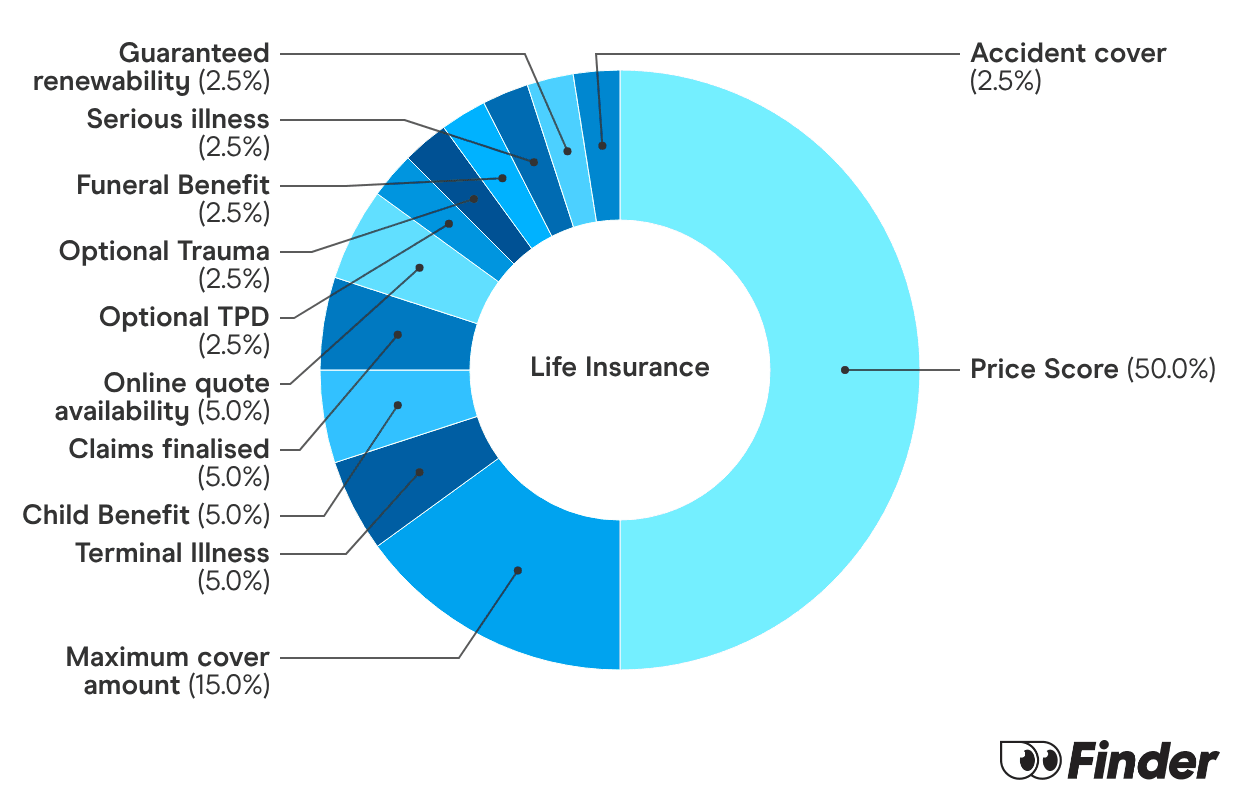
Finder Score - Life Insurance
Life Insurance is a little complicated and a lot overwhelming. That's why we made the Finder Score, to make it easier to compare Life Insurance products against each other. Our experts analysed over 30 products and gave each one a score out of 10.
But a higher score doesn't always mean a product is better for you. Your situation is unique, so your policy choice will be too. Don't think of Finder Score as the final word, but as a good place to start your life insurance comparison.
You pay the same price as buying directly from the life insurer.
We're not owned by an insurer (unlike other comparison sites).
We've done 100+ hours of policy research to help you understand what you're comparing.
How to get life insurance with a pre-existing medical condition
You generally have 3 options:
Directly from an insurer
You might be able to get life insurance for a pre-existing condition if you take out a policy directly with an insurer. In most cases, you will need to go through the underwriting process upfront. This means you'll be asked questions about your health, lifestyle and occupation when you apply.
Through an adviser
A financial adviser can shop around for a policy on your behalf. These are often medically assessed upfront so you'll know whether any exclusions will be applied to your policy before it's issued.
Through group insurance
You usually get group life insurance through a super fund or employer. It may cover pre-existing conditions because it usually requires minimum or no personal information to apply, unless you want to increase your level of cover within the group insurance product.
Watch out for exclusions
If you get group insurance, there may be exclusions such as disability relating to a pandemic, says financial adviser Grant Millar, so check the product disclosure statement (PDS) to see if you're covered.
Or speak to an insurance specialist to help you find cover
What information about my medical history will I need to disclose?
When purchasing an insurance plan with a pre-existing medical condition or illness, you will need to disclose personal information. The required information can vary depending on the condition and brand.
1. Information about specific conditions
For example:
Asthma, sleeping disorders
High cholesterol, blood pressure, diabetes or high blood sugar
Skin problems such as cancers, moles or tumours
Depression or anxiety
Serious disorders like cancer, epilepsy, heart conditions, anemia, kidney or bladder disease or thyroid conditions
Female specific conditions like breast cancer
Male specific conditions like prostate cancer
2. General medical information
Other information may require you to disclose if you have been in the hospital, seen a doctor for a condition, have been prescribed medication in the past 5 years or any of the following:
If you made a previous claim because of an illness.
If you have had symptoms which made you seek medical advice or a professional health practitioner and are awaiting tests or medical treatment or are taking prescription drugs.
If you have had to miss work because of the condition.
What else is assessed during the underwriting process?
Your medical history. During your application for life insurance you should let your insurer know of any congenital problems, illnesses or diseases, injuries, psychological issues or any undiagnosed by ongoing symptoms.
Your family medical history. Family history is an important indicator for ailments that are known to have familial links such as cancer, depression or congenital heart defects.
Your lifestyle. You should inform your insurer if you're a smoker, drinker, or taking any prescription or non-prescription drugs.
Your occupation. Your occupation, hours you work, your title, the size of the company you work for are all important factors for insurers.
Your financial situation. Your insurer will want to make sure that the amount you're being insured for is both logical and that you will be able to keep up with the required premium repayments.
Your participation in hazardous pursuits. Your participation in hazardous pursuits may be assessed depending on both the type of activity and your level of competency.
Your location. Your insurer will look at your access to medical facilities and likelihood of natural disasters in the areas you work and live.
Your present risk. Contemporary events are current risks that may pose an immediate threat such as civil unrest or natural disasters.
Frequently asked questions about life insurance with pre-existing conditions
If you don't tell the life insurer about your pre-existing condition, you may have your claim denied. This is because you would have been paying premiums for a policy that doesn't cover you properly. While disclosing a pre-existing condition may increase your premiums or lead to an exclusion, it's not worth risking it.
Some common reasons for a premium loading due to a pre-existing condition include:
Family history of certain medical conditions or cancers
Asthma (not typically an issue if symptoms are mild)
Crohn's disease
High blood pressure or cholesterol
Anaemia
Thrombocytopenia
Elevated liver function
Arthritis (including rheumatoid arthritis)
Yes, you might be able to. "Both loadings and exclusions may be able to be taken off the policy in the future, subject to a re-assessment of your circumstances (and depending on what caused the loading or exclusion to begin with), so even if you are offered revised terms that include a loading or exclusion, that may not be the case for life," says financial adviser Grant Millar.
You generally only need to inform your insurer of any changes to your condition prior to them agreeing to cover you. Once they have accepted your condition and have chosen to provide you with cover, you will only need to disclose any medical changes if you want to:
Extend cover
Vary your life insurance
Sources
Was this content helpful to you?
Thank you for your feedback!
To make sure you get accurate and helpful information, this guide has been edited by
Joelle Grubb
as part of our
fact-checking process.
Gary Ross Hunter has over 6 years of expertise writing about insurance, including life, health, home, and car insurance. Having reviewed hundreds of product disclosure statements and published over 800 articles, he loves simplifying complex insurance topics for everyday readers. Gary has contributed to major outlets like Yahoo Finance, The Sydney Morning Herald, and news.com.au, and holds a Bachelor of Arts (Honours) in English Literature from the University of Glasgow, along with a Tier 2 General Advice certification, ensuring his work adheres to ASIC’s RG146 standards.
See full bio
Gary Ross's expertise
Gary Ross
has written
555
Finder guides across topics including:
You can get life insurance if you have a pacemaker. We explain how it works in this guide.
Important information about this website
Finder is a comparison service. We do not compare every product or every provider in the market.
We make money through commercial arrangements with some of the providers on this site. Products marked 'Sponsored', 'Promoted', 'Featured' or 'Advertisement' appear as a result of a commercial arrangement.
Our editorial content, product reviews and any 'Top Pick' designations are prepared independently of these commercial arrangements.
The default order of products in our tables can be influenced by commercial arrangements. You can re-sort or filter using the controls above each table.
Some content on this site may be generated or supported by AI tools. You should verify details directly with the provider.
Finder is one of Australia's leading comparison websites. We are committed to our readers and stand by our editorial principles.
Our comparison service does not include every product or every provider in the market. Some product issuers offer their products under multiple brands or through associated companies. Where we can, we identify the underlying issuer so you can compare like with like, but you should always check with the provider directly to confirm which brand you are dealing with.
Finder is a comparison website and an intermediary. We are not a product issuer and we do not provide personal financial or credit advice. When you click a link to a product, or apply for a product through our site, you deal directly with the product issuer. We may receive a referral fee, commission or other payment from the issuer if you click through, apply or take out a product. We describe these arrangements in more detail under 'How we make money' below.
Product features, fees, terms and eligibility criteria are set by the product issuer and may change. We rely on information supplied by issuers when we present product details on our site. Before you apply for or take out any product, you should confirm the details directly with the issuer.
We earn revenue from Finder in four principal ways:
Referral fees and commissions. When you click a product link, complete an enquiry form or apply for a product through our site, we may receive a referral fee, commission or other payment from the product issuer. We may also receive payment based on the volume of leads or conversions we send to an issuer.
Sponsored placements. Products marked 'Sponsored', 'Promoted', 'Featured' or 'Advertisement' appear as a result of a commercial arrangement between Finder and the issuer. These labels always indicate a paid placement. We do not use them for editorial choices.
Display advertising. Banner advertising, newsletter advertising and similar display ads on our site are paid by advertisers.
Content sponsorship. Some articles, videos and social media posts are sponsored by an issuer and are clearly labelled as such.
Our editorial opinions, product reviews and any 'Top Pick' designations are prepared independently of these commercial arrangements. A 'Top Pick' is an editorial choice made by our writers and editors based on the criteria described on each comparison page. A 'Top Pick' is not a personal recommendation and does not mean the product is appropriate for your circumstances.
If you would like to know whether we have a commercial arrangement with a specific product issuer, please contact us.
When products are grouped in a table or list, the default order can be influenced by commercial arrangements we have with product issuers. In some categories, sponsored or featured products appear in the top positions of the table by default, and are always labelled as such.
Other factors that influence default order include price, fees and features, and (where relevant) our editorial view of the product.
You can re-sort every comparison table using the controls above the table. You can filter by product features that matter to you. The order you see after re-sorting or filtering is not influenced by commercial arrangements.
Some content on this site is generated or supported by artificial intelligence tools, including our AI-powered assistant FinderBot. AI-generated content may contain errors. Please verify important information directly with the product issuer before making a financial decision. For more information about FinderBot, see the FinderBot Terms of Use and FinderBot Privacy Collection Notice.
Please read our website terms of use and privacy policy for more information about our services and our approach to privacy.
We update our data regularly, but information can change between updates. Confirm details with the provider you're interested in before making a decision.
Our goal is to create the best possible product, and your thoughts, ideas and suggestions play a major role in helping us identify opportunities to improve.