The best balance transfer offers in September 2026
ANZ's Low Rate Credit Card remains Australia's best balance transfer offer this month with its market-leading 0% for 26 months (plus a 3% balance transfer fee). But it's followed very closely by NAB's Low Rate card, which also comes with a 0% balance transfer rate for 26 months and a 3% balance transfer fee. The only difference is the higher annual fee of $99 versus ANZ's $0 in the first year (and $58 after that). Beyond that, only a few cards offer 0% 25 or 24 months.
Updated September 2026 by Finder's senior money editor, Richard Whitten.
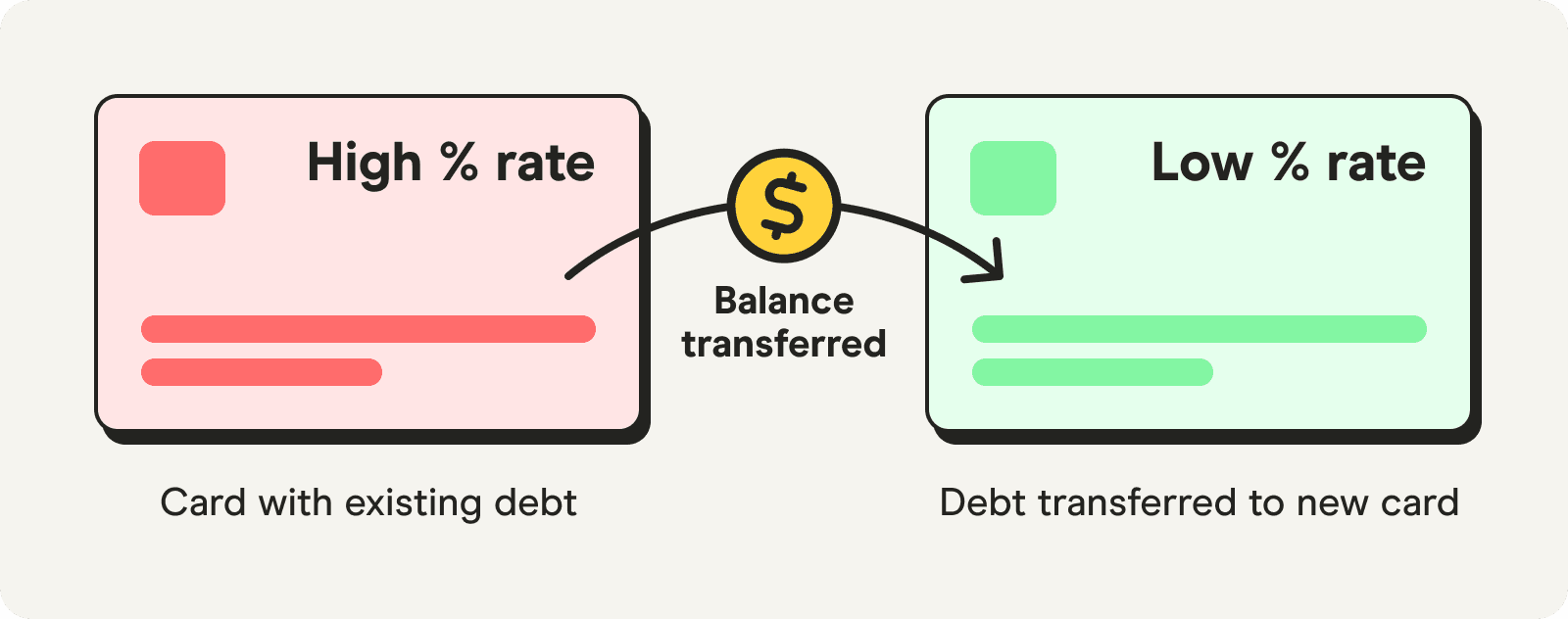
You can move the debt onto a new credit card via a balance transfer. The best balance transfer offers let you repay your balance with a special 0% rate. Most cards give you 12 months but some go up to 24 months or more.
This lets you pay off your debt without having to worry about super high interest charges. It's a debt-busting lifeline for people with big credit card debts.
The key thing is to make sure you pay it off and avoid spending too much on the new card.
Sounds great! What's the catch?
There's no catch. But you need to be aware of a few possible costs:
Your new card provider may charge a one-off balance transfer fee of 1–3% of your balance.
At the end of the balance transfer period the 0% interest rate reverts to a much higher rate (often above 20%). Pay it off before this happens.
You will get charged interest on any new spending you do on the card. This is called the purchase rate.
Must read: The key to making a balance transfer work
1. Once the balance transfer is complete, start paying the debt off. 2. Figure out a realistic amount you repay each month (and stick to it). 3. Close the old credit card or cards (the ones you used to rack up the debt). That way you won't get into any future trouble. 4. Avoid over-spending on the new card. If possible, just pay off the balance and use a debit card for your spending until the debt is paid.
How to compare balance transfer credit cards
Look for a long offer. The longer the offer term, the more time you'll have to pay off your debt for a low or 0% rate. So compare credit cards carefully.
Watch out for the transfer fee. Most cards charge a balance transfer fee. This one-off fee is 1% to 3% of the amount you transfer.
Find a 0% balance transfer rate. The best balance transfer credit cards in Australia offer 0% interest for the promotional period.
Take note of the revert rate. If you haven't paid off the balance transfer by the end of the offer period, the higher revert interest rate will be charged on your leftover debt.
Know your limits. On some cards you can only transfer up to a percentage of your approved credit limit (usually 70% - 100%). You can see Finder's guide to balance transfer limits for more information.
Want to see how much you could save? Put your balance and interest rate into the balance transfer table's calculator, or use Finder's credit card repayment calculator to help set your repayment goals.
Pros and cons of balance transfer credit cards
Pros
Save on interest costs. You can transfer your existing balance to a new card and get a low or 0% interest rate for a while. This will almost always be lower than the interest rate you're currently paying.
Pay off debt faster. By not paying interest you should be able to get rid of your balance a lot faster.
Simplify your payments. If you have several debts, you can use a balance transfer card to combine them so you only have to keep track of one credit card bill. This also saves you money on card fees.
Perks and extras. If you want to use the card after you have paid off your balance, perks like credit card travel insurance or rewards could help you get more value out of the card.
Cons
Balance transfer fee. This one-time fee can range from 1% to 3% of your balance transfer amount, when it applies. That would mean a fee of $100 to $300 on a $10,000 debt.
Revert rate. If you don't pay off your whole balance transfer during the introductory period, this is the interest rate you'll pay on the remaining balance.
Balance transfer limits. Depending on the card and how much you want to transfer, you may not be able to move it all onto the new card. You could still be saving money.
Credit score impact. Every time you apply for a new credit card, an enquiry is recorded on your credit report. If you already have a weak credit score, this could lower it further, temporarily.
Is a balance transfer credit card right for me?
A balance transfer credit card is really useful if you are struggling with unpaid credit card debt - and interest - from one or multiple cards.
Still not sure if a balance transfer card is right for you? Ask yourself these questions first.
Is there a way I can pay off my balance without getting a new card?
Can I afford the fees that come with the new card?
Will I be able to pay my balance off before the 0% period ends?
Am I eligible for this credit card? Is my application likely to be rejected?
"I got into some credit card trouble in my early twenties. I was stuck with over $5,000 of debt on a Commonwealth Bank credit card that I should never have taken out. That might not seem like a lot to some people, but I was struggling financially at the time, and the interest was crippling. I took out an ANZ balance transfer card and was able to get zero interest for 18 months, which gave me a lot more space to pay the thing off."
What's the best way to pay off a balance transfer credit card?
Make a plan. Look at your budget and see how much you spend and save each month. Figure out how much you can use to pay off the balance. If there's not much money, try to find ways to cut back, like cutting out subscriptions or unnecessary expenses. Use the savings to pay down your balance.
Set up auto-pay. Your bank should offer you a way to automatically set up a monthly card payment. This means you'll never miss a card payment, as long as there's money in your transaction account.
Do the maths. Take your unpaid balance and divide it by the number of months on your 0% balance transfer offer. Let's say you have a $4,000 balance to repay and a 26-month balance transfer offer. You need to repay $154 a month to pay it off on time.
Avoid getting into further debt. Recognise the money mistakes that got you into trouble in the first place. Try not to spend wildly on the new credit card (if possible, don't use it for new spending it all and just pay off the balance).
Set yourself up for success by setting up direct debit payments from your bank account each month. Watch as your balance goes down, and make sure it's paid off before the balance transfer period ends.
How long will it take Aussies to pay off their credit card debt?
How long will it take Aussies to pay off their credit card debt?
Length of time
Percentage
3-4 years
2%
5 or more years
3%
1-2 years
6%
7-12 months
9%
1-6 months
16%
Struggling with debt? Help is available
It's easy to get into trouble with a credit card. Sometimes it's easy to sort this out with some careful budgeting and a balance transfer.
But if you've got multiple, serious debts, bad credit history, or other issues that seem to make it impossible to get back on track financially, it's much harder.
Hardship support is available. If you're struggling, talk to your bank, card company, utility or other service provider. These companies have hardship support schemes in place. You might be able to get extra time to pay a bill, or a pause on loan repayment.
Free financial counselling. You can also call the National Debt Helpline on 1800 007 007 and get free financial counselling and support.
Frequently asked questions
Right now, the longest balance transfer offer is 0% for 26 months. With the cards listed below, you can transfer your balance and get charged no interest while you pay it off for over 2 years.
There is no set maximum amount of times you can transfer a balance between credit cards. However, you should factor in any balance transfer fees, the enquiries on your credit report and your chance of being approved for new cards with different banks. Ideally, you should focus on paying it back in full and eliminating the need for multiple transfers.
The ANZ Low Rate is the winner of the 2026 Finder Balance Transfer Credit Card Award. This card had the longest 0% balance transfer offer on the market plus no annual fee in the first year. The clear winner.
These balance transfer cards were highly commended in 2026:
The number of balances you can transfer depends on the provider and the offer but typically you'll be able to move debt from 1 to 3 eligible accounts. If you want to use a balance transfer credit card to consolidate debts, check the offer details or contact the provider to find out exactly how many balances you'll be able to transfer.
Unfortunately, no. Balance transfer offers are only for new customers, meaning you'll have to open a card with a different bank or card company. This also goes for cards within the same group. For example, St.George, Bank of Melbourne and BankSA are all part of Westpac group, so you couldn't transfer a balance between any of these institutions.
When used correctly, a balance transfer credit card can help you repay your debt and improve your credit score in the long-term. But applying for a new credit card leaves a hard enquiry on your credit report (and may decrease your score for a month or two).
Try to avoid applying for multiple cards. This will lower your credit score. Missing repayments on the balance transfer card will also hurt your credit score.
After the introductory period ends, the 0% interest rate ends too. If there's any debt left over, it will start to be charged interest at the revert rate.
This rate is high, often around 20%. It's higher than the purchase rate you get charged on new card spending.
If you haven't paid your balance off by the end of balance transfer period you could end up getting charged more interest than you were on your old card.
This is why it's so important to plan your repayments and pay off as much of your debt as possible during the introductory period
A balance transfer fee is a one-time charge that may apply when you move your debt to a new card. It's typically worth 1-3% of the balance transfer amount, but not all providers charge a balance transfer fee.
To give you an idea of the cost, transferring $5,000 onto a card with a 1.5% balance transfer fee would add $75 to the balance.
Unless the card offers an interest-free period for the purchases, you'll be charged interest on them. So, you'd need to make sure you could repay your purchases and the balance transfer debt. Otherwise, you'll waste your 0% balance transfer offer.
When transfering an existing balance to a new card, it's your responsibility to contact your provider and close the old account. If you don't, you could end up paying account costs for a card you're not using - or worse, rack up debts on both cards. Before you close the card, make sure the balance is completely transferred or paid in full and move any regular payments such as (direct debits) to another account.
The Commonwealth Bank stopped accepting balance transfer applications in December 2023. This means you can no longer move an unpaid balance from another card onto a new Commonwealth Bank credit card.
However, you can still transfer your Commonwealth Bank credit card balance to another bank.
Finder Scores: What they mean
9+ Excellent - These cards offer the longest 0% interest periods, lowest balance transfer fees, and competitive revert rates for maximum savings.
7+ Great - Tackle debt with generous interest-free periods, reasonable balance transfer fees, and potential for additional perks.
5+ Standard - Reduce interest costs with reasonable interest-free periods and balance transfer fees.
Less than 5 – Basic - These are generally cards aimed as general audiences which include a balance transfer feature.
Let's face it, the average person doesn't spend all day comparing credit cards. But we do. That's why we developed the Finder Score.
It's a quick, easy way you can see how one credit card compares to others on the market.
Every month we:
Analyse 80+ credit cards with balance transfer offers.
Assess seven features of each card and give each component a rating.
Combine the ratings via a weighted methodology to decide the Finder Score.
The Finder Score methodology is designed by our insights and editorial team. We review products objectively. Commercial partnerships do not affect the scores.
Remember that Finder Score is just one factor to consider. Look at other aspects like fees, features, benefits and risks to make sure a product is suitable for you. Double-check details that matter to you before applying or buying.
Feature
Definition
Assessment
Weight
Balance Transfer Period
Length of the interest-free period on transferred balances (in months)
Longer periods earn more points, up to the market maximum
40%
Balance Transfer Fee
Percentage charged on the transferred balance
Lower fees score higher. 0% fee receives the maximum points
20%
Balance Transfer Rate
Interest rate on transferred balances during the introductory period
Lower rates score higher. 0% rate receives the maximum points
15%
First-Year Fee
Annual fee charged in the first year of ownership
Lower fees score higher. $0 fee receives the maximum points
12%
Ongoing Annual Fee
Annual fee charged from the second year onwards
Lower fees score higher. $0 fee receives the maximum points
8%
Revert Rate
Interest rate applied to remaining balance after the introductory period
Richard Whitten is Finder’s Senior Money Editor, with over eight years of experience in home loans, property, credit cards and personal finance. His insights appear in top media outlets like Yahoo Finance, Money Magazine, and the Herald Sun, and he frequently offers expert commentary on television and radio, helping Australians navigate mortgages and property ownership. Richard started his career in education and textbook publishing in South Korea. He holds multiple industry certifications, including a Certificate IV in Mortgage Broking (RG 206) and Tier 1 and Tier 2 certifications (RG 146), as well as a Bachelor of Education from the University of Sydney and a Graduate Certificate in Communications from Deakin University.
See full bio
Richard's expertise
Richard
has written
794
Finder guides across topics including:
If you use the 0% balance transfer and do not pay off the total debt, can you then go to another bank offering 0% or are you stuck with the original bank?
Finder
RenchMarch 4, 2018Finder
Hi Susan,
Thanks for your inquiry.
It may not be ideal to do a second balance transfer for a short period of time as that could affect your credit history. With BT, you’d usually go with the standard process in applying for a new credit card, thus a new application in just a short time would mean credit enquiries and several enquiries on the file have negative effect on your future approval.
Furthermore, banks can actually find out that you’re not able to pay off your first balance transfer so that may cause them to reject second BT application.
Best regards,
Rench
RobertJanuary 2, 2018
i want to transfer credit cards to a 0% balance credit card for 24 months with little or no fees, and 100% of monies transferred , can you tell me which bank will do this <
AnndyJanuary 3, 2018
Hi Robert,
Thanks for your question.
You may compare credit cards with up to 24 months 0% balance transfer offer. Most of these cards have an annual fee. We can’t guarantee that you will be able to move 100% of your old debts to any of these cards as this will depend on your approved credit limit. Typically, you can only transfer between 80 to 95% of your approved credit limit.
You can use our comparison table to help you find the card that suits you. When you are ready, you may then click on the “Go to site” button and you will be redirected to the bank’s website where you can proceed with the application or get in touch with their representatives for further inquiries you may have.
Before applying, please ensure that you meet all the eligibility criteria and read through the details of the needed requirements as well as the relevant Product Disclosure Statements/Terms and Conditions when comparing your options before making a decision on whether it is right for you. You can also contact the provider if you have specific questions.
Cheers,
Anndy
ArnoldOctober 24, 2017
Hi K,
Thanks for your inquiry
You should make repayments by the due date detailed on your bank statement each statement period. While you’re only required to pay the minimum repayment, you should always aim to pay more to clear your debt faster. This is especially important when you’re using a 0% balance transfer offer that will only apply for a promotional period. To avoid paying interest on your debt, you should calculate how much you need to pay each month by dividing the size of your debt by the how the length in months of your promotional period. This will give you a goal repayment to make each month to repay your balance before the promotion ends.
You can repay your balance as early as you’d like. there are no penalties for clearing your credit card debt ahead of time.
Balance transfers are not allowed between certain credit card brands. Read on for a list of lenders that do and don’t allow a balance transfers between them.
Learn about the concept of making money from credit cards with stoozing and the downfalls you should look out for.
Important information about this website
Finder is a comparison service. We do not compare every product or every provider in the market.
We make money through commercial arrangements with some of the providers on this site. Products marked 'Sponsored', 'Promoted', 'Featured' or 'Advertisement' appear as a result of a commercial arrangement.
Our editorial content, product reviews and any 'Top Pick' designations are prepared independently of these commercial arrangements.
The default order of products in our tables can be influenced by commercial arrangements. You can re-sort or filter using the controls above each table.
Some content on this site may be generated or supported by AI tools. You should verify details directly with the provider.
Finder is one of Australia's leading comparison websites. We are committed to our readers and stand by our editorial principles.
Our comparison service does not include every product or every provider in the market. Some product issuers offer their products under multiple brands or through associated companies. Where we can, we identify the underlying issuer so you can compare like with like, but you should always check with the provider directly to confirm which brand you are dealing with.
Finder is a comparison website and an intermediary. We are not a product issuer and we do not provide personal financial or credit advice. When you click a link to a product, or apply for a product through our site, you deal directly with the product issuer. We may receive a referral fee, commission or other payment from the issuer if you click through, apply or take out a product. We describe these arrangements in more detail under 'How we make money' below.
Product features, fees, terms and eligibility criteria are set by the product issuer and may change. We rely on information supplied by issuers when we present product details on our site. Before you apply for or take out any product, you should confirm the details directly with the issuer.
We earn revenue from Finder in four principal ways:
Referral fees and commissions. When you click a product link, complete an enquiry form or apply for a product through our site, we may receive a referral fee, commission or other payment from the product issuer. We may also receive payment based on the volume of leads or conversions we send to an issuer.
Sponsored placements. Products marked 'Sponsored', 'Promoted', 'Featured' or 'Advertisement' appear as a result of a commercial arrangement between Finder and the issuer. These labels always indicate a paid placement. We do not use them for editorial choices.
Display advertising. Banner advertising, newsletter advertising and similar display ads on our site are paid by advertisers.
Content sponsorship. Some articles, videos and social media posts are sponsored by an issuer and are clearly labelled as such.
Our editorial opinions, product reviews and any 'Top Pick' designations are prepared independently of these commercial arrangements. A 'Top Pick' is an editorial choice made by our writers and editors based on the criteria described on each comparison page. A 'Top Pick' is not a personal recommendation and does not mean the product is appropriate for your circumstances.
If you would like to know whether we have a commercial arrangement with a specific product issuer, please contact us.
When products are grouped in a table or list, the default order can be influenced by commercial arrangements we have with product issuers. In some categories, sponsored or featured products appear in the top positions of the table by default, and are always labelled as such.
Other factors that influence default order include price, fees and features, and (where relevant) our editorial view of the product.
You can re-sort every comparison table using the controls above the table. You can filter by product features that matter to you. The order you see after re-sorting or filtering is not influenced by commercial arrangements.
Some content on this site is generated or supported by artificial intelligence tools, including our AI-powered assistant FinderBot. AI-generated content may contain errors. Please verify important information directly with the product issuer before making a financial decision. For more information about FinderBot, see the FinderBot Terms of Use and FinderBot Privacy Collection Notice.
Please read our website terms of use and privacy policy for more information about our services and our approach to privacy.
We update our data regularly, but information can change between updates. Confirm details with the provider you're interested in before making a decision.




If you use the 0% balance transfer and do not pay off the total debt, can you then go to another bank offering 0% or are you stuck with the original bank?
Hi Susan,
Thanks for your inquiry.
It may not be ideal to do a second balance transfer for a short period of time as that could affect your credit history. With BT, you’d usually go with the standard process in applying for a new credit card, thus a new application in just a short time would mean credit enquiries and several enquiries on the file have negative effect on your future approval.
Furthermore, banks can actually find out that you’re not able to pay off your first balance transfer so that may cause them to reject second BT application.
Best regards,
Rench
i want to transfer credit cards to a 0% balance credit card for 24 months with little or no fees, and 100% of monies transferred , can you tell me which bank will do this <
Hi Robert,
Thanks for your question.
You may compare credit cards with up to 24 months 0% balance transfer offer. Most of these cards have an annual fee. We can’t guarantee that you will be able to move 100% of your old debts to any of these cards as this will depend on your approved credit limit. Typically, you can only transfer between 80 to 95% of your approved credit limit.
You can use our comparison table to help you find the card that suits you. When you are ready, you may then click on the “Go to site” button and you will be redirected to the bank’s website where you can proceed with the application or get in touch with their representatives for further inquiries you may have.
Before applying, please ensure that you meet all the eligibility criteria and read through the details of the needed requirements as well as the relevant Product Disclosure Statements/Terms and Conditions when comparing your options before making a decision on whether it is right for you. You can also contact the provider if you have specific questions.
Cheers,
Anndy
Hi K,
Thanks for your inquiry
You should make repayments by the due date detailed on your bank statement each statement period. While you’re only required to pay the minimum repayment, you should always aim to pay more to clear your debt faster. This is especially important when you’re using a 0% balance transfer offer that will only apply for a promotional period. To avoid paying interest on your debt, you should calculate how much you need to pay each month by dividing the size of your debt by the how the length in months of your promotional period. This will give you a goal repayment to make each month to repay your balance before the promotion ends.
You can repay your balance as early as you’d like. there are no penalties for clearing your credit card debt ahead of time.
Hope this information helps
Cheers,
Arnold