Key takeaways
- Doctors face Australia's highest work injury rate, highlighting the need for income protection.
- Choose 'own occupation' cover to ensure protection for your medical specialty specific duties.
- Income protection premiums are often tax-deductible, reducing the overall cost of your cover.
Why doctors need income protection
According to Safe Work Australia, the healthcare industry has the highest proportion of work-related injuries and illnesses every year. Unlike other professions, healthcare workers encounters a range of health and safety hazards on a daily basis. You might be normalized to it, but it doesn't mean you shouldn't take the necessary precautions. Some of the hazards you might encounter include:
- Blood borne diseases. Exposure to blood borne viruses such as HIV and hepatitis. Needle stick injuries can include cover for occupationally acquired HIV, Hepatitis B and Hepatitis C. Most policies also cover splash injuries as well.
- Other contagious illnesses & diseases. Doctors have famously strong immune systems but that doesn't mean you're not susceptible to contagious illnesses and diseases. Some can be spread by coming into contact with infectious patients. This is especially a concern for GPs.
- Back injuries. Many health professionals, including paramedics and nurses, need to lift and move their patients. As a result, back injuries are among the most common reasons for claims among healthcare and social assistance workers, according to Safe Work Australia.
- Mental health issues. Being a doctor can be stressful. The high stress nature of the job means that you might need time off as a result of a mental health problem you are dealing with. Fortunately, it's possible to get income protection for mental health issues.
Finder survey: Did Australians in different states know that income protection is tax deductible?
| Response | WA | VIC | SA | QLD | NSW |
|---|---|---|---|---|---|
| Yes | 7.21% | 7.88% | 3.7% | 7.73% | 7.24% |
| No | 3.6% | 3.08% | 6.17% | 3.18% | 4.46% |
Data for ACT, NT, TAS not shown due to insufficient sample size. Some other states may also be excluded for this reason.
How does income protection for doctors work?
Income protection insurance pays you a large portion of your income if you're unable to work due to an injury or illness. If you are a doctor and you have to take some time off work due to an injury or illness, income protection will pay you up to 70% of your regular income, and up to 75% with some insurers, until you return to work or your agreed benefit period ends. It may also end when you reach a certain age - usually around 65 or 70. Income protection premiums are also tax deductible. Some features of income protection for doctors include:
- A non-offset clause. This entitles you to a full benefit payment even if you're already receiving compensation from WorkCover. In a nutshell, you can receive your income protection payments as well as any other form of compensation you are entitled to as a medical professional.
- Own occupation. Medical professionals can also get own occupation income protection. This means you're covered if you can't perform the duties specific to your own specialty, regardless of your ability to perform other medical duties.
- Cover inside and outside of work. Unlike workers' compensation, income protection is there for you all the time. It's designed to cover policyholders for injuries or illnesses sustained both inside and outside of work.
Compare income protection quotes
Looking for other options? Check out these similar products.
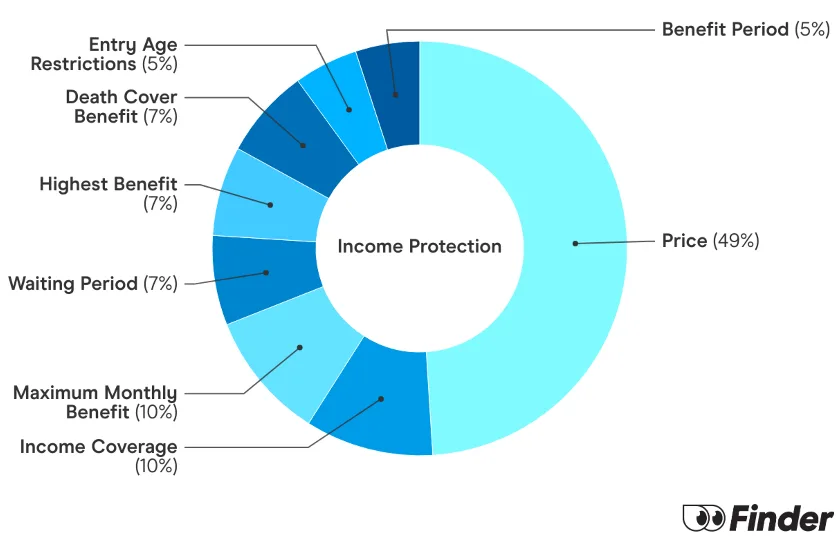
How we picked theseFinder Score - Income Protection
Income Protection is a little complicated and a lot overwhelming. That's why we made the Finder Score, to make it easier to compare Life Insurance products against each other. Our experts analysed over 21 products and gave each one a score rank out of 10, to make it easier to compare Income Protection products against each other.
But a higher score doesn't always mean a product is better for you. Your situation is unique, so your policy choice will be too. Don't think of Finder Score as the final word, but as a good place to start your life insurance comparison.
How much can doctors expect to pay
Aside from factors such as your age and sex, occupation has a big influence on how much you will pay. Doctors and health professionals, including nurses, can expect to pay higher premiums because they're working in a riskier profession than most.
While there are several exceptions, many doctors and medical professionals are high-earners. In the past, this meant you may have found it difficult to insure yourself for the level of income you are used to receiving. This is because the Australian insurance industry limited high income earners to an insured amount of $30,000 per month, meaning you were only protected if you earned up to $480,000 a year.
However, you can now get income protection benefits of up to $60,000 per month. This means that high earning doctors can now get the protection they need to sustain their lifestyle should something happe.
Income protection for doctors conditions or exclusions
There are some conditions and exclusions worth keeping in mind when you apply for cover. These include:
- Part-time workers. You generally need to work for at least 20 hours per week to be eligible for cover.
- 'Own occupation' vs 'any occupation'. You will need to decide whether you want 'own occupation' or 'any occupation' income protection. 'Own occupation' is more expensive but means that your insurer could not claim you are able to perform other duties related to the medical industry. For example, if you have 'any occupation' cover, are a surgeon and suffer a hand injury, an insurer might refuse a claim as you can still work as a GP.
- Overseas cover. Some insurers won't maintain full cover if you take an overseas placement. Others might have exclusions for specific countries and regions, so be sure to read the product disclosure statement (PDS) beforehand.
- Waiting periods. Every policy will come with a waiting period. Essentially, it means you can't make a claim until you have held the policy for a specific length of time. Waiting times can vary from around 30 days to 2 years.
What other types of insurance should doctors think about?
All health practitioners are required to have professional indemnity insurance. So whether you're a nurse working in an elderly care home or a surgeon at a private hospital, you should consider getting medical malpractice insurance. This protects you in the event of a medical malpractice claim, ensuring you are not liable for any expensive compensation payouts or additional costs associated with legal fees and disruption to business.
If you're worried about exposure to blood borne viruses, some insurers offer needlestick cover as an optional benefit for medical professionals. If you become infected with HIV, hepatitis B or hepatitis C as a result of your work, needlestick cover can pay you with a large lump sum benefit.
Frequently Asked Questions
-
Medical students generally cannot get income protection because they do not have an income to protect. Junior doctors including interns and residents are usually eligible for cover. Your benefit amount will be based on your current income which may be lower than a specialist doctor. Some policies allow for future income increases without additional underwriting as your career progresses.
-
Yes income protection can differ for locum and self-employed doctors. Insurers typically calculate your income based on an average over a period usually 12 to 24 months rather than a fixed salary. You may need to provide more extensive financial records to support your application and any future claim. Self-employed doctors might also consider business overheads insurance which covers fixed business expenses if you cannot work.
-
Yes it is possible to hold income protection cover through your superannuation fund. Many industry and retail super funds offer a basic level of income protection by default. While this can be a cost effective option as premiums are paid from your super balance it often comes with more basic features and a shorter benefit period. Benefits are typically paid to your super fund first then disbursed to you. It is important to compare these policies carefully as specific features like 'own occupation' cover may not be available or as comprehensive when held inside super.
-
If you have a pre-existing medical condition you must disclose it during your income protection application. The insurer will assess your medical history and may apply specific exclusions to your policy. They might also impose a loading which means higher premiums or in some cases decline to offer cover. It is crucial to be honest and provide all relevant information to ensure your policy is valid when you need to make a claim.
-
To make an income protection claim as a doctor you should notify your insurer as soon as possible after your injury or illness prevents you from working. You will need to complete claim forms and provide medical evidence from your treating doctor detailing your condition and inability to perform your duties. Financial documents such as payslips or tax returns will also be required to prove your income. Once your waiting period has passed and your claim is assessed and approved payments will begin.
-
Yes your medical specialisation can affect your income protection premiums and the type of cover available. Insurers classify occupations based on risk and some medical specialisations such as surgeons emergency doctors or those involved in high risk procedures may be considered higher risk than general practitioners or dermatologists. This can lead to higher premiums. For specialists 'own occupation' cover is particularly valuable as it ensures you are covered if you cannot perform the specific duties of your specialisation not just any medical work.
-
Many income protection policies offer cover for partial disability or if you return to work on reduced hours. This means that if an injury or illness prevents you from working your full hours or performing all your usual duties resulting in a reduced income your policy can pay a partial benefit. The amount paid is typically calculated based on the difference between your pre-disability income and your reduced income after returning to work. This feature encourages a gradual return to work while still providing financial support.
Speak to an insurance specialist to help you find personalised cover
-
Finder writers are subject matter experts and use primary sources, in-depth research and interviews with other experts to ensure you're getting accurate, up-to-date information. Articles are fact checked in line with our editorial guidelines.
- Finder survey by Pure Profile of 1110 Australians (December 2023)
- TAL income protection insurance PDS (accessed April 2024)
- AAMI income protection insurance PDS (accessed April 2024)
- Nobleoak Disability Income Insurance PDS (accessed April 2024)
- Medibank income protection insurance PDS (accessed April 2024)
- ahm Income Protection insurance PDS (accessed April 2024)
- Insuranceline Income Protection insurance PDS (accessed April 2024)
Gary Ross Hunter has over 6 years of expertise writing about insurance, including life, health, home, and car insurance. Having reviewed hundreds of product disclosure statements and published over 800 articles, he loves simplifying complex insurance topics for everyday readers. Gary has contributed to major outlets like Yahoo Finance, The Sydney Morning Herald, and news.com.au, and holds a Bachelor of Arts (Honours) in English Literature from the University of Glasgow, along with a Tier 2 General Advice certification, ensuring his work adheres to ASIC’s RG146 standards. See full bio
- Health, home, life, car, pet and travel insurance
- Managing the cost of living
James Martin was the insurance editor at Finder. He has written on a range of insurance and finance topics for over 7 years. James often shares his insurance expertise as a media spokesperson and has appeared on Prime 7 News, Insurance News, 7NEWS and The Guardian. An experienced journalist, James' work has featured in publications including The Irish Times, Companies100 and In Business. He holds a Tier 1 General Insurance (General Advice) certification and a Tier 1 Generic Knowledge certification, both of which meet the requirements of ASIC Regulatory Guide 146 (RG146). See full bio
- Car, home, life, health, travel and pet insurance
- Managing the cost of living
- Money-saving tips
Get rewarded $$ for switching with Finder Rewards
Find a better deal, save on your bills and get a free gift card. Sign up to be the first to hear about new Finder Rewards.
More guides on Finder
-
Income protection for tradies
The tradies guide to income protection insurance.
-
Income Protection for Contractors
Here's what contractors need to know about finding income protection insurance policies that fit their specific employment situations.
-
Income protection for dentists
Income Protection has specific features designed for dentists including needlestick cover.