An offset account reduces your home loan interest, allowing faster repayment by calculating interest on a lower principal.
Placing $50,000 in an offset could save over $184,000 in interest and shorten a 30-year loan by more than three years.
A 100% offset account offers greater flexibility than redraw facilities and is generally more beneficial than partial offsets.
What is an offset account?
An offset account is a bank account attached to your home loan. Instead of earning interest for you every dollar you have in your offset account will reduce the amount of interest you pay on your home loan.
The bank will use your loan minus your offset account balance to calculate the interest it charges.
Your monthly repayments stay the same, so you'll pay off your home loan faster.
While you don't earn interest on an offset account, the interest you save is usually at a much higher interest rate than you'd earn in your bank account.
Our best offset home loan for September 2026
How does an offset account work?
If your loan amount is $500,000 and you save $1,000 in your offset account, your lender will calculate your daily interest charges on $499,000.
As long as that $1,000 remains in the offset account, you won't be charged interest on that amount of your home loan.
The more money you have in your account, the greater your financial savings will be.
Offset savings example
Your home loan: $750,000 over 30 years with an interest rate of 6.00%.
The interest you'll pay: $868,787 if your rate stays the same
Let's look at how much interest you'd pay with different amounts in your offset account.
Offset savings
Interest reduced by
Updated total to repay
New loan term
$10,000
$42,031.27
$1,576,755.15
29 years, 3 months
$20,000
$81,225.27
$1,537,561.15
28 years, 6 months
$50,000
$184,500.28
$1,434,286.13
26 years, 5 months
Use our calculator below to see how much you could save by using an offset account.
Expert insight
"The offset account is a magic little Aussie invention that lets you use every dollar twice, both for its intended purpose (holiday, school fees, emergencies, etc) and to save you lots of loan interest. To me, it's a must-have."
Nicole Pedersen-McKinnon
Finance journalist
Offset account calculator
Use our calculator below to estimate how much time and money an offset account could save you. Just enter your mortgage details, the amount you will put into the offset account and how far into your mortgage you currently are.
How to save the most money with an offset account
How much you can save using an offset account depends on your loan amount, interest rate, how much money is in the offset account, when you put it there and how long it stays there.
Add money early. Adding $10,000 to your offset account at the start of a 30-year loan, will save you more than if you added that money 5 years into the loan. Any amount, even $1,000, will have an impact over the long term.
Add money often. If you can, have your salary or wages paid directly into your offset account, so your money is offsetting your interest during the month (before you spend it).
Limit withdrawals. If you need to pull money out of your offset account, it is as easy as withdrawing money from any bank account. This will readjust the calculation on your loan repayments, so try to keep as much money in the account as you can. For example, pay bills on the last possible due date so your money is offsetting your interest for a few more days.
Partial vs 100% offset account
Most offset accounts will offset your loan principal 100%, so every dollar you save in the account offsets your principal by the same amount, dollar for dollar.
Partial offsets only offset your loan principal to a specified percentage. For example, a partial offset may offset your principal by 60%, meaning $1 offsets your principal by 60 cents.
Partial offsets are significantly less beneficial and our calculator does not offer a partial offset calculation. It's not worth settling for a partial offset account when there are so many fully featured 100% offset account options available.
"I keep my savings in my home loan offset account so i can still access them in an emergency. This takes off over $100 in interest from my home loan each month, it may not sound like much, but it actually reduces the term of my loan by 3 years. Unlike a savings account, interest 'saved' under the offset is not taxed. You do have to pay an annual fee for an offset, mine is $350 - so it's worth using an offset calculator to see if it's worth it for your needs."
Should I make extra mortgage repayments or put the cash into an offset?
At first glance, using an offset account seems similar to making extra repayments on your mortgage and just using your loan's redraw facility to pull money out as needed. In both situations, you get a reduction in interest charges, you pay off your loan faster and you still have access to your money – in theory.
But an offset account actually offers you more flexibility and control. The key difference is that money in an offset account belongs to you while extra repayments belong to your lender. Redraw facilities can come with restrictions or fees and your lender can change the rules at their own discretion and make it harder for you to access the money.
Money in an offset account may also give you greater tax deductions if you convert your home into an investment property.
What if my offset savings are equal to my loan amount?
If you save enough money your offset savings could eventually equal the amount you owe on your home loan. This is obviously a great position to be in. But you have to decide what to do next.
You've essentially paid off your mortgage and if you want to end the home loan you can move the offset savings over to the loan and then discharge the mortgage. Now you're debt-free.
However, all of your offset savings have now been spent. If this is the bulk of your savings, you will suddenly be very low on cash, which leaves you financially vulnerable if an emergency or unexpected expense arises.
You could decide to repay most of the loan, leaving some savings accessible while you repay the final loan amount. Or you could keep going with all of your savings offsetting your loan. This means that every mortgage repayment you make will just be paying down the loan's principal and you won't be paying any interest at all.
Expert insight
"Keep in mind any amount you put in an offset account above your outstanding loan balance will earn you nothing. So you may need to find a savings account at that stage for any further savings."
These home loans offer low costs, coupled with a host of features, giving the best overall value.
7+
Great
These home loans may have slightly higher interest rates or fewer features but overall, a competitive offering.
5+
Standard
Usually the home loans would offer above average rates. They may still include some competitive features.
0+
Basic
Higher costs and/or fewer features.
What is Finder Score?
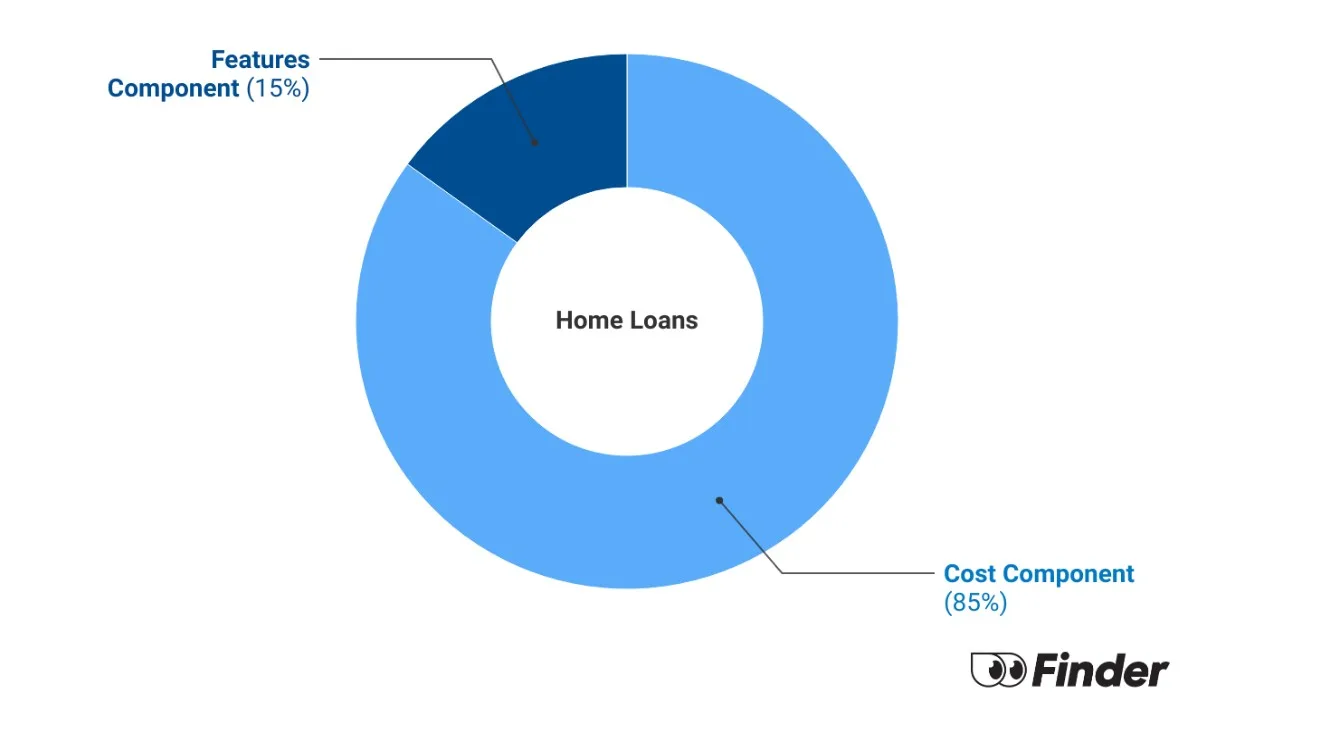
The Finder Score crunches 7,000 home loans across 120+ lenders. It takes into account the product's interest rate, fees and features, as well as the type of loan eg investor, variable, fixed rate - this gives you a simple score out of 10.
To provide a Score, we compare like-for-like loans. So if you're comparing the best home loans for cashback, you can see how each home loan stacks up against other home loans with the same borrower type, rate type and repayment type. We also take into consideration the amount of cashback offered when calculating the Score so you can tell if it's really worth it.
Account fees: Some lenders offer an offset account with a monthly or annual fee attached. Take this into consideration when looking at your loan options. There are many lenders that will offer an offset account without a fee.
Higher interest rate: You might find that taking out a loan with an offset account adds additional basis points to your interest rate.
Some lenders will charge higher interest rates for the inclusion of an offset account. Some lenders will also charge fees to maintain an offset account, which will increase the comparison rate.
It's hard to time the sale of your old home so that it lines up with the purchase of a new one. And until your home sells, you may not have a deposit to cover the new purchase. Many buyers in this situation take out a bridging loan.
But if you have an offset account and you've been making regular payments, you may have access to enough savings to withdraw and use as a deposit on your next property.
Let's say you decide to convert your current home into an investment property while you buy a new home. If you have paid off most of your mortgage, that means you won't have many interest expenses to claim at tax time. You could then end up paying extra tax as the rental income you receive for your investment property will be added to your own taxable income.
However, if you put your savings into an offset account instead of making extra repayments towards your loan, you can withdraw those savings at any time. This means you'll be paying maximum interest again, all of which is tax deductible on an investment loan. You can then use your savings to help you purchase your new owner-occupied home.
You can certainly get an offset account with a variable loan. In fact, the majority of loans that come with offset accounts on Finder's database are variable rate loans.
A 100% offset is where 100% of the money you have in your account is offset against your remaining home loan balance. That means every dollar saved is reducing the interest you're paying. This is in contrast to a partial offset, where only a portion of your offset account balance is used.
As an offset account is directly connected to your loan, you will need to open a new offset account if you are refinancing to a new lender.
If a home loan lets you make unlimited additional repayments, this means the lender doesn't charge any fee for making extra repayments beyond the minimum monthly repayment amount. This means you can repay the loan faster and face no penalty for doing so.
This feature is typically only found on a variable rate home loan. Some fixed-rate home loans let you make limited extra repayments of around $10–$20,000 a year. Some fixed-rate loans don't allow it at all. And you might have to pay a fee for making extra repayments.
Here's an example of how much you can save by making regular extra repayments on your home loan.
Let's say you've purchased an $800,000 home with a 20% deposit. This means you paid $160,000 for the deposit and borrowed the remaining $640,000. Your home loan is for 30 years, and your variable interest rate is 6.00%, in line with the rates in the table above as of September 2026.
This means your monthly repayments (without extra repayments) would equal about $3,837 a month.
But what if you repaid an extra $100 a month on top of that? That's only $1,200 a year extra. But if you started making these extra repayments from the start of your loan, you'd repay your loan in about 28 years instead of 30 years. And you'd pay around $58,800 less in interest over that time.
If you increased that to $250 a month, you'd repay the loan in about 25 years and 6 months while saving around $129,500 in interest.
You can use our calculator to work out how much extra repayments could save you on your home loan.
Sarah is the author of How to Raise Rich Kids. With over 20 years of experience in property, finance and investment journalism, she is a trusted expert whose insights regularly appear across television, radio and print media, including Sunrise, Channel 7 News, Bloomberg and Yahoo! Finance. She has previously served as managing editor for Your Investment Property and Australian Broker. Her expert advice has been shared in the media over 4,000 times. Sarah holds a Bachelor’s degree in Communications and a Tier 1 Generic Knowledge certification, which complies with ASIC standards.
See full bio
Sarah's expertise
Sarah
has written
260
Finder guides across topics including:
If you’re having trouble securing a home loan through traditional means, there are some government programs that might help you achieve your property goals.
Pensioners can have a tough time getting a home loan because each lender treats pension payments differently. Here are some tips you can use to find out whether or not you could get a home loan.
If you haven't sold your house yet, but want to buy your next one before the sale is completed a bridging loan may be able to help. Read on to discover how bridging finance can help.
Low doc home loans allow you to get a mortgage if you're self-employed or don't have regular payslips. check your eligibility and compare competitive offers now.
Important information about this website
Finder is a comparison service. We do not compare every product or every provider in the market.
We make money through commercial arrangements with some of the providers on this site. Products marked 'Sponsored', 'Promoted', 'Featured' or 'Advertisement' appear as a result of a commercial arrangement.
Our editorial content, product reviews and any 'Top Pick' designations are prepared independently of these commercial arrangements.
The default order of products in our tables can be influenced by commercial arrangements. You can re-sort or filter using the controls above each table.
Some content on this site may be generated or supported by AI tools. You should verify details directly with the provider.
Finder is one of Australia's leading comparison websites. We are committed to our readers and stand by our editorial principles.
Our comparison service does not include every product or every provider in the market. Some product issuers offer their products under multiple brands or through associated companies. Where we can, we identify the underlying issuer so you can compare like with like, but you should always check with the provider directly to confirm which brand you are dealing with.
Finder is a comparison website and an intermediary. We are not a product issuer and we do not provide personal financial or credit advice. When you click a link to a product, or apply for a product through our site, you deal directly with the product issuer. We may receive a referral fee, commission or other payment from the issuer if you click through, apply or take out a product. We describe these arrangements in more detail under 'How we make money' below.
Product features, fees, terms and eligibility criteria are set by the product issuer and may change. We rely on information supplied by issuers when we present product details on our site. Before you apply for or take out any product, you should confirm the details directly with the issuer.
We earn revenue from Finder in four principal ways:
Referral fees and commissions. When you click a product link, complete an enquiry form or apply for a product through our site, we may receive a referral fee, commission or other payment from the product issuer. We may also receive payment based on the volume of leads or conversions we send to an issuer.
Sponsored placements. Products marked 'Sponsored', 'Promoted', 'Featured' or 'Advertisement' appear as a result of a commercial arrangement between Finder and the issuer. These labels always indicate a paid placement. We do not use them for editorial choices.
Display advertising. Banner advertising, newsletter advertising and similar display ads on our site are paid by advertisers.
Content sponsorship. Some articles, videos and social media posts are sponsored by an issuer and are clearly labelled as such.
Our editorial opinions, product reviews and any 'Top Pick' designations are prepared independently of these commercial arrangements. A 'Top Pick' is an editorial choice made by our writers and editors based on the criteria described on each comparison page. A 'Top Pick' is not a personal recommendation and does not mean the product is appropriate for your circumstances.
If you would like to know whether we have a commercial arrangement with a specific product issuer, please contact us.
When products are grouped in a table or list, the default order can be influenced by commercial arrangements we have with product issuers. In some categories, sponsored or featured products appear in the top positions of the table by default, and are always labelled as such.
Other factors that influence default order include price, fees and features, and (where relevant) our editorial view of the product.
You can re-sort every comparison table using the controls above the table. You can filter by product features that matter to you. The order you see after re-sorting or filtering is not influenced by commercial arrangements.
Some content on this site is generated or supported by artificial intelligence tools, including our AI-powered assistant FinderBot. AI-generated content may contain errors. Please verify important information directly with the product issuer before making a financial decision. For more information about FinderBot, see the FinderBot Terms of Use and FinderBot Privacy Collection Notice.
Please read our website terms of use and privacy policy for more information about our services and our approach to privacy.
We update our data regularly, but information can change between updates. Confirm details with the provider you're interested in before making a decision.
Our goal is to create the best possible product, and your thoughts, ideas and suggestions play a major role in helping us identify opportunities to improve.