Calculate usable equity by taking 80% of your home's value then subtracting your current loan balance.
Offset accounts offer tax benefits for investors by allowing debt on your former home to become tax deductible.
Borrowing against equity increases debt and carries investment risks; seek advice from a mortgage broker and accountant.
What is equity in a property?
Equity is the difference between the current value of your property, and the amount you owe on it. You can buy a second home by using the home equity in your existing property to cover the deposit or the whole purchase amount, depending on how much equity you have. You do this by borrowing against the equity in your home.
How much equity can I borrow?
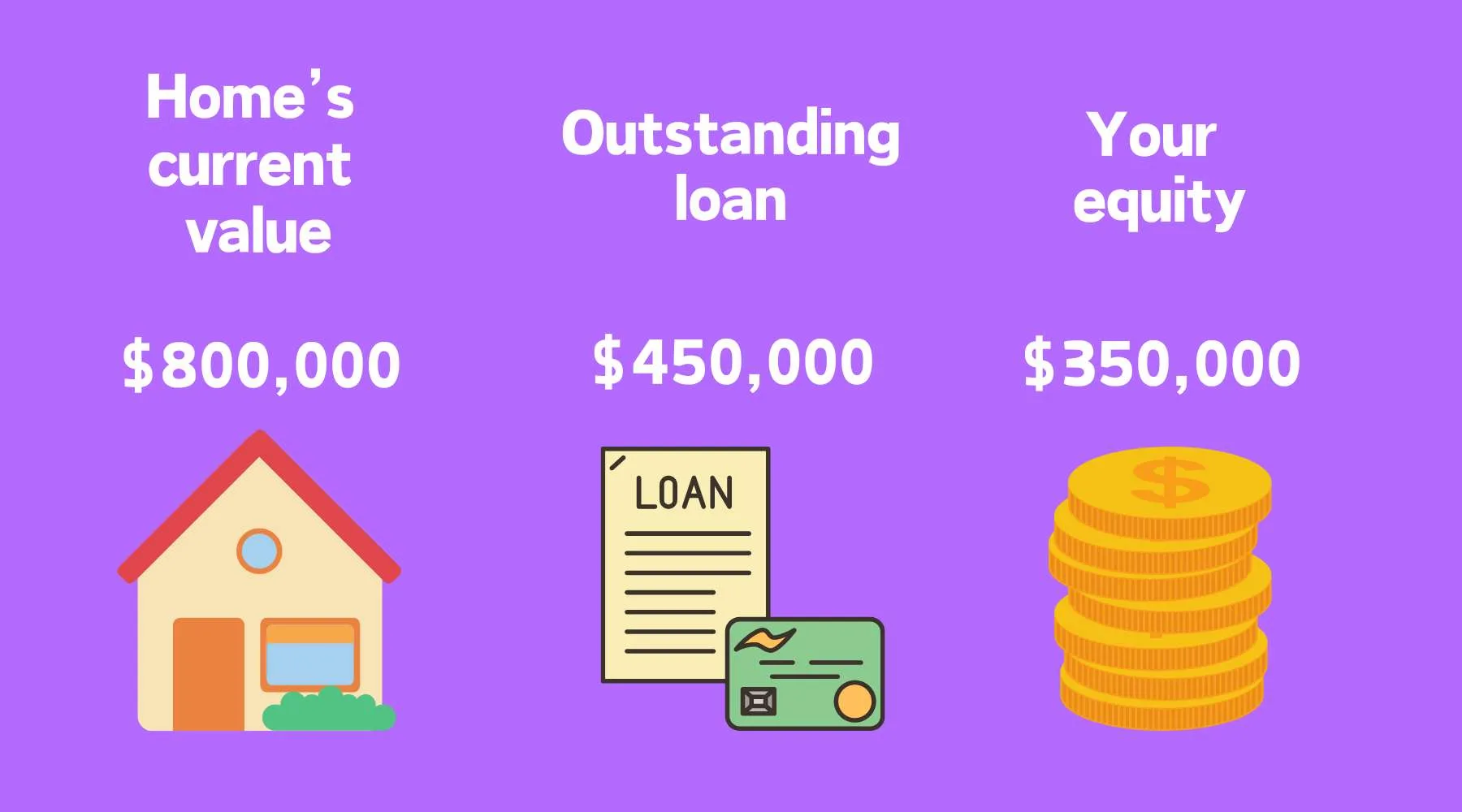
If your home is worth $800,000 and you owe $450,000 on your home loan, you have $350,000 in equity.
Equity increases in 2 ways.
When you make repayments – and pay off your loan balance each month.
Capital growth – as the property grows in value.
Lenders may let you borrow against the equity you've built in your property for a number of reasons – to renovate, to buy a car or to you invest in a second property
But lenders won't let you borrow 100% of your equity – you can usually borrow up to 80% of your equity. Also, using your equity in this way does come with risks.
How can I use the equity in my house to buy another?
Work out your property's current market value. You can get a real estate agent or valuer to give you an appraisal, or use online tools for an estimate.
Calculate 80% of the current market value.
Minus your remaining loan amount from this 80% figure.
For example:
Let's say your home is worth $800,000, and you have $450,000 left on the mortgage. This gives you $350,000 in equity.
But your usable equity is much less. 80% of $800,000 equals $640,000. And $640,000 minus $450,000 leaves you with usable equity of $190,000.
This means you could potentially borrow $190,000 to purchase a second home.
4 ways to finance your second home purchase
1. Refinancing
Refinancing means getting a new home loan. You could get a new 30-year home loan and borrow extra using your equity. You can then use this money to buy a second home.
Keep in mind that by doing this you will pay more interest because you're signing up for a new loan, and borrowing money that you've already repaid. Understand that the bank will lend on the value of your second property, so usually there will be an equity loan from your first property (20%) and then the remaining 80% lent to complete the purchase.
And depending on the cost of the second property, plus your stamp duty costs and other expenses, you may not have enough equity to cover the entire purchase.
2. Line of credit
A line of credit loan lets you access some of your home equity, up to an agreed limit. You can use as much or as little of the credit limit as you like, and only pay interest on the amount you use.
Repayments are interest-only at first, which offers tax benefits for investors. But there are some drawbacks:
Using a line of credit loan to invest in property could potentially see you managing multiple home loans: your owner-occupier home loan, the line of credit, and possibly an investment loan if your equity can't cover the whole purchase.
The interest rates can be higher than standard home loan rates.
Because you don't have to repay the loan immediately while the interest accrues to the limit of the line of credit, you'll ultimately pay more in interest.
3. Offset savings
Some borrowers make extra repayments off their home loan to build equity faster. But if your loan has an offset account you have another option.
You can put money in your offset account and build up savings over time. While the money is in your offset, it acts like an extra repayment and reduces your overall interest charges.
If the second property is an investment property, the debt is tax deductible (good debt) whereas the debt on your owner occupied property is not (bad debt). Ideally, you want to pay down the bad debt first, as there are tax benefits on your repayments for 'bad debt'.
When you're ready to buy a second property you can easily take the money out of the offset and cover the deposit or other costs.
Using your redraw facility
If your loan doesn't have an offset account but does have a redraw facility, you can access extra repayments you've made on the loan. This is another way you can access your equity.
Cross-collateralisation means using more than one property as security for multiple loans. For example, you could have a mortgage on your home, build equity in the property and then use this as security for a second loan for an investment property.
Cross-collateralisation is a risky strategy for investors. If you can't repay the investment loan, your lender could potentially force you to sell your home to recover the debt. The 2 properties are tied together in the lender's eyes. Note that some lenders will allow you to have 2 or 3 separate loans over 2 properties, but not cross securitise them.
But for a well-prepared investor, cross-collateralisation is a way to grow your property portfolio without applying for multiple loans with multiple lenders.
Risks of using your equity to buy a second property
Equity is wealth you've built up in your property. While borrowing against this equity can be a savvy investment strategy, there are risks.
Borrowing against your equity effectively means taking on more debt or extending your existing loan. This means you pay more interest. If you've been making progress on your mortgage for many years, borrowing against your equity means you're undoing that progress.
You should also understand that investing in property is a risk. Property prices don't always rise, and sometimes it can be hard to find tenants. Your property could get damaged, or unforeseen circumstances could force you to sell the property.
It's a really good idea to get the advice of a mortgage broker to structure your loan (or loans) and an accountant to maximise your tax deductions effectively.
Not everyone is buying a second home as an investment, or buying a new home and keeping their existing property as an investment. Some people just want to upgrade by selling their existing home and buying a new one.
But it's hard to get the timing right. You need to find a new property to buy, find a seller for your old home, and try to time the settlement days for each so you can have the money from the sale on hand to cover the new purchase.
If you're in this second home buying scenario you have some options to make it easier for you:
Be flexible on settlement dates. Try to be as flexible as possible with your settlement dates, and be sure to check this in advance with the people you're buying from and selling to. The longer the settlement window on your sale, the more room you have to move.
Use offset savings. If you've made significant savings through your home loan offset account you can easily pull this cash out to form part or all of your deposit. This can let you buy a second house before you've sold the first. Just keep in mind you might get stuck paying off two mortgages if you can't sell your old home fast.
Consider a bridging loan.Bridging loans are financial products designed specifically for people in this situation who are caught with a shortfall or gap between their sale and purchase settlement dates. Bridging loans can be very expensive if they need to be extended.
Finder survey: If Australians have multiple investment loans, are they all with the same lender?
Response
Yes
48.86%
I only have one investment loan
36.36%
No
14.77%
Source: Finder survey by Pure Profile of 1112 Australians, December 2023
What about tax?
For tax purposes, your home is considered your principal place of residence. You don't have to pay capital gains tax when selling your home. But if you own a second property, you will have to pay a tax on the capital gains when you sell it.
There can be some complicated tax calculations you need to work out when using your equity to buy an investment property. The ATO states: For loan interest to be a tax deduction the funds from the loan must be used to produce income. It doesn't matter whose name is on the loan - if the investment is in your name you claim all the deductions.
This means that the equity you borrow from your own home as a home loan, is tax deductible (at least, the interest is) if you use that loan to buy an investment property.
Frequently asked questions about equity in a property
You can buy a second home without cash for a deposit by using the equity in your existing property.
Equity explained Equity is the value of your property minus any debts (such as your remaining mortgage debt). For instance, if your home is valued at $750,000 and you owe $500,000 on the loan, you have built up $250,000 in equity.
Equity increases in two ways. First, you build equity by making your regular principal and interest repayments. The more you pay down the principal of your home loan, the more equity you create.
The second way equity accrues is through your home rising in value. If you paid $650,000 for your home and it's currently valued at $700,000, you would have accrued $50,000 in equity through capital growth.
Here's a more detailed example:
You bought a property in 2018 for $600,000 Your deposit was 20% or $120,000 Now the property is valued $720,000 You've paid a further $90,000 off the mortgage principal by making repayments to the loan Your equity = $330,000 Lenders will typically let you borrow up to 80% of the equity for your property to purchase a second property. So in the example above, the amount of equity you can access is actually $264,000."
The offset strategy makes even more sense if your plan is to buy a new home to live in and convert your existing home into an investment property. In this scenario you actually want the investment property (your former home) to have as much debt as possible because interest paid on an investment loan is tax deductible. Interest on a home is not.
By pulling the money out of your offset account and into your new home, your old home's loan converts to an investment loan with a larger tax deductible debt. This is only possible because of the offset account. If you'd been making extra repayments into the loan itself you wouldn't be able to pull them back out and get the same tax benefit.
This really depends on your goals, your risk profile and your financial situation. Owning a second investment property can be a great way to build your wealth, but it does come with risks. Only you can decide what the right course of action is. Your best path forward may be to seek out professional advice.
Sources
Was this content helpful to you?
Thank you for your feedback!
To make sure you get accurate and helpful information, this guide has been reviewed by
John Pidgeon, a member of Finder's
Editorial Review Board.
Richard Whitten is Finder’s Senior Money Editor, with over eight years of experience in home loans, property, credit cards and personal finance. His insights appear in top media outlets like Yahoo Finance, Money Magazine, and the Herald Sun, and he frequently offers expert commentary on television and radio, helping Australians navigate mortgages and property ownership. Richard started his career in education and textbook publishing in South Korea. He holds multiple industry certifications, including a Certificate IV in Mortgage Broking (RG 206) and Tier 1 and Tier 2 certifications (RG 146), as well as a Bachelor of Education from the University of Sydney and a Graduate Certificate in Communications from Deakin University.
See full bio
Richard's expertise
Richard
has written
794
Finder guides across topics including:
A Section 173 Agreement is a contract between a local council and a landowner about what can be done with the land. If you own property in Victoria, learn about how Section 173 Agreements work here.
A sinking fund is an essential financial plan for any strata scheme, allowing the owners’ corporation to set aside funds for future capital expenditure.
A joint home loan could be your ticket to home ownership with a spouse, friend, relative or partner. Learn more about joint home loans and compare offers today.
A property's market value helps determine how much it could sell for while a bank valuation helps a lender determine its risks, and the two values can be very different.
Important information about this website
Finder is a comparison service. We do not compare every product or every provider in the market.
We make money through commercial arrangements with some of the providers on this site. Products marked 'Sponsored', 'Promoted', 'Featured' or 'Advertisement' appear as a result of a commercial arrangement.
Our editorial content, product reviews and any 'Top Pick' designations are prepared independently of these commercial arrangements.
The default order of products in our tables can be influenced by commercial arrangements. You can re-sort or filter using the controls above each table.
Some content on this site may be generated or supported by AI tools. You should verify details directly with the provider.
Finder is one of Australia's leading comparison websites. We are committed to our readers and stand by our editorial principles.
Our comparison service does not include every product or every provider in the market. Some product issuers offer their products under multiple brands or through associated companies. Where we can, we identify the underlying issuer so you can compare like with like, but you should always check with the provider directly to confirm which brand you are dealing with.
Finder is a comparison website and an intermediary. We are not a product issuer and we do not provide personal financial or credit advice. When you click a link to a product, or apply for a product through our site, you deal directly with the product issuer. We may receive a referral fee, commission or other payment from the issuer if you click through, apply or take out a product. We describe these arrangements in more detail under 'How we make money' below.
Product features, fees, terms and eligibility criteria are set by the product issuer and may change. We rely on information supplied by issuers when we present product details on our site. Before you apply for or take out any product, you should confirm the details directly with the issuer.
We earn revenue from Finder in four principal ways:
Referral fees and commissions. When you click a product link, complete an enquiry form or apply for a product through our site, we may receive a referral fee, commission or other payment from the product issuer. We may also receive payment based on the volume of leads or conversions we send to an issuer.
Sponsored placements. Products marked 'Sponsored', 'Promoted', 'Featured' or 'Advertisement' appear as a result of a commercial arrangement between Finder and the issuer. These labels always indicate a paid placement. We do not use them for editorial choices.
Display advertising. Banner advertising, newsletter advertising and similar display ads on our site are paid by advertisers.
Content sponsorship. Some articles, videos and social media posts are sponsored by an issuer and are clearly labelled as such.
Our editorial opinions, product reviews and any 'Top Pick' designations are prepared independently of these commercial arrangements. A 'Top Pick' is an editorial choice made by our writers and editors based on the criteria described on each comparison page. A 'Top Pick' is not a personal recommendation and does not mean the product is appropriate for your circumstances.
If you would like to know whether we have a commercial arrangement with a specific product issuer, please contact us.
When products are grouped in a table or list, the default order can be influenced by commercial arrangements we have with product issuers. In some categories, sponsored or featured products appear in the top positions of the table by default, and are always labelled as such.
Other factors that influence default order include price, fees and features, and (where relevant) our editorial view of the product.
You can re-sort every comparison table using the controls above the table. You can filter by product features that matter to you. The order you see after re-sorting or filtering is not influenced by commercial arrangements.
Some content on this site is generated or supported by artificial intelligence tools, including our AI-powered assistant FinderBot. AI-generated content may contain errors. Please verify important information directly with the product issuer before making a financial decision. For more information about FinderBot, see the FinderBot Terms of Use and FinderBot Privacy Collection Notice.
Please read our website terms of use and privacy policy for more information about our services and our approach to privacy.
We update our data regularly, but information can change between updates. Confirm details with the provider you're interested in before making a decision.
Our goal is to create the best possible product, and your thoughts, ideas and suggestions play a major role in helping us identify opportunities to improve.