A personal loan can usually be used for a number of worthwhile personal reasons, like making a large purchase, completing home improvements, or consolidating debt.
Personal loan interest rates are often personalised depending on the borrower's credit score, which is why there are minimum and maximum rates for each loan.
You can choose between a secured or unsecured personal loan: a secured personal loan usually has lower interest rates, but you put an asset at risk.
Finder's picks for the best personal loans for September 2026
The crème de la crème of personal loans. These products offer the lowest cost loans accompanied by the best features.
7+
Great
Slightly higher in cost and fewer features, but these products are still competitive.
5+
Standard
Typically offering above average rates and possibly lacking in the features department.
0+
Basic
The least competitive in terms of both cost and features.
What is a personal loan?
A personal loan is money that you borrow to cover the cost of expensive purchases such as a holiday, a car, a renovation, a wedding or medical bills. You repay the loan, plus interest and fees, over time.
Personal loan amounts can often be anywhere from a few hundred dollars up to $100,000. Typically, personal loans are used for larger expenses that can't easily be covered by your savings or other forms of borrowing like Buy Now Pay Later or a credit card, which are usually used for smaller costs.
The features of a personal loan
Loan terms. Usually 1 to 7 years.
Personalised interest rates. Many lenders determine your personal loan interest rate based on your credit score, income and other factors.
Loan purpose. A personal loan can be used "for any worthwhile purpose". But you can't use a personal loan to gamble or invest.
How do I compare personal loans?
1
Look for a lower interest rate
The lower the rate, the less interest you pay. You can choose loans with fixed or variable interest rates. Personal loans offer personalised interest rates tailored to your credit score, so the minimum advertised rate may not be what you're offered.
2
Look for a loan with lower fees
Factor in the cost of any application or establishment fees, plus the ongoing monthly service or account fee. You can spot a loan with high fees by looking at the comparison rate.
3
Consider your loan size
You won't be able to borrow $30,000 if the lender's maximum loan amount is $25,000.
4
Decide your loan term
Most lenders offer terms of 1 to 7 years. Longer terms mean lower monthly repayments but you end up paying more interest. Shorter terms mean less interest and you'll pay off the loan faster, but you pay more each month.
5
Look at the features included
Some lenders let you repay the loan faster, so you can get out of debt quickly. Some even let you redraw those extra repayments to spend in an emergency. Other popular features include a lender's app, which can make it easier to track and manage your debt.
6
Keep an eye out for sneaky extra costs
Be aware if any break fees or early repayment fees apply to your personal loan in the event you pay out your personal loan earlier than the original loan term.
Compare personal loans in under a minute
No contact details required
How your credit score affects your personal loan rate
Most lenders in Australia use risk-based pricing for personal loan interest rates. Every borrower gets a different rate based on their credit score and their own circumstances.
If you have an Excellent credit score you can get a lower interest rate. If your score is Good or Average the rate will be higher.
You can check your credit score for free through Finder before applying for a personal loan. If you have an Average or Bad credit score you can improve it before applying for credit.
How do I know what my personal loan repayments will be?
Because your rate will be personalised it's best to get a quote from a lender once you are comfortable you fit its eligibility criteria. That quote should include the interest rate you are offered, as well as any fees.
When you have that information, use a personal loan calculator to be able to confidently tell what your repayments will be.
Compare personal loan types
Unsecured personal loans
Unsecured personal loans mean you're still responsible for repaying the loan, but you don't have to offer a car, property or other asset as security for the loan. This usually means a slightly higher rate.
Secured personal loans
A personal loan secured by an asset, such as a car, term deposit or home equity. If you fail to repay the loan, the lender can take the asset. Secured loans often have lower rates and better terms since the risk to the lender is lower.
Car loans
While you could buy a car with a typical personal loan, rates are often better if you specifically take out a car loan. You can buy a car with a secured or unsecured loan, depending on the car you're buying. Banks and lenders offer car loans, and so do many car dealers.
If you have a bad credit score and a history of financial trouble you can still get a personal loan. Bad credit personal loans have higher rates, so be careful when taking one out as they are not long-term financial solutions.
Before getting a personal loan you should always check that you can afford the personal loan repayments and ask yourself whether you really need the loan.
If you are in a financial emergency, you should understand that taking out a loan may trap you in a cycle of debt. For more resources and support, visit the Australian government's MoneySmart website.
Alternatives to personal loans
Personal loans are suited to borrowers looking to fund specific, one-off purchases or expenses, like a car, a wedding or a holiday. But there are other forms of credit that borrowers can use.
But remember that some of these options may be riskier and more expensive than a personal loan.
Credit cards.A credit card lets you spend money flexibly, up to an approved limit, and pay it off over time. If you manage your card well, it can be a good form of credit. For smaller purchases it could be cheaper than a personal loan. But if you don't stay on top of your repayments, you'll end up paying a high interest rate month after month.
Buy now pay later (BNPL). Many Australians use BNPL to cover small purchases in a similar way to a credit card. BNPL services are easy to use and don't charge interest, which can be a trap. You have to pay fees, and if you miss repayments then you'll get hit with more fees.
Pay on demand.Pay-on-demand platforms let you access a portion of your salary before payday, but you'll pay a fee to do so. This might be a convenient short-term solution but if you find yourself repeatedly accessing your salary early and paying a fee to do so, you could find yourself falling further behind financially.
Payday loans. These are short-term loans limited to $2,000. They are an emergency option but an expensive one. Payday lenders don't charge interest but instead charge hefty fees.
How much are Aussies borrowing?
According to Finder's Consumer Sentiment Tracker, there's a distinct difference between the amount of debt carried by different generations. While Gen X have an average of $9,346 in debt, millennials have $7,861 and the younger Gen Z has $5,473 in personal loan debt.
Compare personal loan products. You can use our table to find one that suits your needs and has a low interest rate.
Check the lender's eligibility criteria. There's no point applying for a loan you can't get. Make sure you meet the employment, residency and income requirements.
Check your credit score and get a quote. Knowing your credit score helps set your expectations for what interest rate you'll be offered and helps you spot ways to improve your score. Lenders can also provide quotes to give you an idea of your loan.
Submit your application. You'll need some ID and details about your income, spending and employment.
Wait for approval. Most lenders can process a personal loan application within 1 business day. Some can do it in hours.
Documents you need for your personal loan application
ID. A driver's licence, Medicare card, passport or birth certificate.
Proof of income. Payslips, bank statements, a tax return or letter of employment.
Other debts. You may need to provide an account statement from other debts you have, including loans or BNPL accounts.
Security. If the loan is secured you'll need to provide some details about the car or asset offered as security. This can include a tax invoice from a car dealership and evidence of a car insurance policy.
"When I took a personal loan recently it was a smooth and quick experience. I was approved for the loan with the repayments I was happy with. One thing that helped me out was knowing early on what I can afford to pay on the loan."
Raj Lal
Publisher
FAQs about personal loans
The average interest rate for unsecured personal loans in Australia is 10.9% p.a. (as of September 2026). This is the average rate taken from Finder's database, based on an individual with Excellent credit.
Your own credit score, and therefore the rates you are offered, may differ.
There's no simple answer for which bank is best for your personal loan. Your credit score and relationship with the bank will impact the rate you are offered. Comparison tables can help you understand the full interest rate ranges banks offer. It's best to see which is offering the lowest rates, check to see if you match its eligibility criteria and then get a quote. It may also be worth looking at non-bank lenders, as they operate under the same regulation as banks and can have more competitive rates.
For a quicker answer, Finder has done its own research into our top picks for the best personal loans.
Whether you get a personal loan from a Big Four bank, a smaller lender or an online lender, you'll most likely be applying online anyway.
Here are your main lender options:
Big Four banks. If you already bank with CommBank, Westpac, NAB or ANZ then it can be easier to get a personal loan approved. And you'll have all your accounts in one place. Keep in mind that the Big Four may have less competitive rates than online lenders.
Other banks and institutions. Smaller than the Big Four, banks like ING, Bendigo Bank, Bank of Queensland and many others offer personal loans. Then there are financial service companies like Latitude that specialise in personal lending.
Online lenders. There are many online lenders that offer personal loans with fast approval times and competitive interest rates. Examples include Humm, Harmoney, Now Finance and Wisr.
Credit unions. These member-owned organisations are similar to banks but are often more local and smaller. Credit unions offer personal loans that sometimes have quite competitive rates. Some offer online service while many have physical branches in certain towns and cities.
Most unsecured loans offer amounts between $2,000 and $50,000, though some unsecured lenders go up to $100,000; secured loans also reach $100,000.
A good unsecured personal loan interest rate is around 6–15% for people with an Excellent credit score. Personal loans use your credit score to determine the rate, with higher scores leading to lower rates. As a guide, Finder analysis shows most Australians have a Good or Very Good credit score.
An Australian credit score of 550 is generally the minimum you need to qualify for a personal loan. This will likely be an expensive loan, as most Australian lenders use risk-based pricing.
Lower credit scores could qualify for payday or short term loans, though these will be more expensive than even a bad credit personal loan.
It usually takes a few business days to get the money from a personal loan once your application is approved, but it does vary.
Some banks are able to offer existing customers same-day personal loans.
Some payday lenders also offer 1-hour turnarounds but these loans come with risks including higher interest rates and fees.
There is no way to guarantee you're approved for a loan, but there are some key steps you can take before you apply:
Work out how much you can borrow. Lenders have criteria to decide how much you're eligible to borrow, but you also need to understand what is realistically affordable for you.
Maintain a good credit score or improve it. A lower credit score can reduce your chances of getting approved or mean you are offered a higher interest rate. If you already have a poor credit score, you can start improving it by limiting credit applications, paying bills on time and bringing down any limits on your credit card. It can take a while, but these are all good tactics to improve that credit score.
Keep track of your saving goals. If you manage to contribute to your savings regularly, it shows lenders that you are likely to manage ongoing loan repayments.
The lowdown on Finder Score
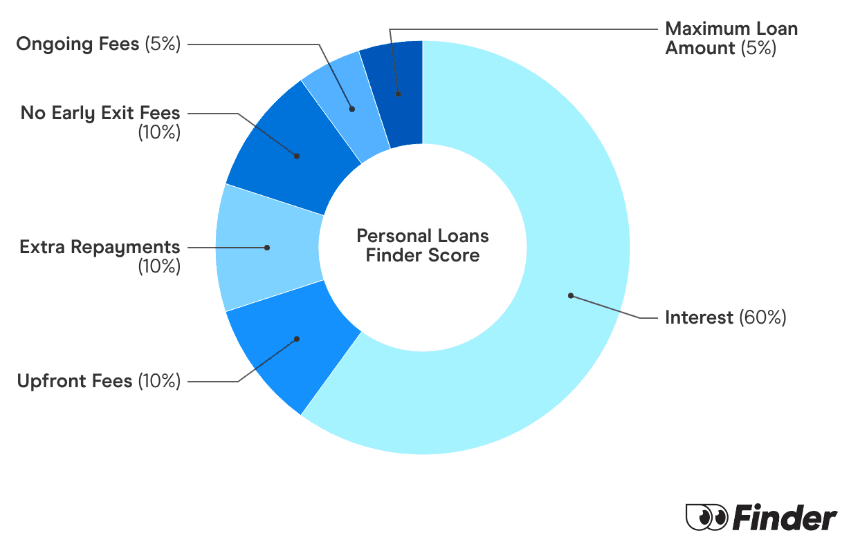
Wondering how we work out Finder Score? We look at 180+ personal loan products across 120+ lenders and we compare them against each other to get our simple score out of 10. Metrics like interest rates, fees and features are weighted and scaled to come up with individual Finder Scores. To give a fair and true personal loan comparison, unsecured and secured personal loan products are scored separately.
The Finder Score methodology is designed by our awesome insights team and reviewed by our just-as-awesome editorial team. Don't worry, commercial partners carry no weight and all products are reviewed objectively.
Finder Scores explained
9+ Excellent - The crème de la crème of personal loans. These products offer the lowest cost loans accompanied by the best features.
7+ Great - Slightly higher in cost and fewer features, but these products are still competitive.
5+ Satisfactory - Typically offering above average rates and possibly lacking in the features department.
Less than 5 – Basic - The least competitive in terms of both cost and features.
Personal loans - score weightings
Feature
Assessment
Weight
Interest
Interest is calculated on a loan amount of $15,000 over a 5 year term. Interest is calculated for a customer using the advertised minimum rate.
60%
Upfront Fees
Application and establishment fees on a $15,000 loan
Richard Whitten is Finder’s Senior Money Editor, with over eight years of experience in home loans, property, credit cards and personal finance. His insights appear in top media outlets like Yahoo Finance, Money Magazine, and the Herald Sun, and he frequently offers expert commentary on television and radio, helping Australians navigate mortgages and property ownership. Richard started his career in education and textbook publishing in South Korea. He holds multiple industry certifications, including a Certificate IV in Mortgage Broking (RG 206) and Tier 1 and Tier 2 certifications (RG 146), as well as a Bachelor of Education from the University of Sydney and a Graduate Certificate in Communications from Deakin University.
See full bio
Richard's expertise
Richard
has written
794
Finder guides across topics including:
Do you need to cover the costs of an elective surgery or unexpected medical bill? Compare a range of personal loans for medical expenses and cosmetic procedures.
Having too much debt and too many monthly repayments can be very stressful. Consolidating your debt with Fox Symes Debt Solutions can be a way to help you manage your debt.
Finder is a comparison service. We do not compare every product or every provider in the market.
We make money through commercial arrangements with some of the providers on this site. Products marked 'Sponsored', 'Promoted', 'Featured' or 'Advertisement' appear as a result of a commercial arrangement.
Our editorial content, product reviews and any 'Top Pick' designations are prepared independently of these commercial arrangements.
The default order of products in our tables can be influenced by commercial arrangements. You can re-sort or filter using the controls above each table.
Some content on this site may be generated or supported by AI tools. You should verify details directly with the provider.
Finder is one of Australia's leading comparison websites. We are committed to our readers and stand by our editorial principles.
Our comparison service does not include every product or every provider in the market. Some product issuers offer their products under multiple brands or through associated companies. Where we can, we identify the underlying issuer so you can compare like with like, but you should always check with the provider directly to confirm which brand you are dealing with.
Finder is a comparison website and an intermediary. We are not a product issuer and we do not provide personal financial or credit advice. When you click a link to a product, or apply for a product through our site, you deal directly with the product issuer. We may receive a referral fee, commission or other payment from the issuer if you click through, apply or take out a product. We describe these arrangements in more detail under 'How we make money' below.
Product features, fees, terms and eligibility criteria are set by the product issuer and may change. We rely on information supplied by issuers when we present product details on our site. Before you apply for or take out any product, you should confirm the details directly with the issuer.
We earn revenue from Finder in four principal ways:
Referral fees and commissions. When you click a product link, complete an enquiry form or apply for a product through our site, we may receive a referral fee, commission or other payment from the product issuer. We may also receive payment based on the volume of leads or conversions we send to an issuer.
Sponsored placements. Products marked 'Sponsored', 'Promoted', 'Featured' or 'Advertisement' appear as a result of a commercial arrangement between Finder and the issuer. These labels always indicate a paid placement. We do not use them for editorial choices.
Display advertising. Banner advertising, newsletter advertising and similar display ads on our site are paid by advertisers.
Content sponsorship. Some articles, videos and social media posts are sponsored by an issuer and are clearly labelled as such.
Our editorial opinions, product reviews and any 'Top Pick' designations are prepared independently of these commercial arrangements. A 'Top Pick' is an editorial choice made by our writers and editors based on the criteria described on each comparison page. A 'Top Pick' is not a personal recommendation and does not mean the product is appropriate for your circumstances.
If you would like to know whether we have a commercial arrangement with a specific product issuer, please contact us.
When products are grouped in a table or list, the default order can be influenced by commercial arrangements we have with product issuers. In some categories, sponsored or featured products appear in the top positions of the table by default, and are always labelled as such.
Other factors that influence default order include price, fees and features, and (where relevant) our editorial view of the product.
You can re-sort every comparison table using the controls above the table. You can filter by product features that matter to you. The order you see after re-sorting or filtering is not influenced by commercial arrangements.
Some content on this site is generated or supported by artificial intelligence tools, including our AI-powered assistant FinderBot. AI-generated content may contain errors. Please verify important information directly with the product issuer before making a financial decision. For more information about FinderBot, see the FinderBot Terms of Use and FinderBot Privacy Collection Notice.
Please read our website terms of use and privacy policy for more information about our services and our approach to privacy.
We update our data regularly, but information can change between updates. Confirm details with the provider you're interested in before making a decision.
Our goal is to create the best possible product, and your thoughts, ideas and suggestions play a major role in helping us identify opportunities to improve.