Compare Income Protection Policies
Income protection keeps cash flowing within your household when you can no longer work. Compare policies and get a quote today.


Life is never linear and many of us often find ourselves in situations we never saw coming. Income protection insurance can give you one less thing to worry about.
Income protection pays a monthly wage if you need to take time off work due to a sudden accident or illness. Most insurers will pay up to 70% of your pre-tax income. They'll also set a maximum benefit, usually around $10,000 monthly.
The payouts from income protection can help you meet regular expenses, such as your mortgage or rent and groceries. It can also maintain your family's lifestyle while you focus on your recovery.
You can compare a range of income protection insurance policies below to find the right fit for your circumstances.
We currently don't have that product, but here are others to consider:
How we picked theseIncome Protection is a little complicated and a lot overwhelming. That's why we made the Finder Score, to make it easier to compare Life Insurance products against each other. Our experts analysed over 12 products and gave each one a score rank out of 10.
But a higher score doesn't always mean a product is better for you. Your situation is unique, so your policy choice will be too. Don't think of Finder Score as the final word, but as a good place to start your life insurance comparison.
Determining how much income protection insurance you need can be tricky. After all, you want to properly financially safeguard yourself and your loved ones, so they can continue to live a comfortable lifestyle.
One of the best places to start when considering how much cover you need is to draft a budget of all your monthly expenses. This will paint a clear picture of how much you'd need to stay on top of expenses. You may also want to consider adding a little bit extra to add to your super.
That said, it's also worth investigating whether you already have some form of income protection through your super.
When comparing income protection policies, there are a few key features that can make a big difference in how useful the insurance is for you, including:
Choosing the right income protection policy is a big decision, as having the right cover by your side can make all the difference. That's why Finder conducts an annual analysis into the best performing products in the market across income protection policies.
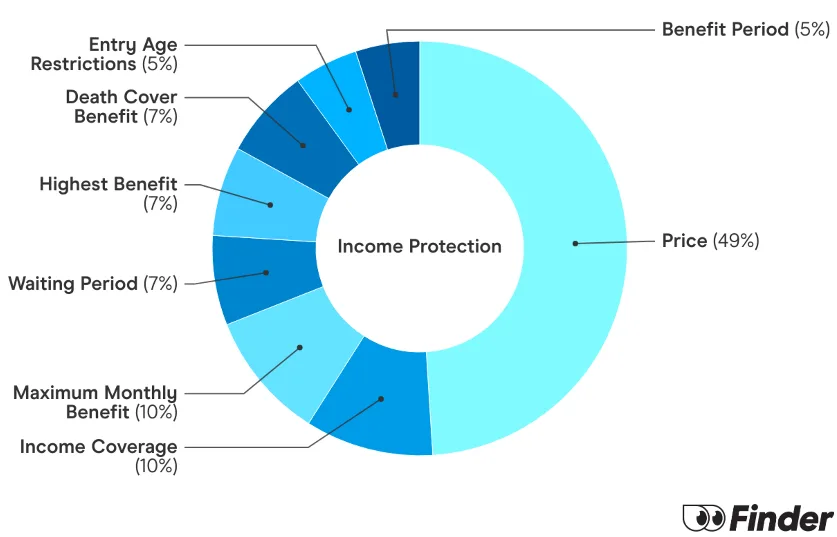
Our experts looked at 7 key features across 21 insurers to determine which policies had top of the range cover and provided exceptional value to customers.
For 2026, NobleOak received a Finder Award for Best Income Protection. The insurer offers an impressive maximum monthly benefit while keeping prices affordable for customers.
We also passed out 2 Highly Commended Awards to TAL and Suncorp for its policies, making both a worthy contender for Aussies seeking cover.
Income protection can be a valuable form of cover for Australians when its features are fully understood.
Find out what is and isn't covered by AAMI Income Protection and how to apply.
Income protection for couples ensures your partner isn't hurt financially if you are temporarily unable to work due to illness or injury.
Although income protection and personal accident cover both provide you with income replacement, there are key differences. Read on and compare.
Income protection provides you with income replacement for sickness and illness but not for pregnancy. However, it does offer features to help you out during pregnancy.
Salary continuance and income protection both serve to replace income in the event of injuries and illness. However, there are some key differences to know about.
Life insurance and income protection serve two different purposes but can both offer valuable cover alone and when combined.
What are the key differences between income protection and WorkCover? If you already have WorkCover why would you still consider income protection?
Income protection insurance are generally tax-deductible, so read on to find out when premiums are tax-deductible and how much you can claim.
Find out how much your income protection insurance policy will pay out in the event of a claim. Receive quotes for income protection and apply securely.