Finder’s RBA Survey: 1 in 3 experts say there’s no cost-of-living crisis


Key takeaways
- Most experts expect the RBA to hold the cash rate at 4.35% in August.
- 35% say Australia is not in a cost-of-living crisis.
- Finder's Cost of Living Pressure Gauge currently sits in the extreme range at 81%.
The nation's experts have weighed in on the cost-of-living ahead of tomorrow's cash rate decision from the RBA.
In this month's Finder RBA Cash Rate Survey™, 38 experts and economists weighed in on future cash rate moves and other issues relating to the state of the economy.
The majority of panellists (92%, 35/38) expect the RBA to hold the cash rate on Tuesday, keeping it at 4.35%.
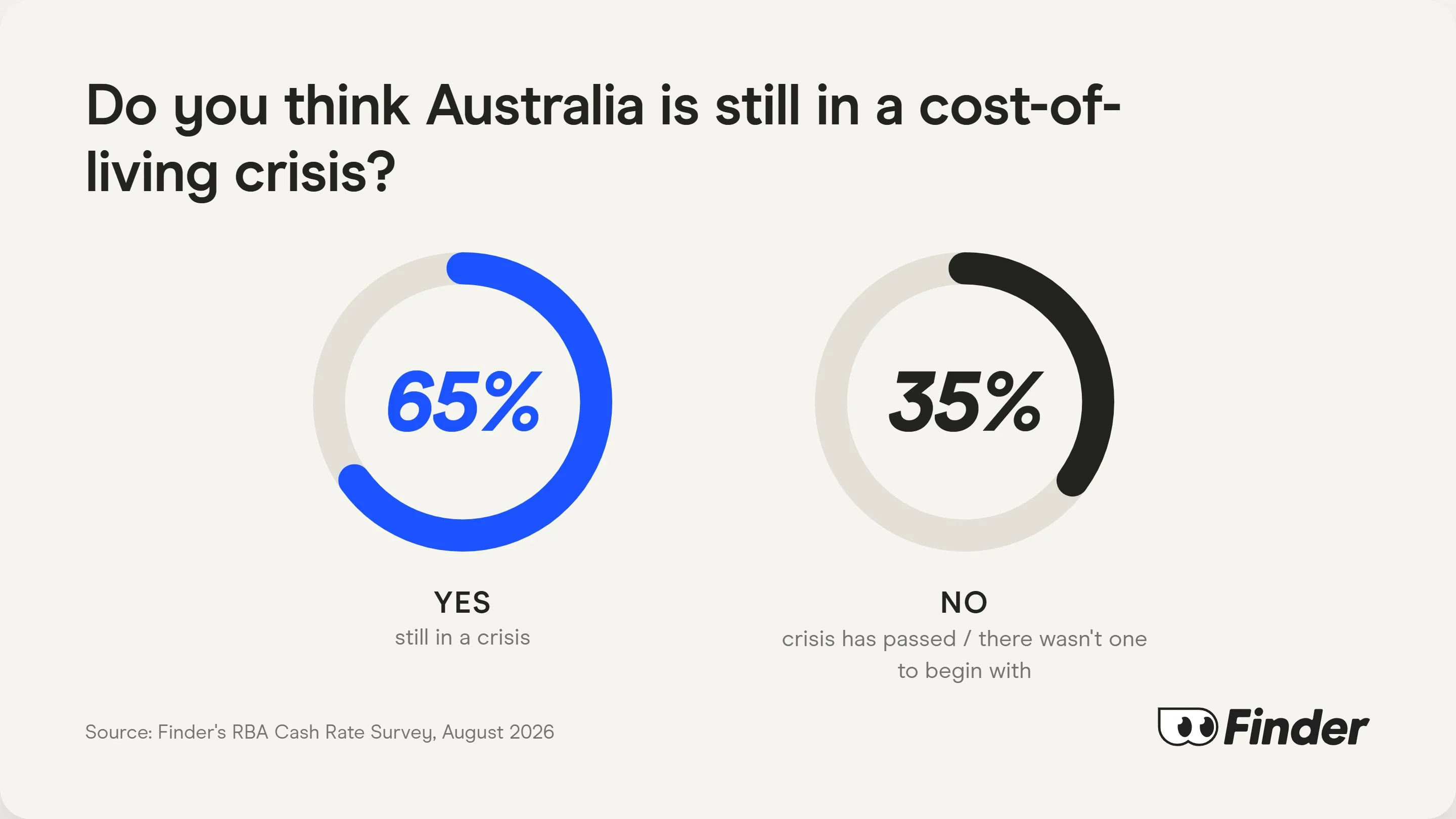
On the topic of cost-of-living, more than 1 in 3 (35%) experts say Australia is not in a crisis.
Finder's Cost of Living Pressure Gauge measures the financial stress experienced by Australian households; it currently sits in the extreme range at 81% in June 2026, unchanged from the previous month.
Richard Whitten, money and home loans expert at Finder, said Aussies were undeniably feeling the squeeze.
"Macroeconomic indicators might be cooling on paper, but millions of people are still confronted with very high housing costs and expensive everyday bills.
"House prices are finally starting to fall, but everything else has only become more expensive. For borrowers with big mortgages and Australians on low incomes, the cost of living is a massive challenge.
"Our latest research shows that 43% of Australians have less than $1,000 in savings," Whitten said.
Experts were asked: Do you think Australia is still in a cost-of-living crisis?
Here's what some of the panellists had to say:
Stephen Miller from GSFM: No. "Crisis" is overblown. It has cost-of-living challenges brought on by long-term neglect by governments (State and federal; Labor and Coalition) of productivity enhancement and an ignorance of regulatory burdens on businesses and ultimately consumers.
Saul Eslake from Corinna Economic Advisory Pty Ltd: No. While I absolutely recognize that some households - including in particular those on low wages, and those with big mortgages - are "doing it tough", I think the word "crisis" exaggerates the circumstances confronting a majority of Australian households. Maybe that's because I'm old enough to remember the double-digit inflation, unemployment and interest rates of the late 1970s and 1980s.
Jeffrey Sheen from Macquarie University: No. The level of prices of goods and services seem too high to many lower income households. However real wages are gradually trending upwards, and hopefully this will continue. Inflation of these prices is actually modest, even if still above the RBA's target range of 2-3%. So Australia does not have a crisis in the cost of living.
Mala Raghavan from the University of Tasmania: Yes. Australia is still experiencing a cost-of-living crisis, with housing and services inflation remaining persistently high. As these categories constitute a significant proportion of household spending, continued price pressures are reducing affordability, weakening real household incomes, and constraining living standards.
Scott Kuru from Freedom Property Investors: Yes. Don't take my word for it. Ask people at the supermarket checkout, the petrol station or the ones queuing up at rental inspections. They're the ones that will tell you it ain't all unicorns and rainbows.
Stella Huangfu from the University of Sydney: Yes. While inflation has slowed a bit, the cost of living remains a significant challenge because prices are still much higher than before the inflation surge. Many households continue to face pressure from elevated housing costs, higher mortgage repayments and increased prices for essential goods and services. Inflation is easing, but affordability has not yet fully recovered.
Graham Cooke from Aussie Insights (and creator of Finder's Cost of Living Pressure Gauge): Yes. Whether it's a crisis depends on your definition. Inflation is cooling and housing is becoming more affordable, so the extremes have certainly eased. However, with groceries and fuel still expensive, households are still facing significant cost-of-living pressures.
Shane Oliver from AMP: Yes. Since 2021 prices are up around 25% and wages are only up about 19%, so real wages have fallen.
Kyle Rodda from Capital.com: Yes. Real wage growth is negative. Living standards are still on the slide for most people.
Ask a question