CBA, Westpac say home loan applications are plummeting


Key takeaways
- CBA announced a 15% decline in home loan applications since May, when the federal government removed investor-friendly tax rules.
- Westpac has seen a 20% drop in home loan applications over the same period.
- What's next: Property prices have fallen nationwide in the last two months. Further falls seem likely.
Australia's big banks are raking in profits, but their loan portfolios are starting to shrink as housing affordability measures from the May budget have started to work.
Or not work, depending on who you ask.
The Commonwealth Bank announced a $10.9 billion profit in its 2026 financial year profit announcement today.
But home loan applications with the nation's largest bank have fallen 15% since May, when the federal government scrapped negative gearing and the capital gains tax discount.
Loan application volumes are down 17% from the 2025 financial year.
Investor loans are down 28%, while loans to home buyers are down 9%.
Westpac announced a 20% decline in home loan application volumes over the same period.
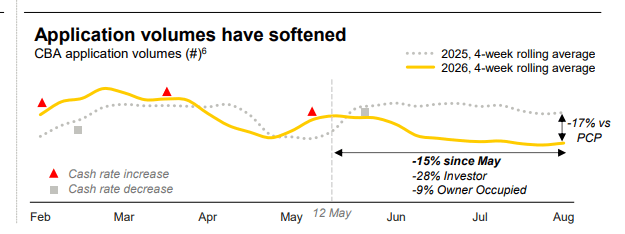
Source: CBA FY26 profit announcement
Housing affordability is improving
In May, the federal government ended the capital gains tax discount and scrapped negative gearing, two policies that heavily favoured property investors.
For critics and investors, this is a growth-killer. A bigger tax on all investors and a move that will hamper housing affordability in the long run by lowering supply.
Supporters argue it's a long-overdue correction that will cool an over-heated housing market and reduce investor activity. So far, it's hard to argue against this.
CBA's drop in investor lending since May is stark. And Australian property prices saw a 0.7% nationwide decline last month, with prices now falling month-on-month in Sydney, Melbourne, Canberra, Brisbane and Adelaide.
Rising rates are a factor too
Rising interest rates are another factor likely driving lending activity downward. The Reserve Bank has lifted the cash rate three times in 2026.
And CBA noted in its outlook that "higher interest rates and inflation [are] placing uneven pressure on household incomes and economic activity," but that "application volumes appear to have stabilised in recent weeks."
By making it more expensive to borrow money, households have less to spend on property (and everything else).
In some respects, lowering house prices is the plan, according to both government tax policy and the RBA's rate decisions. Housing costs are a big component of the inflation rate, which is finally starting to fall, albeit slowly.
44% of the economists Finder surveys each month are still predicting another RBA rate hike by the end of the year. This could lower prices even further.
Sources
Ask a question