Finder Parenting Report 2026
Following a cost of living crisis that won't let up, Finder’s Parenting Report explores how Australians are raising their children in 2026.

In 2026, we're keen to know how Australian families with kids under 13 are spending, saving and planning – 5 years on from our 2021 report.
Australian family life looks quite different. Some changes were predictable, though longer than expected (hello, cost-of-living crisis) and some were a little more surprising. Money pressure is now shaping everything from when people decide to have kids, to how many they have and how long parents take off work.
We surveyed 1,008 Australian parents with kids under 13 to get a real-world snapshot of modern parenting and money: how families prepared financially before having children, whether they went public or private for healthcare, how much parental leave they actually took, and what impact it had on their careers.
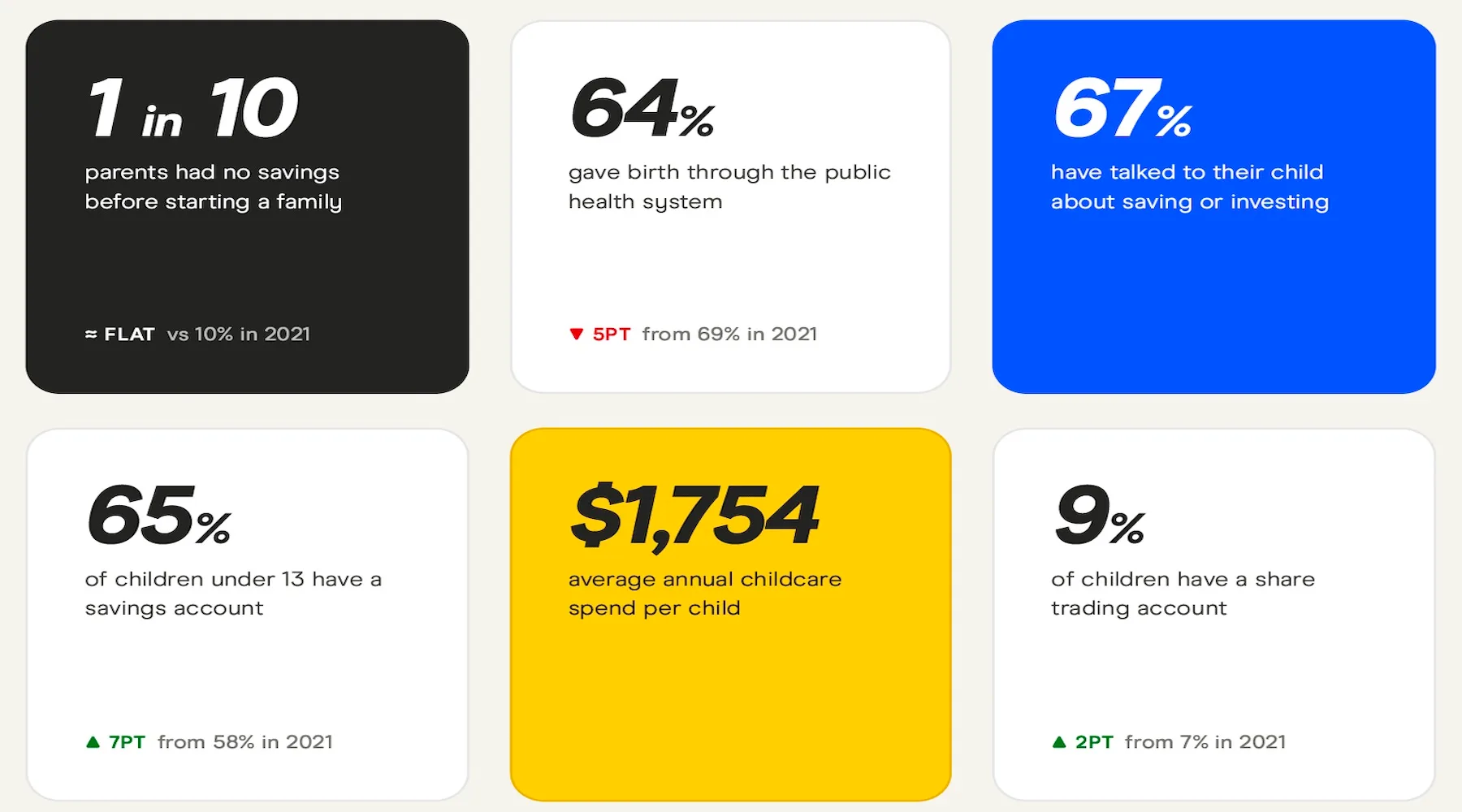
Families are in roughly the same shape as 2021, although a widening gap is emerging between parents who delay having kids until they're financially established, and those who don't have the option to wait.
Almost 1 in 10 parents admit they had no money saved before having their first child, while 28.9% started a family with $25,000 or more in the bank.
Most parents cobble together paid and unpaid leave to get as much time out of the workforce as possible. The reality for most families is a combination of both is needed, and just over half of parents feel that taking leave left a measurable mark on their career or finances.
Parents on average took 3.5 months of paid leave and 3 months of unpaid leave.
Employer super usually pauses or shrinks during unpaid leave — and that's where the long-term wealth gap opens. If you can, salary-sacrifice or make a small after-tax contribution; even $150 a month compounds over 30 years. Before you go, agree with your manager — in writing — on what re-entry looks like: workload, hours and the projects you'll pick back up.
Parents are talking about money more than ever. A clear majority of parents have had a conversation with their child about saving or investing, which is a marker of how seriously today's parents take financial literacy.
67% of parents have talked to their child about saving or investing money, and 3 out of 4 kids under the age of 13 receive some sort of pocket money.
Our research found that the total average annual spend per child was $8,472, across seven main categories: food, childcare, clothing, sports, health, school excursions and tutoring.
Food is the single biggest line item at $3,305 per year, followed by childcare ($1,754).
Sarah Megginson – leader editor and author, How to Raise Rich Kids
"I'm so encouraged to see how many parents are talking openly with their kids about money and investing. Many people find the concept of investing scary, as they weren't taught much about it in school and they weren't lucky enough to learn it from their parents or other loved ones in their life. But the more we talk, share information, learn and educate, the more options we create to understand our money and work towards our goals.
We have a team of editorial and data experts at Finder, committed to producing data-driven stories and reports filled with insightful analysis. We produce Finder's monthly Consumer Sentiment Tracker, RBA Cash Rate Survey and the research that powers Finder Awards programs, as well as several in-depth reports each year.
We do more than just crunch numbers and churn out reports. Our work is rooted in facts and data, and drives national media conversations that aim to inform and educate. Dive into our research-based topics, crafted to assist, enlighten and inform Aussie consumers here.
Compare Ubank Save and Up Bank Saver accounts. See rates, features, fees and which suits you best.
Compare ING Savings Maximiser and Ubank Save Account. See rates, features, fees and which suits you best.
Here are a few different ways to save money automatically without lifting a finger, including using round up savings apps and tools.
NAB vs Commonwealth Bank: which bank offers the best accounts for Australian savers?
Gift savings accounts are just the beginning for starting kids off on the right track to a secure financial future.
See historical interest rates for savings accounts since January 2012.
Looking for the best bank in Australia? Let's take a look at the bank accounts offered by the big banks and see how they stack up against others in the market.
International banking transactions can be made easy with the help of a multi currency account. If you find that you are consistently trying to manage currencies other than the Australian dollar, then consider banking your money in this type of account.
As you approach retirement age, managing a fixed income can be a cinch with a pensioner high interest savings account for the flexibility you need.
If you need help getting your savings back on track, a bonus saver account with competitive interest may provide you with the incentive and features you need.
