SpaceX IPO: a space investment that’s really an AI investment


Key takeaways
- SpaceX has announced plans to go public as early as June 2026, allowing ordinary retail investors to get a piece of the action.
- It will likely be the largest initial public offering (IPO) in history, and could make Elon Musk a trillionaire.
- What's next: SpaceX's IPO filing shows that it's not really a space company but a huge AI bet.
SpaceX wants to go public. Elon Musk's space company filed an S-1 form with the US Securities and Exchange Commission.
If and when the initial public offering (IPO) is approved, retail investors will be able to buy shares in a company that has pioneered reusable rockets and led the private space industry.
Could this be the largest IPO in history?
SpaceX is currently valued at somewhere between $1.75 and $2 trillion USD. This includes SpaceX itself, plus Starlink and xAI.
By going public, the company could raise up to $80 billion. That would make it far and away history's biggest IPO.
SpaceX posts revenue in the low tens of billions, but loses almost $5 billion a year. From its S-1 filing it even admits "We may not achieve or, if achieved, sustain profitability in the future."
But SpaceX also makes some very big claims in its S-1 filing.
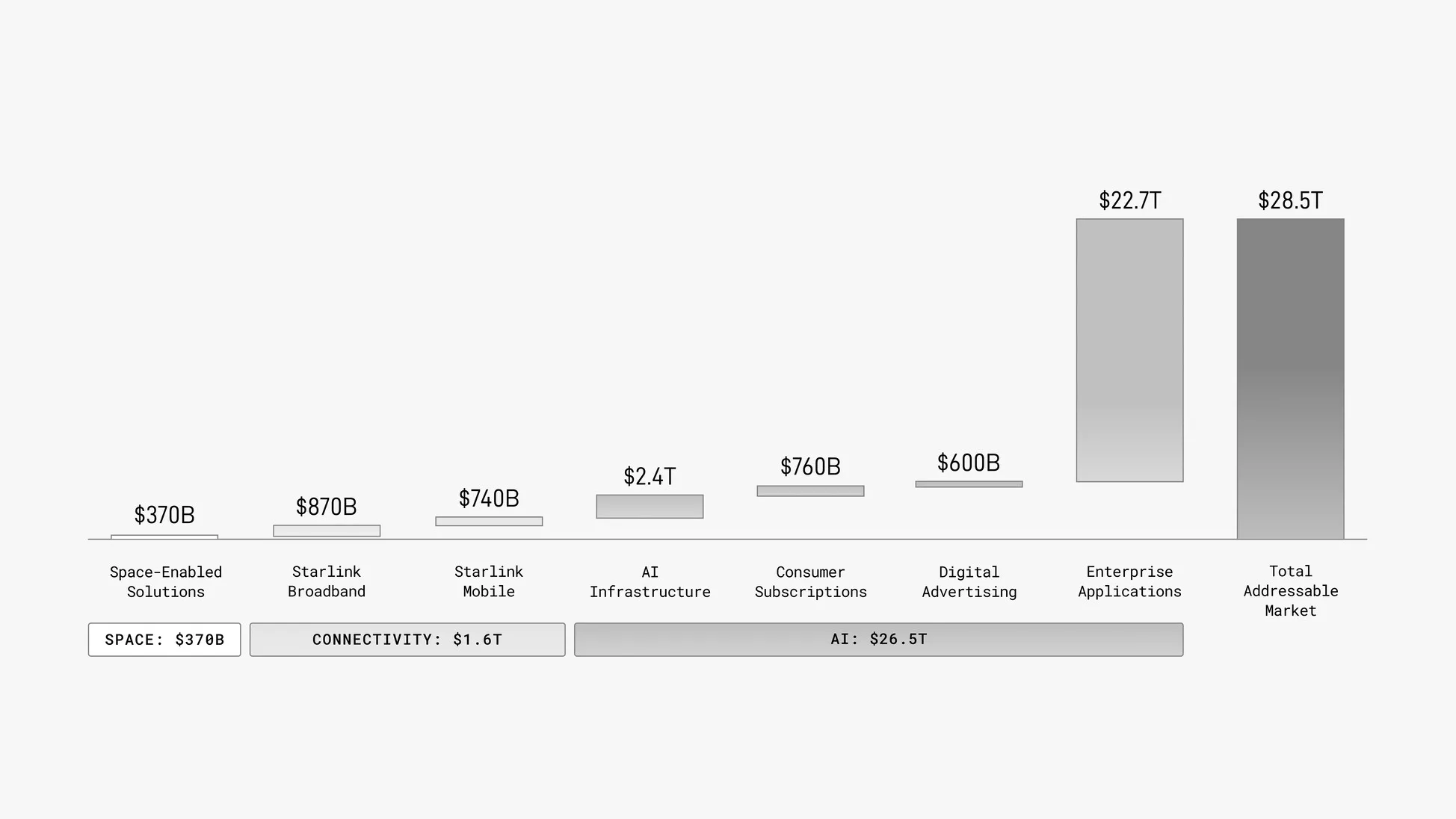
"We believe we have identified the largest actionable total addressable market ("TAM") in human history." That number: $28.5 trillion.
In other words, SpaceX thinks its best-case business scenario will make more money than the total annual US GDP.
Musk in control
Elon Musk will retain around 85% voting power, thanks to a dual-class share setup that gives his Class A shares 10 times more votes than other shares.
Per the S-1, he'll also have "the power to control the outcome of matters requiring shareholder approval, including election of all our directors, and to control our business and affairs."
Want to become an investor?
Get started with the right trading platform
The space company that's actually an AI company
The S-1 filing is the best look inside SpaceX anyone's ever got. And while it has plenty of flashy space visuals, and talks up the company's remarkable achievements in rocketry, it's pretty clear that SpaceX doesn't really see its long-term value as a rocket company.
It's an AI company. In space.
SpaceX believes that it will be a leader in "orbital AI". In other words, putting data centres in space that run on solar power.
"AI's ability to revolutionize human potential is directly dependent on meeting exponentially increasing resource demands," the filing says.
"The Sun contains approximately 99.8% of the solar system's energy and, as a result, we believe it is the only truly scalable solution to terrestrial energy constraints in the age of AI."
The company plans to "begin deploying our orbital AI compute satellites as early as 2028."
It's worth remembering that Elon Musk has a long history of big promises with clear dates that never materialise, by his own admission.
An investment in SpaceX is an investment in the company's ability to put AI data centres in orbit, running off solar power, in a way that is significantly cheaper and more efficient than anything on Earth.
That's quite a gamble.
SpaceX sees AI business software as its biggest opportunity
Of SpaceX's $28.5 trillion TAM estimate, only $2.4 trillion is allocated to AI infrastructure. Its whole "space-enabled solutions" accounts for just $370 billion.
The vast majority of its market opportunity, an estimated $22.7 trillion, is for enterprise applications.
Here are some examples of what that looks like:
- Grok, the X AI (currently being sued by teenagers in a California court for generating explicit images of children).
- Grok Voice, a "real-time speech engine".
- Imagine, an image and video generation system.
- Macrohard, an "agentic AI platform" developed with Tesla that is designed to boost workplace productivity by using AI agents.
So SpaceX is not a rocket company. It's a space-themed AI company that believes AI data centres in space will fuel an AI business software revolution on Earth. And SpaceX will run all of it.
A space company that's an AI company that's a Musk company
You just can't escape the Musk of it all. Any investment in an Elon Musk company is an investment in the man, and the belief that anything with his name on it has a gravity-defying ability to make money.
And Musk himself may be an increasingly polarising and controversial figure (his "views" have their own Wikipedia entry). But he remains the world's richest man.
Tesla may not be the largest car company in the world. It's not even the biggest electric vehicle company (that's BYD). But Tesla is, by market valuation, the biggest by far. It remains a dream, a vision, an idea, and investors are willing to buy it.
SpaceX is the same. The company makes impressive rockets and satellites.
But you might be very sceptical about SpaceX changing the world through solar-powered AI business software beamed to the world from space, while generating more than the entire US annual GDP (a figure that, to be clear, includes all the other AI giants and Musk's own businesses).
But that may not matter if enough investors buy the dream, or jump in because others are buying the dream.
Sources
Ask a question