Finder’s RBA Survey: Cash rate holds in June but experts warn of looming hike

Key takeaways
- The RBA has held the cash rate at 4.35%.
- 55% of experts expect at least one more hike before the end of 2026.
- Experts are split on whether the minimum wage rise will add to inflation pressure.
The RBA has opted to hold the cash rate in June, providing a momentary sigh of relief for thousands of Aussie mortgage holders.
In this month's Finder RBA Cash Rate Survey™, 38 experts and economists weighed in on future cash rate moves and other issues relating to the state of the economy.
Almost all panellists (97%, 37/38) correctly predicted the cash rate hold, keeping it at 4.35%.
However more than half of experts (55%, 21/38) expect at least one more hike before the end of 2026. Of those, 62% (13/21) see it coming as soon as August.
Richard Whitten, home loans expert at Finder, said while a pause is a welcome reprieve, homeowners can't afford to relax just yet.
"Borrowers who have watched their monthly repayments climb this year will view this hold as a moment of calm. But we aren't out of the woods.
"The cash rate remains at its highest level in years, and our data shows 40% of homeowners were already struggling to pay their mortgage in May – up from 35% in January.
"With more than half of our panel predicting another hike is just around the corner, now is the time to act. If you haven't haggled with your bank or looked into refinancing since the start of the year, you could almost certainly be getting a better deal," Whitten said.
Experts are split on whether the minimum wage rise will add to inflation pressure
The panel is divided on whether the Fair Work Commission's decision to raise the minimum wage earlier will lead to further rate rises from the RBA.
Just under half (48%, 14/29) of experts who weighed* said it would make cash rate hikes more likely, while 52% (15/29) said it would not.
Nalini Prasad from UNSW Sydney said the decision could cause further hikes.
"Individuals who are on the minimum wage are typically more financially constrained. Giving them more money will increase their spending," Prasad said.
Adj Prof Noel Whittaker from QUT agreed.
"The wage price hikes hit small businesses particularly hard. And all they can do is raise their prices or reduce their staff numbers. The outcome will be inflationary," Whittaker said.
However Scott Kuru from Freedom Property Investors shared a different opinion.
"The RBA should recognise that these low-paid workers are just trying to make ends meet and that most of that increase to the minimum wage they receive will be spent on essentials, not optional extras," Kuru said.
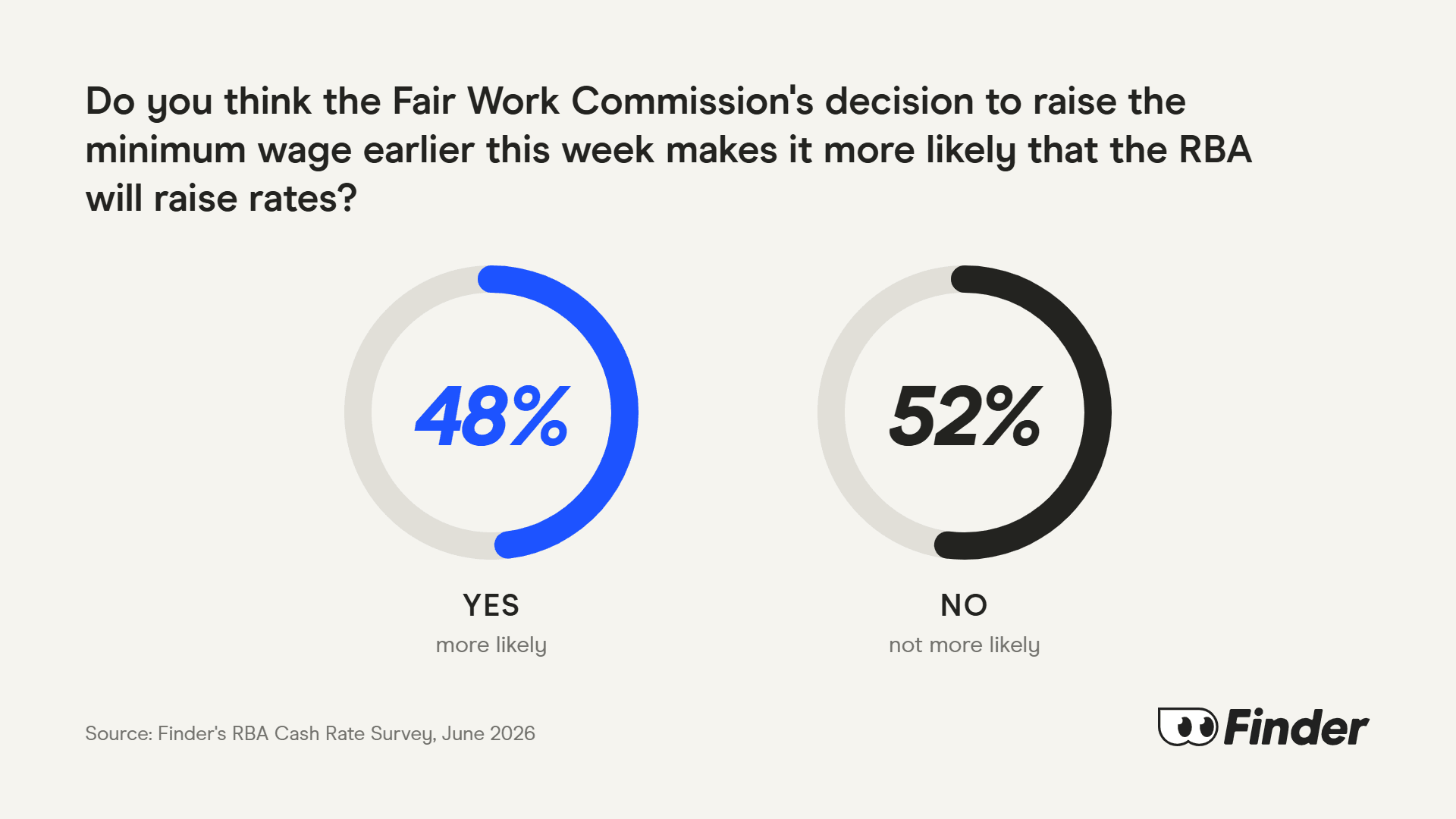
Experts were asked: Do you think the Fair Work Commission's decision to raise the minimum wage earlier this week makes it more likely that the RBA will raise rates?
Here's the full list of what they had to say:
Shane Oliver, AMP (Yes): "By boosting real wages by more than justified by productivity growth it will add to cost pressures which risk being passed on in higher prices. Given the influencing effect it also risks boosting non-award wages growth along with adding to inflation expectations."
Cameron Kusher, Kusher Consulting (Yes): "The wage increase is applicable to a large number of people and it is well above the rate of inflation giving lower income households more money to spend. This will add to inflationary pressures."
Leanne Pilkington, Laing+Simmons (Yes): "Rates are already facing upward pressure and this is another variable adding to this. For now, though, we believe rates should remain steady to enable the market to absorb recent rises."
Jakob Madsen, University of Western Australia (Yes): "The effect will be small, but it will have ripple effects on wages of low income earners (which is a good thing because we need to give incentives for people on transfer payment to join the labor market)."
Mark O'Flynn, Oxlade Financial (Yes): "Rising wages will add to inflation pressures."
Nalini Prasad, UNSW Sydney (Yes): "Individuals who are on the minimum wage are typically more financially constrained. Giving them more money will increase their spending."
Stella Huangfu, University of Sydney (Yes): "A higher minimum wage may increase labour costs for businesses, which could feed into higher prices and stronger inflationary pressures. If the RBA believes these wage increases risk slowing the return of inflation to target, it may be more inclined to raise interest rates or keep them higher for longer."
Matt Turner, GSC Finance (Yes): "Whilst the rise will only just keep up with inflation, people having access to more money will allow higher spending. This will put pressure on inflation, and ultimately may lead to higher rates."
Tim Reardon, HIA (Yes): "Firstly on fuel prices. Evidence is that the Strait of Hormuz is not critical to global fuel supplies. The rest of the world has increased output to offset the loss through the SoH. So when the SoH opens it isn't central to future fuel prices in AU. Demand drivers will settle with time. Secondly, the wage decision will create wage push inflation, on top of the demand driven inflation and in addition to global factors driving inflation, leading to structurally higher interest rates in the future. It will have an adverse impact on employment in small business, who will also bear a high burden from rising rates. This will increase the reliance of economic growth on government spending."
Adj Prof Noel Whittaker, QUT (Yes): "The wage price hikes hit small business particularly hard. And all they can do is raise their prices or reduce their staff numbers. The outcome will be inflationary."
Nicholas Gruen, Lateral Economics (Yes): "Other things being equal, obviously yes as a matter of logic. But probably not much more likely."
Kyle Rodda, Capital.com (No): "It's only going to lead to a modest uptick in inflation – the RBA will be inclined to look through it to deeper, underlying drivers of inflation."
Dale Gillham, Wealth Within Group (No): "Unemployment also rose, and employment decreased in April. Both of these show that the economy is slowing, and I expect these figures to increase in May."
Graham Cooke, Aussie Insights (No): "Markets and economists had already priced in a 4-5% wage increase for this time of year."
Jeffrey Sheen, Macquarie University (No): "Given weak profits (GOS) growth, firms are less likely to pass on wage costs to consumers."
Saul Eslake, Corinna Economic Advisory (No): "I think it might delay rate cuts, but not prompt rate hikes that would not otherwise occur."
Craig Emerson, Emerson Economics (No): "It applies only to a subset of wages."
Mark Crosby, Monash University (No): "It is one factor among many."
Nicholas Frappell, ABC Refinery (No): "'It might – but I think that there are other, bigger factors that the RBA might be looking at."
Scott Kuru, Freedom Property Investors (No): "The RBA should recognise that these low-paid workers are just trying to make ends meet and that most of that increase to the minimum wage they receive will be spent on essentials, not optional extras."
*Experts are not required to answer every question in the survey.
Ask a question