Finder’s Parenting Report for 2021
Finder's research reveals how Aussie parents are managing their finances and how they are teaching their kids about money.

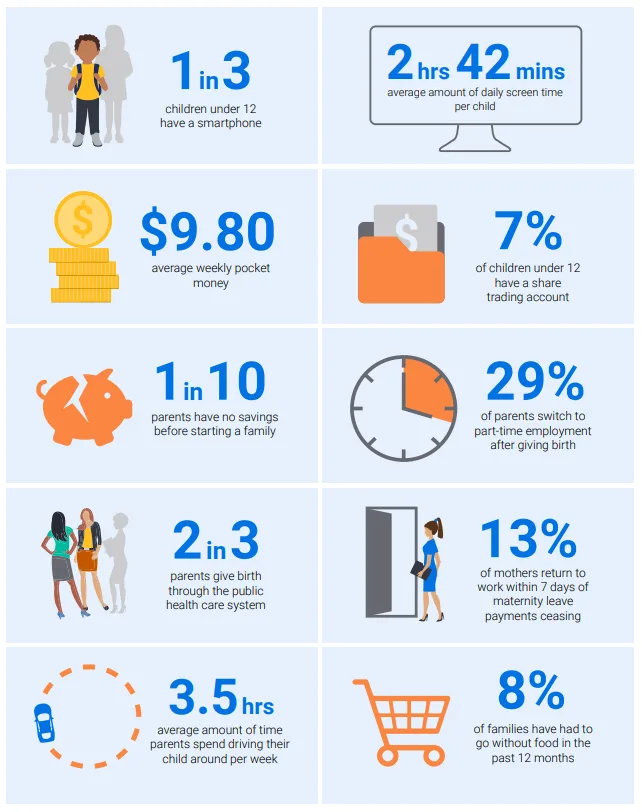
 Parenting has undergone quite the makeover in recent decades. Technology and smartphones are becoming a bigger part of kids' lives, and a growing number of children have savings accounts and even share trading accounts. More recently, the COVID-19 pandemic has had a profound impact on Australian parents. Learning to navigate caretaking and homeschooling amidst a global crisis, while also dealing with the effects of the recession on family finances, has made raising children more challenging than ever.
Finder's Parenting Report 2021 delves into the data and trends underpinning family finances. We surveyed over 1,000 Australian parents of children under 12 to find out how they manage their budgets with children, how they teach their kids about money and finance, and how they navigated pregnancy and birth, among other insights. Finally, Finder's experts offer their words of experience on how to navigate family finances.
Download Finder's Parenting Report 2021.
Prepare for parental leave. You don't want to be stressing about having to go back to work as soon as your paid parental leave ends. Instead, try to save up early on, thinking about how much money you need for living costs while you're not at work. Having enough money to take 6–12 months off means you can get back to work sooner if you want, but without the pressure to do so.
Switch to family health cover. Finder analysed the cost of kids and found parents spend an average of $1,391 per year on healthcare and medical costs. Don't wait until your child needs braces to start thinking about health insurance. Switching to a family health insurance plan as soon as possible means not having to worry once your child starts to need a dentist or optometrist.
Get on the front foot with savings. Take advantage of the power of compound interest by setting up a savings account for your child early on. Not only will this help them to build their money over time, but it's also a great way to teach them about the importance of budgeting. To make the most of your little one's money, find a children's savings account that offers bonus interest.
Can AI effectively manage risk and deliver returns in real-world markets? To answer this question, we have deployed seven of the most advanced AI platforms — ChatGPT, Gemini, Copilot, DeepSeek, Perplexity, Meta AI and Grok — to act as portfolio managers.
Get up to speed with the latest economic update, offering insights into Australia's financial landscape.
Explore the historical milestones and ongoing challenges women face in achieving financial equality in Australia, from early pay disparity fights to when women could get loans to superannuation access.
Finder collected statistics on supermarket spending in 2023 and found that 4 in 5 Australians are signed up to a supermarket rewards program.
Finder's Cost of Living Pressure Gauge measures the financial stress experienced by Australian households.
Tracking the outlook of Finder's panel of economic experts.
Tracking how Australian consumers feel about the economy and their financial lives.
Parents will fork out $13.6 billion on back to school costs this year – $2,671 for primary students and $5,043 for secondary students.
Finder crunched the numbers on Australia's household spending statistics and found NT households are the nation's biggest spenders.
Discover average home loan sizes around Australia and much more with our comprehensive guide to home loan statistics.
